

Business Coach or First Hire? How to Decide
Hire a business coach when the problem is clarity: you're unsure what to prioritize, how to price, or where growth should come from. Hire your first employee when the problem is capacity: you know what needs doing, the work is repeatable, and you simply don't have the hours. If you can't write down the tasks you'd hand over, a new hire usually inherits your confusion, so clarify first.
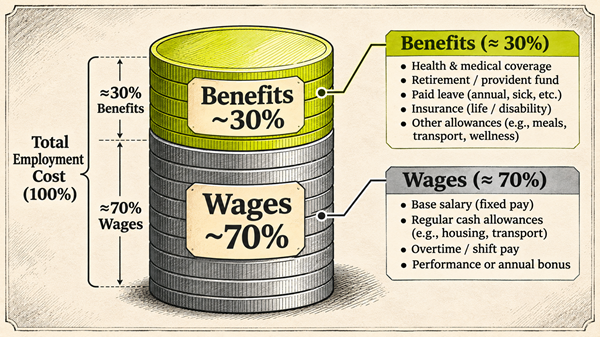
Cost shapes differ too. An employee costs more than wages, since benefits average about 30% of employer costs for US private industry, while coaching is usually a fee with a clear end date. The research on outside help comes from consulting trials, not coaching, so test your decision with a small, low-risk step. This isn't financial, tax or legal advice.
Key Takeaways
Feeling overloaded has two different causes: too little capacity or too little clarity.
A coach helps with decisions. An employee adds hours. Pick the one that matches your constraint.
If you can't describe the work you'd hand over, clarify before you hire.
A salary isn't the full cost. Benefits average about 30% of US employer costs, and payroll adds admin.
The best evidence on outside help comes from consulting studies, not coaching, so read it as a hint.
Test before you commit: a small freelance project or a first coaching session costs less than a wrong hire.
Same Tuesday, Two Different Problems
You're overloaded, and two paths look reasonable. Hire someone or get a coach. Most advice treats them as interchangeable. They aren't, and the difference shows up when you watch two founders with the same symptom.

Meet Maya and Jon. Both are hypothetical founders, invented for this article, not real clients.
MAYA, RUNS A DESIGN STUDIO | JON, RUNS A CONSULTING PRACTICE |
Tuesday, 9 a.m. Maya has more orders than hours. She's working evenings to keep up. | Tuesday, 9 a.m. Jon has a full week too, but it's different every week. He's not sure what deserves his time. |
The pattern. Her work repeats. Each order follows nearly the same steps, and she could write them on one page. | The pattern. His work shifts. He fixes problems as they arrive and can't say which ones move the business forward. |
The real problem. Capacity. She knows what to do and runs out of hours. | The real problem. Clarity. More hands would just speed up a plan he hasn't made. |
What helps. A first hire, probably part time, handling the repeatable steps she's already documented. | What helps. A coach to sort priorities and pricing first, then a hire once the work has a shape. |
Three months later. The part-time hire handles the repeatable steps and Maya's evenings come back. She's still the one who sets prices, but now she has time to think about them. | Three months later. After a few coaching sessions, Jon has three clear priorities and a price he trusts. He can finally write a one-page role and start looking for help. |
If Jon had hired first, his new employee would have received a moving target. If Maya had paid for coaching first, she'd have gotten advice on a problem she already knows how to solve. Neither mistake is dramatic. Both are expensive. Our guide on how to choose a business coach helps once you know coaching is the right call.
Five Questions That Reveal Your Bottleneck
Answer these honestly, ideally on paper. There's no score. The pattern of your answers is the point.
1. Can you describe, on one page, the tasks you'd hand over?
If yes, you're leaning toward a hire. If you struggle, that's a clarity signal. Writing it down is the first step either way.
2. Does the work repeat?
Repeatable work is easier to delegate and train. Work that changes every week needs your judgment, which is where a coach can help.
3. Is your constraint hours or decisions?
If you'd get the answer right but run out of time, that's capacity. If you're not sure what the right answer is, that's clarity.
4. Could you pay for the role for six months without strain?
A hire is an ongoing commitment. If cash is tight, a smaller step such as a freelancer or a short coaching engagement is safer.
5. Could you manage a person right now?
Training and feedback take time up front. If your week has no room, a new hire can add to your load before they reduce it. Our post on stopping acting like an employee in your own company explains why founders often get stuck here.
Mostly "capacity" answers point to a hire. Mostly "clarity" answers point to coaching. A mix often means clarify first, then hire. If you want to talk through your answers, you can book a 30-minute connection call.
Watch for two common traps. The first is hiring to escape a decision. If you're avoiding a pricing change or a hard conversation with a client, a new employee adds cost without fixing it. The second is buying coaching to avoid a hire you already know you need. If you keep hearing good ideas and still work every evening, the constraint is probably hours.
What Each Option Really Costs
For a first employee, wages are only part of the bill. The Bureau of Labor Statistics reports that US private industry employers paid $46.89 per hour worked in June 2026, with wages and salaries at $32.82 (70.0%) and benefits at $14.07 (30.0%). That's an all-industry average, so your numbers will differ. As rough arithmetic, if wages are 70% of the total, a $50,000 wage works out to about $71,000 in total cost. Treat that as an illustration, not a quote for any role.
Then there's the admin. A SCORE guide to hiring a first employee lists steps such as verifying work eligibility, collecting tax withholding forms, withholding and remitting payroll taxes and keeping records. It's a 2019 overview from an SBA resource partner that promotes its own e-book, so check current rules with the IRS or an accountant. Outside the US, the rules and costs differ.
Coaching has a different cost shape: a fee, usually for a defined period, without payroll tasks. Fees vary widely, so ask for pricing in writing and read our business coach red flags before you sign. Limitless Entrepreneur sells coaching, so weigh our view with that in mind. We'd rather tell you to hire than sell you coaching that doesn't fit.

There's also a time cost that never shows up on an invoice. A new employee needs training and feedback, and a coach needs your attention and follow-through. Whichever you choose, ask the same question up front: what will be different in 90 days, and how will we know?
Option | What it fixes | Cost shape | Main risk | Fits when |
Business coach | Clarity: priorities, pricing, direction and decisions. | A fee, usually for a defined period. | Advice without action, or a poor fit. | You're unsure what to do next. |
First employee | Capacity: repeatable work you can already describe. | Wages plus benefits and payroll admin, ongoing. | Hiring into unclear work, or too little time to manage. | You know the work and lack the hours. |
Freelancer or VA | A bounded task or project, without a long commitment. | Per project or per hour, flexible. | Classification and quality control. Ask an accountant. | You want to test before hiring. |
What Research Says About Outside Help
The cleanest evidence comes from consulting, not coaching. In a field experiment in India, Bloom and colleagues gave free management consulting to a small group of textile plants and estimated that productivity rose by about 11%. It covered only 17 firms in one industry, the consulting was expensive at $1.3 million, and the profit estimates rest on assumptions.
A randomized trial of 432 small firms in Mexico reported better productivity and return on assets after a year of consulting, plus a lasting rise in employees and wages. I read only its abstract, and effects varied from firm to firm.
So what does this tell you? Outside help can improve how small firms run, and in Mexico it was followed by growth in staff. But neither study tested coaching or a single founder's first hire, so use them as a reason to test, not as proof. The same applies to the 16-week operational overhaul approach: structure helps when you follow through.
When the Answer Is Both, or Neither Yet
Often it's both, in order. Coach first to sort priorities and document the work, then hire into a role you can describe. Sometimes it's neither yet: if your work isn't repeatable and cash is thin, the best move is a small experiment.
Try a ten-hour freelance project on one repeatable task, or a first coaching session. Review the result after 30 days. If the freelancer frees up real hours, you've got evidence for a hire. If you keep running into decisions you can't make, you've got evidence for coaching. LE's business coaching for entrepreneurs and small business coaching pages explain what a coaching engagement looks like.
Frequently Asked Questions
Should I hire a business coach or an employee first?
Match the choice to your constraint. If you're short on hours for work you can already describe, hire. If you're unsure what to prioritize or how to price, coach first. If both are true, clarify, then hire.
How much does a first employee really cost?
More than wages. BLS data show benefits averaging about 30% of US private-industry employer costs, and payroll adds admin. Your actual cost depends on the role, state and benefits, so ask an accountant.
Can a business coach help me hire?
Yes, in a supporting role. A coach can help you define the role, prioritize and prepare to manage someone. A coach doesn't add hours the way an employee does.
What if I can't afford either?
Start smaller. Document your repeatable work, try a short freelance project and use free resources such as a first coaching session or local small-business support. Revisit the decision in 30 to 60 days.
How do I know I'm ready for my first hire?
You can describe the tasks on one page, the work repeats, you can fund the role for about six months and you have time to train and manage. If one of those is missing, fix it first.
Conclusion
The question isn't which is better. It's which problem you have. If you can't say what you'd hand over, clarity comes first. If you can, capacity might. This week, write the one-page list from question one and see which way it points.
You don't need to settle it today. Run the ten-hour freelance test or book a first session, then look at what changed after 30 days. A reversible step beats a confident guess, especially when the alternative is an ongoing payroll commitment. Whatever you choose, write down what success looks like in 90 days so you can judge it fairly.
Limitless Entrepreneur: build a business that runs without you at the center.
Not sure which problem you have?
Book a 30-minute connection call and bring your one-page task list. We'll talk through whether coaching, a hire or a small test makes sense first. Book your 30-minute connection call