
The 16-Week Operational Overhaul for Founders
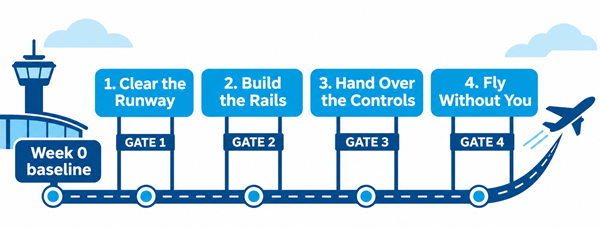
A 16-week operational overhaul works best as four 4-week phases, each ending in a go/no-go gate. Start with a one-week baseline. Then clear the runway by setting decision rights and cutting low-value work, build simple documented workflows with named owners, hand over real control with a weekly cadence and a scorecard, and finish with a short test of how the business runs without you. Sixteen weeks isn't a proven number. It's a practical length: long enough to build habits, short enough to keep urgency.
Research on if-then planning suggests that specifying when and where you'll act helps people follow through, though that work mostly covers individual goals, not companies. Treat the plan as a structure to adapt, and repeat any phase that misses its gate before you move on.
Key Takeaways
Run the overhaul in four 4-week phases, with a one-week baseline before you start.
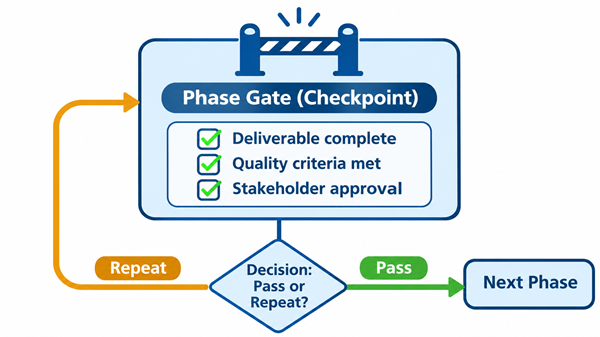
Each phase ends in a gate. Pass it, or repeat the phase. Don't carry unfinished work forward.
Phases in order: clear the runway, build the rails, hand over the controls, fly without you.
Give every workflow one named owner and one number to watch.
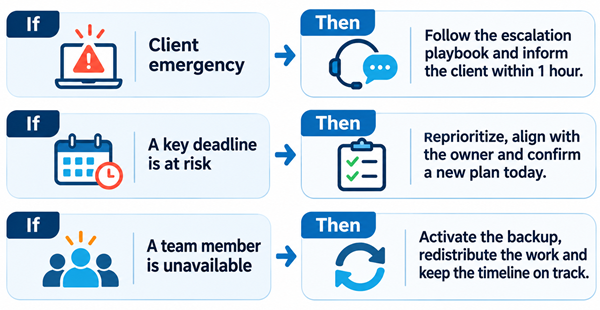
Write if-then plans for the stumbles you expect, such as a missed meeting or a client escalation.
Sixteen weeks is a design choice, not a research finding. Adjust it to your size and season.
If cash is tight or key people are leaving, stabilize first and start the plan later.
Why Most Overhauls Stall
You decide to fix operations. You buy a tool, block a weekend, write a few documents. Three weeks later a big client call eats your week and the plan quietly dies. Sound familiar?
Most published plans share the same bones. EOS Worldwide describes 90-day priorities with one owner each and weekly check-ins, and blames annual goals for being too distant. A consulting firm's 90-day plan covers decision rights, a weekly cadence and delegation. Both are reasonable starting points, and both are marketing for a paid service. Neither cites studies, so treat their numbers as claims, not facts.
What they tend to skip is the decision point. When a phase slips, what do you do? Most founders push on and stack unfinished work on top of new work. The Four Gates Flight Plan fixes that by making each phase earn its exit.
Why 16 Weeks, and What Counts as Evidence
Let's be honest about the number. No study says 16 weeks is the right length. We chose it because it splits into four equal phases, fits inside a business quarter plus a buffer, and gives habits time to settle. If your business is small and simple, 12 weeks may do. If it's complex, 20 may suit you better.
One piece of research does support the way the plan works. A review of 94 tests by Gollwitzer and Sheeran found that if-then plans, which spell out when, where and how you'll act, improved goal attainment with a medium-to-large effect (d = .65). That review mostly covers personal goals, and I read only its abstract. So we borrow the idea, writing if-then plans for every phase, without claiming it's proven for companies.
Week 0: Baseline
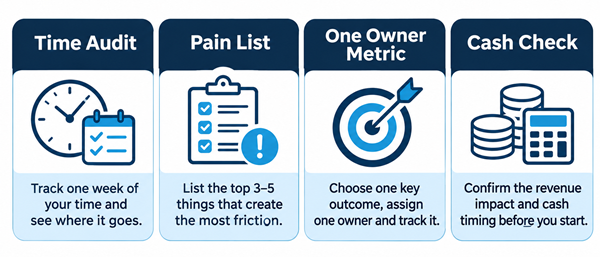
Before the clock starts, spend one week measuring. You can't tell whether things improved if you never recorded where you began.
Time audit: Log where your hours go for five working days, in 30-minute blocks.
Pain list: Write the five recurring problems that cost you the most energy.
One owner metric: Pick a single number that shows how much the business depends on you, such as the count of decisions people bring to you each week.
Cash check: Confirm you have a few months of runway. If you don't, pause and steady the finances first.
The Four Gates Flight Plan
Each phase lasts four weeks. At the end you face a gate with a short checklist. If you pass most items, move on. If you miss, repeat the phase for one to two weeks. Repeating isn't failing. It's how you avoid building on sand.
Phase 1 (Weeks 1 to 4): Clear the Runway
You can't build new systems on top of a calendar that's already full. This phase removes weight.
Decision rights: List the ten decisions you make most often. Mark each as "I decide," "I decide after input" or "they decide and tell me."
Stop-doing list: Pick three recurring tasks to drop, hand off or batch.
Meeting reset: Cut or shorten any meeting that doesn't lead to a decision.
Gate 1: Ready to Build? ☐ Decision-rights list is written and shared with your team. ☐ At least two items are off your plate. ☐ Your calendar shows at least four hours of open, protected time each week. Pass rule: three of three, or two of three with a clear plan for the third. |
If this happens | Then do this |
A client emergency eats your week | Pause the phase for up to one week. Resume at the same task, not a new one. |
Your team keeps asking you to decide | Point to the list and ask, "Which column is this?" Repeat until it's habit. |
You feel guilty dropping a task | Write what you fear will happen. Check it after two weeks. |
Phase 2 (Weeks 5 to 8): Build the Rails
Now you write down how the work gets done. Keep it light. A one-page checklist beats a 40-page manual nobody reads.
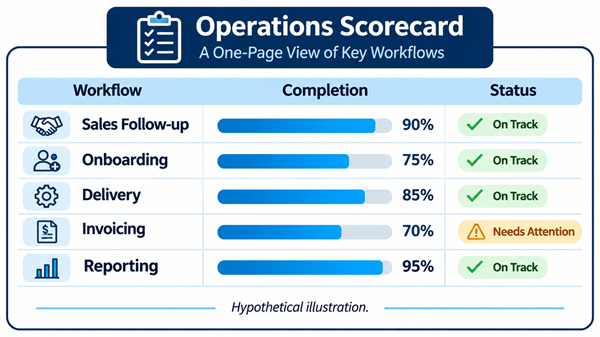
Five core workflows: Choose the five that matter most, such as sales follow-up, client onboarding, delivery, invoicing and reporting.
One owner each: Name one person for every workflow. Joint ownership usually means no ownership.
One number each: Pick a simple measure per workflow, such as days to onboard a client.
Gate 2: Rails in Place? ☐ Five workflows each have a one-page checklist. ☐ Each has one named owner who has read it. ☐ Each has one number, with a first reading recorded. Pass rule: at least four of five workflows complete. |
If this happens | Then do this |
The documents are too long | Cut each to a single page. If it won't fit, split the workflow. |
An owner doesn't use the checklist | Ask what's missing. Revise the checklist, not the person, first. |
You can't pick a number | Use a time or count measure. Simple beats perfect. |
Want a partner to pressure-test your plan? If you'd like a second view on your gates or workflows before you commit, book a 30-minute connection call and bring your Week 0 notes. |
Phase 3 (Weeks 9 to 12): Hand Over the Controls
This is where many founders flinch. Handing over real control is a skill, and a gap in it is common. In research from DDI reported by SHRM, only 19% of rising leaders had the delegation skills needed to prevent burnout. That's vendor research, so read it as a signal, but it fits what many founders describe.
Delegate with ownership: Give owners the decision, not only the task, within a limit you both agree on.
Weekly cadence: Hold one 30-minute weekly meeting. Each owner shares their number, one blocker and one next step.
Scorecard: Put the five numbers on a single page you can read in two minutes.
Gate 3: Controls Handed Over? ☐ The weekly meeting ran at least three times without you leading it. ☐ The scorecard was updated each week. ☐ Your owner metric from Week 0 has dropped. Pass rule: three of three, or two of three if the third is trending the right way. |
If this happens | Then do this |
You take a task back | Write down why. Hand it back within 48 hours with a clearer limit. |
The meeting turns into a status dump | Return to three prompts: number, blocker, next step. |
A mistake happens | Review the process, not the person. Update the checklist. |
Phase 4 (Weeks 13 to 16): Fly Without You
You've built it. Now see how it behaves when you step back. This isn't a vacation test that risks the business. It's a controlled step away.
Absence test: Stay out of day-to-day work for one week, then two if the first goes well. Stay reachable for true emergencies only.
Fix list: At the end, list every place the business leaned on you. Fix the three biggest.
Next-quarter plan: Choose three priorities with owners, and schedule your first quarterly review.
Final Gate: Does It Run Without You? ☐ One full week passed with no decisions escalated that your list says others own. ☐ Scorecard numbers stayed flat or improved. ☐ A fix list and next-quarter plan exist. Pass rule: three of three. If you miss, repeat Phase 3 for two weeks and test again. |
A Hypothetical Example: Dana
This is an invented example for illustration, not a real client.
Dana runs a ten-person marketing agency. In Week 0 she finds that she makes about forty decisions a week that others could own. In Phase 1 she sorts them and drops two weekly reports. She passes Gate 1 on her second try, because a client emergency ate Week 3.
She passes Gate 2 with four of five workflows documented. Invoicing misses, so she finishes it during Phase 3. By Gate 3 her weekly decision count has fallen from forty to about twenty. In the final phase she steps away for a week and gets two escalations, both about pricing. She adds pricing rules to her fix list. Real change tends to take 3 to 6 months of practice, so Dana treats week 16 as a checkpoint, not a finish line.
Data & Findings
Source | What it shows | Caveat |
If-then plans improved goal attainment across 94 tests (d = .65). | Mostly individual goals, not company programs. Abstract only. | |
Describes 90-day priorities with one owner and weekly check-ins. | Vendor marketing. No studies cited. | |
Shows a common structure: decision rights, cadence, delegation. | Unsourced stats and anonymous examples. Context only. | |
Only 19% of rising leaders show strong delegation skills. | Vendor research. Not peer reviewed. |
None of these sources proves that 16 weeks, or any specific length, produces results. The plan is a practical design built on common-sense structure and one well-tested planning idea.
Who Should Use This Plan
Founders whose business stalls when they step away.
Teams of roughly 5 to 50 people with no real operating rhythm.
Owners who start plans and drop them when client work piles up.
Anyone who wants a built-in way to decide when to move on and when to repeat.
Who Should Avoid This Plan
Businesses in a cash crisis. Steady the finances first.
Teams losing key people right now. Fix retention before you restructure.
Anyone handling regulated work. Keep legal, tax and compliance oversight in place. This article isn't legal or financial advice.
Frequently Asked Questions
How long does an operational overhaul take?
Many founders plan for about a quarter. This plan uses 16 weeks, but no research sets the right length. Smaller businesses may finish in 12, and complex ones may need more.
What should I fix first in my operations?
Start with decision rights and your calendar. Until you clear space and clarify who decides what, new documents and tools won't stick.
Can I overhaul operations without slowing revenue?
Usually, yes, if you protect a few hours a week and keep each phase small. Pause a phase for a client emergency, then resume where you left off.
How do I know the overhaul is working?
Watch your Week 0 owner metric, such as decisions brought to you each week, and your scorecard. If those improve and your calendar opens up, it's working.
What if I miss a gate?
Repeat the phase for one to two weeks, then check the gate again. Moving on with unfinished work is the most common reason plans stall.
Conclusion
You don't need a perfect plan. You need a clear one, with gates that tell you when to move on. Take decisive action this week by blocking your Week 0 audit and picking your owner metric. When you'd like a partner to talk it through, book a 30-minute connection call.
Limitless Entrepreneur: build a business that runs without you at the center.