
Stop Acting Like an Employee in Your Own Company
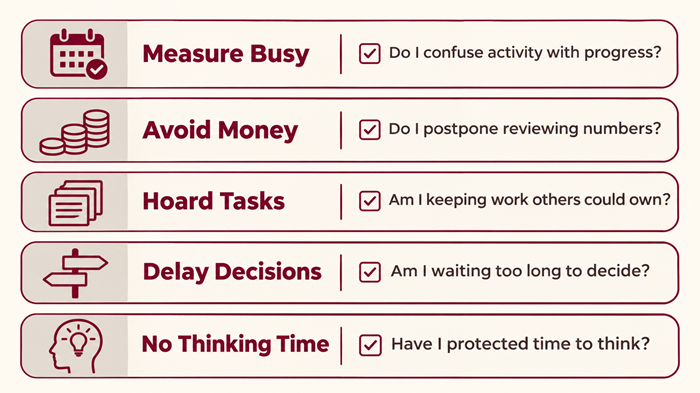
Acting like an employee in your own company means you trade hours for tasks, wait for permission nobody is giving you, and let urgent work crowd out the decisions only an owner can make. Five tells show it: you measure busyness instead of outcomes, you avoid the money side, you keep doing work you could hand off, you put off big decisions, and you never block time to think.
The fix is practical. Compare your current week, the Employee Calendar, with an Owner Calendar that protects time for decisions, people, money and the market. Then swap one block at a time over four weeks. Research on founders shows that many hand over the CEO role as ventures grow, but that work mostly covers venture-backed startups, so treat it as a lens, not a rule for every small business.
Key Takeaways
You can own a company and still behave like its most overworked employee.
Five things give it away: busy-ness as a score, avoiding money, hoarding tasks, delaying decisions and never thinking time.
Compare two calendars: the week you have and the week an owner would build.
Swap one block at a time over four weeks. Don't rebuild everything overnight.
Keep the hands-on work you love. The goal is to choose it, not to drop it.
The founder-transition research is mostly about venture-backed startups, so apply it loosely to small businesses.
If you're a solo practitioner whose service is the work, adapt the plan. Don't copy it.
What Acting Like an Employee Really Looks Like
You started the company so you'd answer to yourself. Then the work arrived. You answer client emails first thing, fix the invoice problem yourself, and spend Friday afternoon formatting a proposal. You're busy from eight to six, and the business still doesn't move forward much.
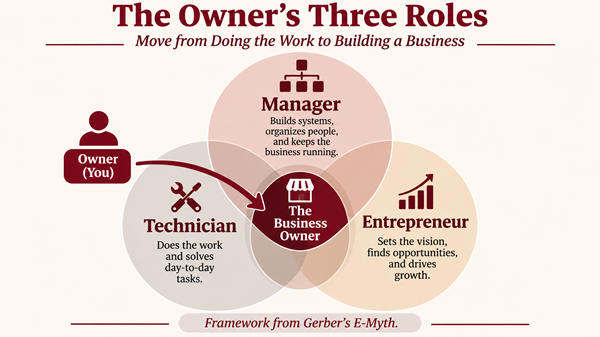
This isn't a new idea. Michael Gerber's E-Myth describes three roles inside every small business: the technician who does the work, the manager who organizes it and the entrepreneur who sets direction. A summary from Process Street lays this out, though it comes from a software vendor, so I read it as a framing, not proof. Many owners start as technicians and never leave the role.
Others frame it as a mindset. A column by Len Jessup in Entrepreneur suggests asking, "What would I do if this were my company?" It's a fair prompt, but it's opinion without data. The question is useful. The missing piece is what to do with your Tuesday afternoon.
The Five Tells
Read these and notice which ones sting. Nobody scores perfectly.
You measure busyness. A full day feels like a good day, whether or not it moves a number that matters.
You avoid the money side. You can't say your margin by service or your cash runway without looking it up.
You hoard tasks. You do work someone else could do because explaining it feels slower.
You delay owner decisions. Pricing, hiring and dropping a client will sit on a list someday.
You never block thinking time. Your calendar holds meetings and tasks, but no space for strategy.
Two or three calls are normal. Four or five suggest your week is shaped by reaction. The next two calendars show how.
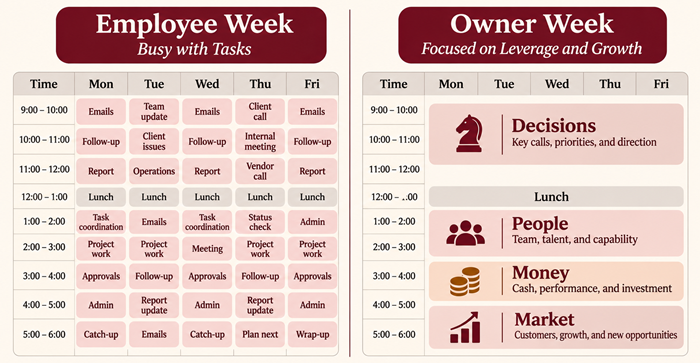
Calendar A: The Employee Week
Here's a typical week for a founder stuck in the technician role. It's an illustration, not data from a study.
Day | Morning | Afternoon | What it says |
Mon | Inbox and client replies | Delivery work | You start to react. |
Tue | Delivery work | Fixing a team error | Your team brings you problems. |
Wed | Proposals | Calls with prospects | Sales happen in gaps. |
Thu | Admin and invoices | Delivery work | You do back-office work yourself. |
Fri | Catch-up on emails | Planning, if time remains | Strategy comes last, if at all. |
Nothing here is lazy. Every block is useful. The problem is that all of it is work an employee could own, and none of it is work only an owner can do.
Calendar B: The Owner Week
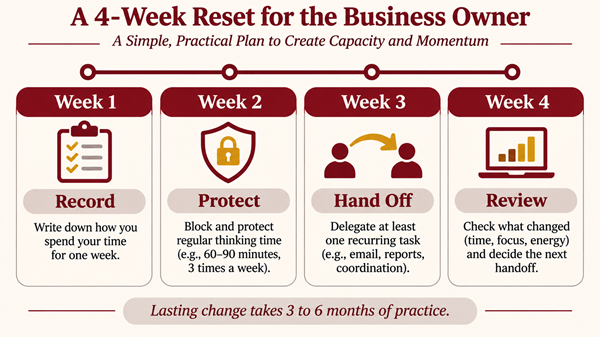
Now rebuild the same week with four owner jobs in mind: decisions, people, money and the market. Some delivery stays, because you still do some of it.
Day | Morning | Afternoon | What it protects |
Mon | Weekly review: numbers and priorities | Team check-in | Money and people |
Tue | Delivery work you chose to keep | Prospect calls | Market |
Wed | Thinking block: one big decision | Proposals with a template | Decisions |
Thu | Coaching or feedback for a team member | Open time for urgent items | People |
Fri | Cash and margin review | Learning, networking or planning | Money and market |
Notice what changed. Admin, invoices and error-fixing moved to other people or to a process. Thinking, money and people now own protected blocks. You still do plenty of hands-on work, but you chose it. Also look at the open block on Thursday afternoon. A week with no slack tends to slide back toward Calendar A, because every surprise lands on a full schedule. A little empty space is what lets you absorb the urgent without losing the important.
Want a second pair of eyes on your two calendars? Bring both versions to a call. Book a 30-minute connection call and we'll look at where your week leaks. |
The Five Swap Moves
These moves turn Calendar A into Calendar B.
Move 1: Block Thinking Time First
Put one 90-minute block on your calendar before anything else. Protect it like a client meeting. Use it for one decision you've been delaying.
Move 2: Hand Off One Admin Block
Choose the admin task you most dislike, such as invoicing. Write a one-page checklist and give it to someone, or use a tool. You'll find more on handing off work in our guides on delegation and team systems.
Move 3: Learn Your Numbers
Set up a short weekly money review. Look at cash on hand, revenue, margin by service and what's owed to you. Fifteen minutes weekly is enough to start. If the numbers feel foreign, write the same four figures on one page each Friday for a month. By the fourth week, patterns show up that no single reading would reveal, such as a service that sells well but barely pays for itself.
Move 4: Make One Owner Decision a Week
Pick one item from your someday list, such as a price change or a client you should drop, and decide it. A small decision made beats a big one deferred.
Move 5: Keep What You Love
Don't strip out every hands-on task. If you love the craft, keep a block for it and own that choice. You're an owner who chose to do the work, not an employee stuck with it.
A Four-Week Migration
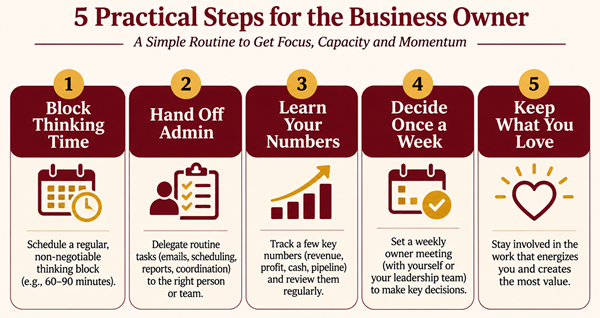
Week 1: Record your real week. Fill in Calendar A honestly, then write Calendar B beside it.
Week 2: Add your thinking block and weekly money review. Move nothing else yet.
Week 3: Hand off one admin block and make your first owner decision.
Week 4: Review what worked. Adjust Calendar B and choose the next block to swap.
Lasting change in how you work usually takes 3 to 6 months of practice, so treat the four weeks as a start.
A Hypothetical Example: Priya
This is an invented example for illustration, not a real client.
Priya runs a small bookkeeping firm with six staff. She does client work most days and checks every report before it goes out. In Week 1 she fills in Calendar A and notices she hasn't looked at her margins in months. She blocks a Friday money review, hands report checks to a senior bookkeeper, and finally decides to raise prices for two small clients. Her hours don't drop much at first. What changes is that her week now includes decisions only she can make.
Data & Findings
Source | What it shows | Caveat |
Founders are often replaced as CEO as ventures grow, including very successful ones, because scaling needs different skills. | Venture-backed startups, not small owner-run firms. The page gave no sample size. | |
Repeats the claim that many founders aren't CEO by year three. | Opinion piece citing the research secondhand. I left its number out. | |
Shows a common mindset framing for owners. | Opinion, no data. | |
Summarizes Gerber's three roles. | Vendor content. I read a summary, not the book. | |
Only 19% of rising leaders show strong delegation skills. | Vendor research. Not peer reviewed. |
None of these shows that a specific calendar produces results in a small business. The two-calendar test is a practical tool, not a proven method.
Who Should Use This Approach
Owners who feel busy all day yet see little progress.
Founders with a small team who still do most of the delivery.
Anyone who can't say their margin or runway without checking.
Leaders who keep putting off a big decision.
Who Should Avoid This Approach
Solo practitioners whose service is the work. Adapt the idea instead of handing everything off.
Businesses in a cash crisis. Stabilize the money first.
Anyone in regulated work. Keep legal, tax and compliance oversight. This article isn't legal or financial advice.
Frequently Asked Questions
What does it mean to act like an employee in your own business?
It means you spend your time on tasks and reactions, not on the decisions, money and people work that only an owner does. You may own the company and still behave like its busiest worker.
How do I work on my business instead of in it?
Start with one protected thinking block and a short weekly money review. Then hand off one admin task. Small, repeated shifts work better than a total reset.
Why do I keep doing everything myself?
Common reasons include habit, fear that others will do it worse, and the sense that explaining takes longer. Tracking your week for five days often shows how much of it you could hand off. Your own log is better evidence than any statistic, so trust it over a rule of thumb.
Do I have to stop doing hands-on work?
No. Keep the work you love and choose it deliberately. The aim is for hands-on time to be your decision, not your default.
How long does the shift take?
The four-week migration starts it. Lasting change in how you work usually takes 3 to 6 months of practice. No study gives an exact timeline.
Conclusion
You don't have to quit the work you love to act like an owner. You do have to protect time for the decisions, numbers and people that only you can handle. Take decisive action this week by filling in your two calendars and booking one thinking block. When you'd like a partner to look at them with you, book a 30-minute connection call.
Limitless Entrepreneur: build a business that runs without you at the center.