
Online vs In-Person Business Coaching: Which Is Better?
Neither format is better across the board. Pick by task. Research on workplace coaching found no significant difference in outcomes between face-to-face coaching and blended coaching that mixed in-person, online and phone sessions, so being in the room isn't required. Separate experiments on group work found that video meetings produced fewer creative ideas than in-person meetings, though video groups chose ideas as well.
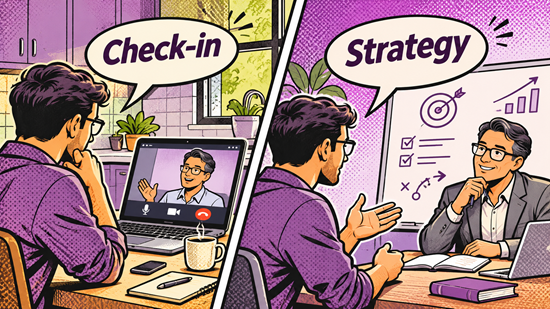
In practice, online suits regular check-ins, accountability and coaches who aren't nearby. In-person suits kickoffs, brainstorming and high-stakes conversations. A hybrid often works best. The evidence comes from employee and lab studies, not founder coaching, so treat it as a guide, not proof. Choose the format you'll actually show up for, and test it for a few sessions.
Key Takeaways
The better question is which format fits the task, not which format is better.
One meta-analysis summary found no significant difference between face-to-face and blended coaching.
Video groups came up with fewer creative ideas than in-person groups in one lab and field study.
Online suits check-ins, accountability and distance. In-person suits kickoffs and brainstorming.
A hybrid rhythm often gets the best of both. Choose the one you'll actually keep.
No study here tested founder coaching, so test your format for a few sessions before you commit.
Why the Wrong Question Keeps Coming Up
Most people ask whether online coaching is as good as in-person. It sounds reasonable, but it treats coaching as one activity. It isn't. A five-minute Tuesday check-in and a two-hour strategy reset ask different things of the format.

So we've split the question into seven moments from a coaching engagement. Each one sits on a dial from online to in-person. The moments are hypothetical illustrations, not client stories. If you're still picking a coach, start with our guide on how to choose a business coach.
Think of your own week for a moment. Some of your best coaching conversations probably happened when you were relaxed and focused, and some when you were rushed and distracted. The room, or the screen, shaped less of that than your state of mind did. The format matters most when it changes how well you can think, listen and follow through.
One note up front: Limitless Entrepreneur sells business coaching, so weigh our view with that in mind. We're not claiming one format is better for everyone.
Seven Moments, Seven Verdicts
Read the dial left to right. One dot on the left means online is the clear fit. One on the right leans in-person. The middle means either works. The verdicts mix evidence with my judgment, and each one says which is which.
MOMENT 1 The 7 a.m. check-in before the school run
A short, regular session is about cadence. Removing travel makes it easier to keep every week. The only research summary we found on this found no significant difference between face-to-face and blended coaching, so format alone doesn't seem to decide whether routine coaching works. The practical benefit is mostly consistency. If your calendar is the main obstacle to coaching, this is the moment where online earns its place.
MOMENT 2 The first meeting with a new coach
Rapport forms from small signals, such as posture, pauses and eye contact. A small study of clients coached by video describes the coach as a "talking head" with fewer visual cues, though clients also valued the wider choice of coaches that video gave them. It had 11 participants and no in-person comparison, so treat it as one set of experiences. If you can't meet in person, ask for a trial video session and judge the fit before you commit.
MOMENT 3 The monthly accountability review
Reviewing numbers and commitments needs a screen, a shared document and focus. That's easy online, and a regular slot keeps the habit alive. This is my judgment, not a tested finding. One tip: share the same tracker or spreadsheet every month, so each review starts from last month's numbers instead of from memory.
MOMENT 4 Brainstorming a new offer
In a Nature study, groups working by video produced fewer creative ideas than groups meeting in person, and the authors linked this to the narrow attention a screen encourages. The same abstract found no evidence that video groups were worse at choosing which idea to pursue. These were group experiments, not coaching, and I read only the abstract. A sensible split is to generate ideas in person or on paper, then narrow and decide online.

MOMENT 5 Rehearsing a hard conversation
In person lets you read body language. Online lets you rehearse in the same medium you may use for the real talk, such as a video call with a client. Pick the one that matches the conversation you're preparing for. No study we found tests this, so it's judgment.
MOMENT 6 The quarterly strategy reset
Long sessions with big decisions benefit from whiteboards, fewer interruptions and time to think out loud. If distance makes in-person hard, split the reset into two shorter online sessions with homework in between. That's a practical suggestion, not a research finding.
MOMENT 7 The travel-heavy month
When you're on the road, keeping the rhythm beats a perfect room. Online coaching lets you hold the meeting from anywhere with a connection. It also widens your pool of coaches beyond your city, which clients in the video-coaching study noted as a benefit.
Online, In-Person and Hybrid Side by Side
The table is a summary of the points above plus my judgment. Prices vary by coach and aren't compared here, so ask for pricing in writing before you commit.
Particulars | Online | In-person | Hybrid |
Time and travel | No commute, easy to fit around a day | Travel time, fixed location | Travel only for key sessions |
Access to coaches | Any location | Local coaches only | Wider pool, occasional meetings |
Rapport | Builds well over time, fewer visual cues at first | Stronger early read of the coach | In-person start, online follow-through |
Brainstorming | Weaker for generating ideas, fine for choosing | Stronger for generating ideas | Generate in person, decide online |
Consistency | Easiest to keep weekly | Harder to sustain | Regular online, periodic in-person |
Best for | Check-ins, accountability, distance | Kickoffs, strategy resets | Most founders who can meet occasionally |

What the Research Can and Can't Tell You
A summary of a meta-analysis of workplace coaching reports on 17 studies and says face-to-face and blended coaching, a mix of face-to-face, online and phone sessions, showed no significant difference. It also reports small to moderate effects on skill development and the strongest effects on performance. I read a secondary summary because the paper's own page blocked access, and it gives no numeric effect sizes.
Three limits matter. The studies are mostly about coaching inside organizations, not founders running their own companies. "Blended" doesn't mean fully online. And the video research here is about group creativity and client experience, not coaching results. We found no study comparing online and in-person coaching for business owners, so use all of this as a guide, not proof. If a coach or a directory tells you one format is proven better for founders, ask to see the study, its sample and who funded it.
The lesson is modest. Format probably matters less than the coach, the fit and whether you keep showing up.
Building a Hybrid Rhythm
For many founders, the answer is a mix. As one example, not a prescription: meet in person for the kickoff and each quarterly reset, then use short online sessions for weekly or biweekly check-ins. That gives you the rapport and thinking space of the room plus the consistency of the screen.
Whichever format you choose, get the terms in writing, including whether you can switch formats. Our post on business coach red flags lists the warning signs to watch for. Switching formats mid-way can also expose a mismatch early, which is useful information, not a failure. And business coach or first hire? helps if you're still deciding whether coaching is the right move.
Three Questions Before You Choose
First, where's the coach? If the best fit lives far away, online lets you hire them. Second, what do you need most in the next 90 days? If it's regular accountability, lean online. If it's a big strategic reset, lean in-person or hybrid. Third, which will you actually keep? A format you skip isn't better than one you attend. Fourth, and worth a quick check: does your internet connection, your workspace and your household allow a focused hour? If not, an in-person room away from home may protect your attention better than a screen at the kitchen table.
If you'd like to test the experience, you can book a 30-minute connection call and see how a conversation feels in your preferred format. LE's business coaching for entrepreneurs and small business coaching pages describe what coaching with us involves.

Frequently Asked Questions
Is online business coaching as effective as in-person?
A summary of one meta-analysis found no significant difference between face-to-face and blended coaching. It doesn't test fully online coaching or founders specifically, so treat it as encouraging, not conclusive.
Is in-person coaching worth the extra time?
Sometimes. It can help with first meetings, brainstorming and big strategy sessions. For routine check-ins, the travel time often outweighs the benefit. Count the full cost, including the commute, parking and the hour of focus you lose on either side of the meeting, before you decide.
What is hybrid coaching?
A mix of formats, such as in-person kickoffs and quarterly resets with online sessions in between. The meta-analysis summary above used the term for coaching that combined face-to-face, online and phone sessions.
How do I judge a coach's format before I commit?
Ask for a trial session in the format you plan to use, and notice whether you feel heard. Also ask what happens if you want to switch formats later, and get the answer in writing.
Can I switch formats mid-engagement?
Often yes, but it depends on the coach and the agreement. Ask before you sign and put the answer in the terms.
Conclusion
Online and in-person aren't rivals. They're tools for different moments. Match the format to the work, test it for a few sessions and keep the one you'll show up for. If you already work with a coach, ask what they would change about the format if you could redesign it together. This week, list your next three coaching goals and mark each as an online or in-person job.
Limitless Entrepreneur: build a business that runs without you at the center.
Not sure which format fits you?
Book a 30-minute connection call and bring your three coaching goals. We'll talk through which format would serve each one. Book your 30-minute connection call