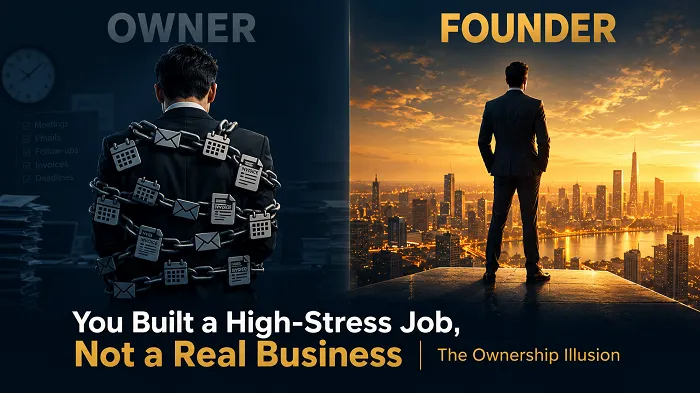
You Built a High-Stress Job, Not a Real Business
The difference between a high-stress job and a real business is devastatingly simple: a job stops generating income the moment you stop working. A real business generates income whether you are present or not. If you are the fulfillment mechanism, the primary salesperson, the head of operations, the customer service team, and the chief firefighter, simultaneously, you have not built a company. You have built yourself a demanding employer you cannot quit. Most service-based entrepreneurs cross this line without noticing, because the early hustle that built the business is the exact same pattern that prevents it from becoming autonomous. The transition from high-stress job to real business requires three architectural shifts: a psychological rewiring of the founder's identity away from operational indispensability, a strategic restructuring of the offer and delivery model, and a structural redesign that embeds the founder's expertise into systems rather than personal execution. Until all three are in place, you are not an entrepreneur. You are a self-employed person with no days off.
Key Takeaways
The Ownership Illusion: Owning the legal entity of a business does not mean you own a business in any meaningful sense. If the business owns you, your time, your attention, your nervous system, the legal structure is irrelevant.
The Early Hustle Becomes a Later Prison: The same habits that generate a founder's first clients (personal involvement in every detail, doing everything yourself, being "always available") are the precise habits that prevent the business from ever becoming autonomous.
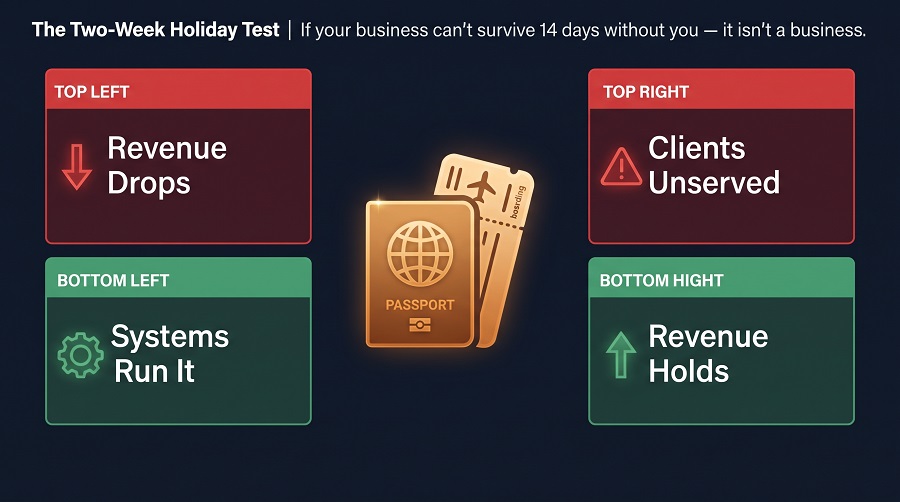
The Test of a Real Business: Take two weeks off with zero access to your phone or email. If the business generates revenue, serves clients adequately, and does not collapse, it is a business. If it cannot survive 14 days without you, it is a job.
The Conversion Is Psychological First: Before you can redesign the structure of the business, you must dissolve the unconscious need to be needed. Many founders subtly sabotage their own systems because a business that runs without them threatens their identity.
The 25-Hour Test: A genuine business can be run strategically in 25-35 focused hours per week. If you regularly exceed 50 hours, the excess is not dedication, it is a symptom of structural failure.
The Mirror Moment: What Kind of Entity Did You Actually Build?
Pull up your calendar from the past two weeks. Do not look at the revenue figures or the client roster. Look only at what you, personally, did between 8 AM and 7 PM every working day.
How many of those tasks required your unique expertise, the insight, judgment, or creative vision that only you can provide?
How many of those tasks could have been completed by a well-briefed team member, a trained assistant, or an automated system?
For the majority of founders who run this exercise honestly, the ratio is roughly 20% genuine CEO work to 80% tasks that should not require the founder's personal involvement at all. You are doing the work of four different employees simultaneously, and calling it entrepreneurship.
It is not. It is self-employment with better branding.
How the High-Stress Job Gets Built
Nobody decides to build a high-stress job. It is constructed gradually, almost invisibly, through a sequence of individually reasonable decisions that compound into a structurally broken business model.
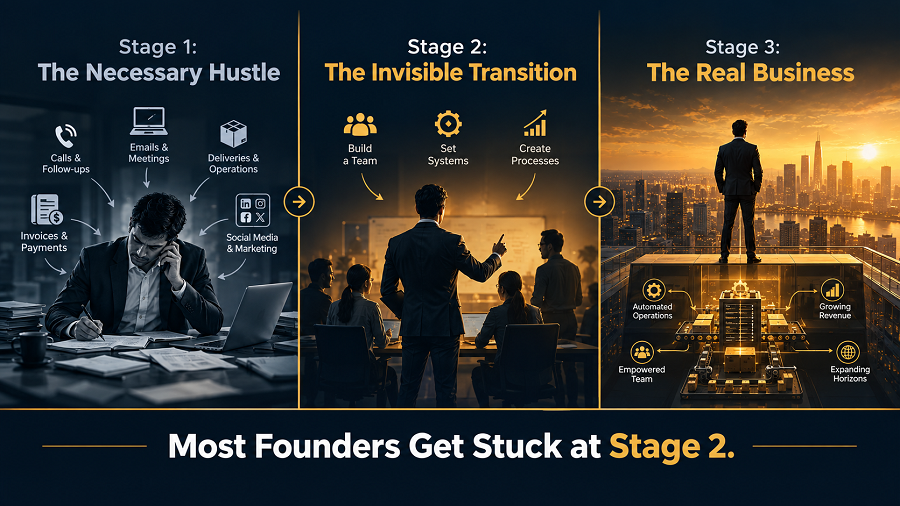
Stage 1: The Launch (Doing Everything Is Necessary)
In the beginning, doing everything yourself is not a character flaw — it is a survival strategy. You have no budget for a team. You have no documented processes because you are still discovering what the process actually is. The personal involvement is justified and appropriate.
Stage 2: The Traction (Doing Everything Becomes Habitual)
As the business gains traction and revenue grows, the founder's personal involvement in every detail continues — not because it is necessary, but because it has become habitual. The brain has learned that "doing it yourself" is the reliable path to quality control, and the nervous system has adapted to the constant low-grade stress as its baseline state. This is the inflection point. Most founders do not notice they have crossed it.
Stage 3: The Ceiling (Doing Everything Becomes the Trap)
At a certain volume, typically around 15-25 clients or a revenue band that demands more than 50 hours per week to maintain, the personal-involvement model hits an absolute ceiling. The founder cannot add more clients without compromising quality. They cannot take time off without the business suffering. They cannot hire effectively because they have never documented how they do anything. They are fully trapped in the self-employment loop, with a client roster large enough to create the illusion of success and a calendar that makes genuine strategic growth impossible.
"The hustle that built your first $10,000 month is the exact mindset that will prevent you from ever building a business that runs without you. Recognising that distinction is the single most important thing a founder can do." — James R. Elliot
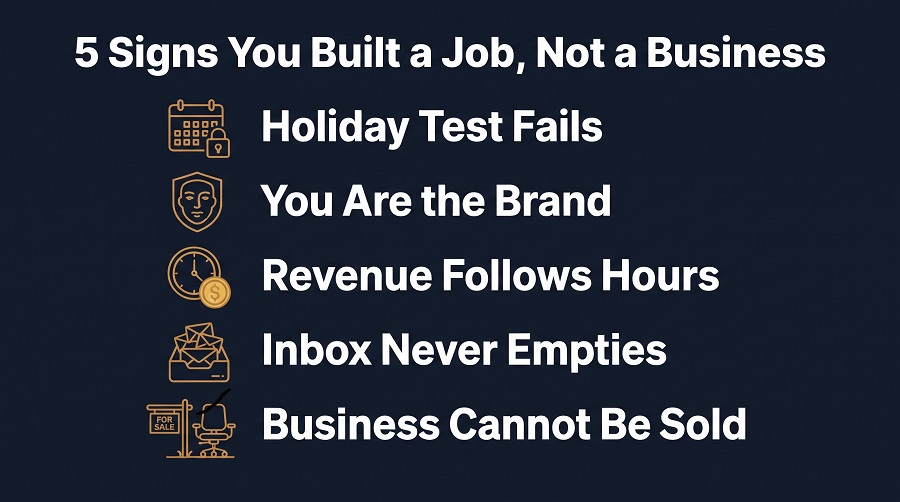
The 5 Telltale Signs You Built a Job, Not a Business
Sign | What It Looks Like | What It Actually Means |
The Holiday Test Fails | You cannot take seven consecutive days off without actively managing your business remotely or returning to a state of crisis. | Your business has zero operational autonomy. You are the system. |
You Are the Brand | Clients book with you specifically and personally. If you left the business, so would the majority of your revenue. | You have built reputation equity, not business equity. The asset lives in your personality, not your company. |
Revenue Follows Your Hours | When you work more, revenue rises. When you work less, it dips. There is a direct, visible correlation. | You are selling your time. That is the definition of employment, not ownership. |
The Inbox Never Empties | Operational decisions and client questions flow directly to you because there is no system or team authority to intercept them. | You are the operational bottleneck. Every hour spent in the inbox is an hour stolen from strategic growth. |
The Business Cannot Be Sold | If someone asked to buy your business today, the honest answer would be: "There is nothing to buy except my time and personal relationships." | A real business has separable value, systems, IP, processes, team. A self-employment arrangement does not. |
The Job vs. Business Diagnostic Matrix
Where does your business sit right now? Run each dimension through this matrix honestly.
Business Dimension | High-Stress Job | The Transitional Stage | A Real Business |
Revenue Generation | Entirely dependent on the founder's active selling and relationship management. | Some inbound enquiries from reputation and content, but close rate requires founder personally. | Qualified enquiries arrive systematically. A team member can close or onboard without the founder. |
Client Delivery | The founder delivers every piece of work personally, often at a semi-custom level for each client. | A partial team exists but the founder reviews and approves every deliverable before it leaves. | Delivery runs entirely via a documented methodology executed by a trained team. Founder is consulted strategically, not operationally. |
Daily Operations | Founder manages scheduling, invoicing, client communication, and team coordination personally. | Some admin is delegated but the founder is still the single point of failure for key decisions. | All operational functions run through documented systems and accountable team roles. Founder intervenes on strategic exceptions only. |
Founder's Weekly Hours | 55-80+ hours. No clear finish line. Guilt on any day that ends before 8 PM. | 40-55 hours. Some improvement but strategic work still gets crowded out by operational demands. | 25-35 focused hours. CEO strategy blocks protected. Genuine rest scheduled and taken without guilt. |
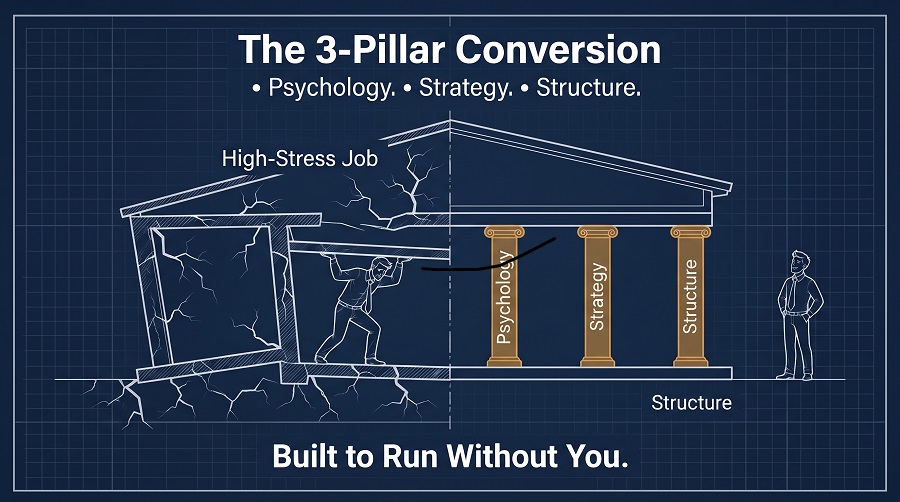
The 3 Pillars: The Conversion Engine
Pillar 1 — Performance Psychology: We use NLP and Timeline Therapy to rewire the founder's identity away from operational indispensability. The core question we address: If the business ran perfectly without you, who would you be? Until this question has a comfortable answer, every system you build will be subtly undermined by the part of you that needs to be needed.
Pillar 2 — Freedom-First Business Strategy: We apply Ruthless Elimination to your offer suite, client roster, and marketing channels, stripping the business back to its highest-leverage 20%. The fewer things the business does, the easier it is to systematise. Complexity is the enemy of autonomy.
Pillar 3 — Freedom-First Business Structure: We build the operational architecture — the documented delivery methodologies, the team accountabilities, the automated workflows, that allow the business to function as a self-sustaining entity rather than an extension of the founder's personality.
The 5 Shifts: The 16-Week Conversion
Phase 1: Clarity (Weeks 1-4)
Shift 1 — Vision Alignment: The founder defines, for the first time with precision, what the business looks like as a genuine autonomous entity. This becomes the architectural blueprint that guides every subsequent decision.
Phase 2: Liberation (Weeks 5-11)
Shift 2 — Ruthless Elimination: Every element of the business that cannot be systematised or delegated is identified and removed. The business becomes simple enough to be genuinely autonomous.
Shift 3 — Systems That Scale: The founder's expertise — the decisions, the quality standards, the client experience — is extracted from their head and encoded into documented frameworks.
Phase 3: Amplification (Weeks 12-16)
Shift 4 — Mindset Unlock: The residual psychological resistance to stepping back from operations is resolved at the neurological level. The founder genuinely releases the reins.
Shift 5 — Magnetic Authority: The founder operates exclusively in their zone of genius — thought leadership, premium relationships, strategic vision. The business grows because the founder is no longer in the way of it.
Case Evidence: The Conversion in Practice
David — From Indispensable to Invisible
David ran a client services business with genuine market demand and an impeccable personal reputation. He also had not taken a full week off in three years. Every significant client decision was escalated to him personally. Every deliverable was reviewed and often rewritten by him before it went out. The business had twelve team members and still could not function for more than four days without his direct involvement.
The problem was not his team's capability. It was David's unconscious need to remain central. His professional identity was so fused with his personal involvement in the work that any step back felt like a step toward irrelevance.
Through Pillar 1, we dissolved that identity fusion. Through Pillars 2 and 3, we rebuilt the operational architecture around documented standards that his team could own entirely. Within 90 days, David took his first two-week holiday in five years. Revenue did not dip. It increased. His team — finally trusted and empowered with clear authority, outperformed his personal involvement.
Jennifer — Separating Identity from Execution
Jennifer's business was her. She was the face, the delivery engine, the sales process, and the quality control system. She had turned her expertise into a one-woman operation that generated excellent client results and completely consumed her life.
The critical shift was Jennifer recognising that her value to clients was her methodology — the thinking framework she had developed over a decade — not her personal physical presence in every session. Through Shift 3 (Systems That Scale), we extracted that methodology into a documented, teachable process. She trained two associates to deliver it. She removed herself from direct delivery entirely within 60 days. She retained the strategic, highest-value touchpoints — the intake assessment, the final review, the premium relationship. Her capacity expanded from 12 to 40 clients. She worked 15 fewer hours every week.
Decision Framework: Are You Ready to Convert?
✓ You are ready if: You have a proven offer that delivers real results, an existing client base, and the honest willingness to examine what your need for personal control is actually protecting. The business exists. The problem is that it currently requires you to exist inside it every day.
✗ You are not ready if: You are in the first six to twelve months of building and have not yet validated your core offer with paying clients. The conversion from job to business requires a proven methodology to systematise. Without proof of concept, there is nothing to extract into a system.
Try This: The "Two-Week Letter" Exercise
Step 1 — Write the Letter. Imagine you are leaving on a two-week trip with no phone signal tomorrow morning. Write a letter to your business — to your team, your clients, your operational processes — covering everything they would need to know to function without you for 14 days.
Step 2 — Identify the Gaps. Every place where you write "call me if..." or "only I know how to..." or "this needs my personal sign-off because..." is a documented structural gap. These are the exact systems that need to be built.
Step 3 — Count the Gaps. How many gaps did you find? Each gap represents an area where the business is still a job. The list you have just written is your conversion roadmap.
Further Reading
Harnessing Structure & Systems — the operational architecture that converts a job into a business.
Entrepreneurial Mindset Through NLP — the psychological tools that dissolve the founder's need to be indispensable.
Mastering Mindsets for Business — shifting from self-employed thinking to genuine ownership thinking.
Strategies to Scale Your Business — strategic moves that create leverage beyond personal execution.
Harvard Business Review: The Founder's Dilemma — external research on why founders struggle to release operational control and what the transition actually requires.
Frequently Asked Questions
How do I know if I have built a job or a real business?
Apply the Holiday Test: can your business operate, generating revenue and serving clients adequately, for two consecutive weeks without your active involvement? If the answer is no, you have a job. The Five Telltale Signs table in this article provides a more granular diagnostic across five key business dimensions.
Is it possible to convert a one-person service business into an autonomous entity?
Yes, consistently and reliably, provided two conditions are met. First, the founder's expertise must be encodable into a repeatable methodology (which it almost always is, once the right extraction process is applied). Second, the founder must be willing to resolve the psychological need for personal indispensability. Without both, the conversion stalls.
Why do so many successful entrepreneurs end up with high-stress jobs instead of real businesses?
Because the skills and habits that generate initial success, deep personal involvement, exceptional attention to quality, being perpetually available, are the precise patterns that prevent the business from ever becoming autonomous. Success in stage one creates the behaviours that trap founders in stage two. Crossing to stage three requires a deliberate architectural intervention, not more of the same effort.
Won't clients notice and object if I step back from personal delivery?
Clients pay for results, not your personal presence in every step of delivery. When the methodology is properly documented and your team is properly trained, client outcomes remain consistent or improve, because your team is executing the system without the cognitive load of the founder's competing priorities. Jennifer's case above is the proof: she removed herself from direct delivery entirely and her client results improved.
How long does it take to go from a high-stress job to a real business?
Within the 16-week Limitless methodology, the structural conversion, documented systems, delegated delivery, autonomous operations, is completed by week twelve. The psychological shift (Shift 4: Mindset Unlock) resolves the residual need for personal control between weeks twelve and sixteen. The full operational proof, the founder taking two consecutive weeks fully offline with the business growing in their absence, typically arrives within 90-120 days of starting the programme.
Conclusion: The Business That Grew When the Founder Left
When James R. Elliot was running his fifth business at 80 hours a week, on anxiety medication, managing every operational detail personally, he genuinely believed he was building something. He had a brand, a reputation, clients who respected his work, and a team of people who technically worked for him.
What he actually had was a sophisticated, expensive, exhausting job, with himself as the tyrannical employer.
The wake-up came when his niece asked why he was never around. The question dismantled the story he had been telling himself. He wasn't building a legacy; he was building a prison with impressive revenue figures on the wall.
The conversion happened in 90 days. Not because the business was radically restructured overnight, but because the psychological shift happened first. Once he genuinely released the need to be indispensable, the systems almost built themselves. His working week dropped from 80 hours to 25. Revenue grew. He now runs his business from wherever he chooses to be. He visited his niece. He takes a 36-minute nap every afternoon without guilt.
That is not a lifestyle reward for working hard enough. That is the evidence of a real business.
Ready to convert your job into a business? Book the Freedom Blueprint Call (30 mins). We will identify exactly where your business is still a job, and map the architectural path out of it.