Working Less Is How You Scale: The Contrarian Guide to Business Growth
Working Less Is How You Scale: The Contrarian Guide to Business Growth
Working less is how you scale because in most small and growing businesses, the owner is the bottleneck, and you cannot multiply a company that runs through one exhausted person. The math is blunt: research on working hours shows that productivity per hour drops sharply past about 50 hours a week, and someone grinding 70 hours produces roughly what they'd produce at 55. So the extra hours don't add output, they cap it.
True scaling means revenue climbs while your personal involvement falls, which only happens when you remove yourself from the work, build systems others can run, and protect your time for the few decisions that actually move the business. Working less isn't a reward you earn after you scale. It's the mechanism that lets you scale in the first place. Done deliberately, doing less is the most decisive growth move you can make.
Key Takeaways
The owner is usually the bottleneck; you can't scale a company that runs through one exhausted person.
Past ~50 hours a week, extra hours add stress, not output, effort and results stop rising together.
Growth means more with more; scaling means more with less. Only scaling has no built-in ceiling.
The real block isn't time, it's a limiting belief that "only you" can do the work.
NLP gives you practical tools to clear that belief so delegation feels like leverage, not loss.
The LEVER Framework, Locate, Eliminate, Vision, Empower, Reclaim, is a repeatable way to scale by subtraction.
Working less is a scaling tool for established businesses, not a tactic for the pre-product-market-fit stage.
The Hustle Math That Doesn't Add Up
More hours don't scale a business, past a point, they shrink it. We've been sold the idea that effort and outcome rise together in a straight line, all the way to exhaustion. They don't.
The data is hard to argue with. A landmark Stanford study on working hours found that output per hour falls sharply once you cross roughly 50 hours a week, and so steeply after 55 that the extra hours are essentially wasted. Put plainly: the founder bragging about an 80-hour week is often producing what a focused 55-hour week would deliver.
Now layer in the toll. Recent reporting shows more than half of founders hit burnout, and burned-out leaders make worse decisions at exactly the moments that matter most. You're not just trading time for nothing, you're trading clarity, judgment, and energy for nothing.
Here's the reframe. If hour 60 is worth less than hour 30, then your job isn't to add hours. It's to make sure the hours you keep are aimed at the highest-value work, and to get everything else off your plate. That's not laziness. That's leverage.
Growth vs. Scaling: Doing More With Less
Growth and scaling are not the same thing, and confusing them is what keeps owners trapped. Growth means doing more with more, more hours, more hires, more overhead to produce more revenue. Scaling means doing more with less, revenue rises while your costs and personal involvement stay flat or fall.
That distinction matters because growth has a ceiling and scaling doesn't. When your revenue depends on your hours, you can only sell as much as you can personally produce. The business becomes a high-paying job you can't quit, and one that quietly stalls. (We dig into the patterns behind this in our piece on why small businesses fail to grow.)
Scaling is rare precisely because it's hard. Of the roughly 28 million companies in the U.S., only about 17,000 ever reach $50 million in revenue, and most never cross $1 million, according to analysis on growth versus scaling. The few that break through don't out-hustle everyone. They out-design them.
You Are the Bottleneck (And That's Good News)
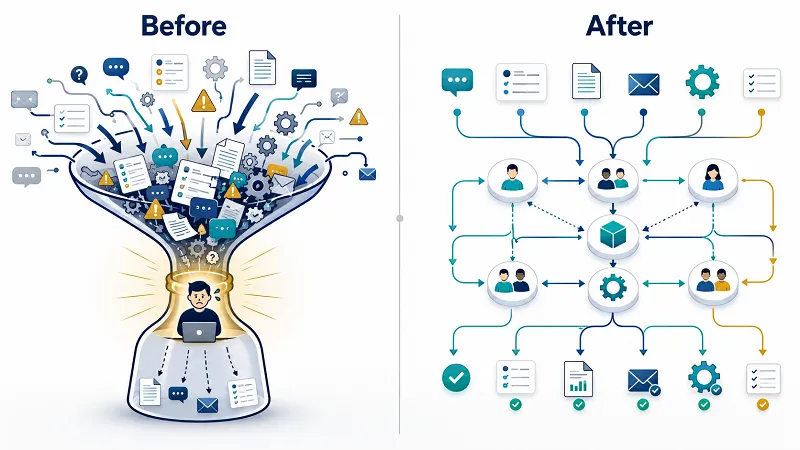
In most growing businesses, the single biggest constraint on scale is the founder. If every decision, sale, and fix routes through you, the company can only move as fast as one tired person, and that's the real cause of the plateau.
Scale doesn't fix this; it exposes it. As one Entrepreneur analysis on scaling puts it, scale amplifies whatever already exists, good systems get stronger and bad ones spread faster. If the "system" holding your business together is just you, growth multiplies your stress, not your output.
The good news? A bottleneck is the most fixable problem there is, because you control it. Removing yourself from low-value work isn't abandoning the business, it's the only way to lift its ceiling.
Take Darren, who came to James feeling stuck and purposeless despite a well-paying job, blocked from the raises, promotions, and ownership he wanted. Working through his "goal blocks," he uncovered the limiting patterns keeping him stuck and broke through to real momentum in his career and income. The block was never hours. It was what he believed he had to do himself. In 20+ years of coaching leaders, James has seen that exact pattern more times than he can count.
The Real Block Isn't Time, It's a Belief
The reason most owners won't work less isn't logistics, it's a belief. "No one can do it as well as I can." "If I step back, it falls apart." "Resting is for after I make it." These aren't facts. They're limiting beliefs running quietly in the background, and they're the true ceiling on your business.
This is where NLP earns its keep. Neuro-Linguistic Programming gives you practical tools to surface the belief driving the behavior, challenge it, and install a more useful one. When a founder stops believing that their worth equals their hours, delegation stops feeling like a threat and starts feeling like leverage. (Our guide to NLP for stress management in business walks through several of these techniques.)
Consider Mike, who battled constant mental "noise", overthinking and second-guessing that drained his confidence. Once that internal clutter cleared, he could hear people, decide cleanly, and lead without the anxiety that had been running the show. That mental quiet is what makes letting go possible. You can't hand off work you're white-knuckling.
Try this: Write down the one task you swear "only you" can do. Then ask: Is that true, or have I just never trained anyone to do it? Sit with the honest answer. That single question has unlocked more capacity for our clients than any productivity app.
The LEVER Framework: Scale by Subtraction
Working less isn't about doing nothing, it's about doing the right thing less. The LEVER Framework is James's five-step process for scaling by subtraction, built on the 5 Pillars of Massive Success and proven NLP tools. Each step removes friction so the business can grow without you grinding.
Step 1 — Locate the Bottleneck. Track where work piles up waiting for you. Approvals, sales, fixes, wherever the queue forms, that's your constraint. You can't fix what you can't see, so start with honest clarity (Pillar 1: Clarity of Vision).
Step 2 — Eliminate Low-Leverage Work. Apply the 80/20 rule to your business: a small slice of your activity drives most of your results. Cut, automate, or hand off the rest without apology. Subtraction is a strategy, not a confession.
Step 3 — Vision Clarity. Define the handful of things only you can do, the vision, the key relationships, the decisive calls. Everything outside that circle is a candidate for someone else. Clarity here is what makes courageous delegation possible.
Step 4 — Empower Others. Build the system: document the process, train the person, then let go of the outcome. Delegation fails when you delegate the task but keep the worry. Communicate the standard clearly (Pillar 2: Confident Communication) and trust people to meet it.
Step 5 — Reclaim & Reinvest. Protect the time you free up, and aim it at growth, not busywork. Reclaimed hours are the raw material of scale. Reinvest them in strategy, leadership, and the work that compounds (Pillar 5: Continuous Growth).
Who Should Work Less to Scale?
This approach is built for owners who've become the ceiling on their own business. You'll know it's you if any of these fit:
You're working 50+ hours a week and revenue still feels capped.
The business can't run for a week without you, vacations don't exist.
You're doing work an organized system or a trained team could handle.
You have demand you can't fully serve because you're the constraint.
You want a business that runs for your life, not one that consumes it.
If you nodded along, working less isn't indulgent. It's your highest-leverage growth strategy.
Who Should Not Use This Approach Yet?
Working less is a scaling tool, not a starting-line tactic, and it backfires if you apply it too early. Be honest about your stage before you pull back.
You should hold off if you're pre-product-market fit and still discovering what customers actually want, that early, hands-on, "unscalable" work is often essential. Scaling on a shaky foundation just multiplies the cracks; as one analysis warns, scaling too fast on a weak base builds a house of cards, not a skyscraper.
This also isn't a license to disengage. Working less means removing yourself from low-leverage work, not from leadership. If you delegate the vision instead of the tasks, the business drifts. Get the foundation and the clarity right first, then subtract.
Data & Findings
The case for working less to scale is backed by independent research and our own client outcomes.
Productivity collapses past ~50 hours. Stanford research on working hours found output per hour falls sharply after 50 hours a week and so far after 55 that 70-hour weeks produce no more than 55-hour weeks.
Burnout is the norm, not the exception. A global study of 308 entrepreneurs found 87% reported anxiety, depression, or burnout, and many work 50–60 hours a week, more in the startup phase.
Boundaries change the outcome. In that same research, founders who set work-life boundaries were far less likely to burn out, about 23% reported high burnout versus 67% of those who didn't.
The bottleneck stalls growth. Founder burnout reporting notes that owners who insert themselves into every process believe it ensures quality, when it's usually stalling the company.
Unleash Your Power Client Performance Report (2026): Across coaching clients who applied a subtraction-first approach, identifying their bottleneck, offloading low-leverage work, and clarifying their core role, the recurring pattern was the same: more capacity, calmer decision-making, and momentum that had been blocked for years finally breaking loose, often within the first few months.
FAQ
Does working fewer hours really help a business grow?
Yes, once you're past the early hands-on stage. Because hourly productivity drops sharply beyond about 50 hours a week, extra hours stop adding output. Reducing your low-leverage work and building systems lets revenue rise without your hours rising, which is the definition of scaling.
What's the difference between growth and scaling?
Growth is doing more with more, more hours, hires, and overhead to lift revenue. Scaling is doing more with less, where revenue climbs while your costs and personal involvement stay flat. Growth has a ceiling set by your capacity; scaling doesn't.
How do I know if I'm the bottleneck in my business?
Watch where work piles up waiting on you, approvals, sales, fixes, decisions. If the business can't run for a week without you, or you're doing tasks a trained team could handle, you're the constraint. The fix is removing yourself from low-leverage work, not adding hours.
Isn't delegating risky if no one does it as well as I do?
That belief is usually the real ceiling, not the truth. Most "only I can do this" tasks have simply never been documented or taught. Delegate the standard clearly, train the person, and let go of the outcome, that's how capacity multiplies.
Conclusion
Here's the contrarian truth: the path to a bigger business usually runs through doing less, not more. When you remove yourself as the bottleneck, harness the right systems, and break the belief that your worth equals your hours, you don't shrink your business, you finally give it room to scale. Start by locating your bottleneck this week, and offload one thing only habit says you have to do yourself.
Ready to build a business that grows without grinding you down? Explore business coaching with James in Toronto and turn working less into your most decisive growth move.
Unleash Your Power: Stand Out, Take Action, and Create the Success You Want.