Why Working 60 Hours a Week Is Actually Sabotaging Your Business Growth
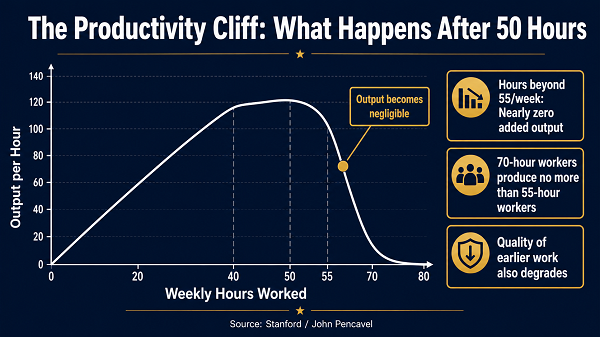
Working 60+ hours a week doesn't create business growth; it creates the illusion of progress while quietly eroding decision quality, strategic thinking, and the mental energy your business actually needs to scale. Research from Stanford economist John Pencavel found that productivity per hour drops sharply above 50 hours a week and becomes essentially zero beyond 55. For entrepreneurs, this means long hours are often a symptom of a deeper problem: doing the wrong work with too much of your own bandwidth instead of building the systems and team that grow the business for you.
You're proud of your work ethic. You should be; it's what built your business. But here's a question worth sitting with: if working more hours was the real path to growth, why isn't your business growing faster?
Sixty-hour weeks are practically a badge of honor in entrepreneurship culture. The all-nighters, the early mornings, the "always on" mentality- somewhere along the way, these became proof that you're serious. That you're committed. That you want it enough.
But the data tells a very different story. And so do the results.
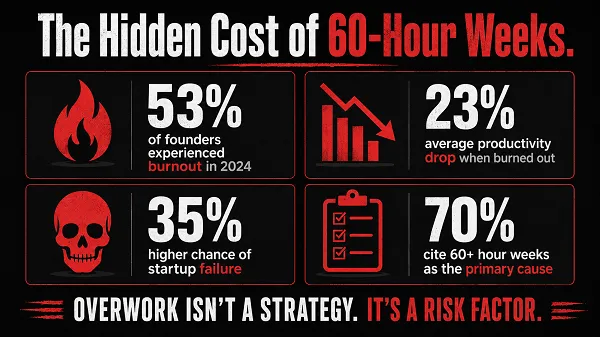
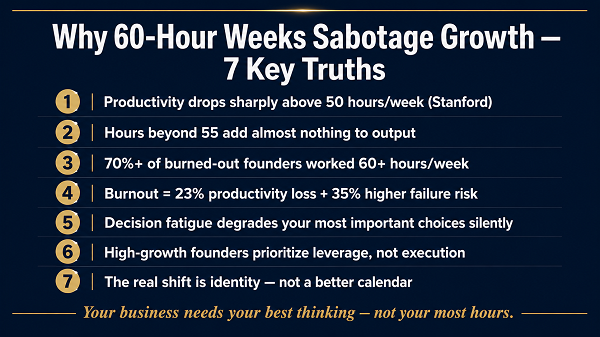
Research from Stanford University found that productivity per hour drops sharply after 50 hours a week, and that hours worked beyond 55 contribute almost nothing to total output. You're not just running out of steam. You're actively making your work worse. Meanwhile, a 2024 survey of founders revealed that 53% experienced burnout in the past year, and 70% named working 60-plus hours a week as the primary cause.
Here's the hard truth that took me over 20 years of working with entrepreneurs and leaders to really understand: working long hours is often a signal of a growth problem, not a solution to one. When you're the busiest person in your business, it usually means the business isn't working; you are. And those are two very different things.
In this article, you'll discover exactly why the 60-hour week is slowing you down, what's happening in your brain and body when you push past the productivity threshold, and the smarter approach that actually builds business growth.
Key Takeaways
Stanford research confirms productivity drops sharply above 50 hours per week; hours worked beyond 55 add almost nothing to total output, and degrade earlier work.
Entrepreneur burnout affects over half of all founders, with 70% naming 60-plus hour weeks as the primary cause, and burnout correlates with a 23% productivity drop and a 35% higher business failure risk.
Decision fatigue compounds quietly across a long workday, leading to avoidance of hard conversations, lower-quality choices, and missed strategic signals.
Long hours are often a structural symptom, not a solution; the business needs systems and leverage, not more of your personal bandwidth.
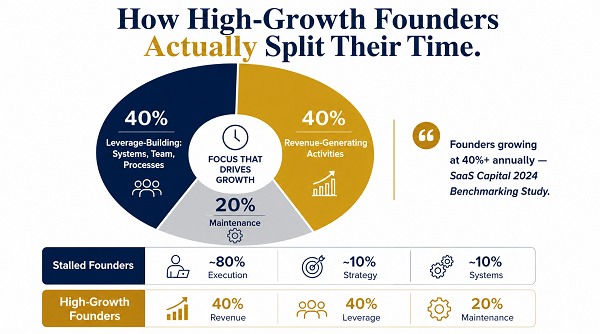
High-growth founders split their time 40% on revenue, 40% on leverage-building, and 20% on maintenance, not 80% on execution.
Rest isn't the opposite of productivity. For entrepreneurs doing cognitive work, it's the precondition for it.
The real shift isn't a time management change; it's an identity change. When you stop measuring your worth by your hours, you start making decisions that actually grow your business.
The Myth That's Costing You More Than You Think
Before we get into science, let's name the belief sitting beneath all of those long hours: if I work hard enough, long enough, the results will come.
It's not a bad belief to start with. In the early stages of building something, grinding through problems, learning by doing, and outworking the market is a legitimate strategy. But there's a transition point, and most entrepreneurs miss it.
When Hard Work Stops Being a Strategy
The transition happens when the limiting factor in your business is no longer effort; it's leverage. Systems, people, decisions, strategy, and direction. These are what move a growth-stage business forward. And they require a quality of thinking that a 60-hour week actively destroys.
A SaaS Capital benchmarking study analyzing over 800 founders scaling from $1M to $10M found that companies growing at 40% or more annually had founders working around 58 focused hours per week, with a key distinction. Those founders spent their hours on strategic leadership, product innovation, high-level partnerships, and building scalable systems. The founders who stalled were working 80+ hours a week, but on execution, repeating manual tasks and plugging operational holes that should have been systematized or delegated.
Same industry. Radically different results. Completely different use of time.
The myth isn't that hard work matters. It does. The myth is that more hours of any kind of work equals more growth. It doesn't. And the science is unambiguous.
What Science Actually Says About Working 60+ Hours
This isn't motivational rhetoric. The evidence is clear, consistent, and decades deep.
The Stanford Finding Every Entrepreneur Needs to Know
Stanford economist John Pencavel conducted landmark research on the relationship between working hours and output. What he found should change how every entrepreneur plans their week: productivity per hour begins to drop sharply above 50 hours a week. Beyond 55 hours, additional work contributes almost nothing to total output. And workers putting in 70-hour weeks produced no more than those working 55 hours, while the quality of earlier work in the week suffered too.
Let that sink in. Those extra 15 hours at 70 hours per week? They disappear. Worse, they compromise the work you already did.
For knowledge workers and entrepreneurs, where results depend on cognitive quality, the clarity of a decision, the strength of a strategy, the sharpness of a sales conversation, the degradation is even more severe.
Decision Fatigue: The Silent Business Killer
An average adult makes more than 30,000 decisions each day. For entrepreneurs leading small teams, the stakes and complexity of those decisions are exponentially higher. Should you pursue this opportunity? How do you fund it? Who needs to be promoted or replaced?
After hours of high-stakes decision-making, the brain's capacity for quality choices deteriorates dramatically. This is decision fatigue, and it doesn't just make you tired. Research linked in the Journal of Management Studies directly connects fatigued leadership to measurable drops in productivity, revenue, and profit.
Decision fatigue at hour 12 of your workday doesn't look like obvious incompetence. It looks like:
Defaulting to "safe" choices instead of bold ones
Avoiding hard conversations you know need to happen
Approving things you'd normally push back on because it takes less energy
Missing the strategic signal hidden in a piece of data
These aren't character flaws. They're predictable neurological consequences of sustained overwork. And every bad or avoided decision compounds over time inside your business.
The Burnout Math
The numbers on entrepreneur burnout are not subtle. According to data compiled from multiple 2025 studies, over 87% of founders report experiencing anxiety, depression, or burnout. A separate 2024 survey of 156 founders found that more than half experienced burnout within the prior year, with 70% identifying 60-plus-hour weeks as the primary driver.
Burnout doesn't just affect how you feel. It directly impacts business outcomes: a 23% average drop in productivity, a 35% higher likelihood of startup collapse, and a 41% higher probability of fumbling a critical funding or partnership opportunity. These aren't soft consequences. They're structural business risks that compound quietly until something breaks.
Try This: At the end of your next three workdays, rate the quality of your decision-making from 1 to 10, morning, midday, and end of day. Most entrepreneurs discover their decision quality has dropped 3 to 5 points by late afternoon. That's your data point. That's the cost of those extra hours.
Why You Keep Working Too Much (Even When You Know Better)
Understanding science doesn't automatically change behavior. If it did, every entrepreneur who's read a burnout article would already be working 45 hours a week. The reason long hours persist isn't ignorance; it's identity, psychology, and environment. All three need to be addressed.
The Busyness-as-Value Trap
There's a deeply embedded cultural equation in entrepreneurship: how hard I work = how serious I am = how much I deserve success. This equation feels true, especially in communities where hustle culture is celebrated and rest is treated as a competitive disadvantage.
But busyness and productivity are not the same thing. Motion is not momentum. A full calendar isn't evidence of leadership; it can actually be evidence of the opposite.
When your self-worth is wrapped up in how hard you're working, rest doesn't feel like strategy. It feels like failure. And so you stay in the 60-hour cycle, not because it's working, but because stopping feels like giving up.
This is where NLP becomes a transformative tool. Neuro-Linguistic Programming works at the identity and belief level, where these patterns actually live. Not at the calendar level. Not at the task list level. The work of overcoming limiting beliefs with NLP begins with surfacing the exact belief driving the behavior, and replacing it with one that actually serves your growth.
You Haven't Built the Systems That Would Let You Stop
Here's the other piece: many entrepreneurs are working 60 hours a week because if they didn't, things would genuinely fall apart. Not because they enjoy the hours, but because the systems, team, and processes that should exist don't yet.
This is a structural problem, not a time management problem. And the only way to solve a structural problem is to invest time in building the structure, which requires freeing yourself from enough execution to think clearly about how to architect the business differently.
That freedom doesn't come first. You have to create it. But you can only create it if you see it as legitimate, high-value work, not a luxury you'll get once the busy period passes. (There will always be a busy period.)
The Dopamine Cycle of Doing
As covered in the science of the grinder trap: ticking tasks off a list feels productive. Clearing your inbox gives a neurological reward that strategic thinking, which is open, uncertain, and cognitively demanding, simply doesn't match in the short term.
This is why entrepreneurs who know they should be working less and thinking more still find themselves buried in operational tasks at 9 p.m. The behavior is reinforced by its immediate neurological payoff, even when the long-term cost is enormous.
Recognizing the cycle is the first step. Breaking it requires rewiring both the behavior and the identity that keeps recreating it.
The Real Equation: Hours Worked vs. Value Created
Here's the reframe that changes everything: stop measuring your contribution by hours worked and start measuring by value created.
What Are Your Hours Actually Worth?
If your highest-value work, the strategic decisions, client relationships, and business architecture that only you can drive, is worth $500 an hour, what are you actually producing during hours 50 through 60 of your week?
Based on Stanford's research, productivity during those late hours is a fraction of what it was earlier. The decisions are foggier. The thinking is slower. The output is lower quality. You may be "working" in the technical sense, but you're not producing anywhere near your real value.
Meanwhile, you're too depleted to invest time in building the systems that would multiply your output across the whole business. Every hour you spend exhausted doing $25-per-hour work costs you not just that hour; it costs you the $475-per-hour strategic work you could have been doing with clear energy and a sharp mind.
What High-Growth Founders Do Differently
The SaaS Capital data is instructive: founders whose businesses grew at 40%+ annually weren't just working differently on paper. They had made a real operational shift. Their week was structured around a 40-40-20 principle: 40% on revenue-generating activities, 40% on leverage-building (systems, team, and processes that scale), and 20% on maintenance.
Notice what's missing: no category called "doing everything myself." That's the difference. Not the total hours, the allocation.
Try This: For the next five days, tag every task you complete as one of three things: Revenue (directly generates income), Leverage (builds something that grows the business without your constant involvement), or Maintenance (necessary but could be delegated or systemized). At the end of the week, total up the percentages. Most entrepreneurs find that 60–80% of their week falls into Maintenance, and less than 10% into Leverage. That ratio is your growth ceiling.
The Smarter Alternative: How to Work Less and Grow More
Working smarter isn't about doing less. It's about doing the right things at the right level, with the right quality of attention. Here's how to make that real.
Build the 5-Step Limitless Work Model
This framework, grounded in 20+ years of NLP-backed coaching with entrepreneurs, gives you a practical architecture for replacing hours-as-metric with value-as-metric.
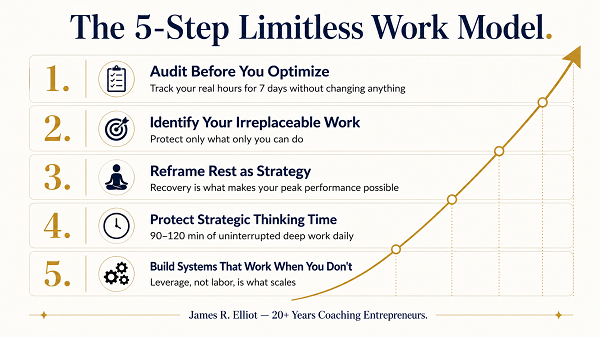
Audit Before You Optimize
You can't fix what you haven't measured. Track your time in 30-minute blocks for seven days without changing anything. Just observe. Where your hours actually go will almost certainly surprise you — and reveal your three biggest leverage opportunities.
Identify Your Irreplaceable Work
What can only you do? Not what you're capable of, or what you've always done, but what genuinely requires your judgment, relationships, authority, or expertise. Protect this work first. Everything else is a candidate for delegation, automation, or elimination. For more on how NLP training for business develops this kind of strategic clarity, explore the programs built specifically for growth-stage entrepreneurs.
Reframe Rest as Strategy
This is the NLP identity work. Rest, recovery, and white space are not rewards for finishing your work. They are the conditions that make your best work possible. Cognitive research consistently shows that insight, creativity, and breakthrough decisions don't happen during hour 11 of your workday. They happen after rest. This isn't permission to slack, it's permission to perform at your ceiling. Tie your self-worth to the quality of your output, not the quantity of your hours.
Protect Strategic Thinking Time
Block 90 to 120 minutes of uninterrupted thinking time into your calendar every day, and treat it as your most important appointment. No email. No Slack. No fires. Just the high-altitude work that moves your business forward. Most entrepreneurs report that this single habit produces more business movement in a week than three weeks of reactive busyness. An excellent starting point is the framework in mastering mindsets for business.
Build Systems That Work When You Don't
The goal isn't to be more productive. The goal is to build a business that compounds. Every process you document, every capable person you hire and trust, every system you build that handles execution without your direct involvement- that's leverage. That's the work that creates the freedom to think clearly and lead powerfully. See how small businesses fail to grow connects directly to this missing layer.
When Working Long Hours Does Make Sense
This article isn't anti-effort. Some entrepreneurial seasons genuinely demand more hours: a product launch, a critical client delivery, a funding round. Short-term intensity, when chosen consciously and time-limited, is a legitimate tool.
The problem is when intensity becomes identity. When "sprint mode" becomes your permanent operating mode. When 60 hours isn't a season, it's your default.
Here's the distinction: are you working long hours because a specific, finite situation requires it, and you have a clear endpoint? Or are you working long hours because you don't have the systems, team, or beliefs that would make it safe to stop?
The first is strategy. The second is a signal.
Mike came to James carrying a mind that never stopped, constant self-doubt, mental noise, and second-guessing that made every decision harder than it needed to be. The overwork wasn't about the hours. It was about the fact that he didn't trust himself to make the right call without checking everything twice. After working through the limiting beliefs driving that pattern with NLP techniques, something shifted. The noise quieted. The confidence came online. He began delegating not because he had to, but because he finally trusted that things would be handled. His work hours dropped. His output, and his career trajectory, both climbed.
That's the shift. Not time management. Identity.
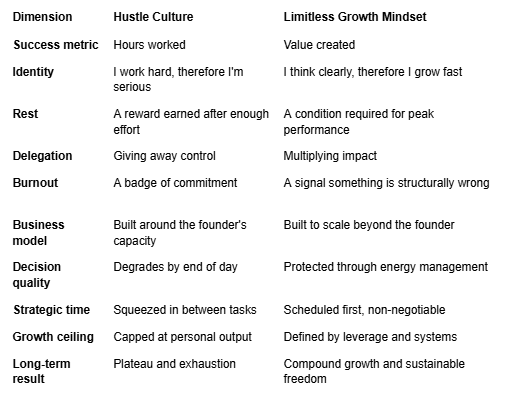
Hustle Culture vs. Limitless Growth: What's the Real Difference?
Frequently Asked Questions
If working 60 hours a week is counterproductive, why do so many successful entrepreneurs do it?
They don't, at the level people assume. Many celebrated founders have periods of intense work, but the public image of "always-on" doesn't reflect their daily reality at scale. High-growth founders, per SaaS Capital data, average about 58 hours per week with a deliberate focus on strategic work. The ones working 80+ hours are typically stuck in execution, not leading growth. Social media glorifies hustle, but it rarely shows the plateaus, burnout, and stalled growth that come with it.
What's the difference between being busy and being productive as an entrepreneur?
Busyness is activity, filling time with tasks, responding to demands, staying in motion. Productivity is output, moving the business meaningfully forward. An entrepreneur can be intensely busy and barely productive if most of their activity is maintenance work that could be delegated or systematized. The measure isn't hours or even tasks completed. It's: did the business get meaningfully closer to its goals today?
How do I stop working 60 hours a week when there's always more to do?
There will always be more to do. That's not a problem you'll solve by working more hours; you'll solve it by building a business that doesn't require everything to flow through you. Start small: identify three recurring tasks this week that could be delegated or systematized, and make that transition. Protect one 90-minute block of strategic thinking daily. Track your task value for a week. The goal isn't to flip overnight; it's to start shifting the ratio of execution to leverage until the business begins running instead of being run.
Can NLP help with the habit of overworking?
Absolutely. Overworking is rarely just a scheduling problem; it's usually driven by beliefs about what makes you valuable, fears about what happens when you let go, and identity patterns that equate effort with worthiness. NLP works directly at that level. Techniques like belief reframing, anchoring resourceful states, and timeline processes help entrepreneurs examine and update the internal operating system driving their behavior, creating lasting change rather than temporary discipline.
What are the signs that my long hours are a symptom of a structural business problem?
Key signals: things stop moving when you take a day off, you're the first point of contact for problems your team should resolve, you haven't documented any of your key processes, and you feel guilty resting even when there's nothing urgent. These aren't work ethic problems; they're architecture problems. Your business is structurally dependent on your constant input, and the solution is building the systems and team that remove that dependency.
Conclusion
Working 60 hours a week isn't a sign that you're not working hard enough. It's often a sign that you're working in the wrong way, at the wrong level, on the wrong things. The science is unambiguous. The business outcomes are consistent. And the path forward isn't more hours; it's more clarity, better systems, and the identity shift that makes both possible.
Your business doesn't need more of your time. It needs more of your best thinking. And your best thinking happens when you protect it, not when you grind it down to nothing by hour 12 of a 60-hour week.
You have what it takes to build something extraordinary. The question is whether you're willing to work smarter to get there, to step back from the execution long enough to lead the business you actually set out to build.
If you're ready to make that shift, NLP-based business coaching at Unleash Your Power gives you the tools to do it, not just productively, but permanently.
Unleash Your Power: Stand Out, Take Action, and Create the Success You Want.