

Why You Don't Need More Marketing - You Need a Structural Redesign
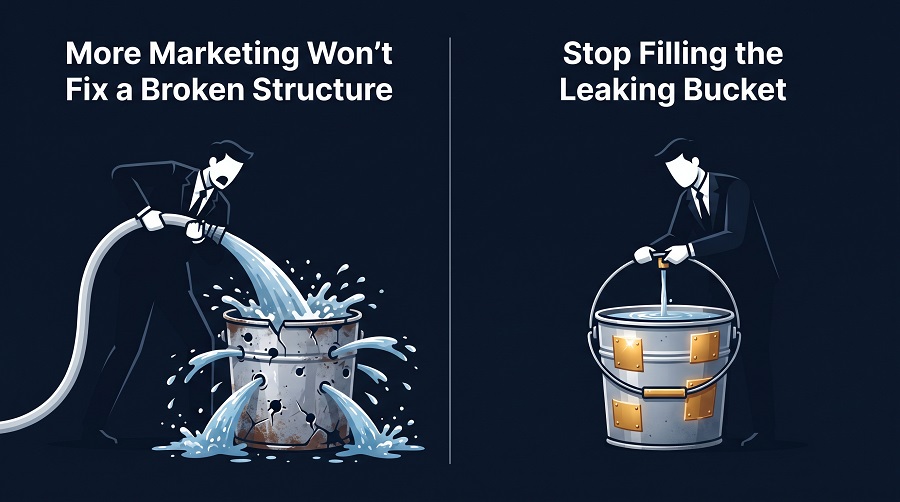
If your business is not growing despite consistent marketing, the problem is almost certainly structural, not promotional. Marketing amplifies what already exists. If the underlying business model is broken, if your offers create dependency instead of results, your fulfillment requires your constant presence, and your pricing does not reflect your value, more marketing simply delivers more clients into a broken system faster. This accelerates burnout rather than growth. A Structural Redesign means auditing and rebuilding four interconnected components: your offer architecture, your pricing model, your fulfillment systems, and your operational workflow. Only when the structure is solid does marketing produce compounding returns instead of compounding chaos. Founders who pour budget into marketing before fixing their structure are filling a leaking bucket. The most leveraged decision you can make right now is to stop marketing and start redesigning.
Key Takeaways
Marketing Amplifies, It Does Not Fix: More leads entering a broken operational system produce more exhaustion, not more revenue. Marketing is a multiplier, it multiplies whatever already exists, good or bad.
The 4 Structural Pillars: A truly scalable business requires a redesigned offer, a premium pricing model, systematised fulfillment, and an autonomous operational workflow. All four must be rebuilt before marketing is scaled.
The "Leaking Bucket" Diagnosis: If your client churn is high, your referral rate is low, or your workload increases faster than your revenue, you have a structural leak — not a marketing shortfall.
Structure Creates Compounding Returns: A single hour spent redesigning your onboarding system saves five hours every week for the next three years. Marketing cannot produce that return.
The Psychology of Avoidance: Most founders prefer to increase their marketing spend because it feels like action. Structural redesign requires confronting uncomfortable truths about the business model they have built.
The Most Expensive Mistake in Business Growth
There is a moment that almost every service-based business owner experiences. Revenue has plateaued. The pipeline feels thin. The natural impulse is immediate: run more ads, post more content, hire a marketing agency. Something, anything, to bring more people in the door.
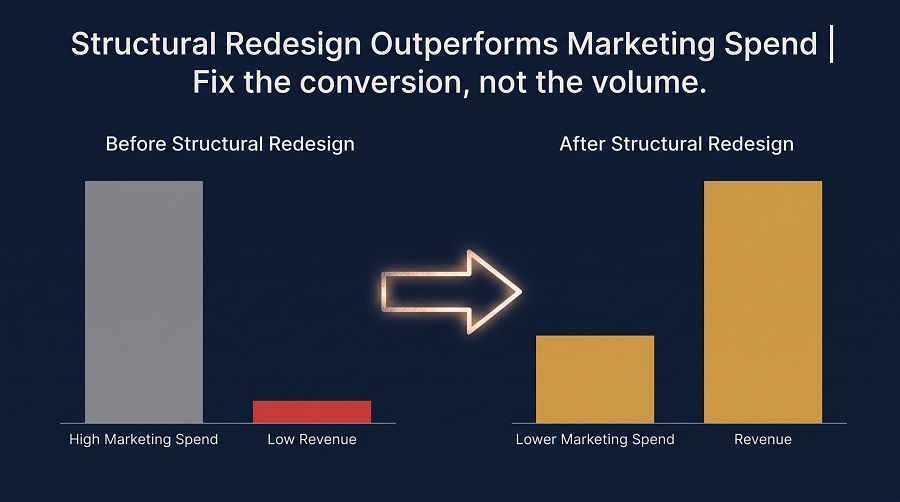
This impulse is understandable. It is also one of the most expensive mistakes a scaling entrepreneur can make.
If you have a leaking bucket, the answer is not to pour water in faster. The answer is to find the leaks and seal them. Pouring more leads into a structurally deficient business model does not generate growth. It generates faster burnout, lower margins, and increasingly desperate discounting.
The reason your business is not growing is almost certainly not your lack of visibility. It is the architecture underneath the visibility.
Why Marketing Fails When Structure Is Broken
When Offers Create Dependency Instead of Results
Many service providers have unconsciously built offers that keep clients dependent on them rather than delivering a clear, self-contained transformation. This feels profitable at first. But dependent clients churn unpredictably, require constant energy, and never refer their peers. Marketing more of these dependency-based offers means recruiting an ever-larger group of clients who consume your time without generating real business momentum.
When Fulfillment Cannot Survive Volume
If the delivery of your core service requires you personally, your attention, your judgment, your presence, there is an absolute ceiling on how many clients you can serve without the quality collapsing. Marketing aggressively beyond this ceiling does not generate scale; it generates overwhelm, refund requests, and reputation damage.
When Pricing Attracts the Wrong Clients
Low-ticket pricing does not simply mean lower revenue per client. It systematically attracts clients with lower commitment levels, more customisation demands, and less capacity to implement your advice. Marketing to grow a low-ticket client base produces more admin, more churn, and less transformational impact, making it harder to generate the testimonials and referrals that fuel organic growth.
When Conversion Is Low Because Trust Is Absent
Founders often interpret poor conversion rates as a marketing problem ("we need better copy" or "we need a better ad"). But conversion rates are primarily a trust and authority issue. When your brand positioning, offer clarity, and social proof are structurally weak, spending more money to reach more people simply accelerates the rate at which people say no.
The 4-Layer Structural Redesign
A Freedom-First Structural Redesign rebuilds four interconnected layers of your business in a specific, deliberate sequence.
Layer 1: Offer Architecture
Your signature offer must be redesigned to deliver a specific, named transformation, not access to your expertise or a bundle of deliverables. A transformation-based offer has a defined beginning, a clear methodology, and a predictable outcome. It does not require you to customise it for every client. It produces referrals organically because clients can describe exactly what you do and who it is for.
Layer 2: Premium Pricing Model
Your pricing must be rebuilt around the economic value of the transformation you deliver, not the hours you invest. Premium pricing is a structural decision, not a confidence decision. It filters out low-commitment clients before they enter your system, and it creates the profit margins required to invest in the team and systems that will eventually replace your personal involvement in delivery.
Layer 3: Systematised Fulfillment
Every repeatable step in your client delivery must be extracted from your brain and codified into a system that your team can execute without you. Onboarding, check-ins, deliverable creation, and progress tracking must all run independently. This is the layer that breaks the direct relationship between your hours and your revenue.
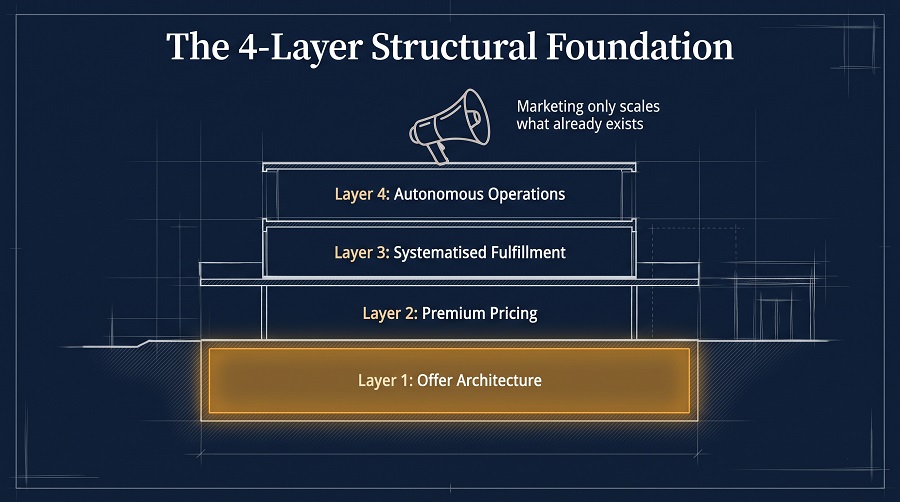
Layer 4: Autonomous Operational Workflow
The business's day-to-day administrative functions, scheduling, invoicing, reporting, client communication, team coordination, must be automated or delegated through clearly designed workflows. A CEO should not be managing their own calendar or chasing unpaid invoices. When this layer is solid, the founder's role becomes purely strategic.
"You can't market your way out of an operational failure. You have to build your way out. And the build always precedes the broadcast." — James R. Elliot
Structural Audit: Is Your Business Ready to Scale Marketing?
Use this self-diagnostic to identify exactly which structural layer is leaking.
Structural Layer | Warning Signs of a Structural Leak | The Redesign Priority |
Layer 1: Offer Architecture | Clients cannot describe what you do clearly. Endless customisation requests. Low referral rate. Vague outcomes promised. | Immediate. Rebuild your signature offer around a single named transformation before any marketing spend. |
Layer 2: Pricing Model | You discount regularly. You attract price-sensitive clients. You cannot afford team support. High churn at the first billing cycle. | High. Restructure to outcome-based pricing. Use premium pricing as a client quality filter. |
Layer 3: Fulfillment Systems | Delivery requires you personally. Quality drops when volume rises. You spend nights and weekends "catching up." | High. Systematise and document every repeatable step. Remove yourself from the delivery loop. |
Layer 4: Operational Workflow | You manage your own inbox, scheduling, and invoicing. Fires require your personal intervention daily. | Medium. Automate or delegate all non-strategic admin. Protect the CEO calendar for high-leverage decisions only. |
Comparison Matrix: More Marketing vs. Structural Redesign
Dimension | The "More Marketing" Trap | The Structural Redesign Path |
Root Cause Addressed | Surface-level visibility gap | Broken offer, pricing, fulfillment and operations |
Short-Term Impact | More leads — into a broken system | Temporary slowdown in acquisition, massive efficiency gains |
Medium-Term Reality | Higher burn rate, worse margins, operational chaos | Higher conversions, better clients, sustainable delivery |
Long-Term Outcome | Burnout, client churn, and a ceiling set by personal capacity | Compounding referrals, premium positioning, autonomous growth |
Owner's Working Week | Increases to 60-80 hours | Decreases to 25-35 hours as systems carry the load |
The Framework: The 5 Shifts to Freedom & The 3 Pillars
The Limitless Entrepreneur methodology sequences the Structural Redesign through a proven 16-week architecture, ensuring that each layer is rebuilt in the right order before the next is addressed.
The 3 Pillars: The Engine of the Redesign
Pillar 1 — Performance Psychology: The psychological prerequisite for every structural change. We use NLP to dissolve the "more activity = more progress" bias and decondition the compulsion to default to marketing whenever growth stalls.
Pillar 2 — Freedom-First Business Strategy: The strategic layer. This is where we rebuild the offer architecture, restructure the pricing model, and identify the 20% of activities that drive 80% of real growth.
Pillar 3 — Freedom-First Business Structure: The operational layer. This is where fulfillment is systematised, workflows are automated, and the business is physically redesigned to operate without the founder in the middle of everything.
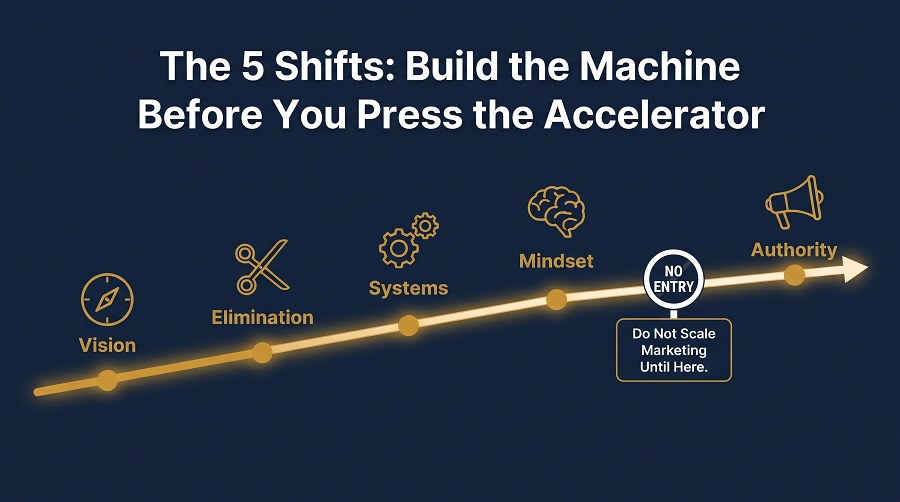
The 5 Shifts: The Redesign Sequence
Phase 1: Clarity (Weeks 1-4)
Shift 1 — Vision Alignment: Establishing the exact future state of the business before touching a single system. What does this business look like when it runs without you?
Phase 2: Liberation (Weeks 5-11)
Shift 2 — Ruthless Elimination: Cutting the offers, clients, and marketing channels that create friction without forward momentum.
Shift 3 — Systems That Scale: Externalising the founder's intellectual property into documented, delegable methodologies.
Phase 3: Amplification (Weeks 12-16)
Shift 4 — Mindset Unlock: Neutralising the psychological need to "stay busy with marketing" even when the structure demands patience.
Shift 5 — Magnetic Authority: Only at this stage, once all four structural layers are solid, does targeted marketing begin. Now it compounds.
Case Evidence: Structural Redesign in Practice
Tom — Rebuilding the Offer, Not the Marketing
Tom was spending heavily on a content marketing strategy. He was posting daily, running ads, and appearing on podcasts. Enquiries were coming in, but his close rate was below 15%. He was convinced he needed better copy and more content. What he actually had was an offer that nobody could explain and a pricing model that attracted clients who were not ready to invest seriously. We paused all marketing activity. We rebuilt his signature offer around a single, named transformation with clear outcome metrics. We raised his prices to premium. His close rate jumped to over 60% without changing a single word of his marketing copy. Same attention, better structure.
Nik — Fixing the Fulfillment Before the Funnel
Nik ran a sought-after consultancy. He had no shortage of inbound enquiries. His problem was that every new client he onboarded required an enormous volume of bespoke time, capping his client count at eight. He wanted to invest in a full marketing campaign to "fill a waiting list." Instead, through Shift 3 (Systems That Scale), we systematised 70% of his delivery into a documented methodology executed by a trained associate. His capacity expanded from eight to thirty clients. Only then did we scale his marketing, because now the structure could support the volume.
Decision Framework: Do You Have a Marketing Problem or a Structural Problem?
You have a STRUCTURAL problem if: You have no shortage of enquiries but a low close rate. Clients churn frequently or do not refer. Your workload grows faster than your revenue. Delivery quality drops when volume rises. You cannot take time off without the business suffering.
You have a MARKETING problem if: Your structural foundations are solid, your offer converts at 50%+, your fulfillment is systematised, and your clients regularly refer, but your total volume of qualified enquiries is simply insufficient for your targets.
Rule of thumb: If in doubt, fix the structure first. Marketing will always wait. Burnout will not.
Try This: The "Leaking Bucket" Self-Audit
Step 1: Calculate Your Referral Rate.
In the last 6 months, what percentage of your new clients came from referrals from past clients? If it is below 30%, your offer is not delivering a clear enough transformation to generate word-of-mouth.
Step 2: Calculate Your Close Rate.
How many discovery calls result in a new client? If your close rate is below 40%, your offer clarity and pricing structure are the problem, not your marketing volume.
Step 3: Map Your Personal Involvement.
List every step of your client delivery process. Highlight every step that requires your personal decision-making or expertise. If more than 50% is highlighted, you are the fulfillment bottleneck, and no marketing campaign will change that.
Further Reading
Harnessing Structure & Systems — how to build the operational backbone of a Freedom-First business.
Strategies to Scale Your Business — the high-leverage moves that compound over time.
Mastering Mindsets for Business — how to overcome the "more marketing" default reflex.
Effective Decision Making — making the strategic call to pause promotion and prioritise structure.
Harvard Business Review: The Elements of Value — external research on why offer architecture drives conversion more than marketing volume.
Frequently Asked Questions
How do I know if my problem is marketing or structure?
Run the three-step Leaking Bucket Audit above. If your referral rate is below 30%, your close rate is below 40%, or your personal involvement is above 50% of delivery, the problem is structural. Marketing can wait. Structure cannot.
Won't pausing marketing cause my business to go backwards?
Short-term, enquiry volume may dip. But a Structural Redesign is a 90-to-120-day process, not a multi-year project. The conversion and referral improvements that result from a rebuilt offer and pricing model consistently outperform any marketing campaign within that same time frame.
What is "offer architecture" and why does it matter so much?
Offer architecture is the design of your service: the specific transformation it delivers, the methodology that delivers it, and the way that transformation is communicated to the market. An offer with a weak architecture produces confused buyers, low conversion rates, and clients who cannot explain what you do to their peers. This is a structural problem that no volume of marketing copy can fix.
How do I transition from bespoke, time-heavy delivery to a systematised model?
Through Shift 3 (Systems That Scale). We map every step of your current delivery process, identify the 20% of steps that generate 80% of the client's results, and build a documented, repeatable methodology around those steps. The bespoke elements are progressively replaced by a structured process your team can execute.
At what point should I scale marketing after the structural redesign?
Shift 5 (Magnetic Authority) specifically addresses this. The signals that you are ready to scale marketing are: a close rate above 50%, a referral rate above 25%, a fulfillment system that operates without your personal presence, and profit margins that can absorb the cost of acquisition.
Conclusion: Build the Machine Before You Press the Accelerator
James R. Elliot has built eight businesses across 24 years and worked with corporate teams at IBM, Lenovo, and Novell. In his fifth business, he made the same mistake that traps most founders: he pressed the accelerator on marketing before the machine was built.
He was working 80 hours a week on anxiety medication, running a business that generated impressive top-line numbers and left nothing behind in the bank because the structure was consuming every pound of profit. More marketing meant more clients, which meant more exhaustion, which meant a harder ceiling and a louder question from his niece about why he was never around.
The shift was not a better ad campaign. It was a complete structural redesign: a single premium offer rebuilt around clear outcomes, systems that ran the delivery without him, and a pricing model that filtered clients by commitment level. Within 90 days, his working week dropped from 80 hours to 25. Revenue grew. He visits his niece now. He takes a 36-minute nap every afternoon.
Stop filling the bucket with more water. Seal the leaks first.
Ready to identify your structural gaps? Book the Freedom Blueprint Call. We will map the specific redesign your business needs before you spend another pound on marketing.