Why Willpower Fails: Beat Subconscious Self-Sabotage
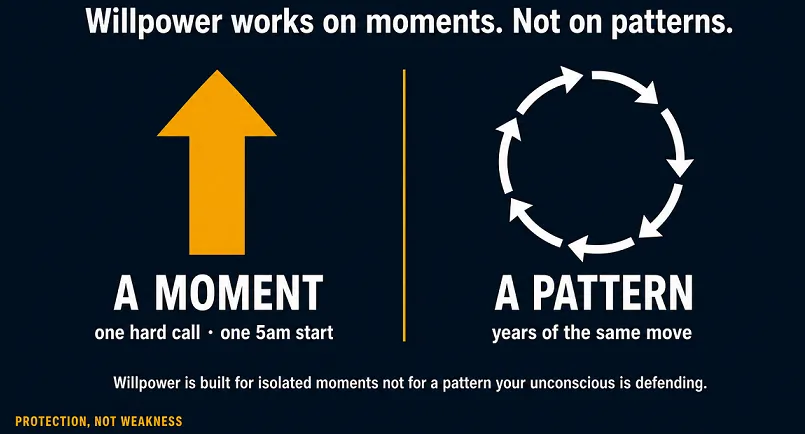
Willpower fails because it's the wrong tool for the job. It works on isolated moments: one hard email, one early morning, one uncomfortable conversation. It's usually a poor tool for changing recurring patterns the ones reinforced by habit, emotion, or a sense of threat because those patterns are typically protecting you from something: rejection, exposure, disappointing someone who depends on you.
Subconscious self-sabotage isn't weakness; it's protection running on outdated instructions. The research has moved here too. The "willpower is a fuel tank" model failed a 23-laboratory preregistered replication, and people with stronger self-control often rely less on moment-to-moment resistance because they've built habits and environments that reduce the need for it.
Key takeaways
Willpower fails on defended patterns because it treats protection as a motivation problem.
The fuel-tank model of willpower didn't survive large-scale preregistered testing.
Self-sabotage looks like productive work: redoing delegated tasks, over-delivering, urgent admin before hard conversations.
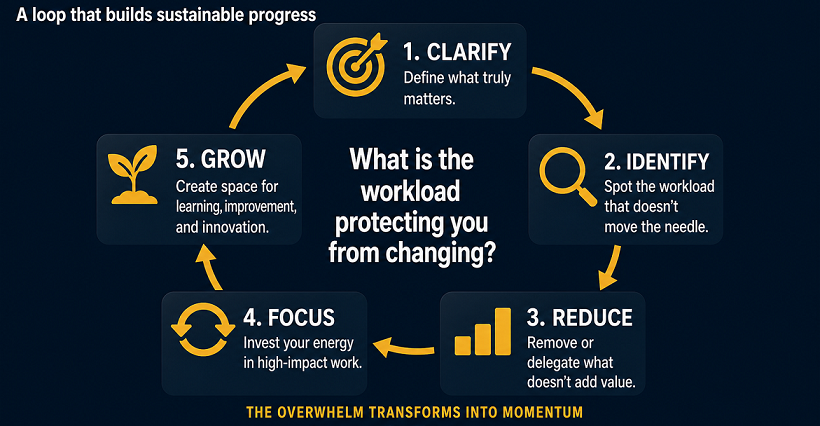
Overwork may be helping to maintain the plateau; ask what the workload is protecting you from changing.
People with stronger self-control rely less on resistance, because they reduced the need for it.
Situation design and if-then plans outperform in-the-moment effort.
Expect roughly two months for a new behaviour to feel automatic; a missed day doesn't undo it.
Psychology, then strategy, then structure all three, or the pattern rebuilds itself.
For an overworked coach or consultant, that matters. The harder you work, the more you run on your oldest patterns, which is why a sixty-hour week never breaks the plateau. It is the plateau.
Why does willpower fail?
Willpower fails because it's built for moments, not for patterns. It can carry you through one difficult call or one 5 am start. It's usually a poor tool for changing recurring behaviour that's reinforced by habit, emotion, or a sense of threat and if you've repeated that behaviour for years, all three are generally in play.
Somewhere along the way your system learned that raising your prices risks rejection, that handing over the work risks being seen as replaceable, that an empty calendar means something has gone wrong. So it keeps you safe by keeping you busy and it decides before your conscious mind gets a vote.
What is subconscious self-sabotage?
Subconscious self-sabotage is any repeated behaviour that works against your stated goal while feeling reasonable, necessary or even responsible in the moment. It isn't a decision you make. It's a response that runs before deliberate thought catches up.
The mechanism is protective rather than destructive. A pattern usually forms because it once reduced exposure to something costly rejection, judgment, letting someone down and keeps running long after the original risk has gone.
That's what separates it from procrastination. Procrastination is a delay you can feel. Self-sabotage is a substitution: you swap the high-stakes action for a lower-stakes one and experience the swap as good judgment.
Is willpower actually a limited resource that runs out?
Probably not in the way you were taught. The fuel-tank idea came from ego-depletion research in the late 1990s and was treated as settled for two decades. Then it was tested properly: 23 laboratories, 2,141 participants and one preregistered protocol produced an effect statistically indistinguishable from zero.
That doesn't mean self-control never falters. It means the reservoir metaphor isn't the mechanism, so managing a "willpower budget" was never going to work. What predicts follow-through is closer to motivation, belief, and whether the behaviour took much effort at all.
What does subconscious self-sabotage look like in a business?
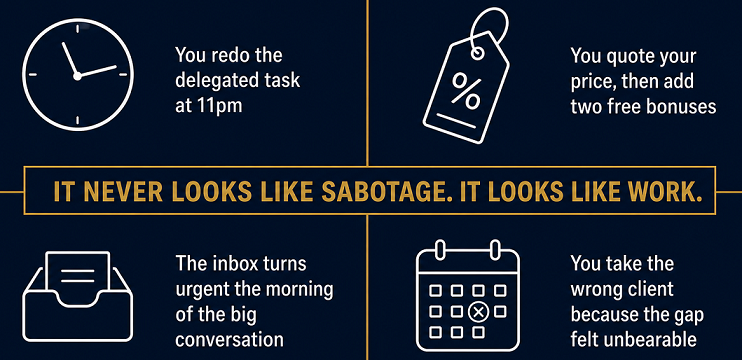
In a service business, it looks like work, which is why it survives for years unquestioned.
You delegate the task, then quietly redo it at 11 pm because it wasn't quite right.
You quote the price you decided on, then add two bonuses nobody asked for.
The morning before the big conversation, your inbox suddenly becomes urgent.
You take the client you knew was wrong for you, because the gap in the calendar felt unbearable.
Every one of those moves lowers your exposure to something uncomfortable, immediately and effectively.
In an experience-sampling study where 205 adults logged 7,827 moments of desire in a week, desires connected to work were among the categories most likely to end in self-control failure. Work is the temptation nobody warns you about, because giving in gets applauded.
If any of those four made you wince, identify the programming that's actually running before you try to out-discipline it.
Why willpower fails hardest when you're busiest
Because pressure pushes you back toward your defaults, and your defaults are the problem. The high-leverage move the price increase, the offer you cut, the hire is exactly the one that needs you calm and thinking forward.
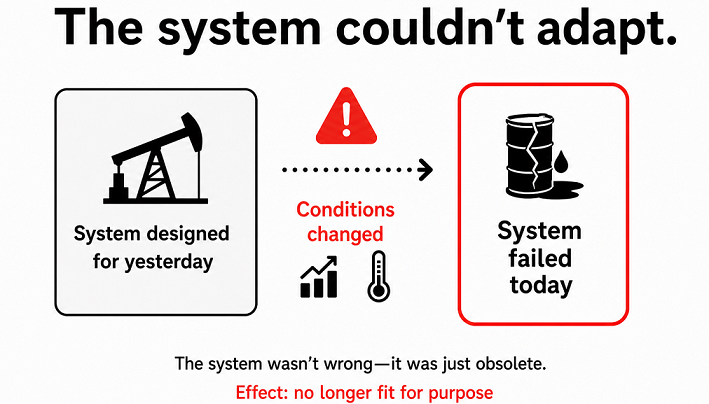
The neuroscience here is suggestive rather than settled. A 2009 study found stressed participants kept repeating a learned action after the reward stopped mattering, read as evidence that stress pushes us from goal-directed behaviour into habit, though 2023 preregistered replications didn't reproduce it. You know what you're like in week three of sixty hours anyway: you don't make bold decisions, you make familiar ones.
I know this one from the inside. On my fifth business, I was working 80-hour weeks, on anxiety medication, and calling it success. I'd built a prison with a nice view. Then my niece asked why I don't visit anymore, and there was no clever answer to that.
So here's the uncomfortable sentence: the hours may not just be the price of your plateau. They may be helping to maintain it.
That changes the question. Instead of asking how to work harder, ask what the workload is protecting you from changing. What hides under all that motion is often the fear underneath the procrastination, in a convincing productivity costume.
Why doesn't more discipline or another system fix it?
Because strategy without psychology is just another unfinished course. Buy the CRM, hire the assistant, rewrite the offer; if the programming underneath is unchanged, you'll recreate the old business inside the new system within a quarter.
Take Jennifer (name changed). Extraordinary background, real expertise, badly underpriced. She knew she should raise her rates; she'd known for two years and still couldn't make herself send the email. The work wasn't affirmations; it was deep reconditioning of the self-concept underneath the pricing. Within 60 days, she'd doubled her prices and more than doubled her revenue.
Doubled her prices in 60 days. The strategy was never her problem. Her programming was.
It's also why goals fail for reasons that have nothing to do with the goal. The plan was never the thing being tested.
What works instead of willpower?
Three things, in this order: recondition the pattern, redesign the situation, then automate the new behaviour. Effortful resistance comes last, if at all.
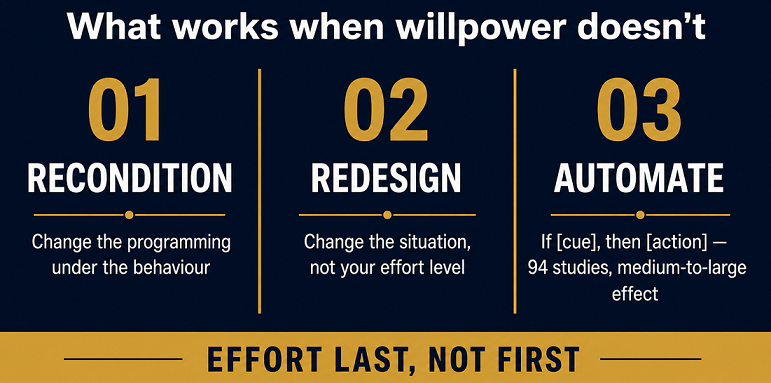
First, across six studies with 2,274 participants, beneficial habits, not effortful inhibition, explained the link between self-control and good outcomes. People with stronger self-control often rely less on moment-to-moment resistance; they've arranged things so the fight starts less often.
Second, change the situation rather than your effort level. Strategies applied early choosing or modifying the situation outperform white-knuckling in the moment. The delegated task never lands back in your inbox; the pricing conversation happens Tuesday morning when you're sharp, not Friday at 6 pm when you're not.
Third, automate the new behaviour with if-then plans. Across 94 independent tests, specifying when, where and how produced a medium-to-large effect on goal attainment. "If a client asks for something outside scope, then I say I'll come back tomorrow" beats "I'll have better boundaries" every time.
Take David (name changed). Brilliant at the work and trapped by it, everything ran through him, which felt like being indispensable and functioned like being stuck. Thirty days to get his expertise out of his head and into a documented process, and his assistant took over the inbox.
First two-week holiday in five years, and the business grew while he was gone. That's what happens when your expertise stops living in your head.
Before any of it, learn to notice the pattern while you're inside it. You can't recondition what you haven't caught in the act.
How long does it take to rewire unconscious programming?
Longer than the internet promises, shorter than you fear. The famous 21 days has no basis in habit research at all. In a study tracking 96 people forming a new daily behaviour, the median time to near-full automaticity was 66 days, with a range of 18 to 254 and missing a single day didn't break the curve.
Emotional reconditioning can move faster: a specific fear response can shift in one focused session, though the structural habits built on top take weeks; change takes the time it takes.
For context: my own rebuild took about 90 days to go from 80-hour weeks to 25, with more revenue coming in, not less. Not because I found more discipline. Because I stopped needing it.
How to break the self-sabotage loop
Breaking the loop means running those three moves in a sequence you can sustain, which is what The 5 Shifts to Freedom is for. It's the journey; the 3 Pillars are the mechanism underneath it:
Performance Psychology (rewiring unconscious programming),
Freedom-First Business Strategy (cutting the 80% that steals your time),
Freedom-First Business Structure (redesigning operations so you're no longer the bottleneck).
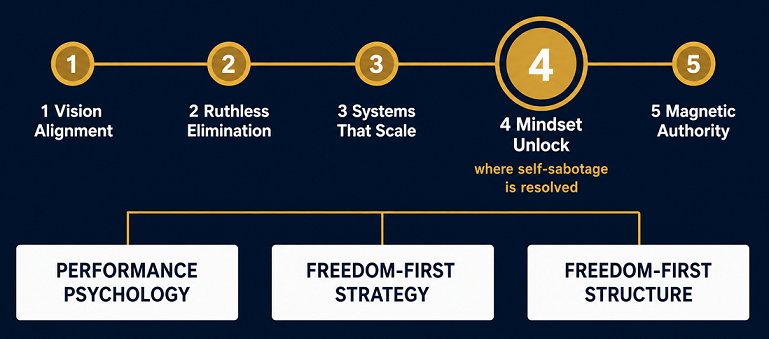
You need all three. Psychology without strategy is feel-good fluff that doesn't pay the bills; structure without both is a prettier prison.
Vision Alignment: get clear on what you actually want, not what you think you should want.
Ruthless Elimination: cut the 80% of activity draining your time and energy.
Systems That Scale: build leverage so the business stops running through you.
Mindset Unlock: dismantle the programming sabotaging your execution, where self-sabotage gets resolved.
Magnetic Authority: position yourself as the expert and charge premium prices.
Who should use this approach?
This fits you if you've already built something real, you're working 50–60+ hours a week, and the bottleneck is no longer information. You know what to do, you've known for a while, and you can't fully explain why you're not doing it.
It also fits if you've bought courses, hired help or rebuilt your systems and the same pattern reassembled itself months later.
Who should avoid this approach?
Skip this if you're at the true start-up stage without clients, yet your constraint is demand, not programming. Skip it if you want tactics with no psychological work; half the method is uncomfortable self-examination. And skip it if you want a system that runs without you changing how you operate. That product doesn't exist.
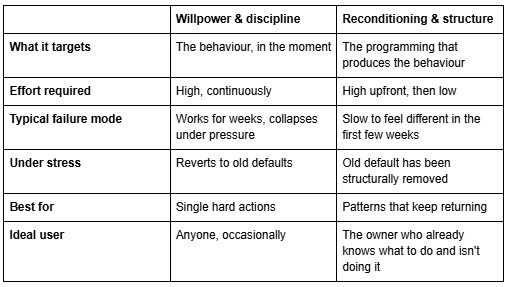
Willpower vs. reconditioning: which approach fits what
Discipline isn't useless; it's the wrong instrument for a defended pattern. Use willpower for one-off pushes, reconditioning plus structure for anything that's already repeated more than twice.
Data and findings
The depletion model didn't hold. 23 labs, 2,141 participants, effect near zero (Hagger et al., 2016).
Habits, not resistance, do the work. Six studies, 2,274 participants (Galla & Duckworth, 2015).
Work is a top source of self-control failure. 7,827 desire episodes were logged by 205 adults (Hofmann et al., 2012).
If-then plans measurably help. Medium-to-large effect across 94 tests (Gollwitzer & Sheeran, 2006).
Automaticity takes roughly two months. Median 66 days, range 18–254 (Lally et al., 2010).
Contested: stress-shifting behaviour toward habit is supported by 2009 work, not reproduced in 2023 replications.
Frequently asked questions
Is self-sabotage a sign that I don't really want it?
Usually not. It more often means part of you is protecting something: safety, status, an identity. Wanting it more was rarely the missing ingredient.
Why does willpower fail for me when other people seem so disciplined?
Because disciplined-looking people often aren't out-resisting you. They've built habits and structured their environment so the fight starts less often. You're comparing your effort to their architecture.
Can't I just hire someone to take the work off me?
Only if the programming changes too. You can't delegate what your unconscious won't release, which is why the assistant gets hired and the work quietly comes back.
How do I know if it's a mindset issue or a strategy issue?
If you know exactly what to do and repeatedly aren't doing it, the problem may no longer be a knowledge or strategy gap. Most established owners are in that position and treat themselves as if they're in the other one.
What if I've tried this before and nothing stuck?
Often one of the three pillars was missing: mindset work without structure, or systems without psychology. One pillar alone tends to fade.
Where this leaves you
You don't have a discipline problem. You have a pattern that's protected you for years and a schedule too full to ever see it, which is why willpower fails and keeps failing.
Working less isn't the reward for breaking through. It's the mechanism. These days I finish early enough to be at dinner with my phone in another room not a flex, just evidence that the pattern no longer runs the business.
If you know what you should be doing and still aren't, that's the conversation worth having. Book a Freedom Blueprint Call 45 minutes. We'll find the one thing that's actually keeping you stuck. No pitch unless you ask for one.