

Why More Clients Will Only Make You More Trapped
The most dangerous myth in business growth is that revenue plateaus are solved by acquiring more clients. If your fulfillment process relies on your personal time, energy, and physical presence, adding more clients does not scale your business—it scales your exhaustion. It mathematically guarantees that you will hit an operational ceiling where quality drops, resentment rises, and your working week spirals past 60 hours. We call this the "Volume Trap." Entrepreneurs unconsciously stay in this trap because client volume provides a dopamine hit of validation (feeling "chosen" and "in demand"). True scaling requires the exact opposite approach: serving fewer clients at a premium price, backed by highly leveraged systems. You do not achieve freedom by filling your calendar; you achieve it by raising your standards, restructuring your offers, and rewiring the psychological need for constant volume.
Key Takeaways
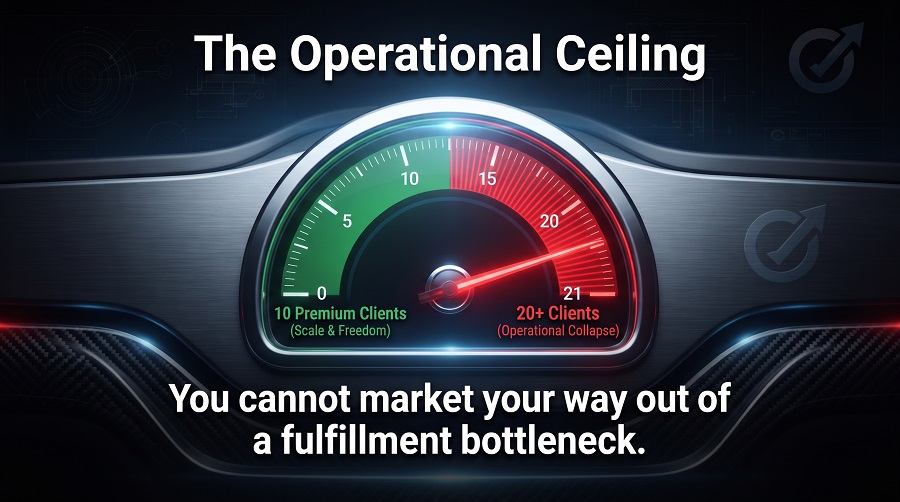
The Math of the Volume Trap: You cannot scale a 1-to-1, time-for-money fulfillment model. At 20+ clients, the founder becomes the ultimate bottleneck.
Ego vs. Economics: A massive client roster often feeds the owner's ego (validation) while starving the business's economics (profit margins and owner sanity).
Fewer Clients, Higher Impact: Halving your client roster while doubling your prices mathematically maintains your revenue, while freeing up 50% of your fulfillment time to focus on strategic scale.
The Systems Prerequisite: Before you even attempt to bring on 100 new clients, you must have Pillar 3 (Freedom-First Structure) in place, or the influx will break your company.
The Psychology of Pricing: Charging premium prices to filter out high-friction clients requires deep subconscious rewiring to overcome the fear of "scaring people away."
The Seduction of "More Leads"
Open any marketing newsletter or scroll through LinkedIn, and the dominant narrative is singular: How to get 50 new clients this month.
Marketing agencies sell you on the dream of a flooded inbox. But what happens when the flood arrives? If you are a coach, consultant, or service provider running a bespoke, highly customised fulfillment operation, a flood of 50 new clients is not a blessing. It is a catastrophic operational failure waiting to happen.
You cannot stuff a million-dollar client roster into a fifty-thousand-dollar operational chassis. If you are still the one answering the emails, customizing the deliverables, and putting out the daily fires, more clients will simply force you to work 80 hours a week until you break.
The Psychology of the Volume Trap
If volume creates so much pain, why do intelligent founders aggressively pursue it?
The Validation Addiction
Having a full calendar provides an immediate, powerful dopamine hit. Every new client signed is external validation that you are valuable, relevant, and in demand. We unconsciously equate a packed schedule with market success, even if that packed schedule is destroying our health and paying us a terrible hourly rate when the math is broken down.
The Fear of Empty Space
Reducing your client load by raising prices creates empty space on your calendar. For an entrepreneur whose identity is fused with "the hustle," empty space is terrifying. Your nervous system interprets rest as a lack of progress. The Volume Trap keeps you too busy to face the silence.
The Scarcity Illusion
The unconscious mind whispers: "If I charge premium prices and work with fewer people, no one will say yes, and I will go out of business." This scarcity mindset forces founders to compete on price, driving them toward low-ticket, high-volume models that require them to operate like assembly-line workers.
The Limitless Framework: Escaping the Volume Trap
You cannot market your way out of an operational bottleneck. You must restructure your business model using the Limitless Entrepreneur methodology.
The 3 Pillars of Strategic Scale
Pillar 1 — Performance Psychology: We use NLP to decouple your self-worth from your client volume. We neutralise the scarcity mindset that keeps you afraid of charging premium prices and turning away bad-fit clients.
Pillar 2 — Freedom-First Business Strategy: We radically restructure your offers. We transition you from selling "time and access" to selling "transformations and systems."
Pillar 3 — Freedom-First Business Structure: We build the operational backend so that when you do bring on new clients, the fulfillment happens automatically, without requiring your constant presence.

Diagnostic Matrix: Is Your Volume Breaking Your Business?
Are your clients an asset or a liability? Use this matrix to evaluate where your business currently sits.
Operational Phase | The Symptoms | The Founder's Reality |
The Tipping Point (10-15 Clients) | Deliverables are slightly delayed. Inbox is overwhelming. Weekends are used to "catch up." | High stress, but still feeling successful. The hustle feels justified. |
The Volume Trap (20+ Clients) | Quality is dropping. High client churn. Customization is impossible. Owner resents the clients. | Working 60+ hours. Capped income. Business will collapse if the owner gets sick. |
The Limitless Model (Premium Scale) | Fulfillment is systematised. Client results are incredibly high. Marketing is selective. | Working 25-35 hours. Owner focuses only on strategy and high-level relationships. |
Model Comparison: The Assembly Line vs. The Boutique
Metric | The Volume Agency Model | The Limitless Boutique Model |
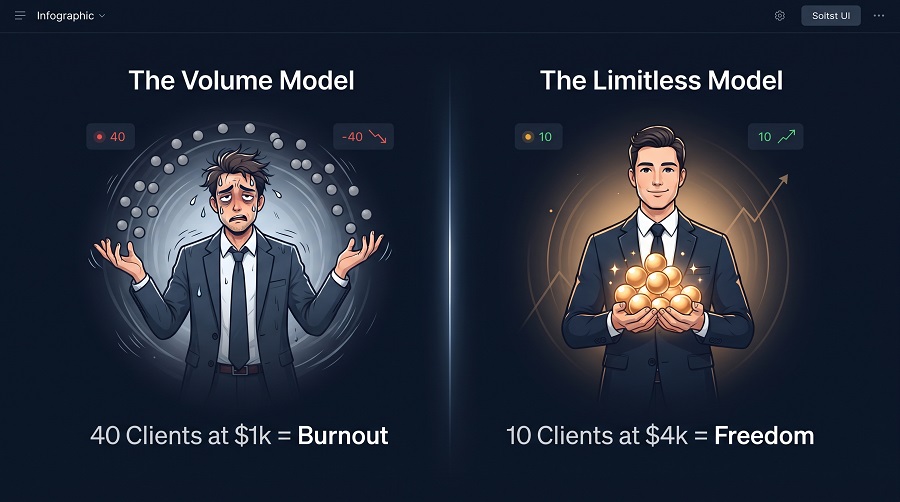
Target Economics | 40 Clients @ $1,000/mo ($40k MRR) | 10 Clients @ $4,000/mo ($40k MRR) |
Operational Friction | Massive. 40 different personalities, 40 emails a day, 40 onboarding calls. | Minimal. Deep, focused work with 10 highly committed individuals. |
Client Commitment | Low. They bought a cheap service and expect you to do the heavy lifting. | Extremely High. They made a significant investment and are ready to implement. |
Owner's Calendar | No white space. Total reactive firefighting. | Guilt-free naps, CEO strategy blocks, deep work. |
Case Evidence: The Mathematics of "Less"
Marcus — 20 Clients Down to 9 (Name Changed)
Marcus was the quintessential victim of the Volume Trap. He had 20 active clients. He was working sixty hours a week, and his operational systems were literally breaking under the weight of the communication. He came to us wanting to hire three more staff members to handle the load. Instead, through Pillar 2 (Ruthless Elimination), we did the opposite. We raised his standards and his prices. He systematically moved from twenty clients down to nine premium ones. His working hours dropped from sixty to thirty. His revenue actually went up. Same man, different mountain.

Jennifer — Pricing as a Filter (Name Changed)
Jennifer had built her business on a low-ticket, high-volume model that left her exhausted. The sheer volume of low-paying clients meant she was dealing with constant scope-creep and boundary violations. Through Pillar 1 (Performance Psychology), we rewired her fear of rejection. She doubled her prices in 60 days. The price increase acted as a filter—the high-friction clients left, and the highly resourceful, committed clients stayed. She maintained her roster size but immediately doubled her revenue without adding a single hour to her week.
Decision Framework: Are You Ready to Reduce?
✓ This Approach Is Designed For: Exhausted experts whose business feels like a chaotic group chat they can never mute. You have proven you can get results, but your delivery model is destroying your life.
✗ This Approach Is Not For: Beginners who have zero clients and need reps to build their skills, or individuals who are terrified to say "no" to anyone with a credit card.
Try This: The Roster Amputation Audit
Step 1: The P&L of Energy. List all of your active clients on a sheet of paper. Next to each name, write their monthly revenue. Next to that, score them from 1-10 on the "Energy Drain" scale (1 = effortless to work with, 10 = absolute nightmare).
Step 2: Locate the Friction. Highlight any client who is paying you below your current standard rate AND scores an 8 or higher on the Energy Drain scale.
Step 3: The Amputation. You are spending 80% of your emotional energy on these highlighted clients, preventing you from serving your premium clients (or finding new ones). Fire the worst one this week. The psychological relief will be immediate.
Further Reading (Internal & External Links)
Harnessing Structure & Systems — how to build fulfillment architecture.
Effective Decision Making — why choosing fewer clients is a CEO-level move.
Mastering Mindsets for Business — escaping the validation addiction.
Why Goals Fail — how vanity metrics (like massive client counts) ruin real growth.
Harvard Business Review: Why You Should Fire Your Worst Clients — external data on the economics of bad volume.
Frequently Asked Questions
If I reduce my client roster, won't my business shrink?
Only if you reduce your roster without simultaneously raising your prices and elevating your offer (Shift 5: Magnetic Authority). The Limitless method is about recalibrating the math: 10 clients at $4k is infinitely more scalable and profitable than 40 clients at $1k.
How do I turn away paying clients if they aren't a perfect fit?
By understanding that a bad-fit client costs you more in operational friction and emotional energy than they pay you in cash. Turning them away requires Pillar 1 (Performance Psychology) to rewire your nervous system out of a scarcity mindset.
Can I scale a high-volume model if I just hire a massive team?
You can, but you transition from being a prisoner of client work to being a prisoner of HR management. Unless your systems are flawless, managing a massive team to handle massive volume still requires 60+ hour weeks from the founder.
What if my industry doesn't support "premium" pricing?
Pricing is largely determined by positioning, not the industry. People pay for outcomes, speed, and certainty. If you shift your offer from "hourly consulting" to a guaranteed structural transformation, the industry standard becomes irrelevant.
I'm scared to fire my bad-fit clients. What should I do?
This fear is a neurological threat response. Your brain equates losing the client with losing survival resources. This is exactly why we start with NLP and psychological rewiring before we ever touch your business model.
Conclusion: The Proof of Premium Scale
When James R. Elliot was running his fifth business, he thought a massive client roster was the ultimate flex. He was working 80 hours a week on anxiety medication, convinced that this was what "winning" looked like. Then his niece asked why he was never around.
He realised he hadn't built a limitless empire; he had built a volume-based prison. He was the bottleneck holding the entire structure together. Within 90 days of applying the Limitless Framework—rewiring his psychological need for volume, ruthlessly eliminating the friction, and restructuring his delivery—his working week plummeted to 25 hours. He didn't need 100 clients; he needed the right clients, backed by the right systems.
He now visits his niece. He takes a 36-minute nap every afternoon. That is the difference between surviving a volume trap and owning a Limitless business.
Ready to escape the Volume Trap? Book the Freedom Blueprint Call (30 mins). We will map the exact path to higher revenue with fewer clients.