
Why More Clients Trap You: Scale Premium Capacity
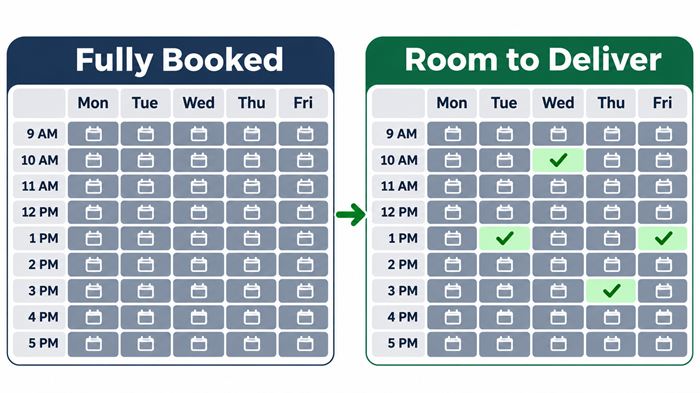
More clients trap you because every new client adds hours, context switching and scheduling risk, while your capacity stays fixed. Past a point, quality slips and your income per hour can stall. Premium capacity is the opposite approach: set a client ceiling you can serve well with room to spare, price for it, and design delivery so each client gets more value without more of your time.
In operations research, the Kingman formula shows waiting time climbing steeply as utilization nears 100%, and lab studies of task switching find that unfinished work carries attention into the next task. These are analogies for a one-person practice, not measurements of yours. Start by logging the real hours behind your current clients, then compare adding clients, raising price and redesigning delivery on revenue per client hour.
Key Takeaways
A full calendar measures how busy you are. It doesn't measure how well you earn or how well you serve.
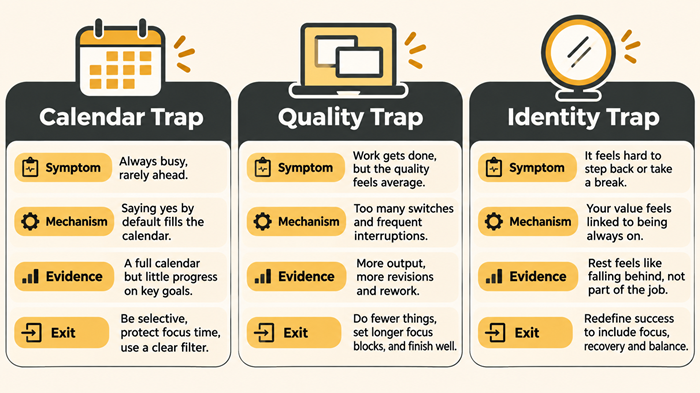
Three traps sit behind "just add more clients": the Calendar Trap, the Quality Trap and the Identity Trap.
Judge every growth option on revenue per client hour, counting the unseen work too.
Premium capacity means fewer clients, a higher fee and a deeper result, with room left in your week.
Set your ceiling with a simple formula, then test price changes on new inquiries first.
The numbers in this post are illustrations and analogies. Run your own hours before you decide.
The Full-Calendar Paradox
You hit capacity, and it felt like winning. Your calendar filled, inquiries kept coming, and for a few weeks the business looked exactly the way you pictured it. Then the other side showed up. Prep ran late. Messages stacked up. A client had a rough week and you had no slack to absorb it.
Most advice at this point says take more clients. It sounds logical, since more clients means more revenue. But revenue and income per hour are different numbers, and your hours don't grow. If you're still working out what a coaching practice can realistically earn, our guide to life coaching income and earnings is a good companion to this one.
Three traps keep solo coaches and consultants stuck at a full calendar. Notice which one feels familiar, then use the math and the decision matrix to choose your exit.
Trap 1: The Calendar Trap
Symptom. You're booked solid, and every small surprise ripples across your whole week. A rescheduled call turns into three rescheduled calls.
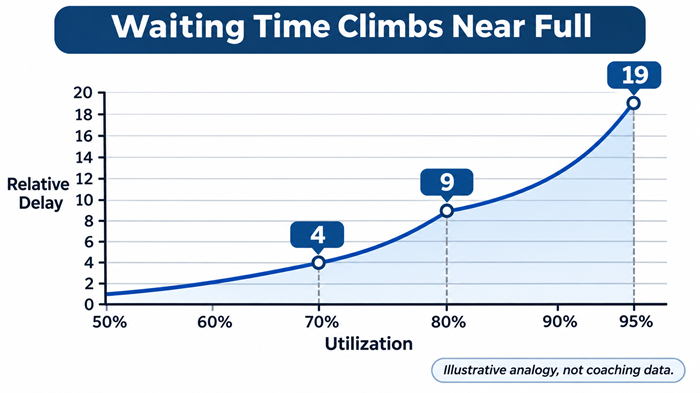
Mechanism. Operations researchers use the Kingman formula to estimate how long things wait in a queue. Waiting time grows with the ratio of utilization to unused capacity, written as p divided by (1 minus p). At 80% utilization that ratio is 4. At 90% it's 9. At 95% it's 19. Variability multiplies the effect, so uneven demand makes it worse.
Think of your week the same way. At 95% booked, a client emergency has nowhere to land, so everything else waits behind it.
Evidence. Treat this as an analogy, not a coaching study. The formula is an approximation for a single process with independent arrivals and service times, and it holds best at high utilization. Your practice is messier than a factory line. The shape of the curve is the useful part: the closer you run to full, the faster the delays grow.
Exit. Plan for slack on purpose. A ceiling below your theoretical maximum is a design choice, not a loss. If you want help building the systems that protect that slack, our post on why structure and systems are key to accelerating is a useful next read.
Trap 2: The Quality Trap
Symptom. You show up to sessions prepared, but a little less than before. You catch yourself thinking about the next call while you're still on this one.
Mechanism. Leroy's 2009 paper on attention residue ran two experiments on switching between work tasks. People found it hard to pull their attention off an unfinished task, and their performance on the next task suffered. Each extra client adds more switches: a different story, a different goal, a different set of open loops.
Evidence. The participants did lab tasks, not coaching sessions, so read this as a pattern worth watching in your own days. There's a second idea about quality too. The whale curve is a customer-profitability tool, and its example figures show the top 20% of customers producing 180% of profit, the middle 60% roughly breaking even, and the bottom 20% erasing 80% of it. Those are illustrative numbers from an example, not a study of coaches. The takeaway is a question to ask, not a statistic to repeat: which of my clients cost more attention than they return?
Exit. Name your best-fit clients, the ones who do the work and get results. Then notice which engagements drain the most prep time, messages and mental space. Those are the first candidates when you set a ceiling.
Trap 3: The Identity Trap
Symptom. Saying no to a client feels wrong. A fuller calendar feels like proof you're good at this, and a thinner one feels like falling behind.
Mechanism. Davidson's 2023 interviews with 37 founders described three phases of letting go: attachment, uncoupling and opportunity. Founders said staying attached kept them stuck, and loosening their grip opened room to grow. The same pull shows up when a coach ties self-worth to client count.
NLP trainers like James R. Elliot use a technique called chunking up to loosen this kind of knot. Ask yourself: what does a full calendar really give me? The answer is usually safety, proof, or the feeling of being needed. Then ask whether a different structure could give you the same thing with fewer hours. That question often changes the whole plan.
Evidence. Davidson's study is small and qualitative, so it points in a direction and proves nothing on its own. It studied founders, not coaches.
Exit. Name the belief out loud, then take decisive action on one small test. That's Courageous Action, one of the five pillars James teaches. Our post The Danger of Helping is a related read if saying yes to everyone is a habit for you.
The Capacity Math: Four Paths Compared
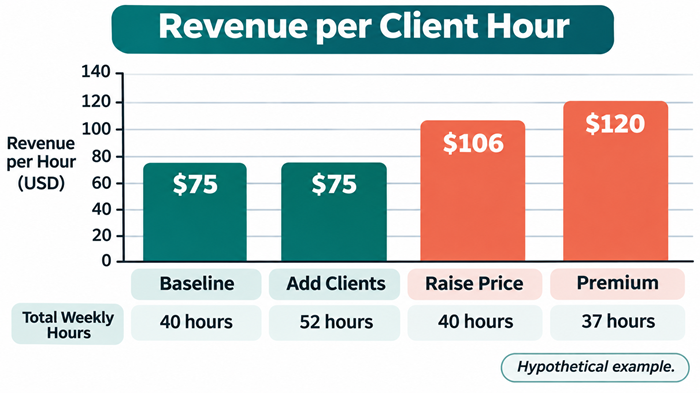
The table below is hypothetical. It assumes a solo coach with 12 hours a week of marketing, admin and sales on top of client work, and it uses four-week months. Every figure is an illustration of the arithmetic, not a benchmark or a recommended price.
Path | Clients | Monthly fee | Client hours per week | Total hours per week | Revenue per month | Revenue per client hour |
Baseline | 7 | $1,200 | 28 | 40 | $8,400 | $75 |
Add clients | 10 | $1,200 | 40 | 52 | $12,000 | $75 |
Raise price | 7 | $1,700 | 28 | 40 | $11,900 | $106 |
Premium | 5 | $2,400 | 25 | 37 | $12,000 | $120 |
Read the table slowly. Adding clients lifts revenue from $8,400 to $12,000, but it also lifts your week from 40 hours to 52, and your income per client hour stays flat at $75. The premium path reaches the same $12,000 in 37 hours.
Two honest caveats apply. A price increase can cost you some clients, so the Raise price row assumes everyone stays, which won't always happen. And the Premium row only works if the program delivers more value, since a higher fee without a deeper result is just a higher fee.
For context, the ICF's 2023 Global Coaching Study reports an average fee of $272 per coaching hour in North America and an average coaching income of $67,800 there. Those are averages across every kind of coach, in US dollars, from data gathered in late 2022. Use them to sanity-check your own numbers, not to set your fee.
Choose Your Exit: If/Then Decision Matrix
Match your situation to the move that fits it best. Most coaches need only one change at a time.
If this is you | Try this first | Watch for |
Booked past 85%, fee unchanged for a year | Raise your fee for new clients only | Existing clients may ask why. Give them a clear date for any change. |
Revenue is fine, but prep runs long and some calls drain you | Set a ceiling and let the lowest-fit engagements end at renewal | A short income dip while you rebuild around fewer, better-fit clients. |
Many clients ask the same questions | Launch a small group program | You need a stable curriculum, and one-to-one attention per client drops. |
Waitlist and a method you can write down | Bring in an associate coach | Quality control matters, because your name is on the work. |
Income is steady, but you don't know why | Run the 14-day audit below | Don't change prices or capacity before you know your real hours. |
WANT A SECOND SET OF EYES ON YOUR CEILING? Bring your hours and your numbers to a short call and talk through your options. Book a 30-minute connection call. |
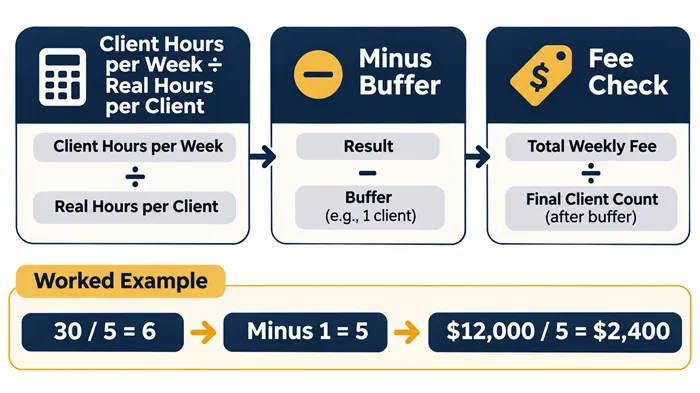
The Premium Capacity Ceiling Formula
Premium capacity starts with knowing how many clients you can serve well. Use this two-step formula as a starting point.
Step 1: Weekly hours you can commit to client work, divided by the real hours each client takes per week (sessions, prep, follow-up, messages and admin). That's your maximum.
Step 2: Take off a buffer, such as one open slot in every five, so surprises have somewhere to land. The buffer is your own call, not a research finding.
Fee check: Divide the monthly revenue you want by your ceiling to find the minimum fee per client.
For example, 30 client hours a week divided by 5 hours per client gives 6 clients. One open slot in five brings it to 5. A target of $12,000 a month divided by 5 clients points to a fee near $2,400. Your numbers will differ.
For more on growth paths beyond one-to-one work, see our post on strategies to scale your business. If you're building in Toronto, scaling a coaching business in Toronto covers a local angle. And if your calendar is the main stress point, time management for leaders has practical habits.
Your 14-Day Capacity Audit
Days 1 to 7: Log every minute of client-related work, including prep, follow-up, messages and scheduling. Don't edit, just record.
Day 8: Divide each client's monthly fee by their real monthly hours. Rank your clients from highest to lowest.
Days 9 to 10: Mark the clients who fit best and the ones who cost the most attention. Note why.
Days 11 to 12: Work out your ceiling with the formula above, then compare it to your current client count.
Days 13 to 14: Pick one exit from the matrix and design a small test, such as a new fee for the next three inquiries.
Results from changes like these build with practice, usually over three to six months, so judge the test on what you learn, not on one week of numbers.
FAQs
How many clients is too many for a solo coach?
There's no universal number. It depends on the real hours each client takes, including prep, messages and admin. Use the ceiling formula above, then check whether you feel stretched, not just whether the schedule technically fits.
Should I raise my prices or take on more clients?
Compare both on revenue per client hour. If adding clients leaves that number flat while your week grows, a price change usually gives you more room. Test the new fee on new inquiries before you change what current clients pay.
What is premium capacity?
It's a way of scaling by value instead of volume. You serve fewer clients, charge a fee that matches a deeper result, and keep enough slack in your week to deliver well. It isn't an official term, so define it clearly for your own practice.
Will raising my prices make clients leave?
Some might. This post doesn't offer data on how many, so test gently. Apply a new fee to new clients first, give current clients notice, and watch how prospects respond over a few months.
When should I add a group program or an associate coach?
When you can write your method down in a form someone else could follow. A group program suits questions many clients share. An associate suits a waitlist you can't serve alone. Both need clear standards, since your name stays on the result.
Conclusion
A full calendar can hide three traps: a week with no slack, attention split too thin, and an identity tied to client count. You don't need more clients to grow. You need a ceiling you can serve well, a fee that matches the value, and delivery built for depth. Take decisive action on one small test this month. When you'd like help shaping yours, book a 30-minute connection call.