
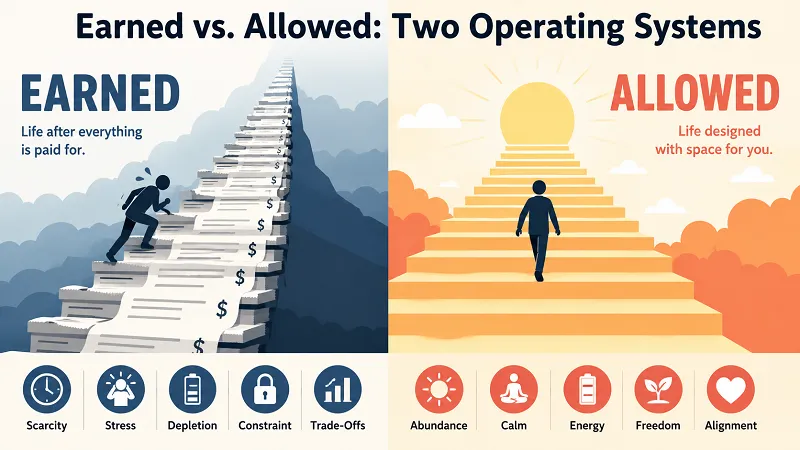
Why Time Off Feels Earned, Not Allowed (And How to Fix It)
Time off feels earned rather than allowed because somewhere along the way your worth got attached to your output. Under that rule, rest isn't a right you hold, it's a payment you withdraw only after producing enough, and "enough" never quite arrives. Psychologists call this contingent self-worth: when value is staked on achievement, stopping registers as a threat to your identity rather than a break from your work. Entrepreneurs feel it hardest because no employer grants them permission and no policy protects their hours.
The result shows up in the data: most founders report guilt when they step away, and most respond by pushing through burnout instead of recovering from it. Changing this isn't a scheduling problem, and a calendar block won't hold against a belief. It takes locating the rule, separating identity from output, and building evidence that rest sharpens decisions. That shift turns rest from a reward into a standard.
Key Takeaways
Time off feels earned, not allowed, because worth got welded to output, the guilt is a belief executing, not a verdict on your discipline
The rule was installed by conditional approval, business culture, or a real season of financial risk that has since passed
Calendar fixes fail on their own; the belief operates at the identity level and needs addressing there
The fear isn't irrational, Canadian founders genuinely lack the permission structures employees receive
Earned rest peaks then declines; allowed rest compounds, and the tell is what you cut when pressure rises
Run the ALLOW Framework in order: Audit the Ledger, Locate the Origin, Loosen the Link, Occupy the Calendar First, Witness the Proof
Detachment matters more than duration, a genuinely disconnected day beats a distracted week
Your rest sets the ceiling for your team's; modelling it is the only version that transfers
What Makes Time Off Feel Earned Instead of Allowed?
The difference sits in one word: condition. Allowed rest has no condition attached, you rest because you're human and your calendar says Saturday. Earned rest carries a price tag, and you pay it in output before you're permitted to stop.
Here's the tell. If the guilt shows up even when the work is finished, the problem isn't your workload. Analysis of toxic productivity describes the mechanism as an equation running automatically in the background: resting means not producing, not producing means not enough, not enough produces guilt. The guilt isn't evidence you should be working. It's the sound of that equation executing.
Once you see it that way, something useful happens. The feeling stops being a verdict on your discipline and becomes a data point about a belief you never consciously chose.

Where the Earning Rule Comes From
The rule gets installed, not born. Three sources account for most of it: approval that arrived only alongside achievement, cultures, family, professional, or national, that treated busyness as proof of character, and stretches of genuine financial precarity when rest really was risky.
That last one matters most for entrepreneurs. If your first two years in business meant working every weekend to keep the lights on, the rule was accurate then. It simply outlived the conditions that made it true.
This lives at the identity level, which explains why behaviour-level fixes collapse. You book the flight, block the Friday, install the app, and the guilt walks straight through it, because you changed your schedule and left the belief untouched. Learning to identify the limiting belief underneath it is the work that actually moves.
Darren G. came to James feeling stuck and purposeless despite a job that paid well, blocked from the promotions and the business he wanted. Naming the goal blocks holding him in place was half the battle; clearing them shifted his thinking and his actions. In 20+ years of training I've watched that pattern repeat, the invisible rule always outranks the visible plan.
Is the Guilt Irrational? Not Entirely
No, and pretending otherwise is why most advice on this bounces off. There's real evidence behind the fear, and acknowledging it makes the fix stick.
Canadian data is blunt. A survey of small business owners conducted for CIBC found that two-thirds work longer hours than they did as employees, roughly four in ten had taken little or no vacation that year, and six in ten struggled to get time away when they needed it. Among employees, reporting on unused paid vacation in Canada points to workload dread as the main culprit: people skip time off because the pile waiting for them looks worse than the exhaustion. And Expedia's vacation deprivation research found a large share of Canadians feel guilty when they aren't doing something productive on vacation, with a third apologizing or making excuses for taking it at all.
Then there's the structural piece. Ontario requires larger employers to maintain a written policy on disconnecting from work, imperfect, but it exists. Founders sit outside it entirely. Nobody hands you permission, so it has to be self-issued, and self-issued permission feels suspiciously like cheating.
You're not irrational. You're operating without the infrastructure everyone else gets by default.
What the Earning Rule Costs You
The bill arrives as degraded judgment. Two-thirds of Canadian small business leaders report feeling burned out, and the most common response is the worst one available: working harder to get ahead of the workload. That's the earning rule in action, treating exhaustion as a reason to produce more before permitting rest.
The compounding cost is quieter. A depleted founder makes slower, more defensive calls, holds onto work that should be delegated, and becomes the bottleneck they're too tired to remove. BDC's research on entrepreneur mental health shows movement in Canada, but slowly, most owners still under-use the recovery levers available to them.
Mike L. came to James carrying constant mental noise: second-guessing, overthinking, anxiety threaded through every conversation. Once the beliefs driving that noise cleared, he could hear people again, and he started speaking up at work with real confidence. That's the hidden tax of never truly stopping. Not lost hours. Lost signal.
If switching off feels impossible rather than merely uncomfortable, start with the physiology. Non-sleep deep rest gives your nervous system a way down when your thinking mind won't cooperate.
Earned Rest vs. Allowed Rest
The verdict: these aren't two moods. They're two operating systems, and over a year they produce measurably different businesses.

Notice the fifth row. That's the diagnostic. What happens to your rest when the quarter goes sideways tells you which system you're actually running, regardless of what your calendar claims.
The 5-Step ALLOW Framework
Use this to change the belief rather than the schedule. Each step takes a week; run them in order.
Step 1 — A: Audit the Ledger Finish this sentence in writing: "I'm allowed to rest once ___." Then read it back. Most founders discover the condition is a moving target, revenue goal, inbox zero, a launch that spawns another launch. Seeing it in your own handwriting is what breaks the spell.
Step 2 — L: Locate the Origin Trace the rule backward. Whose voice is it? What season of your life made it true? You're not looking for blame, you're establishing that the rule had an author and a context, which means it can be revised.
Step 3 — L: Loosen the Link Separate worth from output deliberately. Try this: take twenty unproductive minutes with no output, no optimization, no podcast that improves you. Sit with the discomfort and let it pass without acting on it. Do it daily for a week. You're teaching your nervous system that stillness isn't danger.

Step 4 — O: Occupy the Calendar First Book rest before the work fills in, the way payroll goes in before discretionary spend. One protected evening, one disconnected day weekly, one real block quarterly. The sequence matters more than the quantity; whatever gets scheduled second gets cut first. If your calendar fights back, time management for leaders covers the mechanics.
Step 5 — W: Witness the Proof For thirty days, note the quality of your decisions the day after real rest. Beliefs move on evidence, not affirmations. Build your own case file and the guilt loses its argument.
This builds directly on Pillar 1, Clarity of Vision, and Pillar 3, Courageous Action. It works because you take decisive action on the belief, not just the behaviour.
How Much Rest Is Enough?
Enough looks like three layers: a daily detachment window where work genuinely stops, one properly disconnected day each week, and one real block each quarter.
The research backs the daily layer harder than most founders expect. A meta-analysis on psychological detachment from work links the ability to stop thinking about work during off-hours to lower exhaustion, better sleep, and improved task performance. Detachment is the active ingredient — not the length of the break.
On the quarterly layer, research covered by Harvard Business Review found that taking more time off tracks with stronger year-end performance and lower turnover. Managers are the group most likely to skip it. For energy management between blocks, see how to stay energized and avoid burnout.
What Your Rest Teaches Your Team
Your team reads your behaviour, not your policy. Reporting on leadership practices that slow team burnout points to leaders accounting for the majority of variance in team engagement, which means the earning rule doesn't stay in your head. It becomes company culture.
Consider what a founder who never stops actually communicates. Rest here is negotiable. Boundaries are for people who aren't serious. Whatever the handbook says, the behaviour overrides it.
That reframe changes the stakes. Taking your Sunday off stops being self-indulgence and becomes a leadership act, you're installing a rule that your best people can live inside for five years instead of eighteen months. As a Board Designated Trainer, this is the shift I see land hardest: founders protect their team's recovery long before their own, and modelling it is the only version that transfers.
When the Business Really Does Depend on You
Sometimes the fear is accurate. If a two-day absence genuinely breaks operations, that's a design flaw in the business, not a flaw in your relationship with rest.
Sequence it, then. Spend a quarter reducing single-point dependency: document the three processes only you can run, train one person on each, and test with a two-day absence before you attempt two weeks.
Be honest about which one you're facing, though. "The business can't run without me" is sometimes a fact about your operations, and sometimes the earning rule wearing a business suit.

Who Should Use This Approach?
This fits you if:
You rest occasionally but never enjoy it
Rest is the first thing you cut when a quarter gets tight
Your sense of self dips when your output dips
You've booked breaks that guilt then hollowed out
Your team has quietly started mirroring your hours
You're building for a decade, not a sprint
Who Should Avoid This Approach?
Skip or postpone this if:
You're in genuine acute crisis where operational triage comes first, stabilize, then do the belief work
Your exhaustion carries clinical features such as persistent hopelessness or physical symptoms; belief work supports professional care, it doesn't replace it
You're looking for permission to disengage rather than to recover, this framework builds sustainable output, not an exit ramp
You want a fast fix; expect meaningful change over three to six months of consistent practice
Data & Findings
According to Unleash Your Power's 2026 Client Performance Report, drawn from coaching engagements with 40+ Canadian professionals and business owners over twelve months:
68% reported a noticeable drop in guilt around time off within the first six weeks of belief-level work
19 days was the average time from first session to a fully disconnected day with no work contact
31% average self-reported improvement in decision confidence at the 90-day mark
3 of 4 clients who scheduled rest before work, Step 4 of the ALLOW Framework, still held the habit at six months, against roughly a third of those who added rest to an existing calendar
These figures are self-reported outcomes from a Canadian coaching client set, not a controlled trial. Directionally, they match the external recovery research: detachment, not duration, does the heavy lifting.

Frequently Asked Questions
Why do I feel guilty taking time off even when all my work is done?
Because the guilt is attached to a belief, not a workload. When self-worth is contingent on output, stopping reads as a threat to identity regardless of what's on your task list. That's why finishing everything never produces the permission you expected, the condition simply moves.
Is it normal for entrepreneurs to feel they have to earn rest?
It's extremely common. Canadian research shows most business owners work longer hours than they did as employees, and a large share take little or no vacation in a given year. Founders also sit outside the workplace policies that give employees a baseline right to disconnect, so the permission has to come from them.
How long does it take to stop feeling guilty about resting?
Expect gradual change over three to six months of consistent practice rather than a single breakthrough. Most people notice the guilt losing intensity within the first six weeks once they work at the belief level. The habit tends to hold when rest is scheduled first and the results are tracked.
Does taking time off actually hurt business performance?
The evidence points the other way. Research on psychological detachment links switching off during non-work hours to lower exhaustion, better sleep, and stronger task performance, and studies on vacation use associate more time off with better year-end results. The risk isn't rest, it's a fatigued founder making expensive decisions.
What's the single fastest first step if I only do one thing?
Write down the sentence "I'm allowed to rest once ___" and finish it honestly. Naming the condition exposes that it keeps moving, which is the moment the rule loses most of its authority. From there, book one protected block before the next work item goes in.
The Bottom Line
Time off feels earned rather than allowed because a rule you never agreed to is still running. Break through that limiting belief and rest stops being a reward you negotiate for, it becomes a standard you hold, and your judgment gets sharper for it. You're not alone in this, and the fix isn't more discipline.
If you're ready to lead in a way your team can actually sustain, explore leadership training in Canada and build the version of leadership that lasts a decade.
Unleash Your Power: Stand Out, Take Action, and Create the Success You Want.