
Time Management is Dead: Why Energy Management is the Key for Founders
Time management assumes your most valuable resource is hours. For founders, it isn't. Your most valuable resource is energy: the quality of focus, creativity, and decisive thinking you bring to each hour. You can have a perfectly optimized calendar and still produce mediocre work when you're running on empty.
Performance psychologists Jim Loehr and Tony Schwartz identified four dimensions of energy: physical, emotional, mental, and spiritual and demonstrated that unlike time, energy can be systematically expanded and renewed. For founders, this matters enormously: the stakes on every decision are higher, the cognitive load is relentless, and burnout isn't just personal; it can collapse the company.
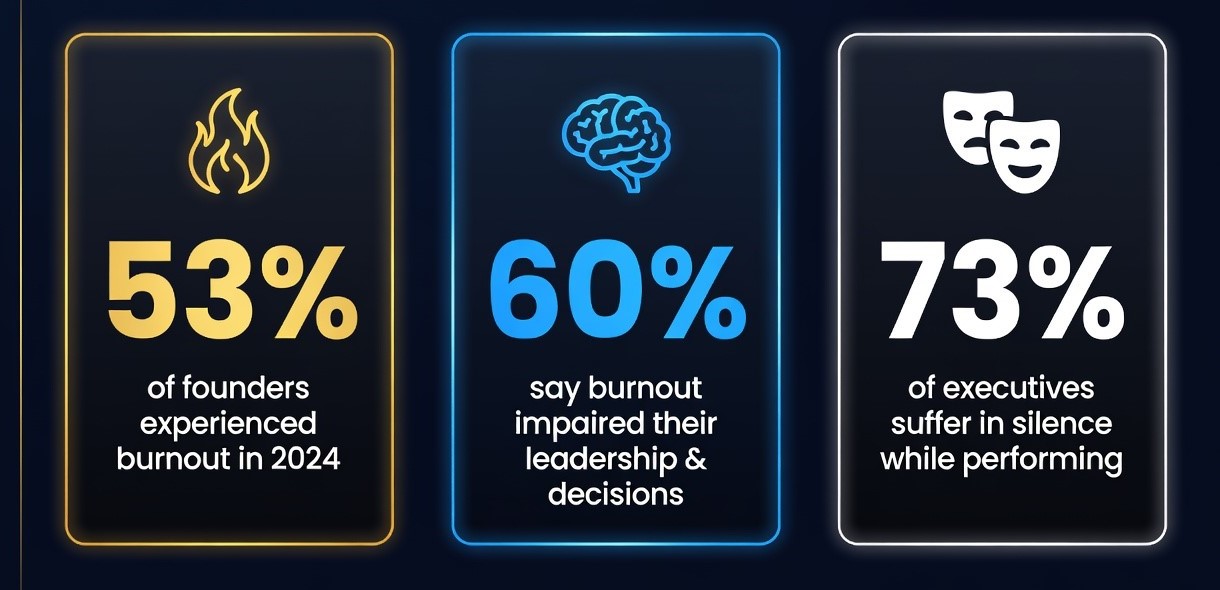
A 2024 study found that over 53% of startup founders experienced burnout, with nearly 60% reporting it directly impaired their ability to lead and think clearly. Energy management is the framework that breaks this cycle not by working fewer hours, but by ensuring that the hours you do work, you're operating at your best.
Key Takeaways
Time management organizes hours; energy management determines what you accomplish within them. For founders, the distinction is the difference between busy and breakthrough.
Energy has four dimensions: physical, emotional, mental, and spiritual and depletion in any one reduces your capacity across all four.
Burnout is an energy crisis, not a time crisis. Over 53% of founders experienced it in 2024, and the cause isn't long hours; it's unmanaged depletion without renewal.
Your peak energy windows are finite and individual. Protecting them for your highest-leverage work is the single highest-ROI scheduling change most founders can make.
NLP anchoring gives you on-demand access to peak states: confidence, focus, creative clarity rather than hoping they show up when you need them most.
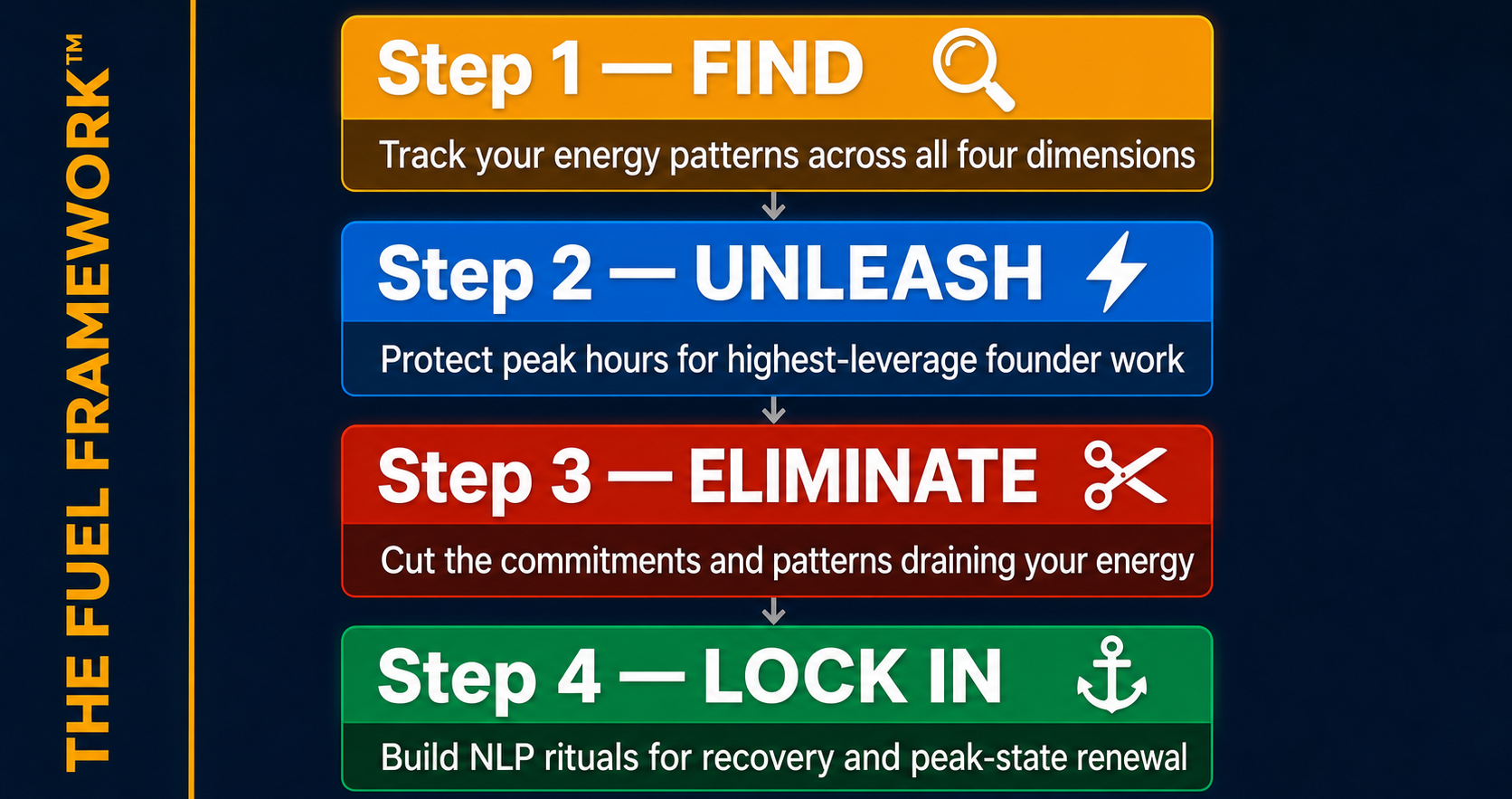
The FUEL Framework Find, Unleash, Eliminate, Lock In provides a four-step system for building energy management into your founder life as a permanent operating upgrade.
The goal isn't to work less. It's to show up fully when it counts and recover completely when it doesn't.
Why Time Management Fails Founders
Most founders have tried every system. The color-coded calendar. The time-blocking method. The productivity app that promised to fix everything. And most of them still end the week feeling behind, drained, and vaguely guilty.
Here's the hard truth: the problem was never your schedule.
The Calendar Illusion
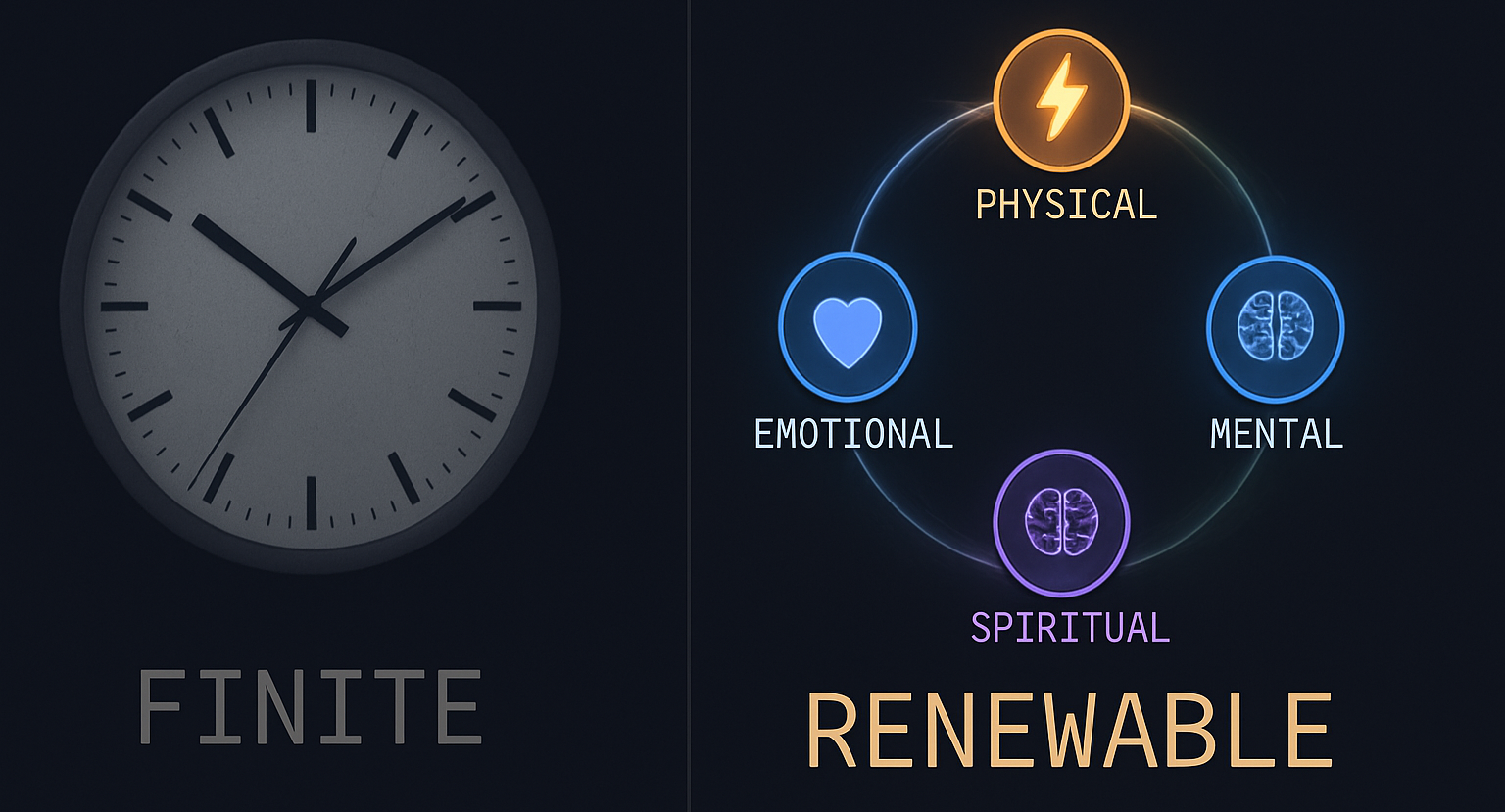
Time management is built on a flawed assumption that if you allocate your hours correctly, results will follow. But time is a fixed resource. There are 24 hours in a day regardless of how artfully you organize them. Scheduling a complex strategic decision at 3 pm doesn't make you sharper at 3 pm. Blocking two hours for deep work while you're emotionally depleted doesn't produce deep work.
Research from The Energy Project published in Harvard Business Review makes this case plainly: the core problem with working longer hours is that time is finite. The real variable is energy and that's the one most founders never consciously manage.
The Hidden Cost of Depleted Hours
When you're exhausted, an hour of work can take three hours. Decisions that should take minutes spiral into paralysis. Creativity dries up. Communication becomes reactive instead of intentional. You're physically present on the calendar and mentally absent in the room.
The result? Founders end up burning more hours just to compensate for lower-quality output a cycle that compounds over weeks and months into full-scale burnout. This isn't a discipline problem. It's an energy problem.
What Is Energy Management (and Why Founders Need It)
Energy management is the practice of deliberately tracking, protecting, and renewing your capacity for high-quality output across all dimensions of how you function as a human being, not just physically.
Energy, Not Time, Is the Fundamental Currency
As Loehr and Schwartz argue in The Power of Full Engagement, energy is the fundamental currency of high performance. Every thought, decision, and interaction has an energy cost. A founder who manages their energy well brings full engagement to the moments that matter most: the pitch, the hard conversation with a team member, the strategic decision that shapes the next quarter.
The shift in thinking is significant. Instead of asking "Do I have time for this?" you start asking "Do I have the energy to do this well?" That single reframe changes everything about how you structure your day.
The Renewable Resource Time Management Ignores
Here's what makes energy management so powerful for founders specifically: unlike time, energy is renewable. Sleep restores physical energy. Movement replenishes mental clarity. Purposeful work aligned with your values and vision generates emotional and spiritual energy rather than depleting it. You can manufacture energy. You cannot manufacture time.
The Four Dimensions of Energy Every Founder Must Know
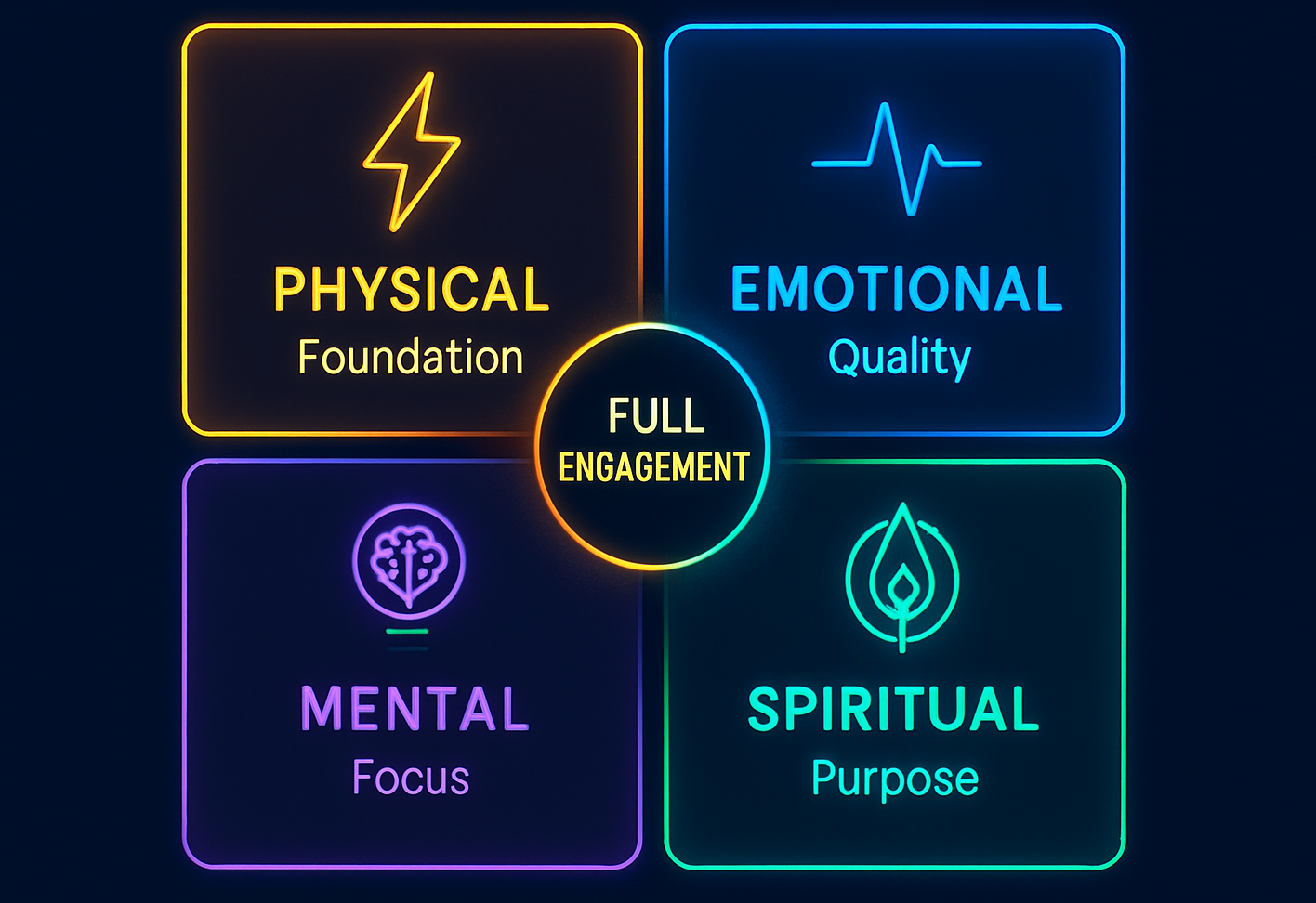
Drawing on the framework from Loehr and Schwartz and refined through James R. Elliot's 20+ years of NLP training and coaching with entrepreneurs, energy operates across four interconnected dimensions. Neglect any one of them and your capacity as a founder diminishes, no matter how well-optimized your calendar is.
Physical Energy: The Foundation Everything Runs On
Physical energy is the baseline. Without it, nothing else works. Sleep, movement, nutrition, and recovery aren't luxuries or "self-care" side projects; they are the infrastructure that every cognitive and emotional function depends on. Research cited by Gitnux's Entrepreneur Burnout Report shows that nearly 40% of startup founders work more than 60 hours per week, and 70% report that their workload regularly disrupts their sleep, the primary driver of depleted physical energy.
Try this: Audit your last week. How many nights did you get 7+ hours of sleep? How many days included 20 minutes of intentional movement? Your answers reveal the true floor of your current capacity.
Emotional Energy: The Quality of Feeling You Bring to Every Decision
Emotional energy is the often-invisible driver of leadership quality. When it's high, you bring curiosity, patience, and perspective to difficult conversations. When it's low, you're reactive, short-fused, and defensive. Emotional depletion doesn't announce itself; it shows up as poor communication, micromanagement, and the creeping sense that everything is urgent.
Darren G. came to James feeling blocked in his career and income despite working relentlessly. Through their work together, James identified that Darren's emotional energy was being drained by misaligned goals, pursuing targets he'd inherited rather than ones tied to his real vision. Once that alignment shifted, radical improvements followed not just in his business outcomes but in his relationships and overall quality of life.
Mental Energy: Focus, Clarity, and Cognitive Bandwidth
Mental energy is your capacity for sustained attention, creative thinking, and sound judgment. It depletes with distraction, multitasking, information overload, and sustained cognitive load without recovery. For founders making dozens of high-stakes decisions daily, mental energy is under constant siege.
The most effective founders protect their mental energy by doing their highest-leverage cognitive work strategic planning, complex decisions, creative problem-solving during their peak mental windows, and deliberately scheduling lower-stakes tasks (email, admin, routine calls) outside those windows.
Spiritual Energy: What Burns Out When You're Misaligned
Spiritual energy has nothing to do with religion. In this context, it means purpose: the degree to which your daily work connects to what genuinely matters to you. Work aligned with your values generates energy. Work in persistent misalignment drains it disproportionately, regardless of how much you're earning or how successful things look from the outside.
This is the dimension that most productivity systems ignore entirely and it's often the one that depletes fastest under the relentless pressure of building a business. When a founder's purpose is clear and their daily work reflects it, they experience what Loehr and Schwartz call "full engagement." When it isn't, no amount of calendar optimization compensates.
How to Identify and Protect Your Peak Energy Windows
Most founders assume their best thinking happens in the morning because productivity culture says so. The truth is your peak energy windows are individually shaped by your biology, your habits, and your current season of life.
Mapping Your Personal Energy Rhythms
For one week, track your energy and focus in three simple slots: morning (6 am–12 pm), afternoon (12 pm–5 pm), and evening (5 pm–9 pm). Rate each slot 1–10 for mental sharpness, emotional steadiness, and physical drive. Patterns emerge quickly. Most people have one clear peak, one solid secondary window, and one genuine trough.
That trough is where email belongs. Your peak window is where your highest-leverage founder work belongs: strategy, vision, creative decisions, and difficult leadership conversations.
Scheduling by Energy Type, Not Just Time Blocks
Once you know your windows, rebuild your calendar around energy, not convention. Schedule deep work and high-stakes decisions in your peak window. Schedule meetings, calls, and collaborative work in your secondary window. Protect your morning energy rituals fiercely; they set the energetic tone for everything that follows.
This is a fundamentally different use of your calendar. You're not filling time; you're deploying energy where it generates the most return.
The NLP Advantage: Managing Your State on Demand

One of the most powerful distinctions James R. Elliot brings to energy management, drawing on his credentials as a Board-Designated NLP Trainer and 20+ years of working with entrepreneurs, is the ability to actively manage your internal state, not just hope your energy shows up.
NLP Anchoring: Accessing Peak States When It Matters Most
NLP anchoring creates a neurological link between a specific physical stimulus and a peak emotional or mental state. Through the anchoring process, you recall a moment of peak confidence, focus, or creative flow, re-experiencing it vividly and at the height of that state, and apply a consistent physical trigger (a specific touch, gesture, or breath pattern). Over time, the trigger reliably re-accesses that state on demand.
For founders, this is a game-changer. Before a high-stakes investor pitch, a difficult board conversation, or a creative breakthrough session, anchoring lets you deliberately step into the internal state the moment requires rather than leaving it to chance.
Mike L. came to James overwhelmed by mental noise, anxiety, and self-doubt that was affecting his performance and relationships. Through NLP techniques focused on state management and emotional anchoring, Mike's internal experience transformed. The anxiety that had dominated his day-to-day cleared, and he found himself communicating with confidence in situations that had previously paralyzed him.
State Shifting Between Deep Work and Recovery
Energy management isn't just about sustaining peak states; it's about consciously transitioning between engagement and recovery. NLP state-shifting techniques allow founders to step out of high-intensity work and genuinely decompress, rather than staying in a half-on, half-off limbo that prevents real recovery. As NLP teaches: where focus goes, energy flows, and that applies to recovery just as much as performance.
Try this: Before your next high-stakes meeting, take 90 seconds. Stand tall, recall a specific moment of confident achievement, and re-experience it fully what you saw, heard, and felt. At the peak of the feeling, press your thumb and forefinger together firmly. Repeat three times. You've just built an anchor. Use it before the next meeting and notice the difference.
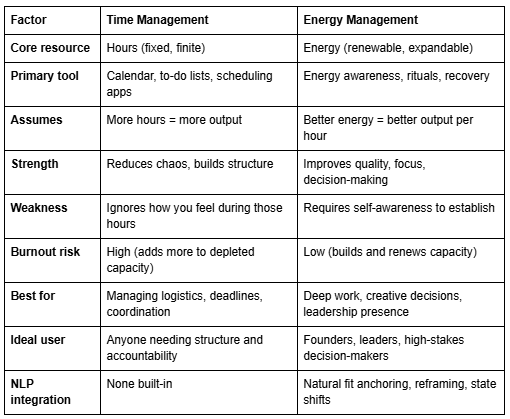
Time Management vs. Energy Management: A Direct Comparison
Who Should Switch to Energy Management
Energy management is particularly transformative for founders who:
Feel productive on paper but creatively or strategically depleted in practice
Have tried multiple time management systems and still feel behind
Notice that the quality of their work varies wildly depending on the day
Are experiencing early signs of burnout: emotional flatness, decision fatigue, loss of motivation
Lead teams where their emotional state directly shapes culture and morale
Want to scale sustainably without sacrificing health, relationships, or long-term purpose
If you've ever sat down to do your best thinking and come up empty despite having the time, energy management is the missing piece.
Who Should Reconsider (Or Combine Both)
Energy management alone isn't the full answer if:
You're in an early-stage startup with hard external deadlines and team dependencies you still need calendar discipline to coordinate
You struggle with procrastination rooted in avoidance rather than depletion that's a mindset challenge, not solely an energy one
Your business requires predictable availability and responsiveness; time structures protect your team and clients
The most effective founders integrate both: time management for coordination and accountability, energy management for performance and sustainability. The key is knowing which lever to pull for which problem.
Data & Findings
The case for energy management isn't anecdotal; it's backed by converging research on founder health, performance psychology, and neuroscience.
According to a 2024 study by WithDouble, more than 53% of startup founders reported experiencing burnout and, critically, nearly 60% acknowledged it directly impaired their ability to lead, think clearly, and make decisions in high-stakes moments. A separate 2025 report by Cerevity found that 73% of startup executives reported significant stress and depletion while continuing to perform externally, a pattern described as "shadow burnout," where performance remains intact while internal systems fail.
According to Unleash Your Power's 2026 Client Performance Report, founders who integrated energy management practices including NLP state management, structured recovery rituals, and peak-window scheduling reported measurable improvements in decision quality, leadership presence, and sustained output within 60–90 days of consistent application.
Research from the Harvard Business Review reinforces the paradigm: organizations that trained employees in energy management rather than time management alone saw significant gains in both productivity and employee wellbeing, confirming this isn't a personal productivity hack but a structural performance advantage.
The data points to the same conclusion from every angle: the founders who last, lead well, and build something meaningful aren't the ones who optimize their calendars; they're the ones who master their energy.
The FUEL Framework: James R. Elliot's 4-Step Energy Management System for Founders
Built on 20+ years of NLP coaching with high-performing entrepreneurs, the FUEL Framework gives founders a practical, repeatable system for shifting from time-obsessed to energy-optimized. It maps directly to James's 5 Pillars of Massive Success from Clarity of Vision through to Continuous Growth.
Find Your Energy Patterns
Spend one week tracking your energy across four dimensions: physical vitality, emotional steadiness, mental sharpness, and sense of purpose. You can't manage what you don't measure. Most founders discover that their genuinely high-energy hours are a smaller fraction of the day than they assumed and they've been scheduling their most important work outside those windows. This step builds Pillar 1: Clarity of Vision. You can't build a high-performance life without first seeing clearly how you're currently operating.
Unleash Your Peak Hours
Once patterns are clear, restructure your week around them. Your highest-energy window gets your highest-leverage work no exceptions. Strategic thinking, creative decisions, and leadership conversations belong here. Everything else belongs elsewhere. This step embodies Pillar 3: Courageous Action. It requires saying no to convenience and yes to what actually produces results.
Eliminate Energy Drains
Identify the top three activities, commitments, or patterns that cost the most energy relative to their return. Common culprits: misaligned commitments, unresolved conflict, decisions you keep re-making, and work that doesn't connect to your deeper purpose. Using NLP reframing and belief-change techniques, James helps entrepreneurs dissolve these drains at the root rather than just managing them at the surface. This step builds Pillar 5: Continuous Growth and it's where the deepest transformation happens.
Lock In Recovery Rituals
High performance requires oscillation, alternating between full engagement and genuine, deliberate recovery. Loehr and Schwartz's research shows that recovery isn't a reward for hard work; it's part of how high-quality work happens at all. Morning rituals, end-of-day wind-downs, weekly recovery blocks, and NLP anchoring practices aren't indulgences; they're the infrastructure of sustained founder performance. This step fulfills Pillar 2: Confident Communication and Pillar 4: Compelling Presence because you can only show up fully for others when you've first shown up fully for yourself.
Your Next Move
You've been optimizing the wrong variable. More hours won't fix depletion; only the right energy will. The founders who build something lasting aren't necessarily the ones who work the hardest. They're the ones who show up most fully, most consistently, to the moments that matter.
If you're ready to stop running on empty and start leading from strength, James R. Elliot's coaching is built for exactly where you are right now, with proven strategies from 20+ years of transforming how entrepreneurs perform, lead, and live.
Frequently Asked Questions
What is the difference between time management and energy management for founders?
Time management focuses on how you allocate your hours. Energy management focuses on the quality of focus, creativity, and decision-making you bring to those hours. For founders, energy management is the more critical skill because the impact of any single hour depends far less on when it's scheduled and far more on the state you're in when you're inside it.
How do I start managing my energy as an entrepreneur?
Start by tracking your energy across four dimensions: physical, emotional, mental, and spiritual for one week. Identify your peak windows and your biggest drains. Then restructure your calendar to protect peak hours for high-leverage work. Add one deliberate recovery ritual and build from there. The FUEL Framework above provides a full four-step roadmap.
Can energy management replace time management entirely?
For most founders, the most effective approach is integration: use time management for structure, coordination, and team accountability, and energy management for performance optimization and sustainable output. The two aren't in conflict but if you've been running on time management alone and still feel depleted, energy management is the missing layer.
What is NLP anchoring and how does it help with energy management?
NLP anchoring creates a reliable neurological link between a physical trigger (like pressing your thumb and forefinger together) and a peak emotional or mental state. Once established, the anchor allows you to access that state of confidence, focused clarity, calm authority on demand, before high-stakes moments. It's one of the most practical tools James R. Elliot teaches entrepreneurs for managing their internal state rather than leaving performance to circumstance.
How long does it take to see results from energy management?
Most founders who apply structured energy management practices, including peak-window scheduling, energy audits, and NLP state management, begin noticing meaningful differences in decision quality and daily output within 30 to 60 days. Bigger, systemic change in how you show up as a leader typically becomes evident within 60 to 90 days of consistent practice.