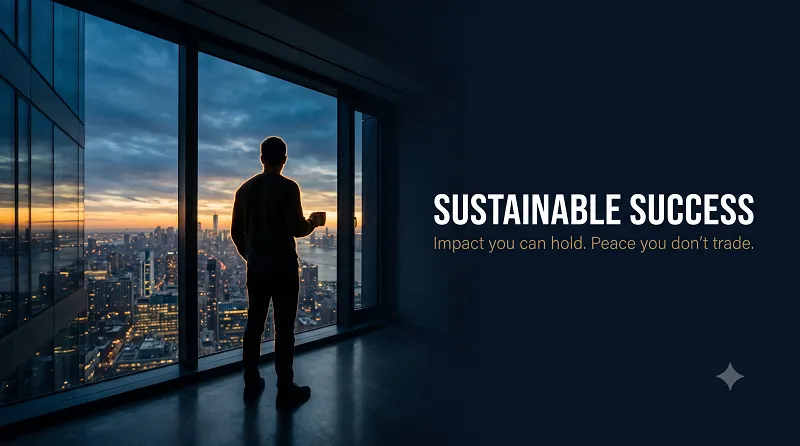
Sustainable Success: Impact Without Sacrificing Your Peace
Sustainable success is the practice of building measurable impact at a pace your judgment, your relationships, and your nervous system can hold indefinitely. It is not scaling back ambition. It is removing the assumption that impact has to be purchased with exhaustion. Most entrepreneurs treat peace as the reward waiting at the summit, something you earn once the revenue target clears. The recovery research points the other direction: rest is what makes high performance repeatable, and its absence degrades exactly the capacities founders depend on most, including decision quality, creativity, and the ability to lead other people well.
Sustainable success replaces the hustle model's single lever, more hours, with a defined operating condition: protected capacity. Output is then built on top of that condition rather than extracted from underneath it. The shift is structural, not motivational. It changes what you measure, what you refuse, and how you recover.
Key Takeaways
Sustainable success means impact built on inputs you can replenish, repeatable, non-extractive, reversible.
Hours become the default growth lever because they're the only input a founder controls unilaterally.
Psychological detachment research links recovery to reduced exhaustion and stronger work performance.
More than a third of Canadian business owners report mental health challenges disrupting work weekly; 60% of those under 40.
The signals of unsustainable success are behavioural, slower decisions, no free time you can use, presence gone missing.
Run the ecology check before any major goal: what does this cost, and who pays?
Boundaries built into systems survive pressure; boundaries built on willpower do not.
Durable change takes three to six months. Anyone promising faster is selling extraction in softer language.
What Is Sustainable Success?
Sustainable success is a business built on inputs you can replenish. Three tests define it.
It's repeatable. Last quarter's result came from a system, not from a sprint you can't run again. It's non-extractive. Growth doesn't draw down your health, your marriage, or your capacity to think clearly. It's reversible. You can step away for two weeks and return to a business, not a wreckage.
This is a different thing from work-life balance, which implies a scale with two pans and a zero-sum trade between them. Sustainable success makes no such trade. It treats your capacity as the asset that produces everything else, which is why protecting it is a growth strategy, not a concession.
Canadians already sense the priority shift. Work-life balance has become the leading driver of job satisfaction for 57% of Canadians, ranking above compensation. Founders feel that pull too. They just rarely have a model for acting on it without believing they're choosing to matter less.

Why Massive Impact Usually Costs Your Peace
The cost isn't a character flaw. It's a structural default.
Hours are the only input a founder controls unilaterally. You can't summon demand on command, or capital, or a great hire. You can always add hours. So when growth stalls, hours become the lever, and because it works in the short term, it gets pulled again.
The baseline is already heavy. The average Canadian small business owner works 54 hours a week, an eight-day workweek by salaried standards, rising to about 59 hours for those absorbing labour shortages. Statistics Canada found that half of workers in management report frequently working to tight deadlines, and 34.6% complete unpaid work in their free time several times a month or more.
Add the second cost, the one nobody puts on a calendar: the mental residue. The problem you carry into dinner. The pricing decision replaying at 2 a.m. That residue is where peace actually disappears, not in the hours worked, but in the hours never recovered. Learning to interrupt that cycle is the foundation of managing stress before it compounds into burnout.
I've walked this path. Early in my career I mistook exhaustion for commitment, and it cost me years of momentum before I learned the difference.
Is Peace a Performance Advantage, or Just a Nice-to-Have?
It's a performance advantage, and the evidence is specific.
Organizational psychologists study this under the term psychological detachment, the ability to mentally switch off from work during non-work time. Across a large body of research, detachment has been shown to reduce exhaustion, psychological strain, depressive symptoms, health complaints, and sleep problems, while increasing life satisfaction, with studies linking it positively to work performance.
A 2026 review in the American Journal of Pharmaceutical Education reframes rest as strategy rather than indulgence, arguing that sustained engagement beyond reasonable hours damages well-being, creativity, and long-term productivity, while regular detachment improves performance and career vitality.
Now the founder-specific number. BDC's national survey found that more than one-third of Canadian business owners report mental health challenges interfering with their ability to work at least once a week, and among entrepreneurs under 40, that figure climbs to 60%.
Read that as an operations metric, not a wellness metric. A leader whose judgment is compromised weekly is not making the same quality of decisions as one whose isn't. Peace isn't the soft outcome of success. It's the input that protects the decisions success depends on.
Seven Signals You're Trading Peace for Impact
The signals are behavioural, not emotional. Check them honestly.
Revenue is climbing while your recovery time is shrinking.
Decisions that once took an hour now take a week.
You can't name what you'd do with a genuinely free Tuesday.
Your best thinking hasn't happened in months, only your fastest.
You've started resenting the work you built specifically to love.
Time off requires more preparation than it delivers in relief.
You're competent everywhere and present nowhere.
That last one is common. Statistics Canada reports that 32% of working Canadians say their work interferes with home and family life, peaking at 40% among those aged 35 to 49, precisely the years most founders are scaling hardest.

Darren G. came to me carrying the version of this that looks like success from the outside. He had a job that paid well and a life he described as purposeless, blocked from promotions, blocked from starting his own venture, convinced the problem was effort. It wasn't. The problem was a set of goal blocks running underneath every decision he made. Once we exposed and cleared them, his thinking, his behaviour, and his relationships all shifted. The output changed because the operating condition changed.
Hustle-Driven Success vs. Sustainable Success
The verdict first: hustle wins sprints, sustainable success wins decades. Most founders don't choose between them consciously, they inherit hustle by default and only reconsider after something breaks. Choosing deliberately is the whole point.

Data & Findings
According to Unleash Your Power's 2026 client observations, drawn from coaching and NLP training engagements with professionals and business owners across Canada:
Client set: Entrepreneurs, executives, and independent professionals, most working 50+ hours weekly at intake
Most common presenting problem: Not a lack of drive, a lack of recovery. Over two-thirds arrive describing constant mental noise rather than insufficient effort
Typical first shift: Reported reduction in decision latency and rumination within 4–8 weeks of state-management work
Timeframe to durable change: 3–6 months for new patterns to hold under real pressure, not just under calm conditions
National context supports the pattern. BDC measures entrepreneur well-being using the WHO-5 index, and the average score among surveyed Canadian business owners was 59 out of 100, only marginally above the 50-or-below threshold considered low well-being. Roughly 35% sought professional help for a mental health concern in the past year, rising to 57% among those under 45.
The direction is encouraging. The baseline is not.
The 5-Step Sustainable Impact Framework
This is the sequence I use with clients. It works because it addresses the operating condition before touching the output. If you've been rewiring how you think as an entrepreneur through NLP, several of these tools will feel familiar.
Step 1 — Run the Ecology Check.
Before pursuing any goal, ask what it costs and who pays. This is a core NLP discipline: a goal that damages your health, your relationships, or your integrity is not well-formed, no matter how impressive the number attached to it. Most founders have never run this check on their own strategy.

Step 2 — Define the Well-Formed Outcome.
State what you want in specific, sensory terms, what you'll see, hear, and feel when it's true, and confirm it's within your control to initiate. Vague ambition is the reason capacity gets spent indefinitely with no clear finish line. This is why conventional goal-setting so often fails to hold.
Step 3 — Audit Your True Capacity.
Track two weeks of actual hours, actual energy, and actual recovery. Not intended. Actual. Nearly everyone discovers they've been planning against a capacity they haven't had in years, and planning against fiction guarantees the shortfall gets paid in peace.
Step 4 — Anchor Your Recovery State.
Peace is a trainable state, not a set of circumstances. NLP anchoring lets you access a calm, resourceful state deliberately rather than waiting for conditions to permit it. Pair it with structured recovery, this is where understanding why non-sleep deep rest works earns its place. Longitudinal research finds that detachment strategies remain protective for mental well-being over time, including for self-employed workers navigating difficult periods.
Mike L. is the clearest example I've worked with. He arrived with relentless self-doubt, second-guessing, and anxiety humming under everything. Once the mental noise cleared, he described actually hearing people for the first time, and he began speaking with confidence at work. His capability never changed. His access to it did.
Step 5 — Build Boundaries Into Systems.
Willpower boundaries fail under pressure, which is exactly when you need them. Structural ones hold: a calendar that closes, a decision rule for after-hours requests, a delegation threshold defined in advance. Take decisive action here and the boundary stops requiring a decision every single day.
How Long Does This Shift Actually Take?
Longer than a weekend, shorter than you fear.
The capacity audit takes two weeks and usually delivers the first real jolt of clarity. State-management work tends to produce noticeable change in four to eight weeks. Holding the new pattern under genuine pressure, a bad quarter, a lost client, a crisis, generally takes three to six months of consistent practice.
Anyone promising overnight transformation is selling you the same extraction model in gentler language.
Who Should Use This Approach?
Sustainable success fits you if you're building past a three-year horizon, if your business currently depends on your personal output more than your systems, if you've hit targets and felt nothing, or if people close to you have started commenting on your absence. It fits especially well if you're competent and exhausted, because competence is rarely the missing piece.
Who Should Avoid This Approach?
Skip this for now if you're in a genuine, time-boxed crunch with a real end date, a launch, a funding round, a seasonal peak. Short sprints are legitimate; the danger is a sprint with no finish line.
Skip it if you're experiencing clinical burnout or a mental health crisis. Stress has an endpoint you can see; burnout is what long-term untreated stress becomes. That needs medical support first, coaching complements care, it doesn't replace it.
And skip it if "peace" is functioning as permission to avoid work you're afraid of. That's not sustainability. That's avoidance wearing better clothing, and it deserves an honest look.

Frequently Asked Questions
Is sustainable success just work-life balance with a new name?
No. Work-life balance frames the two as competing for the same finite pool. Sustainable success treats your capacity as the asset that generates business results, which means protecting it is a growth decision rather than a personal indulgence.
Won't this slow my growth?
In the first months, sometimes. Over a three-year horizon, it typically does the opposite, because your decision quality holds and you don't lose a quarter to a collapse you didn't see coming. Speed and sustainability only conflict when your time horizon is short.
Can early-stage founders apply this, or is it for established businesses?
Early-stage founders benefit most, because they're setting the defaults everything else gets built on. The patterns you establish in year one become the culture you can't easily change in year five, which is also central to building a business that stays resilient under pressure.
What's the actual difference between stress and burnout?
Stress is demand exceeding resources with a visible endpoint, you know it will pass. Burnout is what stress becomes when it's left untreated long enough, and it brings emptiness and disengagement that don't resolve on their own. If you've stopped caring about work you used to love, that distinction matters and warrants professional support.
Your Impact Doesn't Require Your Depletion
The choice was never between making a difference and having peace. That trade was assumed, inherited, and never actually tested. When you break through the limiting belief that exhaustion proves commitment, you get both, and the impact usually gets larger, because it's finally built on something that holds.
Ready to build a business that fuels you instead of consuming you? Explore NLP training and coaching with Unleash Your Power and put proven strategies from 20+ years of practice to work in your own operating model.
Unleash Your Power: Stand Out, Take Action, and Create the Success You Want.