

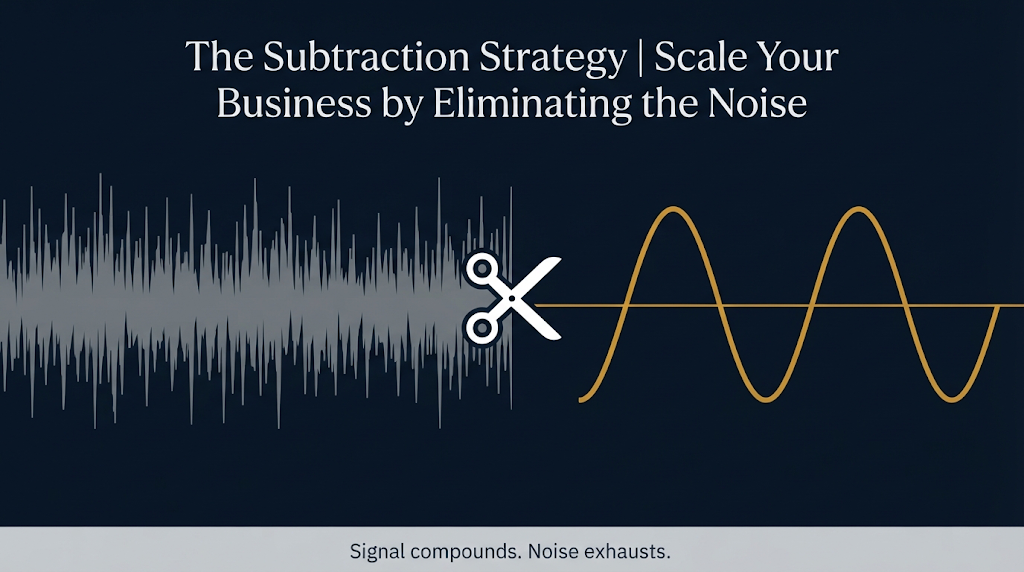
The Subtraction Strategy: Scale Your Business by Eliminating the Noise
The Subtraction Strategy is the deliberate, systematic elimination of everything in your business that generates noise without generating signal. Noise is any activity, offer, client relationship, or operational task that consumes your cognitive bandwidth without meaningfully moving your business toward its core goal. Most entrepreneurs scale backwards: they add new services to capture more market segments, launch new marketing channels to reach new audiences, and hire more people to manage the growing complexity, without first asking whether any of it should exist at all. The result is a business that is busier, louder, and less profitable than it was six months ago. The Subtraction Strategy reverses this. By applying Ruthless Elimination to your offer suite, your client roster, your team's tasks, and your own calendar, you concentrate your scarcest resource, clear, strategic attention, entirely on the highest-leverage 20% that drives 80% of your results. You scale not by shouting louder, but by creating the silence in which your real work can finally be heard.
Key Takeaways
Noise Is the Real Business Tax: Every low-margin offer, high-friction client, and unfocused marketing channel extracts a hidden tax, in energy, attention, and opportunity cost, that far exceeds its apparent revenue contribution.
Subtraction Requires Psychological Courage: Letting go of a revenue-generating client or a six-month-old marketing experiment triggers a threat response in the nervous system. The brain equates elimination with loss, not with leverage.
The Signal-to-Noise Ratio Drives All Growth: Compounding growth in any business is a direct function of how clearly the owner can identify and concentrate on the highest-leverage activities. Noise destroys this clarity.
Elimination Must Precede Optimisation: Optimising a noisy system makes it a more efficient noisy system. You must eliminate the noise first. Then, and only then, does optimisation compound.
Working Less Is a Feature, Not a Bug: A founder who works 25 focused hours per week on high-leverage activities outperforms one who works 60 scattered hours across low-leverage tasks — without exception.
The Business That Was Too Loud to Grow
Imagine a recording studio trying to capture a world-class performance — but the control room is filled with the sound of twelve different radio stations playing simultaneously. The musician is extraordinary. The equipment is state-of-the-art. But the output is unintelligible noise.
This is the operating state of most scaling businesses.
The founder is exceptional. The core offer genuinely changes lives. But somewhere between years two and five, the business accumulated layers of operational noise: a secondary offer added to "capture a different segment," a third social media platform activated to "expand reach," a handful of legacy clients kept on at below-market rates out of guilt, a team of three people whose roles overlap so heavily that clarity of ownership is impossible.
The answer that most growth consultants provide is more: more marketing, more team, more systems, more strategy. The Subtraction Strategy provides the opposite answer, and it is the one that actually works.
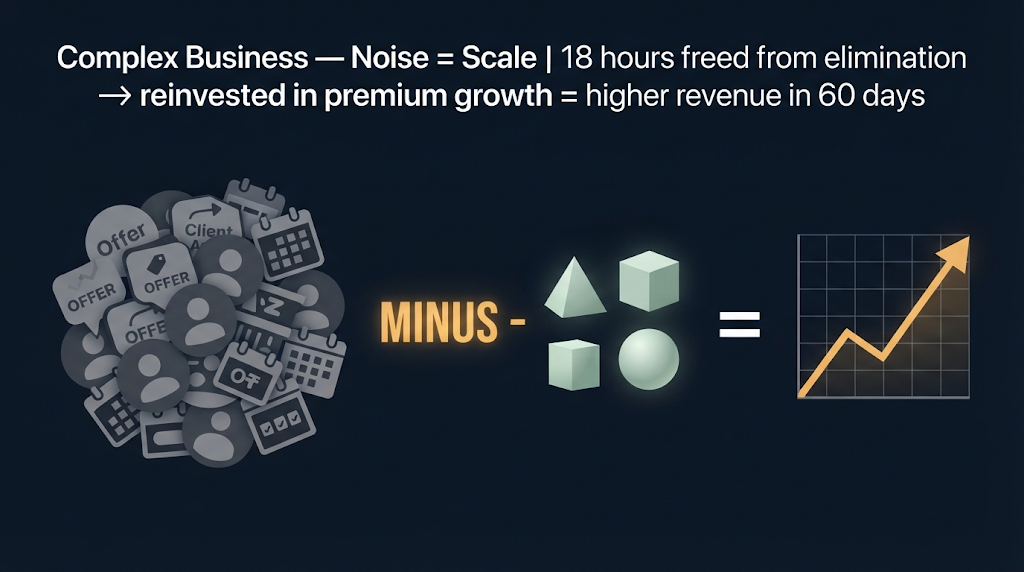
The Four Categories of Business Noise
Noise Category 1: Offer Noise
Every additional offer in your portfolio beyond your single highest-performing signature offer is a candidate for elimination. Each additional offer requires its own marketing angle, its own fulfillment process, its own client education journey, and its own quality control system. Multi-offer businesses are exponentially more complex to operate than single-signature-offer businesses, and they almost always generate lower margins on every product line because focus is diluted across all of them.
Noise Category 2: Client Noise
Not every paying client is an asset. A client who pays below your standard rate but demands above-standard access, customisation, and emotional management is consuming resources at a net loss. The revenue they contribute is visible on the invoice. The energy they extract is invisible in your nervous system — but it is real, and it compounds. Client noise systematically crowds out the bandwidth required to attract and serve your premium clients exceptionally well.
Noise Category 3: Marketing Noise
The average service-based business owner maintains a presence across four to seven marketing channels simultaneously. They post inconsistently on all of them and convert meaningfully on none of them. Marketing noise creates the illusion of activity while generating a fraction of the results that full commitment to a single channel would produce. Signal — the one channel, the one message, the one audience — compounds. Noise simply exhausts.
Noise Category 4: Operational Noise
Operational noise is the daily friction created by unclear ownership, manual processes that could be automated, and meetings that could be emails. It is the 45 minutes spent each morning triaging an inbox that could be managed by an assistant. It is the custom proposal written from scratch for every prospect instead of using a standardised framework. Operational noise steals the founder's most valuable cognitive hours — the first three hours of the morning — and fills them with tasks that require execution, not expertise.
"Subtraction is not the strategy of the lazy entrepreneur. It is the strategy of the precise one. Every cut sharpens the signal. Every elimination returns bandwidth. Every simplification compounds." — James R. Elliot
The Noise Register: Diagnosing Your Business
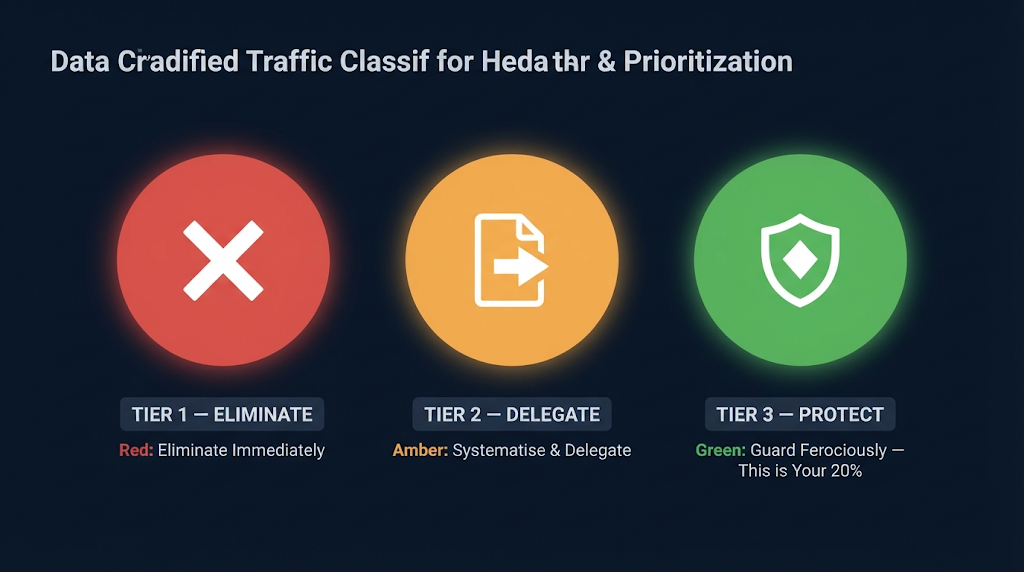
Run every element of your business through this three-tier classification before deciding what to keep, delegate, or cut.
Noise Tier | Definition | Business Examples | The Subtraction Action |
Tier 1 — Red Noise | Activities that consume significant time and energy and produce zero or negative return on either revenue or brand equity. | Legacy clients at 60% below current rate. A social media channel with no engagement. A service offering with fewer than 3 sales in 12 months. | Immediate amputation. Draft the offboarding email. Archive the channel. End the offer. Do not optimise. Eliminate. |
Tier 2 — Amber Noise | Activities that produce real revenue or operational value but do not require the founder's personal involvement to execute. | Client onboarding calls. Social media scheduling. Proposal creation. Basic financial reporting. | Document and delegate. Build the SOP. Train the team member. Remove yourself from the loop within 30 days. |
Tier 3 — Green Signal | Activities that only the founder can execute and that directly generate premium revenue, strategic partnerships, or compound market authority. | High-ticket discovery calls. Keynote speaking. Premium content creation. Strategic relationship cultivation. Product architecture decisions. | Guard ferociously. Every hour freed from Tier 1 and Tier 2 noise is reallocated here. This is the 20% that creates all the leverage. |
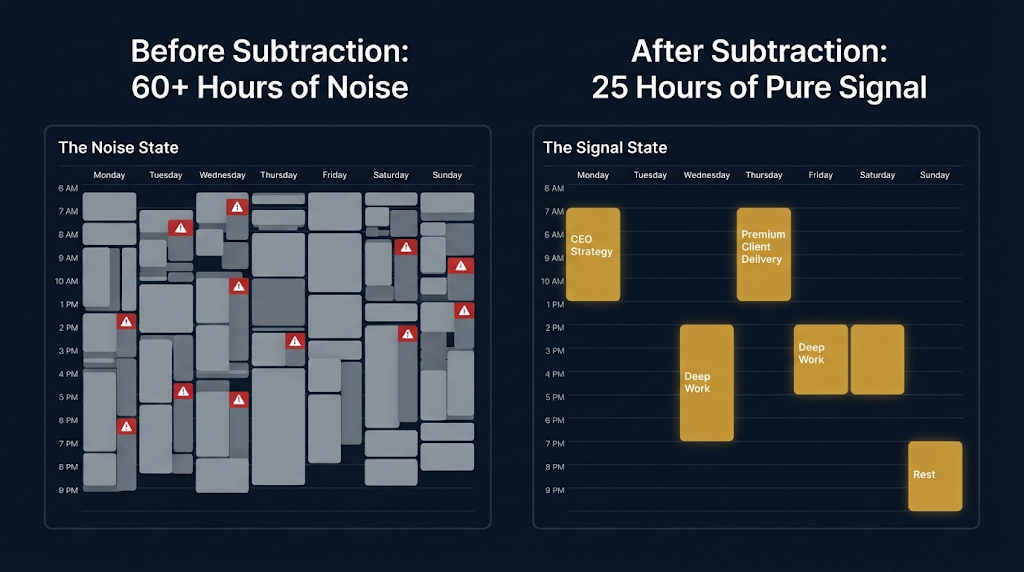
Business Dimension | Before Subtraction (The Noise State) | After Subtraction (The Signal State) |
Offer Suite | 6 offers across 3 price points. Each requires different marketing, onboarding, and delivery. Margins are thin on all of them. | 1 premium signature offer. One delivery system. One onboarding process. High margins. Referrals are effortless because clients know exactly what you do. |
Client Roster | 22 active clients across 4 different service tiers. Several legacy clients at below-market rates consuming disproportionate energy. | 8 premium clients, all at full rate, all pre-qualified for commitment and fit. Deep work. Exceptional results. Consistent referrals. |
Marketing | 5 active channels. Inconsistent content. Moderate presence on each. Conversion is low across all. Exhausting to maintain. | 1-2 channels. Consistent, deep, authoritative content. High conversion. Organic growth. The audience knows what the brand stands for. |
Founder's Week | 60+ hours. Sunday evening dread. No clear finish line. Always behind. Guilt on any day that ends before 8 PM. | 25-35 hours. Hard stop. CEO strategy blocks. Rest is scheduled. A 36-minute nap is not a luxury — it is evidence the system works. |
Before & After the Subtraction Strategy
The Framework: The 5 Shifts to Freedom & The 3 Pillars
The Subtraction Strategy is not a one-time decluttering exercise. It is a permanent operating philosophy embedded into the Limitless Entrepreneur methodology.
The 3 Pillars: Why Subtraction Requires All Three
Pillar 1 — Performance Psychology: The psychological prerequisite. Most founders cannot subtract without first rewiring the unconscious belief that their worth is proportional to their output volume. NLP and Timeline Therapy dissolve the identity fusion that makes elimination feel like personal failure.
Pillar 2 — Freedom-First Business Strategy: The strategic layer where the Subtraction Strategy is applied. This is where we audit every offer, every client, and every marketing channel through the Noise Register and make the definitive cuts.
Pillar 3 — Freedom-First Business Structure: After elimination, the remaining Green Signal activities are systematised into autonomous operational architecture so that the business runs on clarity and leverage rather than the founder's personal energy.
The 5 Shifts: Subtraction Sequence
Phase 1: Clarity (Weeks 1-4)
Shift 1 — Vision Alignment: Define the future state before cutting anything. Subtraction without vision is just destruction. We establish exactly what the business looks like at its highest signal-to-noise ratio before we eliminate a single thing.
Phase 2: Liberation (Weeks 5-11)
Shift 2 — Ruthless Elimination: The primary Subtraction phase. Every Tier 1 Red Noise item is amputated. Every Tier 2 Amber Noise item is systematised and delegated. The founder's calendar is rebuilt around Green Signal activities only.
Shift 3 — Systems That Scale: The surviving Green Signal activities are encoded into repeatable frameworks that the business can deliver without the founder's physical presence.
Phase 3: Amplification (Weeks 12-16)
Shift 4 — Mindset Unlock: The residual guilt and anxiety from eliminating familiar activities and clients is resolved at the neurological level. The nervous system is recalibrated to feel safe in focused simplicity.
Shift 5 — Magnetic Authority: With the noise eliminated and the signal pure, the founder's market position is amplified. Premium clients self-select. The right opportunities emerge without the founder chasing them.
Case Evidence: What Subtraction Actually Produces
Nik — Eliminating Five Offers to Scale One (Name Changed)
Nik ran a consultancy with six service offerings designed to capture every possible client budget. He was proud of his range. He was also running on empty, context-switching between radically different delivery models every day of the week. Through Pillar 2 (Freedom-First Strategy), we ran every offer through the Noise Register. Five were immediately classified as Tier 1 Red Noise — generating some revenue, but at a cost in operational friction that far exceeded their financial contribution. We eliminated all five. Nik was terrified. Within 90 days, the single remaining offer — his premium-tier methodology — had been repositioned with sharper authority and clearer outcomes. His marketing became effortless because he had one story to tell. His revenue hit its highest quarter on record. One offer. One story. Maximum signal.
Marcus — Amputating Nine Clients to Scale the Business (Name Changed)
Marcus had 20 active clients and 60-hour weeks. Eleven of those clients were legacy accounts at below-market rates — clients from his early years who he kept out of loyalty and quiet fear. They were Tier 1 Red Noise: below-rate revenue paired with above-rate energy extraction. Through Pillar 1 (Performance Psychology), Marcus resolved the guilt and fear attached to ending those relationships. Over 45 days, he respectfully offboarded nine clients. His calendar immediately freed 22 hours per week. He reinvested those hours into positioning, a new premium tier, and one strategic referral partnership. Within two billing cycles, the nine premium clients he attracted replaced the revenue of all eleven legacy clients combined — at a fraction of the delivery effort.
Decision Framework: Is Your Business Ready to Subtract?
✓ You are ready to apply the Subtraction Strategy if: You have a proven core offer that delivers results. You are generating revenue. The primary obstacle to growth is internal complexity, scattered focus, and owner exhaustion — not an absence of proof that your work creates value.
✗ This Strategy is not appropriate if: You are in the first 12 months of business and still identifying which offer has the strongest market fit. Subtraction before signal identification simply produces a faster route to nothing. Discover your signal first. Then protect it.
Try This: The 30-Minute Noise Audit
Step 1 — The Offer Audit (10 minutes). List every service or product you currently offer. Next to each, write: (a) monthly revenue it generates, and (b) hours per month it consumes in delivery and client management. Calculate the effective hourly rate. Anything below your target hourly rate is a candidate for elimination.
Step 2 — The Client Audit (10 minutes). List every active client. Score each from 1–10 on two dimensions: Revenue Contribution (10 = highest payer) and Energy Extraction (10 = most demanding). Subtract the Energy score from the Revenue score. Any client scoring below +2 is Tier 1 Red Noise.
Step 3 — The Calendar Audit (10 minutes). Review last week's calendar. Highlight every event that did not directly serve a premium client or move a high-leverage strategic initiative forward. Calculate the percentage of your week consumed by this highlighted noise. That percentage is your subtraction opportunity.
Further Reading
Harnessing Structure & Systems — building the operational architecture after the noise is eliminated.
Entrepreneurial Mindset Through NLP — the psychological tools that make elimination possible.
Overcoming Procrastination — why staying busy is the ultimate form of noise creation.
Strategies to Scale Your Business — the high-leverage moves that compound after subtraction.
Harvard Business Review: Subtract — The Untapped Science of Less — external research on why subtraction is systematically underused in business strategy.
Frequently Asked Questions
What is the Subtraction Strategy in business?
The Subtraction Strategy is the deliberate elimination of every offer, client relationship, marketing channel, and operational process that generates noise — activity without meaningful leverage. It is the strategic opposite of the "add more" instinct that traps most scaling entrepreneurs in complexity, and it is the primary mechanism through which the Limitless Entrepreneur methodology frees 15–25 hours per week while increasing revenue.
Won't eliminating revenue-generating clients or offers reduce my income?
In the very short term, top-line revenue may dip. However, the founder who eliminates three low-margin, high-friction offers consistently experiences a rapid rebound in profitability — not revenue volume — because the bandwidth freed is reinvested entirely in premium client acquisition and delivery. Marcus's case study above is representative: within two billing cycles, nine premium clients replaced the revenue of eleven legacy clients at a fraction of the delivery effort.
How do I know what counts as "noise" versus a legitimate growth activity?
Run every activity through the Noise Register above. The definitive test is this: if an activity does not directly generate premium revenue, compound your market authority, or support a systematised operational backbone — it is noise. The word "directly" matters. Many activities feel strategic but are actually high-effort distractions from the three activities that genuinely move the needle.
The Subtraction Strategy sounds simple. Why don't more entrepreneurs do it?
Because subtraction triggers a visceral psychological threat response. Your nervous system interprets the loss of a paying client or a revenue-generating offer as a survival risk, even when the analytical case for elimination is airtight. This is precisely why Pillar 1 (Performance Psychology) is the required first step of the Limitless methodology. Without it, founders intellectually commit to eliminating the noise and emotionally reinstate every cut item within 30 days.
How long does it take to see results from the Subtraction Strategy?
Most founders who apply Ruthless Elimination (Shift 2) begin experiencing the cognitive and operational benefits within the first 30 days — primarily as a massive reduction in daily decision fatigue and an immediate reclamation of founder hours. Revenue effects typically compound between 60 and 90 days, as the concentrated energy is redirected into the high-leverage Green Signal activities that actually drive premium growth.
Conclusion: The Silence Is Where the Growth Lives
James R. Elliot ran five businesses before he understood the Subtraction Strategy. He built everything the conventional way, adding offers, adding channels, adding team members, adding complexity, until his fifth business was consuming 80 hours of his week, requiring anxiety medication to maintain the pace, and leaving him absent from every personal relationship that mattered. His niece's question, "Why are you never around?", was the final noise audit he needed.
The shift was not an addition. It was a radical subtraction. He eliminated every offer, client, and operational process that was not a Green Signal. He rebuilt the remaining 20% with precision. Within 90 days, his working week dropped from 80 hours to 25. Revenue increased. He took a 36-minute nap after lunch without guilt. He visited his niece.
The growth was not hiding behind the next marketing campaign or the next team hire. It was hiding under the noise he had spent years accumulating.
Subtract the noise. The signal, and the scale, is already there.
Ready to run your Noise Audit? Book the Freedom Blueprint Call (45 mins). We will identify your Tier 1 Red Noise and your Green Signal in a single conversation.