Strategy Without Psychology: Why You Have the Blueprint but Still Feel Stuck
If you have a sound strategy and still aren't executing it, the missing piece isn't information and it isn't discipline. Knowing what to do and repeatedly doing it are two different behavioural problems. A strategy document assumes a neutral operator. You aren't one. You already run on established patterns: you don't delegate without micromanaging, you undercharge, you over-deliver because disappointing someone feels unbearable, and you stay busy enough to avoid the one move that would actually change things.
But psychology on its own doesn't fix it either. Insight with no elimination and no structure gives you a better understanding of the same 60-hour week.
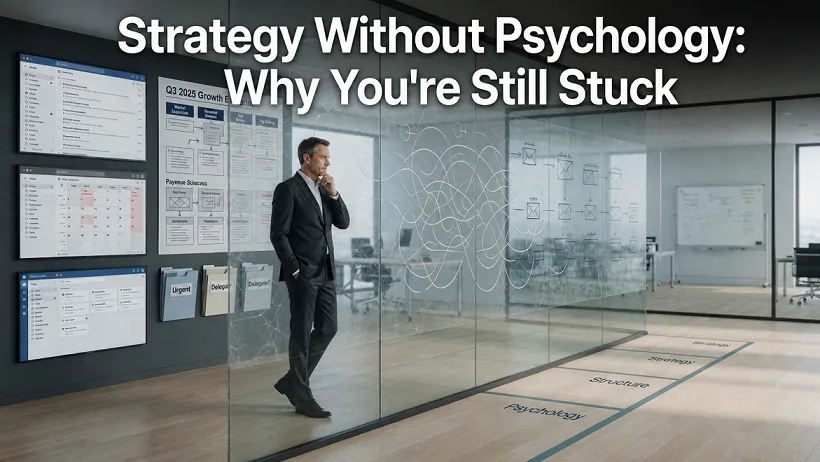
The problem isn't strategy versus psychology. It's sequence: psychology → strategy → structure. Strategy sets the direction. Psychology determines whether you can consistently act on it. Structure determines whether that action survives contact with a real Tuesday.
Key Takeaways
Having the blueprint and executing it are two different problems; only one is solved by more information.
Strategy without psychology produces a better plan and the same behaviour. Psychology without strategy produces a better understanding and the same business.
Your unconscious programming is concrete: micromanaging, undercharging, over-delivering, staying busy to avoid the high-leverage move.
Avoidance persists because it's immediately rewarding; the relief is real and it arrives instantly.
The 90-day test: if you've known the move for three months and haven't made it, the constraint isn't informational.
The order is psychology → strategy → structure. The 3 Pillars set the order; the 5 Shifts to Freedom set the work.
You're stuck because you're working 60 hours. Working less isn't the reward for scaling; it's the mechanism.
Why doesn't the right strategy make you execute it?
Because knowing what to do and being able to repeatedly do it are different behavioural problems, and only one of them is solved by a document.
The research is unusually direct here. Across 47 experimental tests, Webb and Sheeran found a medium-to-large effect of interventions on people's intentions (d = 0.66) but a smaller effect on their actual behaviour (d = 0.36). Moving what someone intends to do is easy. Moving what they do is a separate job.
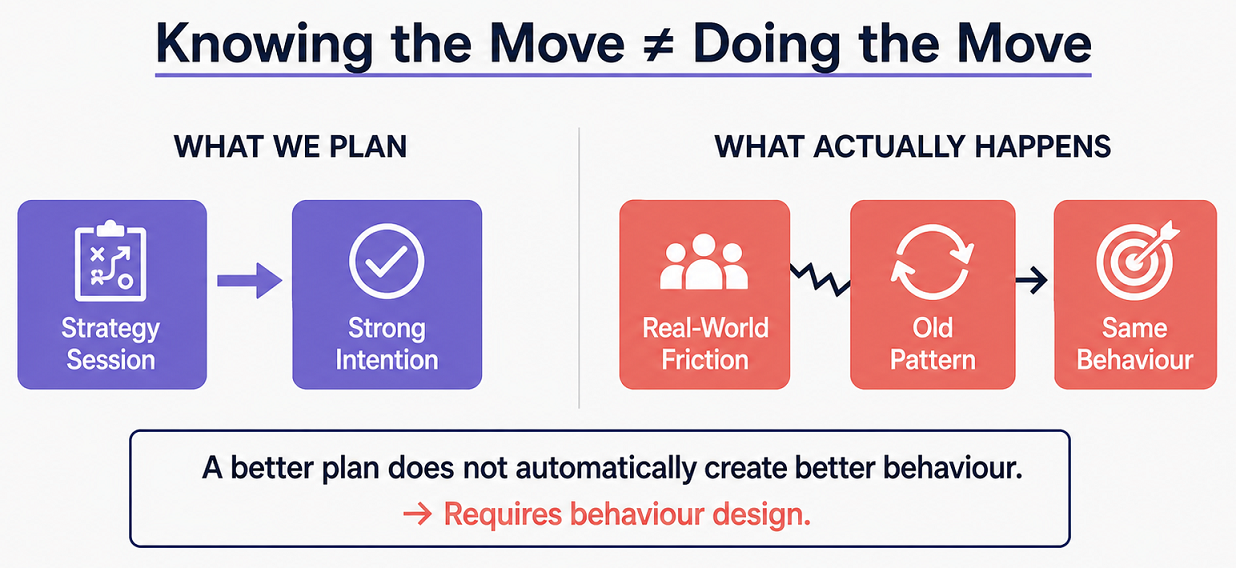
So you leave the strategy session genuinely convinced. The plan is sound. You could recite it. And week six looks almost exactly like week one: same client calls, same inbox, same Sunday evening. It isn't that you forgot. It's that the goal never became behaviour, and nothing in the plan was built to make it one. Notice where that plan lives right now: probably a tab you haven't opened in nine days, sitting behind the work that shouts louder.
What does "strategy without psychology" actually mean?
Strategy without psychology means a plan built for an operator who doesn't exist: one with no history, no fear, and no habits.
Your week is already occupied. In a diary study, Wood, Quinn and Kashy found that roughly 43% of the behaviours participants logged were repeated almost daily in the same context, often while they were thinking about something else. The point isn't that half your life is unconscious. The point is that a strategy document doesn't land on empty ground. It competes with patterns already running.
In your business, those patterns are specific. You rewrite the assistant's work. You quote the number, then discount it before anyone objects. You spend Thursday on admin so you don't have to make the call that would change the quarter. That isn't a strategy failure; that's programming deciding before you get there.
Jennifer (name changed) arrived with an extraordinary background and prices well below her market. She knew she should raise them. She'd known for a long time. Knowing was never the constraint. Doubled her prices in 60 days. The strategy was never her problem. Her programming was.
Is this really a discipline problem?
No. Avoidance is doing a job, and understanding that job is what makes it solvable.
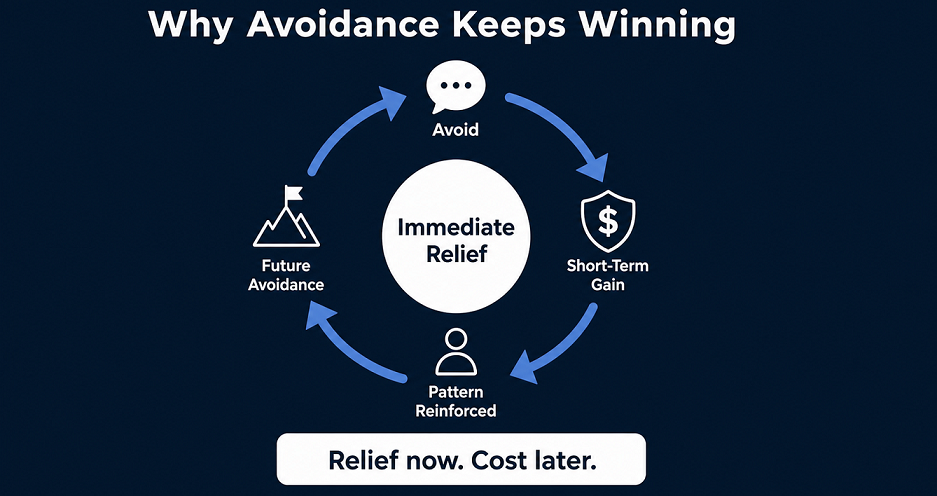
Sirois and Pychyl describe procrastination as a form of short-term mood repair: when a task feels aversive, putting it off delivers immediate relief. So avoidance gets rewarded on the spot, every time, while the cost arrives weeks later and lands on a version of you who isn't in the room yet.
Here's the part that stings: you're not lazy, and you never were. You've been using work as the thing you hide behind because busy feels productive, and productive feels safe.
I know that route well. Fifth business, 80-hour weeks, on anxiety medication and calling the workload proof it was working. I wasn't failing to work. I was using work to avoid the work that mattered.
Why doesn't mindset work on its own either?
Because awareness isn't a delivery mechanism. You can be the most self-aware operator in your market and still answer email at 11 pm.
This is where a lot of advice quietly fails. You do the inner work, something real shifts, then you walk back into a calendar with 34 client hours, no elimination, and every decision still routing through you. The belief changed; the container didn't. That's why change takes longer than the plan promised.
There's a broader version worth naming once. Across 221 courses, Jordan's analysis found a median completion rate of about 12.6%, with enormous variation between them. More information doesn't automatically produce more implementation, true of a strategy programme, equally true of a mindset one.
The verdict: each approach is right about something and incomplete alone. Strategy without psychology gives you a better plan and the same behaviour. Psychology without strategy gives you better beliefs and the same business. Structure without either is a prettier prison.
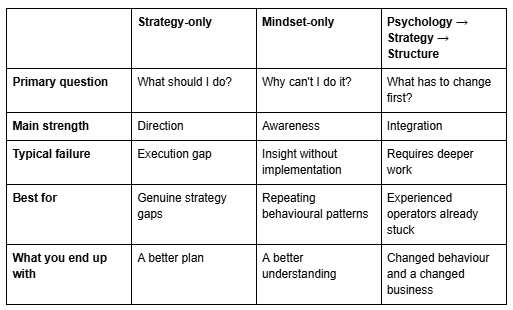
Strategy problem or psychology problem? The 90-day test
Use the timeline, not your self-assessment. It's harder to argue with.
The 90-day test: if you've known the move for roughly three months, you understand why it matters, and you still haven't implemented it stop assuming you need more information. You have all of it. Something else is holding the door.
Five questions to place the constraint:
Do I actually know the move, in specific terms?
Have I repeatedly intended to make it and not made it?
Does the same pattern stop me each time?
Is the obstacle emotional, strategic, or structural?
What happens in the ten minutes right before I avoid it?
Question five is where people find their answer. It's rarely a reasoned decision; it's a feeling, followed by a substitute task that feels productive. Once you can see that sequence, the decision you've been circling for months becomes one you can make.
The Stuckness Loop
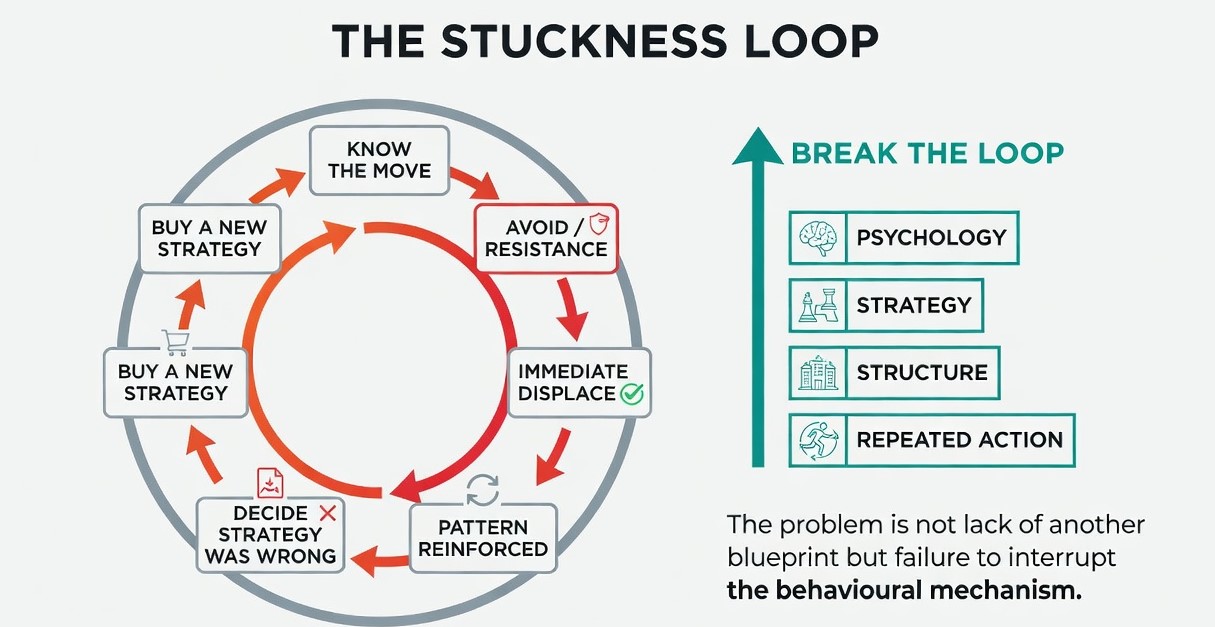
The stuckness loop is the self-reinforcing pattern that keeps a good strategy permanently unexecuted. It isn't a method or a framework; it's the thing you're caught in.
Know the move → feel resistance → avoid or displace → get immediate relief → reinforce the pattern → conclude the strategy was wrong → buy a new strategy → repeat.
The loop is stable because every lap pays out: relief now, cost later, and a fresh plan to feel hopeful about. Your plan isn't stalled by the market or your circumstances. You're the mechanism holding it, which is good news, because it means it's yours to change.
The loop breaks at one point: psychology → strategy → structure → repeated action. Interrupt the resistance first, and every later step finally has somewhere to land.
The sequence: psychology → strategy → structure
These are the 3 Pillars, and their order is the entire mechanism.
Performance Psychology comes first because it governs whether you can act at all: the unconscious programming, the fear, the reconditioning that means you stop bracing against your own plan. Freedom-First Business Strategy comes second, because once you can act, the question becomes what to act on: ruthless elimination of the 80% stealing your time so the 20% can produce. Freedom-First Business Structure comes third, because a new behaviour that depends on you remembering it won't survive a hard month. You redesign operations, so you're no longer the bottleneck.
Get the order wrong and you get the failure modes above. Psychology last, and you spend a year on tactics you can't execute. Structure first, and you systemise the business you already resent.
The 5 Shifts to Freedom: what you do inside the sequence
The 3 Pillars explain the order. The 5 Shifts to Freedom explain what you actually do inside it, across three phases: Clarity, Liberation, Amplification.
Vision Alignment: Get clear on what you actually want, not what you should want. Psychological work, deliberately first: you can't build a strategy toward an outcome you've never honestly named.
Ruthless Elimination: Cut the 80% of activity draining your time and energy. Strategy is mostly subtraction.
Systems That Scale: Build leverage so the business stops routing every decision through you.
Mindset Unlock: Dismantle the programming that quietly recreates the old behaviour. Deep reconditioning, not affirmations and it sits here rather than earlier because this is where the new structure exposes which patterns are still running.
Magnetic Authority: Position yourself so the right clients recognise you immediately, and charge accordingly.
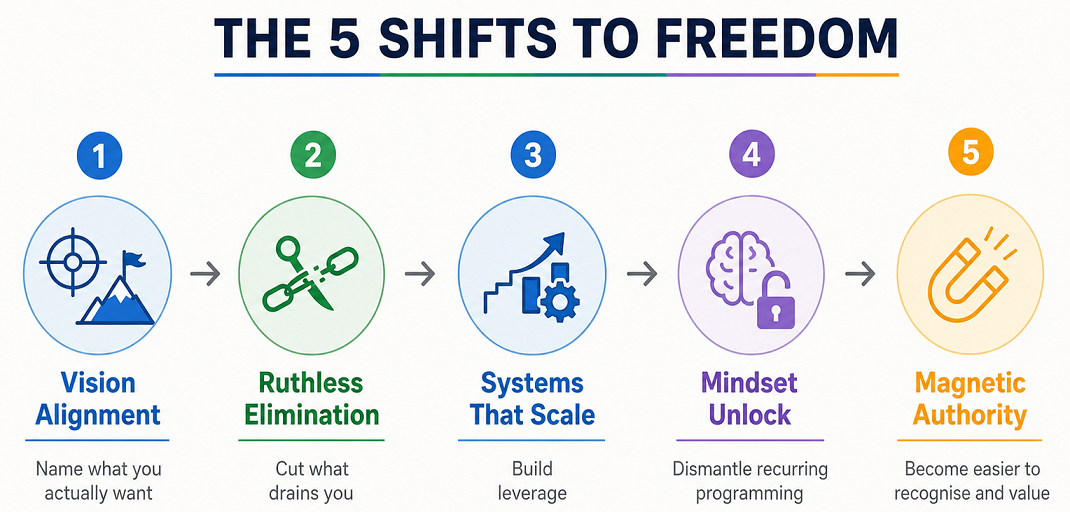
That's the sequence running twice: light at Shift 1 to get you moving, deep at Shift 4 to make it hold. One reliable lever inside it is refreshingly unglamorous: if-then planning produced a medium-to-large improvement in goal attainment across 94 tests compared with intention alone. Implementation intentions are one of the 6 Psychological Hacks for exactly that reason.
David (name changed) was brilliant at the work and completely trapped by it. Thirty days to get his expertise out of his head and into a documented process, and his assistant took over most of his inbox. First two-week holiday in five years, and the business grew while he was gone. That's what happens when your expertise stops living in your head.
My own version is less dramatic and more telling: dinner happens, and my phone is in another room. A 36-minute nap in the afternoon without negotiating with myself about it. Martial arts twice a week, on days that don't move.
Who this is for and who should skip it
This is for you if you're a coach, consultant, or wellness practitioner working 50–60+ hours a week; you already have a strategy you believe in; you've known your next move for months and haven't made it; and the same pattern micromanaging, undercharging, over-delivering, staying busy keeps reappearing in different clothes.
Skip this if you're pre-revenue and haven't validated an offer you genuinely do need strategy first. Skip it if you want insight without changing how the business runs day to day; the sequence only pays out if structure changes. And skip it if you're looking for a health intervention; this is business work, and no substitute for proper support.
What the research actually shows
Intention shifts far more easily than behaviour, across 47 experimental tests (Webb & Sheeran, 2006).
Much of everyday behaviour is repeated in stable contexts rather than chosen fresh; that's what a new plan competes against (Wood, Quinn & Kashy, 2002).
Delay delivers immediate emotional relief, which is why avoidance persists against your own interests (Sirois & Pychyl, 2013).
Specifying when, where and how you'll act improves follow-through over intention alone (Gollwitzer & Sheeran).
FAQs
Is being stuck a mindset problem or a strategy problem?
Usually it's a sequence problem. If you don't know the move, it's strategy. If you know it and can't make yourself take it, it's psychology. If you take it once and it doesn't survive a busy month, it's structure. Most experienced operators sit in the second or third category and keep buying solutions for the first.
How do I know if my unconscious programming is the constraint?
Look for a repeating pattern rather than a single event: rewriting a team member's work, discounting before anyone objects, over-delivering unprompted, filling the calendar with tasks that feel urgent and change nothing. One instance is a bad day. The same one monthly is programming.
Won't better systems solve this on their own?
Not if you build them around the business you resent. Structure amplifies whatever it's wrapped around, which is why it comes third. Build systems after you've cut what shouldn't exist and they multiply the right work instead of the wrong work.
Why does mindset work sometimes change nothing?
Because insight isn't a delivery mechanism, a genuine internal shift dropped back into an unchanged calendar produces the same week with better self-awareness. Reconditioning has to be paired with elimination and operational redesign, or the environment restores the old behaviour.
How long does it take to break the pattern?
The Limitless Entrepreneur runs for 16 weeks, structured as Clarity, Liberation, and Amplification. Movement usually shows up early, once the first constraint lifts. What takes longer is making the new behaviour hold when a hard month arrives.
Do I need to be working fewer hours before this will work?
No, that's the outcome, not the entry requirement. Most people arrive at 50–60+ hours a week with a strategy they can't execute. The hours come down as elimination and structure take effect, not as a precondition for starting.
Where this leaves you
The plan you already have is probably fine. That's the frustrating part and the hopeful part at once: you don't need a better one. You need to change what happens in the ten minutes before you avoid it, cut what's crowding it out, then build a structure that doesn't require you to be heroic on a Wednesday.
My niece once asked why I don't visit anymore. That question did more than any strategy session ever did.
The Freedom Blueprint Call: 45 minutes. We'll find the one thing that's actually keeping you stuck. No pitch unless you ask for one.