
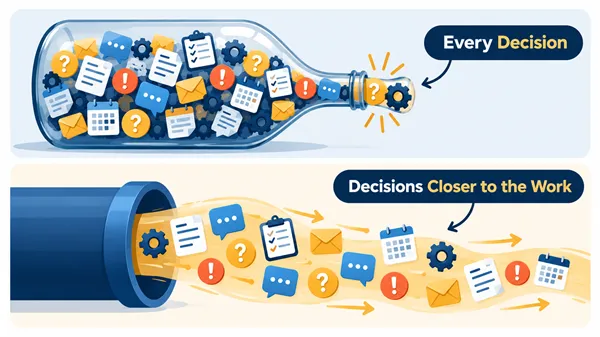
Stop Being the Bottleneck: Autonomous Team Systems
Stop being the bottleneck by replacing your approvals with a system your team can run without you. The 4-Layer Autonomy Stack has four parts: Context, so people know the outcome and the reason for it; Boundaries, so they know which decisions they own; Rhythm, so you review results weekly instead of approving work in advance; and a Safety Net, so mistakes stay small and recoverable.
McKinsey's decision-making survey found only 20% of respondents say their organization excels at decisions, and those who say decisions sit at the right level, often delegated, were 6.8 times more likely to work at a winning company. That's a correlation, not a guarantee. Start with one recurring decision and hand it over with a written brief this week.
Key Takeaways
A bottleneck is the person every decision has to pass through, and in a growing business that's often the founder.
In McKinsey's survey, 61% of respondents said most of their decision time is used ineffectively.
Handing off tasks isn't enough. Teams also need context, decision rights, a review rhythm and a safety net.
Four authority levels remove the guessing: ask first, recommend then act, act then tell, own it.
Review results weekly instead of approving work in advance.
Start with one recurring decision and a one-page brief, and keep the final say on irreversible, regulated or cash-critical calls.
The Number That Should Bother You
McKinsey's decision-making survey gathered 1,228 respondents, from C-suite executives to middle managers, in February 2018. On average, 61% said most of the time they spend on decisions is used ineffectively. Only 20% said their organization excels at decision making.
Those are self-reported numbers from several years ago, so treat them as a warning light, not a measurement. Still, if every question lands on your desk, you've probably felt the cost. Each call that waits for you is a small delay, and the delays stack up as you add people.
This guide gives you a system for moving those calls closer to the people doing the work. It comes with fill-in templates, so you can start this week.
Are You the Bottleneck? A Five-Question Self-Check
Answer yes or no to each question.
Does your team ask for your approval on things you approve almost every time?
Do projects stall when you're out for two days?
Do you get pulled back into decisions you've already made?
Do people ask how to decide, not only what you think?
Do you feel uneasy when a decision gets made without you?
Three or more yeses suggest you're a bottleneck. One or two mean the pressure is building. No yeses is good news, though it's worth checking whether your team is quiet because things run well or because they've stopped bringing you problems. This is a quick reflection tool, not a validated test.
Why Handing Off Tasks Isn't the Same as Building a System
A task has steps. A decision needs judgment, and judgment needs context. When you hand off a task without the reasoning behind it, the questions come straight back, because the person can't see where the edges are.
Davidson's 2023 interviews with 37 founders describe three phases of letting go. In attachment, the company feels like an extension of you. In uncoupling, you separate yourself from decisions. In opportunity, you spend the freed time on bigger work. It's a small qualitative study, so read it as directional. It fits what many founders report: handing off tasks while you're still attached tends to bring them right back.
James R. Elliot calls this Pillar 3, Courageous Action, applied to the business: moving from planning to implementation, even when letting go feels risky.
The 4-Layer Autonomy Stack
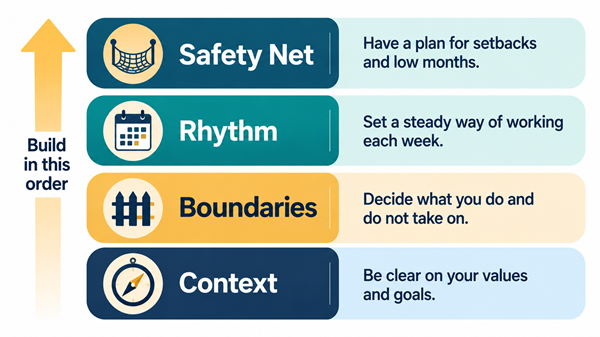
Each layer sits on the one before it, so build them in order. Give each one a single page. If a page runs long, the idea isn't clear yet.
Layer 1: Context. Write the Intent Brief
The idea comes from military mission-type tactics, where leaders state the purpose and the desired end state and leave the method to the people closest to the work. Stefan Wolpers describes a five-part version for teams: outcome, purpose, constraints, success criteria and escalation triggers. It's a practitioner's framework, not research evidence.
NLP's well-formed outcome makes the brief sharper. State the outcome positively, make it observable, and keep it within the owner's control. Then chunk up to the purpose so people can judge trade-offs you didn't foresee.
Heather Chetwynd came to James's NLP Practitioner training confused about how the techniques fit together. She left with clarity on how to use them in her work and business. Your team needs the same thing from you. If you're still shaping that team, see our guide to building a high performance team.
INTENT BRIEF (one page) Outcome: What does done look like? Purpose: Why does it matter now? Limits: What's off the table? Success measure: How will we know it worked? Escalation triggers: What should come back to me? |
Layer 2: Boundaries. Set the Decision Rights
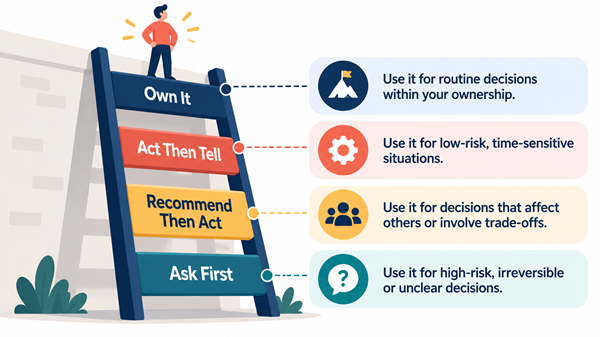
People hesitate most when they can't tell whose call it is. Write down what each owner can decide, using four levels.
Level | What the owner does | Use it when |
1. Ask first | Brings you the question and waits | The owner is new, the decision is new, or the stakes are high |
2. Recommend, then act | Proposes an answer and goes ahead unless you object by a set time | You're building trust in a growing owner |
3. Act, then tell | Decides and reports afterward | The call is reversible and the limits are agreed |
4. Own it | Decides and brings results to the weekly review | The decision recurs and the owner has a proven record |
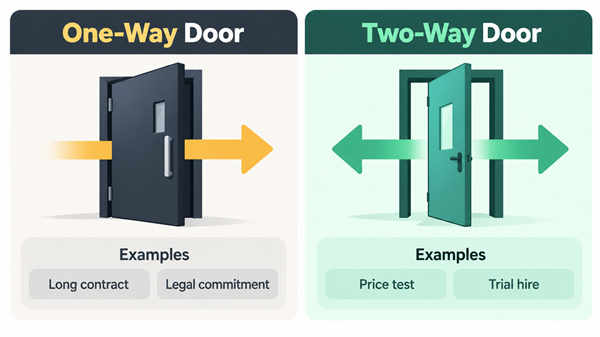
Fortune's discussion of Bezos's letter uses the idea of one-way and two-way doors to place each decision. A one-way door is hard to undo, like signing a long contract. A two-way door can be reversed, like testing a price for a month. Bezos's point, as Fortune reports it, is that most decisions are reversible, and treating them like one-way doors causes delay. Start people on levels 3 and 4 for reversible calls.
McKinsey's authors found that for delegated decisions, empowerment mattered more than clear roles, defined processes or escalation guidelines, and that heavy process can slow those decisions down. That's a survey association, but it makes sense: decision rights give permission, and people still need to believe you mean it. For more on giving real authority, see our guide to empowering employees through effective leadership.
DECISION RIGHTS CARD Decision: ______________________ Owner: ______________________ Level (1 to 4): _____ Spending or risk limit: ______________________ Door type (one-way or two-way): _____ Review date: _____ |
Layer 3: Rhythm. Review Results, Not Requests
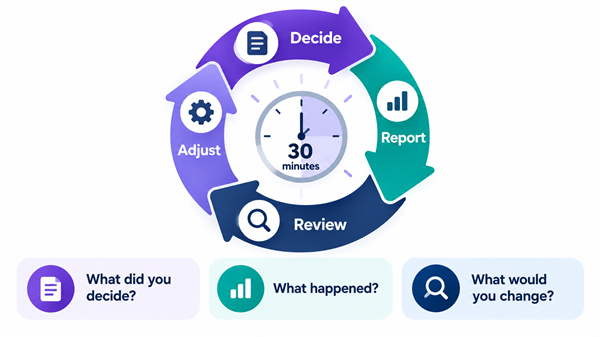
Replace pre-approval with a weekly 30-minute decision review. Owners bring decisions they've already made, and you ask three questions: What did you decide? What happened? What would you change?
The team gets feedback without waiting for permission. In a 2025 study of 485 employees at 10 South Korean companies, Jang and Kim found job autonomy correlated with work engagement (r = 0.41) and innovative behavior (r = 0.54). The study is correlational and measured engagement and innovation, not business results. Autonomy stayed positively linked to both under high performance pressure, though less strongly.
Keep the review short and at the same time each week. Our guide on effective decision making can sharpen the questions you ask.
Layer 4: Safety Net. Make Mistakes Small and Recoverable
Autonomy holds only when people trust that a wrong call won't blow up on them. Agree in advance on what triggers an escalation, such as spending over the limit, a customer threat or a legal question. Then agree on what happens after a miss: you fix the system first and the person second.
In McKinsey's survey, respondents who said employees get coaching and room to fail safely were 3.9 times more likely to work at a winning company. Again, that's an association. Trust builds slowly, so give it time, and see our guide on trust and confidence in teams.
Where Autonomy Breaks, and the Fix
Rubber-stamping. The team brings you everything and you approve it all. Move those decisions to level 2 or 3 and review the results weekly.
Abdication. You hand it over and disappear. Keep the weekly review, because autonomy without feedback isn't a system.
Rule sprawl. Every miss adds a new rule. Defined processes can slow delegated decisions, so fix the brief or the limits before you add a step.
Snapping back. After one bad week, you take the decision back. Raise it in the review, adjust the limits together and give it another cycle. Our guide to the warning signs your systems are failing helps you tell a one-off miss from a pattern.
Your First Handoff in 10 Days
Days 1 to 2: Pick the recurring decision that reaches you most often and whose outcome you can reverse.
Days 3 to 4: Choose an owner. Write the Intent Brief and the Decision Rights Card together, in the owner's words where you can.
Days 5 to 7: Start at level 2. When questions come, answer with "What do you recommend?"
Days 8 to 10: Hold the first 30-minute review. If it went well, move to level 3.
WANT A SECOND SET OF EYES ON YOUR FIRST BRIEF? Bring it to a 30-minute connection call and we'll look at it together. |
Where to Keep Your Hand on the Wheel
Not every decision should move. Keep the final say on decisions that are legally regulated, safety-critical or could put the business's cash at risk, and move them last, if ever. If your team has only two or three people, start with one owner and one decision, since there's little to spread yet. And if constant overwhelm is wearing on your health, a doctor or mental health professional is a better first call than a new system.
Frequently Asked Questions
What does it mean to be the bottleneck in your business?
It means decisions, approvals or knowledge have to pass through you before work can move. The business can then grow only as fast as your attention does.
How do I delegate decisions without losing quality?
Give the owner a written brief with the outcome, purpose, limits and escalation triggers. Start at level 2, review results weekly and move up the ladder as the track record builds.
How long does it take to build autonomous team systems?
Many founders see one decision run without them within a few weeks. A team that runs well across many decisions usually takes three to six months of steady practice, and the pace varies.
What if my team makes a wrong call?
Treat it as feedback on the system first. Check whether the brief was clear and the limits were right, then adjust. Starting with reversible decisions keeps early mistakes cheap.
Do I need software to run this?
No. A shared document for the brief and card, plus a recurring calendar slot for the review, is enough to start. Add tools later if the volume of decisions calls for them.
Conclusion
You don't need to let go of everything. Pick one decision, write the brief and let the first review do its work. Take decisive action this week, and give your team room to show what they can do. When you'd like help turning this into your own system, book a 30-minute connection call.