
Self-Sabotage in Business: Why We Avoid the High-Leverage Tasks That Matter
Self-sabotage in business is the repeated avoidance of the few tasks that would most change your results, while you stay busy with work that looks productive. It is rarely a discipline problem. Research on procrastination describes avoidance as a form of emotion regulation: delaying a task removes the uncomfortable feeling attached to it, which is immediately rewarding even though the delay costs you later.
Related research on self-handicapping shows people create obstacles that allow a poor outcome to be blamed on the obstacle rather than on their ability.
Key Takeaways
Self-sabotage in business is selective avoidance of high-leverage work, disguised as productivity.
The avoidance is protective it manages a feeling, and the relief arrives immediately.
Procrastination is the delay; self-sabotage is the repeating pattern beneath it.
Time management can't fix it. The container was never the problem.
Ask three questions: what task would change the most, what feeling would I have to tolerate, what am I doing instead? The third answer is your diagnosis.
The research supports two moves in sequence: work the emotional layer, then plan the initiation.
Working less is how you scale. The 60-hour week isn't the price of growth; it's what's preventing it.
In a coaching or consulting business, that shows up as undercharging, over-delivering, refusing to delegate, and perfecting work nobody notices. The behaviour is protective. It was built to keep you away from feelings of exposure, judgment, and disappointing someone and it still works, which is exactly why it persists. Changing it means addressing the emotional threat attached to the task, not stacking another productivity system on top of it.
What is self-sabotage in business?
Self-sabotage in business is a pattern, not an event. It's the repeated choice, rarely a conscious one, to spend your best hours on work that can't change your trajectory, while the one or two tasks that could keep sliding to next week.
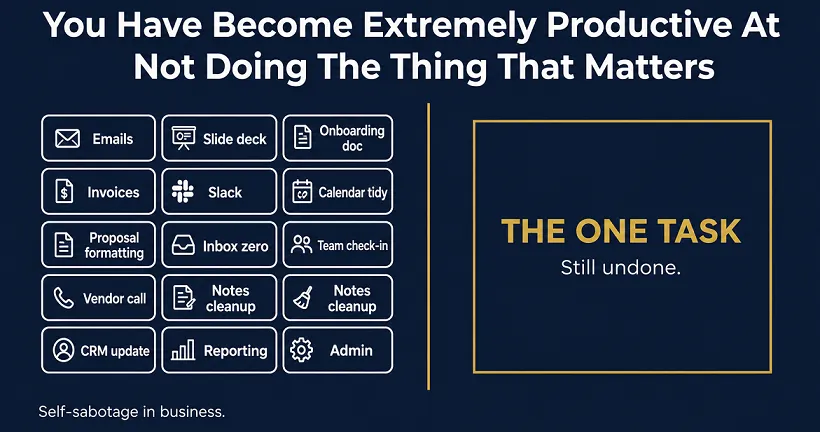
Here's the part nobody says out loud. You have become extremely productive at not doing the thing that matters. You are not lying on the couch. You're answering forty-one emails and rewriting an onboarding doc that was already fine.
Which is why "lazy" is the wrong diagnosis, and why every article telling you to try harder has missed. Effort was never the missing ingredient. You have plenty of effort; you've just been pointing it somewhere safe.
Why do we avoid the high-leverage tasks that matter most?
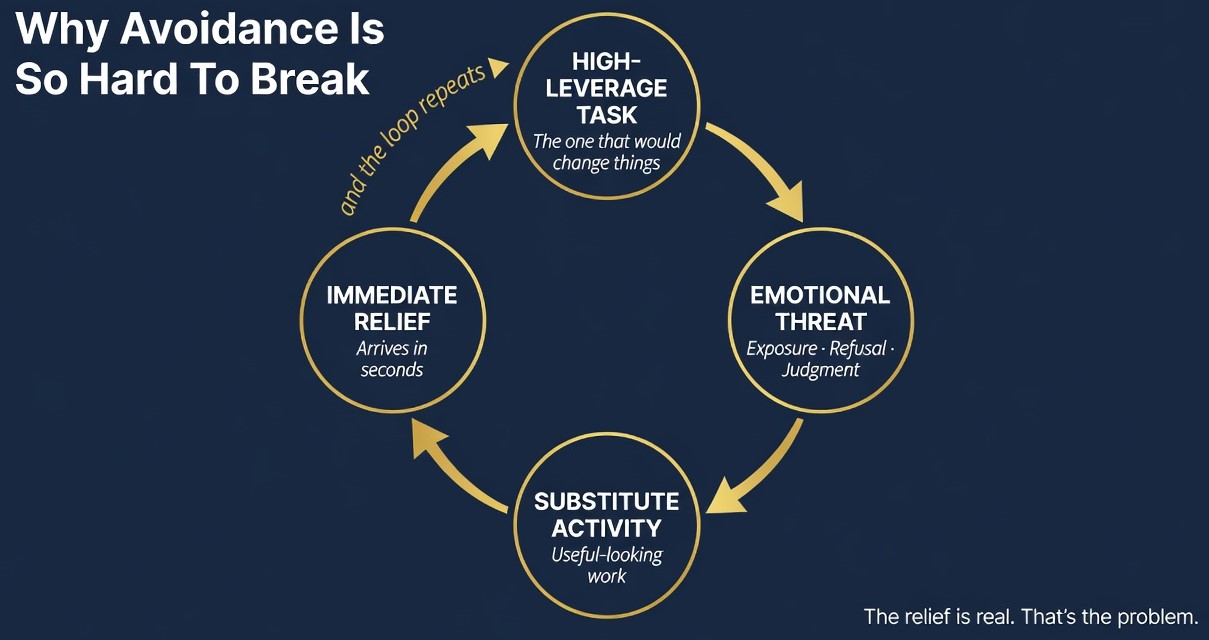
Because the high-leverage task is almost always the emotionally expensive one; you don't avoid it because you don't know what to do. You avoid it because doing it would create a feeling you'd rather not have.
Procrastination researchers have a clear account of this. A review of procrastination and stress describes delay as short-term mood repair: when a task carries difficult emotions, postponing it produces an immediate positive shift, and that relief gets prioritised over the longer-term goal. The relief is real, and it arrives in seconds. That's what makes the pattern so durable.
A second mechanism runs alongside it. Self-handicapping, first described by Berglas and Jones, is the tendency to create or claim obstacles ahead of a performance so failure can be blamed on the obstacle rather than your ability. If you never raise your rates, nobody ever says no to your rates.
So the behaviour is protective. That's the honest frame: not that something is broken in you, but that something built to keep you safe is now charging you rent. The protection still works. It just costs more than it returns. If you've spent years calling yourself undisciplined, you can put that down. It was never accurate.
What does self-sabotage look like in a coaching or consulting business?
It looks like competence. That's the difficulty: each of these is defensible in isolation, and each has a genuinely good week to point to. Every one runs the same chain: a high-leverage task carries an emotional threat, so you substitute a useful-looking activity, take the immediate relief, and pay for it slowly.
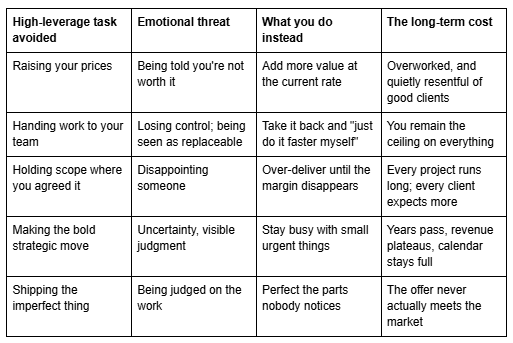
Jennifer (name changed) arrived with an extraordinary background and real expertise, badly undercharging. She'd known for two years that she should raise her prices. She could argue the case better than her coach could and still couldn't make herself send the email.
What moved her wasn't a pricing strategy; she already had one. It was deep reconditioning on what raising the number meant about her. Within 60 days, she'd doubled her prices and more than doubled her revenue. Doubled her prices in 60 days. The strategy was never her problem. Her programming was.
If that lands uncomfortably close, it's worth learning to identify what's actually driving the pattern before you try to out-schedule it.
Is it procrastination or is it self-sabotage?
They're related, and the distinction matters for the fix.
Procrastination is the delay itself. Self-sabotage describes the larger pattern when that delay repeatedly protects you from something psychologically threatening. Procrastination can be one expression of self-sabotage, but it isn't automatically self-sabotage.
Putting off bookkeeping because it's tedious is ordinary delay; a bookkeeper solves it. Putting off the pricing conversation for two years while cheerfully absorbing work you could have delegated is a pattern with a job to do.
The test is repetition and selectivity. If the tasks you keep postponing are consistently the ones where you'd be visible, judged, or refused, that isn't a scheduling issue.
Why doesn't better time management fix self-sabotage?
Because time management optimises the container, and the problem is what you put in it.
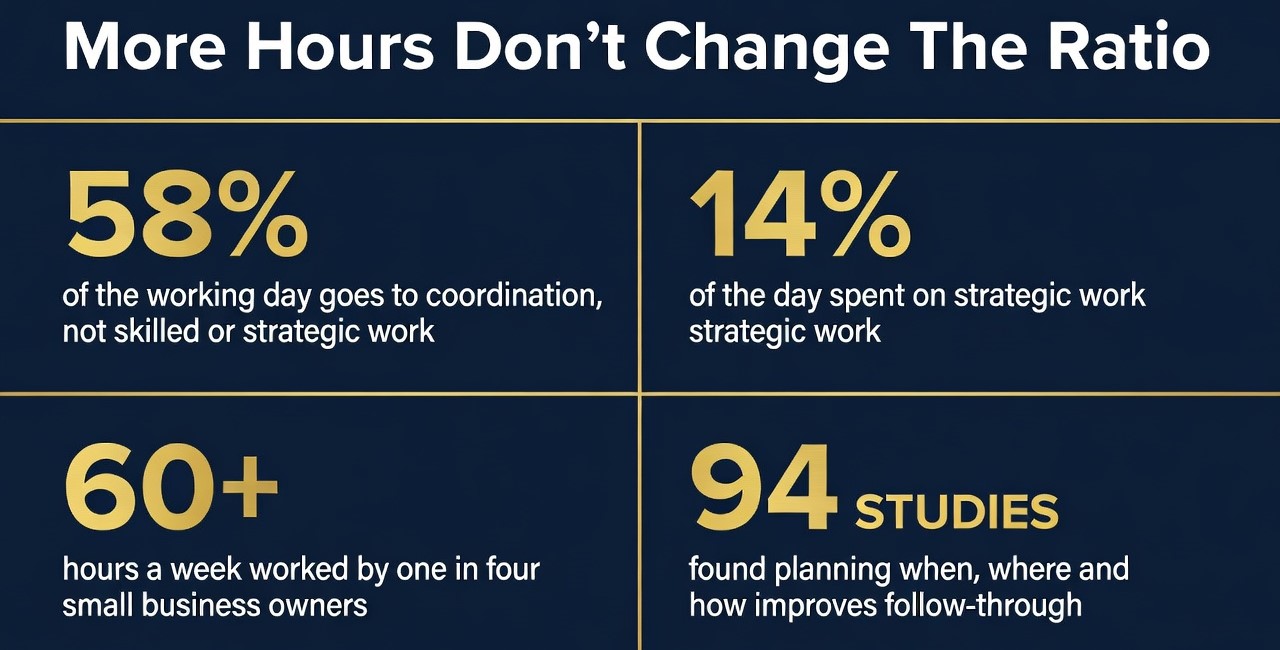
The data is unflattering. Asana's Anatomy of Work Global Index, covering more than 9,600 knowledge workers, found that 58% of the average day goes to coordinating the work about work rather than skilled or strategic work. In an earlier edition, strategic work took roughly 14% of the day. A separate survey of 1,000 knowledge workers found 76% spend under three hours a week on strategy.
Now add owner hours: SCORE reports a third of small business owners work over 50 hours a week and a quarter over 60. Longer weeks, same ratio. More hours just means more room for the substitution.
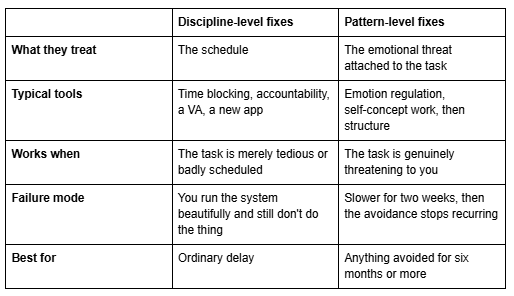
James spent years in the first column. By his fifth business, he was working 80-hour weeks, on anxiety medication, and calling it success: a prison with a nice view. He had systems. He had discipline. He had a calendar that would impress you.
Then his niece asked why he didn't visit anymore.
The realisation wasn't that he needed a better system. It was that the 80 hours were doing something for him: they kept him from ever sitting still with the question of whether he'd built the right thing. Where a leader's hours actually go is rarely where they'd claim they go.
Today he works 25–35 hours a week and he's home for dinner with his phone in another room. Not because he found a better planner.
How do you identify the high-leverage task you're avoiding?
Give this twenty minutes and a piece of paper. Not a document paper. You'll be more honest.
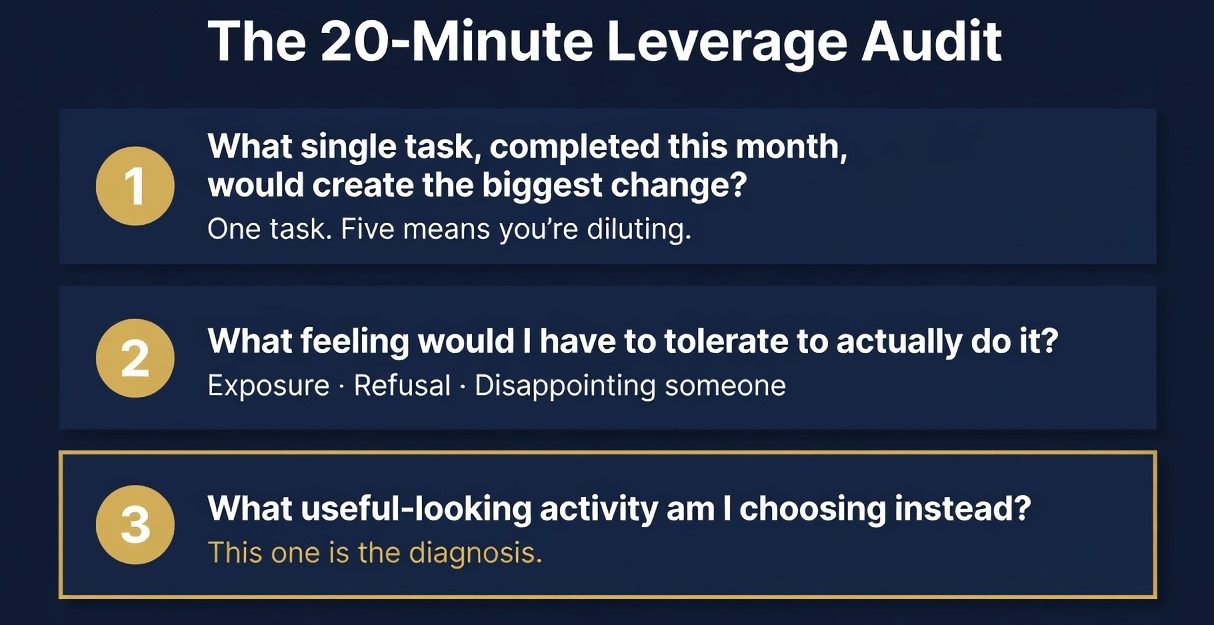
1. What single task, completed this month, would create the biggest change in my business? One task. If you list five, you're already diluting.
2. What feeling would I have to tolerate actually to do it? Name it plainly: exposure, being refused, disappointing someone, being judged on the work. If nothing comes up, you've picked a safe task. Try again.
3. What useful-looking activity am I choosing instead? This is the diagnosis. Whatever fills the hours where that task should live is your substitution, usually something you're good at, which is why it's stayed invisible.
David (name changed) was brilliant at the work and completely trapped by it. His answer to question three was "client delivery," real, valuable work- and precisely where he hid from the task of getting his expertise out of his own head.
Thirty days of documenting processes later, his assistant had taken over most of his inbox, and he took his first proper two-week holiday in five years. First two-week holiday in five years, and the business grew while he was gone. That's what happens when your expertise stops living in your head.
If question two is where you stall, start with the fear underneath the avoidance rather than the task.
What actually changes the avoidance pattern?
Start with what the evidence supports, then how it gets applied.
Two findings are directly relevant. First, emotion regulation skills appear to be trainable rather than fixed: a randomised controlled trial found an online emotion regulation training measurably reduced participants' subsequent procrastination, with the gain in those skills mediating the effect. Second, if-then planning works: Gollwitzer and Sheeran's meta-analysis of 94 independent tests found implementation intentions, specifying in advance when, where and how you'll act, produced a medium-to-large improvement in goal attainment over intention alone.
Read together: work the emotional layer, then automate the initiation. Neither alone is enough. Emotional work without a plan is a nice afternoon; a plan without the emotional work is the productivity system you already abandoned.
How James applies that in coaching. The Limitless Entrepreneur runs on The 5 Shifts to Freedom, and the reason it works is its mechanism: The 3 Pillars: Performance Psychology (the reconditioning that makes the avoided task tolerable), Freedom-First Business Strategy (cutting the 80% so the 20% can produce), and Freedom-First Business Structure (so you stop being the bottleneck). Strategy without psychology is another unfinished course. Structure without both is a prettier prison.
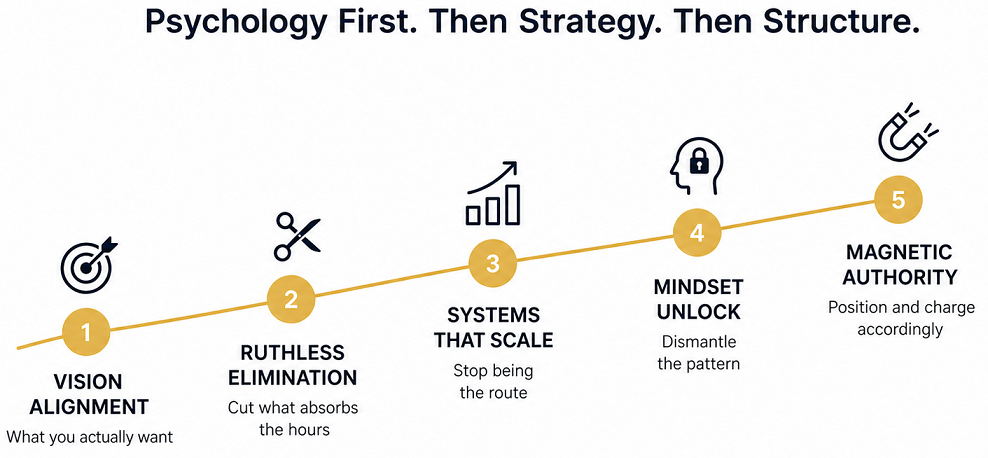
The journey itself, over 16 weeks:
Vision Alignment: Get clear on what you actually want, not what you think you should want.
Ruthless Elimination: Cut the activity absorbing the hours the real work needs.
Systems That Scale: Build leverage so the business stops routing through you.
Mindset Unlock: Dismantle the patterns of can't delegate, undercharges, and over-delivers that reappear every time you try to grow.
Magnetic Authority: Position yourself so the right clients arrive already convinced, and charge accordingly.
This is a coaching framework, not a validated clinical protocol. What the research establishes is the mechanism underneath it: the emotional layer is trainable, and planned initiation beats intention. The five shifts are how that gets sequenced inside a real business.
Who should use this approach?
Coaches, consultants and wellness practitioners with proven results, working 50–60+ hour weeks and plateaued anyway.
Anyone who can name the task they've avoided for six months and has already tried scheduling it.
Owners who keep hiring help, then quietly take the work back.
Who should avoid it?
Pre-revenue founders still testing whether the offer works. Your bottleneck is market feedback, not avoidance.
Anyone wanting a tactic without touching the emotional layer. The tactic will be correct and you still won't do it.
Owners whose delay is genuinely logistical: if the decision itself is the sticking point, start there instead.
What the research tells us
Avoidance functions as emotion regulation; the delay produces immediate mood repair, which is why it repeats.
Self-handicapping supplies an external explanation for a poor outcome before it happens, protecting self-esteem.
Coordination beats strategy on the average day: 58% against roughly 14%. Longer hours don't correct the ratio.
The emotional layer is trainable, and planned initiation beats intention, both shown in the trials above.
Frequently Asked Questions
Why do successful entrepreneurs self-sabotage?
Success raises the stakes rather than lowering them. Once you have a reputation, a team and clients who rely on you, the high-leverage move carries more exposure than it did when nobody was watching, so the avoidance gets stronger, not weaker. This is why self-sabotage in business is so common among people who are demonstrably good at what they do.
How can I tell if I'm avoiding a task because I'm afraid of it?
Check for selectivity and repetition. If the tasks you postpone are consistently the ones where you'd be visible, refused, judged, or forced to disappoint someone while unpleasant-but-safe tasks get done on time, the pattern is emotional, not logistical. A second tell: you can argue the case for doing it better than anyone else can, and still don't.
Is self-sabotage the same as imposter syndrome?
No, though they often travel together. Imposter syndrome is a belief about your competence; self-sabotage is a behavioural pattern of avoidance that protects you from testing that belief. You can hold neither, either, or both and the fix for the behaviour is the same regardless of whether the doubt is present.
Can hiring a virtual assistant or a team member fix it?
Only when the bottleneck is genuinely capacity. If the pattern is avoidance, new help tends to get underused, micromanaged, or quietly overridden while you take the work back. You can't delegate what you won't release, which is why the last hire didn't change anything.
How long does it take to change a self-sabotage pattern?
It varies by person and by how long the pattern has been running, so no honest answer includes a guaranteed timeline. What's consistent is the sequence: address the emotional threat attached to the task first, then build a specific if-then plan for when and how you'll act. Change usually shows up as a task you'd avoided for months finally getting done, not as a sudden shift in how you feel.
What's the single first step if I recognise myself in this?
Name the task, name the feeling attached to it, and name what you've been doing instead. That third answer, the useful-looking substitute, is the one that tells you what's actually happening. Write all three down before you try to schedule anything.
The one thing worth doing this week
You already know which task it is. You knew before you finished the first paragraph and the fact that you can name it while it sits undone is the whole pattern in miniature.
That's not a failure of character. It's a protection that outlived its usefulness and protections can be retired. People who break the plateau don't find more discipline. They stop needing protection from the work that would change everything.
The Freedom Blueprint Call: 45 minutes. We'll find the one thing that's actually keeping you stuck. No pitch unless you ask for one.