Scaling Without Burnout: The 3-Pillar Blueprint
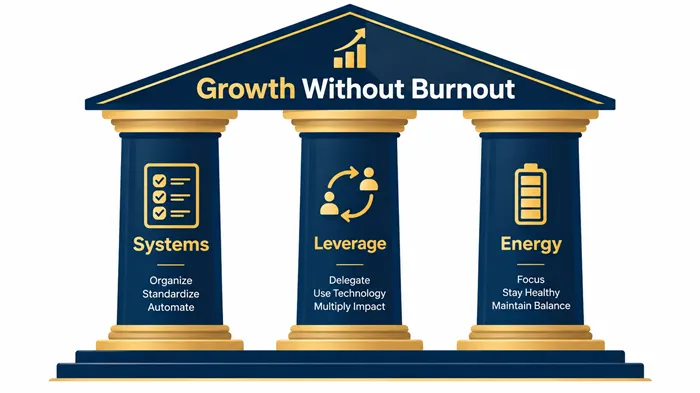
Scaling without burnout means growing your business while it relies less and less on your constant effort. The 3-Pillar Blueprint gets you there in a fixed order. Pillar 1, Systems, moves the work out of your head and into written processes and decision rules. Pillar 2, Leverage, hands off ownership of outcomes instead of isolated tasks. Pillar 3, Energy, protects the sleep, stress response and focus you need to lead well. The WHO describes burnout as exhaustion, growing cynicism about work, and reduced effectiveness, and DDI's 2025 leadership data names delegation as the strongest burnout-prevention skill. Start by choosing the one recurring task that eats the most of your week, writing down how it's done, and handing it off for 30 days.
Key Takeaways
Burnout is a work-stress syndrome of exhaustion, cynicism and reduced effectiveness, so the fix has to change how work is structured, not only how much you rest.
Gallup's research shows burnout risk climbs past 50 hours a week, yet how workload is experienced matters more than hours alone.
DDI's 2025 leadership data ranks delegation first among burnout-prevention skills, and few emerging leaders do it well.
Pillar 1, Systems: write down how recurring work gets done and set clear decision rules.
Pillar 2, Leverage: hand off outcomes with a defined finish line, not scraps of tasks.
Pillar 3, Energy: build a shutdown routine and a calm-state anchor so you recover on purpose.
Start small: one task, one checklist, one 30-day handoff.
What Does Scaling Without Burnout Actually Mean?
If your revenue is climbing while your evenings disappear, you're not alone, and you're not doing it wrong. You're running into a structural problem, and structural problems have structural fixes.
Scaling without burnout means the business grows while your personal workload holds steady or shrinks. The World Health Organization describes burnout as a syndrome that comes from long-term workplace stress that hasn't been managed well. It shows up as three signs: exhaustion, growing mental distance or cynicism toward your work, and a drop in how effective you feel.
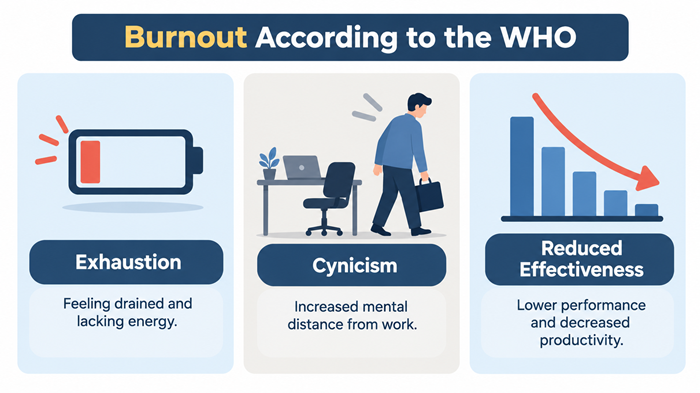
The WHO classes burnout as an occupational phenomenon, not a medical condition, and applies the term to work only. That's useful for founders. If work design causes the problem, work design can fix it.
Why Do Founders Burn Out as the Business Grows?
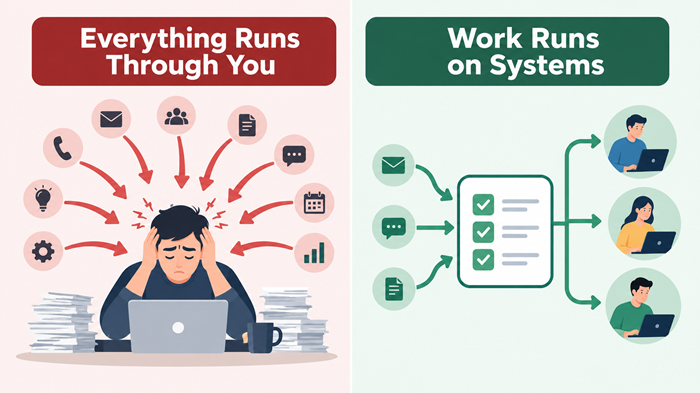
Growth adds decisions, people and exceptions faster than it adds your capacity. When every approval, answer and fix runs through you, the business can only grow as fast as your attention does.
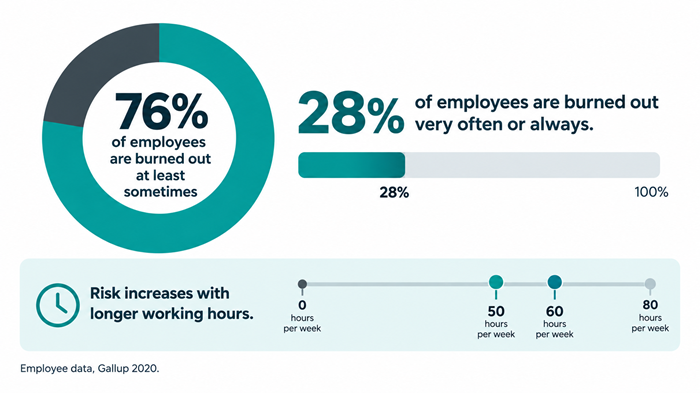
Gallup's research on employee burnout offers a useful pattern. It found that risk climbs sharply past 50 hours a week and rises further beyond 60. It also found that how people experience their workload, including unmanageable demands and unreasonable time pressure, matters more than the raw hour count. Gallup studied employees rather than founders, so treat this as a pattern, not a founder statistic.
Founders feel the same forces without a manager to absorb them. Nobody else decides what can wait. For the day-to-day habits that protect your energy, read our guide on staying energized to avoid burnout.
Data & Findings: What the Research Shows
Here is what the research says, and what each study can and can't tell you.
WHO (2019): Burnout is defined as unmanaged long-term work stress with three dimensions. This is a definition, not a prevalence figure.
Gallup (2020, employees): 76% of employees reported burnout at least sometimes, and 28% reported it very often or always. Hours matter, but so does how the workload feels.
DDI Global Leadership Forecast (2025): In a survey of 10,796 leaders, delegation ranked as the most effective burnout-prevention skill, with about five times the impact of any other method DDI examined. Separate assessments of more than 70,000 manager candidates found only 19% had strong delegation skills. These are leaders and managers, not founders.
Freeman and colleagues (2018): A study of 242 entrepreneurs and 93 comparison participants found that nearly half of the entrepreneurs reported at least one mental health condition, a higher rate than the comparison group (Small Business Economics).
Davidson (2023): Interviews with 37 founders described three phases of letting go: attachment, uncoupling and opportunity. Interviewees said delegating helped their productivity and relationships and reduced burnout. It's a small qualitative study, so treat it as directional.
No single study proves this blueprint prevents burnout. Together they point the same way: workload design, delegation and recovery are the levers you control.
The 3-Pillar Scale-Without-Burnout Blueprint
Each pillar builds on the last. Systems make handoffs possible, and handoffs create the room to recover. Skip the order and you'll end up delegating chaos. For the wider growth picture, see our overview of strategies to scale your business.
Step 1: Systems. Get the Work Out of Your Head
A system is a written way of doing recurring work that someone with basic skills can follow. It also includes decision rules, such as the spending limit your team can approve without asking you. Founders who skip this step hand off tasks and then get the questions back. For a deeper look, read why structure and systems accelerate growth.
Start with a one-week log of every recurring task and every decision you make. Sort each item into three groups: only I can do this, someone else could do this with clear steps, and this shouldn't exist. Pick the biggest time-eater from the middle group and write its steps as a checklist.
Try This: For one week, keep a running list of tasks and decisions. On Friday, circle the single item that took the most hours and that someone else could do with written steps. Write the checklist that weekend. That's your first system.
Step 2: Leverage. Hand Off Outcomes, Not Tasks
Delegation sits at the center of the evidence. DDI's 2025 research ranks it first among burnout-prevention skills, yet only 19% of manager candidates showed strong delegation ability in its assessments.
Davidson's interviews with founders explain why it's hard. Founders start out attached to the business as an extension of themselves, then have to uncouple from decisions before they can use the freed time well. Many stall in attachment, where every handoff feels like a risk to quality.
Hand off an outcome with a clear finish line. "Make sure every invoice goes out by Friday" beats "send the invoices." Add limits on spending and authority, plus a short review date. If you're building the team that receives these handoffs, mastering the art of hiring helps you pick people who can own results.
Try This: Pick one recurring task. Write one sentence that defines done, one that sets the limits of authority, and a date for a 15-minute review. Hand it off for 30 days and resist redoing it yourself.
Step 3: Energy. Recover on Purpose
The WHO's first sign of burnout is exhaustion, so treat your energy as a business metric. Gallup's finding on time pressure points the same way: a calendar with no recovery built in keeps the stress cycle running.
James R. Elliot, an NLP Board Designated Trainer with more than 20 years of experience, has seen capable founders run on willpower until their judgment slips. Recovery needs a routine, not good intentions. Set a firm shutdown time, protect your first working hour for your highest-value task, and train a calm, focused state you can call on demand. Our NLP tools for stress management go deeper on that last piece.
Mike L. came to James caught in self-doubt and second-guessing that kept his mind crowded. After working through limiting beliefs with NLP, he reports less overthinking, clearer listening and more confident communication at work.
Try This: Anchor a calm, decisive state in three steps. First, recall a moment you felt calm and in control, and relive it with all your senses. Second, at its peak, press your thumb and forefinger together for five seconds. Third, repeat daily for a week, then use the same press before a hard conversation. Results build with practice over weeks. This supports your recovery and doesn't replace medical or mental health care.
How to Scale Without Burnout: Your First 30 Days
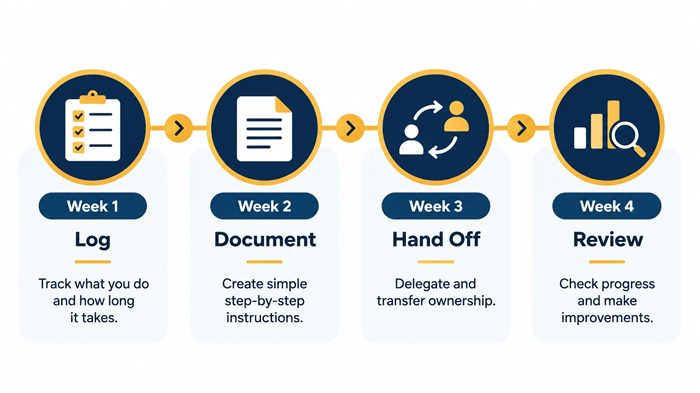
Put it into practice now with this four-week plan:
Week 1: Log every task and decision. Pick your top time-eater.
Week 2: Write the checklist and the decision rules for that task.
Week 3: Hand off the outcome with a clear definition of done.
Week 4: Review. Count the hours you got back and rate your energy from 1 to 10 each evening.
Expect the first hours back within the month. Plan on three to six months of steady practice for the fuller shift.
Hustle, Hire-First or Blueprint: Which Approach Fits?
Hustle works for a short sprint with an end date. Hiring first works when roles and processes already exist. The blueprint works best when you want growth that doesn't depend on your constant effort, because it builds the structure before it adds people.
Approach | Where your hours go | Main burnout risk | Best fit |
Hustle | Your hours cover every gap | Unmanageable workload and constant time pressure | Early stage, short sprint with a clear end date |
Hire-First | Hours shift to managing and fixing | New people without written systems send questions back to you | Steady revenue and roles already defined |
Blueprint | Systems first, then handoffs, with recovery built in | A slower first month while you document | Founders who want growth that doesn't rely on their constant effort |
Who Should Use This?
Founders whose recurring work eats most of the week.
Owners who can hire, outsource or reassign work, even in small amounts.
Anyone noticing early signs: steady exhaustion, cynicism about work they used to enjoy, or slipping effectiveness.
People willing to write things down and let others own outcomes.
Who Should Avoid This?
Anyone in persistent distress, with severe low mood or anxiety. Please speak with a qualified health professional first. This blueprint is not treatment.
Pre-revenue founders still validating an idea. There's little recurring work to systemize yet.
Owners unwilling to let anyone else own a result. The blueprint depends on real handoffs.
Frequently Asked Questions
Is burnout the same as stress?
No. Stress is a reaction to demands and can be short-lived. The WHO describes burnout as the result of long-term workplace stress that hasn't been managed well, with exhaustion, cynicism and reduced effectiveness as its signs.
What are the early signs of founder burnout?
Watch for the WHO's three signs: running low on energy, feeling distant or cynical about your work, and doubting your own effectiveness. A practical early signal is dreading tasks you used to enjoy.
When should I start delegating?
As soon as a task recurs and you can write down its steps. Waiting for the perfect moment usually means waiting until you're overloaded. DDI's data suggests the skill takes deliberate practice, so start with one low-risk task.
How long until I feel relief?
Many founders reclaim their first hours within a month of the first handoff. A fuller shift usually takes three to six months of steady practice, because systems and trust build gradually.
Can NLP help with burnout?
NLP tools can help you manage your stress response and loosen limiting beliefs that make letting go feel risky. They support recovery and decision-making, and they don't replace medical or mental health care when you need it.
Conclusion
Scaling without burnout comes down to three moves. Build systems so the work lives outside your head. Hand off outcomes so the business stops waiting on you. Recover on purpose so your judgment stays sharp. You don't need to overhaul everything this month. Choose one task, start the 30-day plan, and take decisive action. When you want a guided plan built around your business, explore business coaching with James R. Elliot.