
Why Scaling Requires Subtraction Not Addition
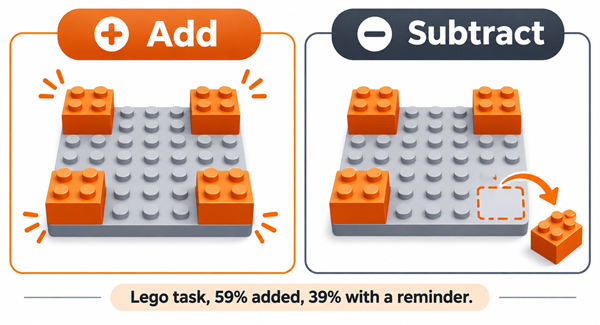
Scaling often requires subtraction because every offer, client, tool and meeting you add also adds coordination work, while your attention stays fixed. Research suggests people default to adding: in a Nature study of eight experiments, a majority of participants in a Lego task added bricks when removing one would have worked, and a simple reminder reduced that tendency.
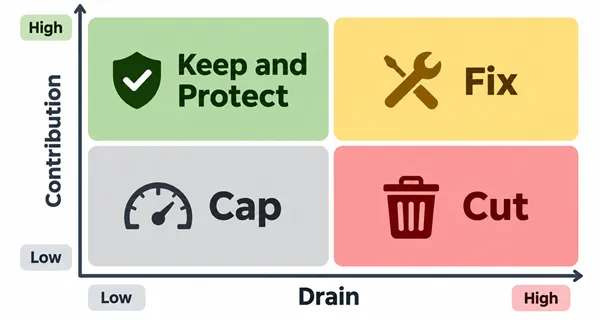
In a Bain survey, 85% of CEOs of companies that stopped creating value blamed internal factors such as complexity. Use the Subtraction Quadrant: rate each activity by contribution and drain, keep what contributes with low drain, fix what contributes with high drain, cap low-drain extras and cut what drains without contributing. These findings come from lab tasks and large firms, so test the idea in your own business before cutting anything critical.
Key Takeaways
Most of us default to adding: a new offer, a new tool, another meeting. Removing rarely comes to mind first.
Each addition brings coordination work, and your attention doesn't grow with it.
Rate every activity on contribution and drain, then sort it into the Subtraction Quadrant.
Start with what contributes little and drains a lot. Remove one item at a time.
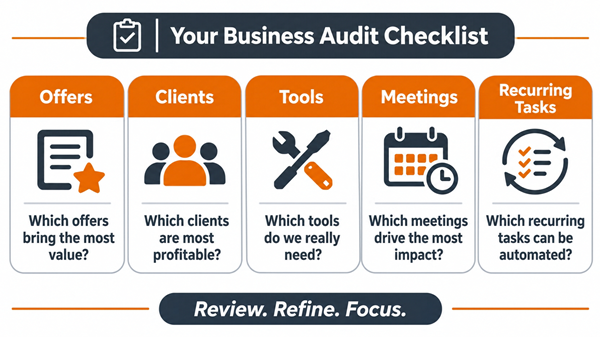
Audit five places: offers, clients, tools, meetings and recurring tasks.
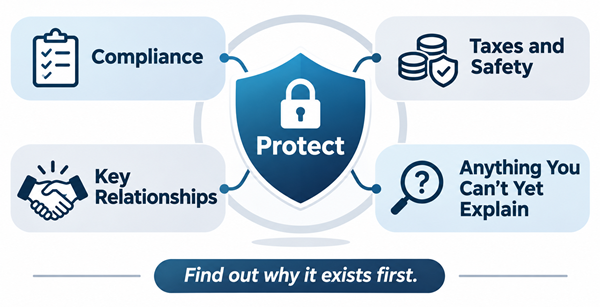
Don't cut compliance, safety or key relationships, and find out why something exists before removing it.
The research here comes from lab tasks and large firms, so treat the method as a practical test, not a proven rule.
Why Your Business Keeps Getting Heavier
You launched a new offer because a client asked. You added a tool to fix a missed follow-up. You started a weekly check-in to stay on top of things. Each move made sense. Yet your week feels heavier, and the growth you wanted feels further away.
There's a reason this happens. In a Nature study by Adams, Converse, Hales and Klotz, participants had to stabilize a Lego platform. A majority added bricks, even though removing one brick would have worked at no cost. In the summary we read, 59% added, and a reminder that removing pieces was free brought that down to 39%. The researchers ran eight experiments and found people were more likely to spot subtraction when something cued them to consider it.
Both pages we read are press summaries, since the paper itself is closed access, so we couldn't check sample sizes. The Lego result also comes from a lab task, not from a business. Even so, it describes something many founders recognize: adding feels natural, and removing takes deliberate effort.
If you've been building more structure to cope, our guide to why structure and systems are key to accelerating pairs well with this one. Systems work best when you've first removed what shouldn't be there.
What Complexity Costs
Bain & Company's 2017 brief on complexity reported that in its survey, 85% of CEOs whose companies stopped creating value blamed internal factors such as complexity, not outside forces. The article didn't state the sample size or years, it concerns large public companies, and Bain sells complexity-reduction services. Read it as a signal, not a measurement of your business.
An MIT Sloan Management Review article makes a related argument: when leaders keep adding products, tools and processes, the people who serve customers absorb the burden. It rests on an example and the author's experience, not on a dataset. In a solo or small business, you are the front line, so every addition lands on you.
The Subtraction Quadrant
The Subtraction Quadrant is a simple way to decide what to remove. Score each activity from 1 to 5 on two questions. Contribution: does it produce revenue, retention or results? Drain: how much time, attention, money or stress does it cost? A score of 3 or higher counts as high.
Quadrant | Contribution | Drain | Rule |
Keep and protect | High | Low | Guard the time it needs, and resist adding extras around it. |
Fix | High | High | Keep it, but cut the drain with a template, automation or a handoff. |
Cap | Low | Low | Allow it within a limit, such as a time box or a review date. |
Cut | Low | High | Remove it first, one item at a time. |
Score from your own records, not your feelings. Check your calendar for time spent, your invoices for revenue and your inbox for the messages an item generates. If you can't score something, that's useful information too, and it usually means you've never measured it.
Start with the Cut box, because it frees time at the lowest risk. Then work on Fix. Remove one item at a time and watch for two to four weeks so you can see what changes. Write down what you expect to happen, such as hours reclaimed or a change in sales, so you can compare it with what actually happens. Prefer reversible cuts first, such as pausing instead of deleting.
For handing off items in the Fix box, our article on strategies to scale your business covers growth paths, and effective decision making can help when you're stuck on a call.
The Audit: Five Places to Subtract
Set aside sixty minutes and list everything you do in each area. Then walk through each one and ask the matching question. NLP trainers like James R. Elliot use a meta-model challenge that fits here: what would happen if I didn't?
Offers. Does this offer return more revenue than the attention it demands?
Clients. Do this client's results and fit justify the time they take?
Tools. Does it save more time than it costs to maintain?
Meetings. Would the outcome happen without this meeting?
Recurring tasks. What would break if I stopped for four weeks?
Cutting takes Courageous Action, one of the five pillars James teaches. It's normal to feel a pull to keep everything. Name that feeling, then let the numbers decide.
A Sample Cut List
Here's a hypothetical solo consultant, Sam, who scored twelve activities. This table shows six. The example is an illustration, not a result from a real business.
Activity | Contribution | Drain | Quadrant | Decision |
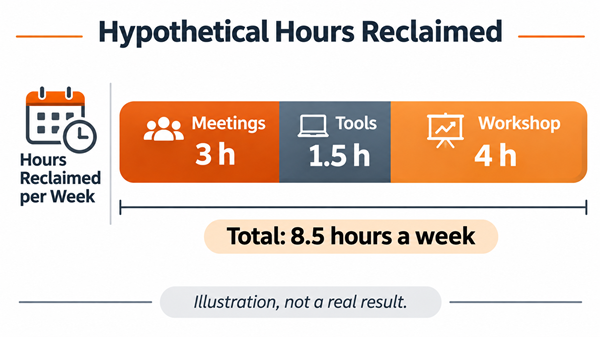
Three recurring standing meetings (3 hours a week) | 2 | 4 | Cut | Drop all three |
Two overlapping scheduling and CRM tools (1.5 hours a week) | 2 | 4 | Cut | Consolidate to one |
Low-selling group workshop (4 hours a week) | 2 | 5 | Cut | Retire after the current cohort |
Flagship advisory package | 5 | 2 | Keep and protect | Protect two weekly blocks |
Proposal writing | 5 | 4 | Fix | Build a template |
Monthly newsletter | 2 | 2 | Cap | Time box to 90 minutes |
Add up the Cut items and Sam gets 8.5 hours a week back: 3 from the meetings, 1.5 from the tools and 4 from the workshop. Sam then spends part of that time on proposals and the flagship package, where contribution is high.
WANT HELP SORTING YOUR OWN LIST? Bring your scored list to a short call and decide your first three cuts together. Book a 30-minute connection call. |
Three Thoughts That Stop You From Cutting
"I already paid for it." Money and time you've already spent are gone either way. The only question is whether the next hour on this item is worth it.
"What if I need it later?" Pause first. Most paused items can be restarted, and knowing you can restart makes cutting feel safer.
"A client might ask for it." Maybe, and you can ask them. If three clients love something, its contribution score is higher than you thought. Let their answers change your numbers, not your nerves.
What Not to Cut
Subtraction is selective. Don't cut anything tied to compliance, taxes, safety or contracts. Don't cut a key relationship because it scores badly on a single week. And pause before removing anything whose purpose you can't explain yet. Find out why it exists first, since some quiet processes protect you from problems you rarely see.
If you're short on time to run this audit, our guide on how to be more productive offers quick ways to make room. For a wider view, see business strategies for growth.
Who Should Use This
Founders whose week feels heavier even as revenue grows.
Owners who keep adding offers, tools or recurring commitments.
Anyone willing to score honestly and remove one item at a time.
Who Should Avoid This
Anyone about to cut required legal, tax or safety work.
Very early-stage founders still testing which offers work. You may need more experiments first.
People who want to cut everything at once. Change one item at a time.
Data & Findings
Here is what the sources show and where they fall short. We found no study testing the Subtraction Quadrant itself, so treat it as a practical method.
Nature study (2021): Eight experiments found people overlook subtractive changes. In a Lego task, 59% added bricks, and a reminder lowered that to 39% in the Darden summary. We read only press summaries, with no sample sizes, and the researchers' explanations are interpretations.
Bain survey (2017): 85% of CEOs of companies that stopped creating value blamed internal factors such as complexity. Large public firms, no stated sample size, and a consultancy that sells related services.
MIT Sloan Management Review: An argument that added products, tools and processes burden front-line staff. It uses a hypothetical example and cites no formal data.
Practical guides: SMBCEO's subtractive operations piece suggests a quarterly kill list and tool audits, but offers no statistics.
FAQs
Why do we add instead of subtract?
Research suggests subtracting takes more deliberate effort, and people often don't think of it unless something prompts them. Adding feels like progress, so it comes to mind first.
What should I cut first in my business?
Start with items that contribute little and drain a lot, such as low-value meetings, overlapping tools and a weak offer. Remove one at a time and watch the effect.
Won't cutting offers lower my revenue?
It can, if you cut something that contributes. The quadrant protects high-contribution items. Test with a pause first, and review the numbers after a few weeks.
How do I know something is safe to remove?
Ask what would break if you stopped for four weeks, and find out why it was added. Leave compliance, safety and key relationships alone.
How often should I run this audit?
Many owners find a quarterly review works well. There's no research-backed schedule, so pick a rhythm you'll keep.
Conclusion
Growth doesn't always come from doing more. Often it comes from removing what weighs the business down, so your best work has room. Take decisive action this week by scoring your list and choosing one Cut item. When you'd like a partner to sort it out, book a 30-minute connection call.
Unleash Your Power: Stand Out, Take Action, and Create the Success You Want.