Sustainable Scaling: Growing Your Impact Without Burning Out
Sustainable scaling means growing the impact and revenue of your business without requiring a proportionate increase in the founder's personal working hours, or in the cognitive and emotional load those hours carry. Most scaling strategies that service-based entrepreneurs follow achieve growth in the short term by adding more: more clients, more team members, more offers, more marketing channels. Each addition increases revenue and simultaneously increases operational complexity, decision volume, and founder dependency, which is why businesses that grow fast through volume addition consistently plateau at a burnout ceiling rather than scaling through it. Sustainable scaling works differently. It grows impact through leverage, by deepening the power of the methodology, the authority of the brand, and the autonomy of the operational systems, so that more value reaches more clients without requiring more of the founder personally. The result is a business that grows its revenue and its positive impact simultaneously with its founder's freedom, rather than at the expense of it. This requires three architectural decisions: choosing only the scaling levers that compound rather than deplete, building the systems that handle growth volume without founder intervention, and designing a premium market position that grows revenue per client rather than requiring revenue through client volume.
Key Takeaways
Volume Scaling Burns Out. Leverage Scaling Compounds: Adding more clients to a founder-dependent model adds more burnout. Adding more leverage, through systems, methodology, authority, and team autonomy, adds more impact without adding founder hours. The scaling method determines the burnout trajectory, not the ambition level.
Most Scaling Plateaus Are Burnout Ceilings in Disguise: The business that "hits a wall" at $300K, $500K, or $1M is almost always hitting the founder's personal capacity ceiling, not a genuine market ceiling. The market has more demand. The founder has no more hours. Sustainable scaling builds through that ceiling by removing the founder's hours from the scaling equation.
The Right Order: Depth Before Width: Scaling width (more clients, more markets, more offers) before scaling depth (more leverage per client, stronger methodology, more autonomous delivery) consistently produces the most fragile, burnout-prone business models. Depth first, then width, at every stage of growth.
Impact and Freedom Are Not in Tension: The conventional assumption is that greater impact requires greater sacrifice of personal freedom. The Limitless Entrepreneur methodology inverts this: a properly architected business reaches more people, with better results, with less founder involvement, because the systems, methodology, and team carry the impact rather than the founder's personal hours.
The Leverage Stack Has a Correct Build Order: There are five leverage levers available to a scaling service business. They must be built in sequence, foundation levers before amplification levers, or the amplification makes the existing structural problems worse faster.
Why Growth Makes Burnout Worse (Before It Gets Better)
There is a cruel pattern that appears almost universally in the growth trajectory of service-based businesses: the harder the founder works to grow, the more burned out they become, and the faster the growth, the faster the burnout compounds.
This is not a paradox. It is the predictable arithmetic of adding volume to a founder-dependent model.
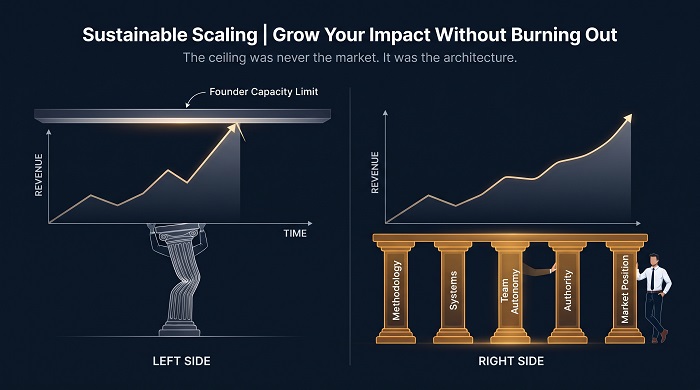
If the business requires one hour of founder time per client per week, then adding ten clients adds ten hours of founder time per week. Add twenty clients and the working week extends by twenty hours. The revenue grows. The burnout grows proportionately. Eventually the founder hits their biological capacity ceiling, there are no more hours in the week, and the business stops growing at exactly the point where it feels like it should be breaking through.
This is the burnout ceiling. It is not a market problem. It is an architecture problem. And it is the most common growth plateau experienced by premium service founders.
The solution is not to work harder or hire more people into the same broken model. It is to change the scaling lever, from volume addition to leverage multiplication.
The Scaling Method That Changes the Equation
Leverage multiplication means that each architectural improvement to the business, a better-documented methodology, a more capable and authoritative team, a more precisely defined premium offer, a more powerful brand position, produces more impact per unit of founder input rather than the same impact per additional founder hour.
This is the fundamental difference between sustainable scaling and burnout scaling. One multiplies the denominator (the founder's hours) in proportion to the numerator (impact and revenue). The other multiplies the impact and revenue while keeping the denominator, the founder's strategic hours, constant.
"Scaling by adding volume to a broken model is not growth. It is accelerated collapse at a higher revenue figure. Sustainable scaling builds the leverage architecture first — then lets volume flow through it." — James R. Elliot
The Impact vs. Input Matrix
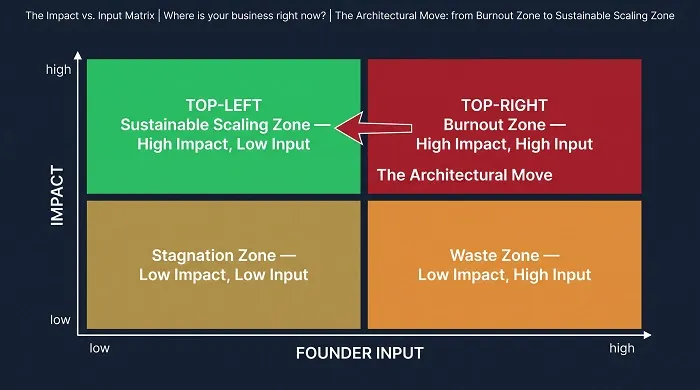
Every scaling decision a founder makes can be positioned on two axes: the impact it produces (for clients, for the business, for the market) and the founder input it requires (personal hours, cognitive load, emotional energy). Sustainable scaling lives in one specific quadrant of this matrix — and most founders spend the majority of their growth energy in a different one entirely.
Impact ↑ / Input → | LOW Founder Input | HIGH Founder Input |
HIGH Impact | ✓ SUSTAINABLE SCALING ZONE | ⚠ THE BURNOUT ZONE |
LOW Impact | — STAGNATION ZONE | ✗ THE WASTE ZONE |
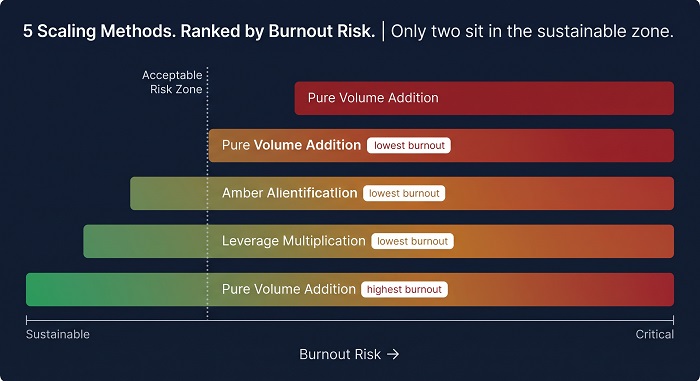
The Five Scaling Methods Ranked by Burnout Risk
Not all growth strategies carry the same burnout risk. This matrix ranks the five most commonly pursued scaling approaches in service businesses, from the highest burnout risk to the most sustainable, with the specific mechanism that determines each ranking.
Scaling Method | How Founders Use It | Why It Burns Out | Burnout Risk | Sustainable Version |
1. Pure Volume Addition | Taking on more clients without changing the delivery model. Revenue grows by working more hours. | Revenue and burnout grow at exactly the same rate. Hits biological capacity ceiling within 6–18 months. No escape route without business disruption. | CRITICAL | None. Volume addition without model redesign has no sustainable version. The model must change before volume can scale. |
2. Team Addition Without Systems | Hiring team members to handle workload without documenting processes or building decision authority. | Each new team member requires founder supervision. Management workload increases alongside delivery workload. Net effect: more hours, more complexity, same ceiling. | HIGH | Build systems first. Hire into documented processes with clear decision authority. Team addition only reduces burnout when the architecture precedes the headcount. |
3. Offer Diversification | Adding new service lines, digital products, or membership programmes on top of existing offers. | Each new offer requires separate delivery, marketing, and client management, typically managed by the founder personally. Often creates a second business running alongside the first. | MEDIUM | Simplify first, then add one systematised high-leverage offer. Diversification only works sustainably when all existing offers are running autonomously before new ones are added. |
4. Premium Repositioning | Moving upmarket: fewer, higher-value clients at significantly higher prices. Same or lower delivery hours per client, but more value delivered per engagement. | Minimal burnout risk if accompanied by methodology extraction. Risk arises if premium price is charged without a premium experience that the team can deliver systematically. | LOW | Premium repositioning is inherently sustainable when combined with Pillar 2 strategy and Pillar 3 systems. Fewer clients, higher revenue per client, team-delivered methodology. |
5. Leverage Multiplication | Building methodology, authority, systems, and team capability that compound, each investment produces more impact per unit of founder input over time. | No characteristic burnout mechanism. Each architectural improvement reduces founder dependency per unit of output. Growth and freedom move in the same direction. | SUSTAINABLE | This IS the sustainable version. The Leverage Stack (methodology + authority + systems + team autonomy + market positioning) is the architecture of permanent sustainable scaling. |
The Leverage Stack: Building in the Right Order
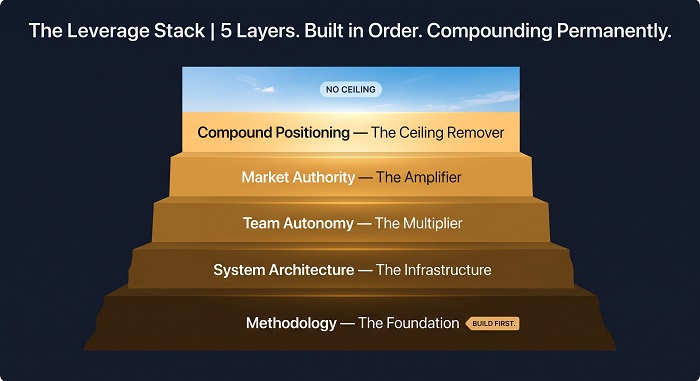
The Leverage Stack is the sequence of compounding architectural investments that produce sustainable scaling. Each layer must be built before the next one can compound effectively, building out of sequence consistently produces fragile, burnout-prone growth.
Layer 1 — Methodology (The Foundation)
The documented, named, proprietary process through which the business delivers results. Before any other leverage lever can be built, the methodology must exist in written form, not in the founder's head. An undocumented methodology is not an asset. It is the founder's personal knowledge, inseparable from the founder's personal time. Once documented, it becomes a business asset that can be taught, delegated, improved, and eventually expanded without the founder's ongoing personal involvement in every engagement.
Layer 2 — System Architecture (The Infrastructure)
The Four-Component operational infrastructure that allows the methodology to be delivered autonomously: documented processes, decision frameworks, quality benchmarks, and accountable owners. Without this layer, the methodology exists as a document but is delivered by the founder personally every time. With this layer, the methodology is delivered by the team at the same standard, without the founder's operational presence.
Layer 3 — Team Autonomy (The Multiplier)
A team that has genuine decision authority, deep familiarity with the methodology, and full accountability for the system's performance. This layer multiplies the system architecture by giving it human judgment — the capacity to handle non-standard situations within the documented framework without escalating to the founder. A team without autonomy is a supervision burden. A team with autonomy is a leverage multiplier.
Layer 4 — Market Authority (The Amplifier)
The founder's visible thought leadership, premium brand positioning, and strategic market relationships, built in the protected time that Layers 1–3 have freed. Market authority amplifies every other layer: it attracts the premium clients who fit the methodology, generates inbound demand that reduces acquisition costs, and establishes a price position that reflects outcome value rather than hourly input. This layer is only available when the founder's operational hours have been genuinely freed by Layers 1–3.
Layer 5 — Compound Premium Positioning (The Ceiling Remover)
The strategic condition in which the business's market position, methodology reputation, and client outcomes compound over time, generating better clients, stronger results, and higher revenue without proportionate increases in operational complexity. At this layer, the business is growing not because the founder is working harder but because the authority and the architecture are compounding. This is the permanent removal of the burnout ceiling.
The Framework: The 5 Shifts to Freedom and Sustainable Scaling
The 5 Shifts to Freedom are the sequential build programme for the Leverage Stack. Each shift corresponds to a specific layer of the sustainable scaling architecture.
The 3 Pillars and Their Scaling Role
Pillar 1 — Performance Psychology: The psychological prerequisite for sustainable scaling. A founder whose identity is fused with operational busyness will unconsciously resist every scaling lever that reduces their personal involvement, because each reduction feels like a loss of worth. Pillar 1 dissolves this resistance, making genuine leverage possible. Without it, the founder builds systems and then re-enters them, builds team authority and then overrides it, builds market authority time and then fills it with operational tasks.
Pillar 2 — Freedom-First Business Strategy: Determines the scaling method. Pillar 2 selects the leverage-based scaling approach (Premium Repositioning and Leverage Multiplication) over the volume-addition approach. It simplifies the offer suite to the point where the methodology can be extracted, documented, and delegated — and positions the business at the premium end of the market where sustainable scaling produces the highest return per founder hour.
Pillar 3 — Freedom-First Business Structure: Builds the Leverage Stack Layers 1–3, the methodology documentation, the system architecture, and the team autonomy framework. This is the operational infrastructure without which sustainable scaling is a strategy document rather than a lived reality.
Shifts Mapped to the Leverage Stack
Shift 1 — Vision Alignment → Methodology Design: The vision of the sustainable business defines the methodology, what it delivers, to whom, measured by what outcomes. The methodology cannot be designed without the vision, and the vision is not operational without the methodology.
Shift 2 — Ruthless Elimination → Layer 1 Preparation: The methodology can only be documented if the number of distinct delivery processes is small enough to be manageable. Ruthless Elimination reduces the offer suite to the point where Layer 1 (Methodology) can be built cleanly and completely.
Shift 3 — Systems That Scale → Layers 2 and 3: The system architecture and team autonomy are built here, the two layers that convert the documented methodology from a founder-delivered to a team-delivered asset. This is the primary build phase for sustainable scaling infrastructure.
Shift 4 — Mindset Unlock → Releasing the Leverage: The psychological release that allows the leverage to actually work. The founder must genuinely trust the methodology in the team's hands, the systems to maintain quality, and the decision frameworks to handle non-standard situations. Without this shift, the leverage is installed but not released, the founder continues to insert themselves into the chain.
Shift 5 — Magnetic Authority → Layers 4 and 5: With Layers 1–3 operational and the leverage released, the founders freed strategic hours are invested in thought leadership and premium positioning, building the Market Authority (Layer 4) and Compound Premium Positioning (Layer 5) that remove the growth ceiling permanently.
Case Evidence: Scaling Without the Burnout
Marcus — From Volume Ceiling to Leverage Compound
Marcus had hit the volume ceiling at 20 clients. Every additional client required a proportionate addition of his personal time. He had reached his biological capacity. Revenue was plateaued. He had been at the same revenue level for 11 months, not because the market lacked demand, but because he lacked the architecture to serve more clients without serving each one personally.
Through the Leverage Stack, we built in sequence. Layer 1: Marcus's delivery methodology was extracted into a 34-page documented framework, "The Clarity Framework", complete with session structures, client assessment tools, and outcome benchmarks. Layer 2: The Four-Component Architecture was built around it. Layer 3: Marcus's associate was trained in The Clarity Framework and given full delivery authority for six of the 20 client accounts. Layer 4: With 12 hours per week freed from delivery, Marcus began producing fortnightly thought leadership content, the first time in two years he had the cognitive space to do so.
At the six-month mark: his associate now served 14 clients autonomously. Marcus served 6 premium flagship clients personally. Total client accounts: 20. Total revenue: significantly above the previous plateau, because the associate's capacity had been added without reducing Marcus's premium engagement quality. Marcus's working week: 26 hours. The burnout ceiling was gone because the volume was no longer flowing through Marcus personally.
David — Scaling Impact Without Scaling Hours (Name Changed)
David's scaling challenge was different. He was not at a volume ceiling, he was at a quality ceiling. He could take more clients, but the quality of their outcomes degraded as his operational bandwidth was consumed by management and administration. More clients meant worse results, which meant worse referrals, which eventually would have meant a declining client base despite a growing founder workload.
Through Layer 2 (System Architecture) and Layer 3 (Team Autonomy), we rebuilt his operational model. Every administrative and coordination task was systematised and delegated. David's personal delivery time, previously consumed 60% by admin and coordination — was freed to be 100% client-facing. He served the same number of clients. But the quality of outcomes improved measurably because his delivery time was now genuinely focused.
Within 90 days, his referral rate increased because client outcomes improved. He had scaled his impact without adding a single working hour, by removing the operational drag that had been consuming his highest-leverage delivery hours.
Decision Framework: Which Scaling Layer Should You Build First?
Build Layer 1 (Methodology) first if: Your delivery is inconsistent across clients or team members. The quality of results depends on which team member handles the engagement. You have never written down exactly what you do in a replicable, teachable format. Without a documented methodology, every other layer is built on an invisible and unverifiable foundation.
Build Layer 2 (System Architecture) first if: Your methodology exists in documented form but delivery still requires daily founder oversight. The decision frameworks and quality benchmarks that allow team members to execute independently are missing. Layer 2 converts a documented methodology into an autonomous delivery system.
Build Layer 3 (Team Autonomy) first if: Systems exist but team members do not trust their own authority within them, and consistently escalate to the founder for decisions the framework already covers. The problem is not the system, it is the clarity and confidence of the authority structure.
Invest in Layer 4 (Market Authority) if: Layers 1–3 are operational. You have genuine protected time available for thought leadership. Investing in authority before the operational layers are complete produces excellent content written by an exhausted founder with no time to follow through on the relationships it generates.
Try This: The 30% Growth Test
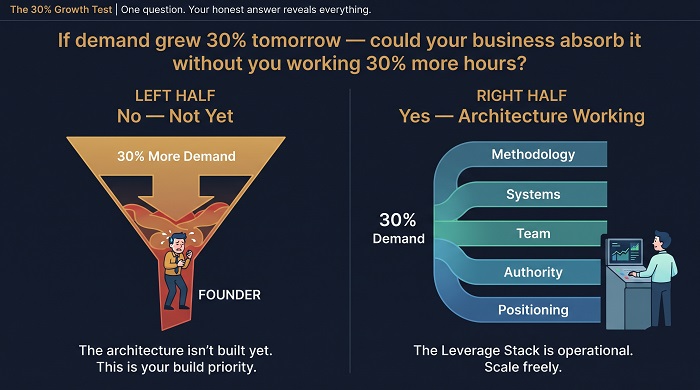
The Test Ask yourself this single question with complete honesty: "If my business received 30% more client demand tomorrow, 30% more enquiries, 30% more signed agreements, could the business absorb and serve that volume without me working 30% more hours?"
If the answer is yes: your Leverage Stack is working. The systems, team, and methodology are carrying growth capacity independent of your personal hours. You are already in the Sustainable Scaling Zone.
If the answer is no, or if the question triggers immediate anxiety about the operational implications: your current scaling ceiling is your own capacity. The architecture is not yet built to absorb growth. The 30% demand increase would flow directly to you personally, as additional client calls, additional decisions, additional oversight, and produce 30% more burnout alongside 30% more revenue.
The Build Target The layer that you would need most urgently to absorb that 30% is your immediate build priority. Name it. Start building it this week, not the week you hit the ceiling.
Further Reading (Internal & External Links)
Strategies to Scale Your Business — the Pillar 2 strategic moves that shift scaling from volume addition to leverage multiplication.
Harnessing Structure & Systems — building the Layer 2 System Architecture and Layer 3 Team Autonomy that carry sustainable growth.
Entrepreneurial Mindset Through NLP — the Pillar 1 work that makes the psychological release of leverage genuinely possible.
Effective Decision Making — how to build the decision authority structures that give team members the confidence to operate without founder escalation.
Harvard Business Review: Driving Growth While Building Resilience — external research on why sustainable business growth requires architectural resilience rather than founder-driven volume addition.
Frequently Asked Questions
What is sustainable scaling and how does it differ from conventional business scaling?
Sustainable scaling grows a business's impact and revenue without requiring a proportionate increase in the founder's personal working hours. Conventional scaling, adding more clients to a founder-dependent model, grows revenue and founder burnout at the same rate, producing a growth ceiling at the founder's biological capacity. Sustainable scaling uses leverage architecture (documented methodology, autonomous systems, team authority, and market positioning) to grow the business's capacity independently of the founder's hours. The practical result: revenue increases while working hours stay constant or reduce.
Why do service businesses hit a growth ceiling and how can they break through it?
Service businesses hit a growth ceiling when their delivery model requires proportionate founder time per additional client. The ceiling is reached when the founder has no more available hours, typically between $200K and $800K in annual revenue depending on pricing. Breaking through requires changing the scaling lever: from volume addition (more clients through the same founder-dependent model) to leverage multiplication (the same or more clients through a systematised, team-delivered methodology). The ceiling is never a market problem. It is always an architecture problem.
How do you scale impact without scaling founder hours?
Through the Leverage Stack, built in sequence. Layer 1: document the delivery methodology into a named, replicable framework. Layer 2: build the Four-Component System Architecture around it (process + decision framework + quality benchmark + accountable owner). Layer 3: install genuine team autonomy, decision authority and accountability without founder supervision. Layer 4: invest freed founder time in thought leadership and market authority. Layer 5: allow the compound effect of authority and architecture to drive growth without additional founder input. Impact scales through the methodology and the team, not through the founder's personal hours.
Is it possible to scale a premium, high-touch service business without reducing quality?
Yes, and in the best-documented cases, quality improves as the leverage architecture is built. David's case above illustrates this precisely: his delivery quality improved when the administrative and coordination burden was removed, freeing his delivery hours for genuine high-value work. Jennifer's methodology documentation produced consistent, measurable client outcomes that exceeded what had been achieved through her personal, non-systematised delivery. Premium, high-touch services are scalable when the quality standard is embedded in the methodology and enforced through the quality benchmark component of the system architecture, rather than depending on the founder's personal quality judgment in every engagement.
What is the first thing to do if you want to begin scaling sustainably?
Run the 30% Growth Test. If your business cannot absorb 30% more volume without 30% more founder hours, identify which Leverage Stack layer is missing and start building it this week. The most common starting point is Layer 1 (Methodology): most service founders have never documented their delivery process in a format that a team member could follow independently. A 34-page methodology document, produced through the Live Narration Extraction process described in the companion article on building business systems, is typically the single highest-leverage first action for a service business beginning the sustainable scaling journey.
Conclusion: The Ceiling That Was Never Real
James R. Elliot believed, for the better part of two decades, that the growth ceiling he kept hitting was a market problem. Not enough demand. Wrong positioning. Wrong price point. He would adjust one variable, break through briefly, and hit a new ceiling at a slightly higher revenue figure, exhausted at each new level, unable to understand why more success felt worse than the level before.
The ceiling was never the market. It was always the architecture. More precisely: the absence of it. Every ceiling was the biological and cognitive limit of a single human being serving as the entire operational system of a business that should have been running on documented methodology, autonomous systems, and a capable team with genuine authority.
The day the architecture was installed, fully, across all five layers of the Leverage Stack, the ceiling disappeared. Not because the market grew. Not because the founder worked harder. Because the business was finally designed to carry more than one person's capacity. Because growth could flow through the systems rather than through the founder personally. Because impact and freedom were, for the first time, moving in the same direction rather than competing for the same limited resource.
He visits his niece now. He takes a 36-minute nap every afternoon. He works 25 hours per week. His business impact, the number of founders served, the depth of results delivered, the authority of the methodology in the market, is greater than at any point when he was working 80 hours per week carrying it all personally. That is what sustainable scaling produces. Not compromise. Not moderation. Compound growth without a ceiling, and the freedom to enjoy it while it compounds.
Ready to identify which layer of your Leverage Stack to build first? Book the Freedom Blueprint Call (30 mins). We will run the 30% Growth Test together and design the precise build sequence for your sustainable scaling architecture.