

Redefining Success: Why a Bigger Business Doesn't Have to Mean a Heavier Burden
Redefining success in business means measuring growth two ways at once: what the business produces, and what it requires from the owner. If revenue rises while owner hours, decision load and personal sacrifice rise with it, the business is growing in size without growing in freedom.
Research on working hours consistently finds output per hour falling sharply past roughly 50 hours a week, so the owner working 65 is not buying more business, only more fatigue at full price. The fix is structural, not motivational.
Address the unconscious programming behind over-delivering and control, cut the low-leverage work, then rebuild operations so the owner is no longer the routing point for every decision. Fewer hours are the visible result, not the goal.
Key Takeaways
Redefining success means measuring what the business produces and what it requires from you. Size without autonomy is accumulation, not success.
The heaviness isn't the price of growth. It's the ceiling on it: growth × owner dependency = a heavier business.
Hours are a lever with a hard ceiling: output per hour drops sharply past roughly 50 a week.
Hiring adds capacity; delegation transfers responsibility; owner independence transfers it without needing your intervention. Most owners buy the first and need the third.
Delegation fails on psychology, not information. I'll just do it myself is programming, not a scheduling preference.
In the largest shorter-week study to date, elimination came before the hours came down. Sequence matters more than schedule.
The 5 Shifts to Freedom works because the 3 Pillars sit underneath: psychology first, then strategy, then structure.
The test: could the business run two weeks without you, and would you let it?
What Does Redefining Success in Business Actually Mean?
It means adding a second measure. Most owners track only what the business produces: revenue, clients, headcount, reach. Redefining success means tracking what it requires alongside what it returns.
That isn't a soft reframe. It's what owners already say they want. In the 2026 Intuit QuickBooks Business Owner Report, a survey of 1,305 US business owners, the most common definition of winning was reaching the point where the business runs profitably without them. Selling for a life-changing sum came a distant last, chosen by fewer than one in ten.
So the most popular definition of success among owners is independence from the business, while almost every piece of growth advice they'll meet this year measures only size.
A business is succeeding when it produces more and demands less. If it's producing more and demanding more, that isn't success with a cost attached. It's a structural problem wearing a growth costume.
Why Does a Bigger Business Usually Feel Heavier?
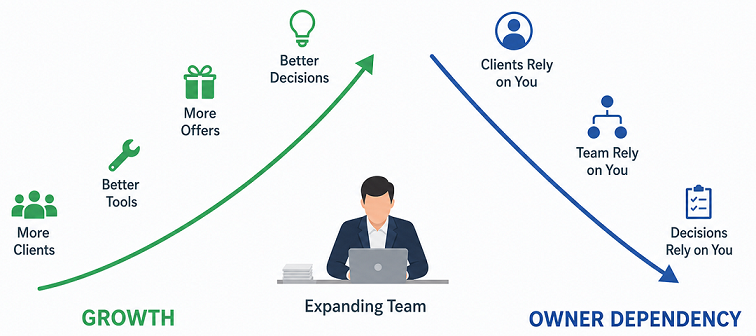
Because growth adds surface area, and if every new piece of surface area routes back through the owner, volume turns into weight.
More clients. More team members. More offers, tools, edge cases, decisions only you have context for. Each addition is small. None feel like a problem the day they arrive. But they compound in a specific way:
Growth × owner dependency = a heavier business.
Notice growth is only one term in it. You can double the first number and keep the product flat if the second falls. This is why so many businesses stall at the same point despite the owner working harder than anyone in their market.
What owner dependency actually looks like
It's rarely dramatic. It's approving things nobody needed approved. Being the only person who knows why one client is handled differently. Rewriting work your team already finished, at 10 pm, so nobody feels bad. Staying visibly busy all week while avoiding the one conversation that would change the quarter.
Most scaling advice tells you to add more offers, more channels, more people. Adding isn't the problem. Adding while every new thing routes through you is.
Are More Hours Actually Making Your Business Bigger?
Past a point, no and the evidence is old, boring, and remarkably consistent.
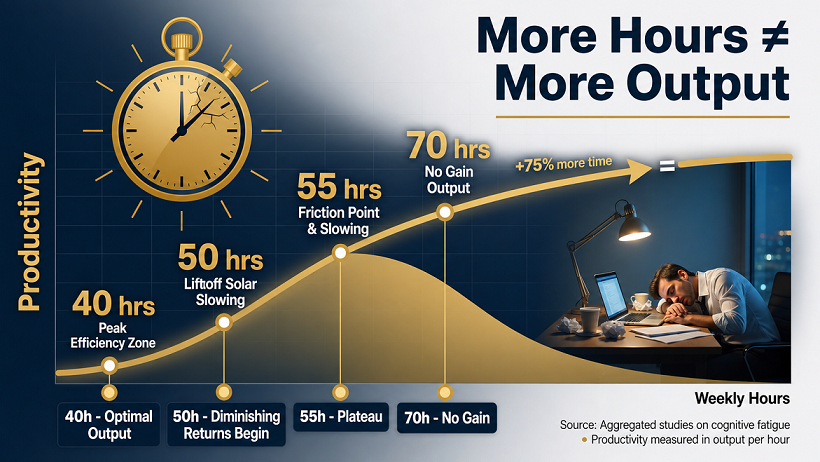
Stanford economist John Pencavel's work on diminishing returns to long working hours found output per hour drops sharply once a week passes roughly 50 hours, and falls away so steeply after 55 that a 70-hour week produces roughly what a 55-hour week does. The extra fifteen hours buy essentially nothing.
That doesn't make 60 hours morally wrong, and plenty of exceptional businesses were built on brutal seasons. It proves something narrower and more useful: additional hours eventually become a poor growth strategy. A lever with a hard ceiling, hit earlier than you'd like.
Which leads to the uncomfortable sentence: if the only way to increase output is to increase your hours, you haven't built a business. You've built an income model with a human bottleneck in it.
I know it lands, because I built exactly that. Fifth business, 80-hour weeks, on anxiety medication, telling everyone it was going well and by every metric I was measuring, it was. Then my niece asked why I don't visit anymore. That was the moment. Not a strategy session. A child asking a reasonable question.
What Is the Real Cost of Building a Business Around Long Hours?
It's paid in three places, and only one shows up in the accounts. The output cost is the one above: hours past the threshold return less and less.
The health cost is documented at population scale. The WHO and ILO joint estimates identified 55-plus hour weeks as carrying a meaningfully elevated risk of stroke and ischemic heart disease versus a 35–40 hour week, and named long hours the occupational risk factor with the largest disease burden globally. That's not a claim about you; it's a claim about the pattern you may be standing inside.
The personal cost is what owners describe themselves. A 2026 Patriot Software survey of 1,000 owners found 84% had sacrificed health, sleep, or relationships to keep the business running, and fewer than a quarter called their mental health thriving.
The cost nobody puts on the P&L
Judgement is the asset you sell. Coaches, consultants and practitioners get paid for discernment for seeing what the client can't. Chronic depletion degrades exactly that faculty first.
Decisions get slower, then avoidant, then deferred. The pricing move waits another quarter. The difficult client stays a year too long.
So the honest framing isn't look after yourself, you deserve it. It's colder. You're degrading the primary asset in your business and calling it commitment. If the pressure is already there, managing it while you rebuild is the prerequisite for deciding well about anything else here.
Why Doesn't Hiring Someone Fix It?
Because hiring, delegation, and owner independence are three different things, and most owners buy the first while needing the third.
Hiring adds capacity. Someone else can now do work.
Delegation transfers responsibility. Someone else owns an outcome.
Owner independence transfers responsibility without requiring your ongoing intervention. The outcome happens whether or not you're looking.
You can hire five people and stay exactly as dependent, because nothing was transferred. You moved work closer to yourself and added a payroll.
This matters commercially. Gallup's study of Inc. 500 CEOs found those with high delegator talent posted higher three-year growth and roughly a third more revenue than peers who delegated poorly, while only around one in four entrepreneurs scored high on the talent.
Strongly associated with growth, and rare. That combination tells you it isn't a knowledge problem. Nobody fails to delegate because they've never heard of delegation.
You can't delegate what your unconscious won't release
That's a behavioural claim, not a mystical one. In your own head it sounds like:
I'll just do it myself; it's faster.
They won't do it properly.
It takes longer to explain than to do.
I'll just check it quickly.
Nobody cares about this the way I do.
Each is defensible alone. Together they form a closed loop guaranteeing the business never stops running through you and the loop isn't held by logic. It's held by what handing over would mean about you. If competence is what makes you valuable, releasing work feels like releasing your worth.
That's why the VA didn't fix it. You never had a systems problem sitting on clean psychology. You had patterns running underneath the decisions, quietly rejecting every system you installed.
Can a Business Grow While the Owner Works Fewer Hours?
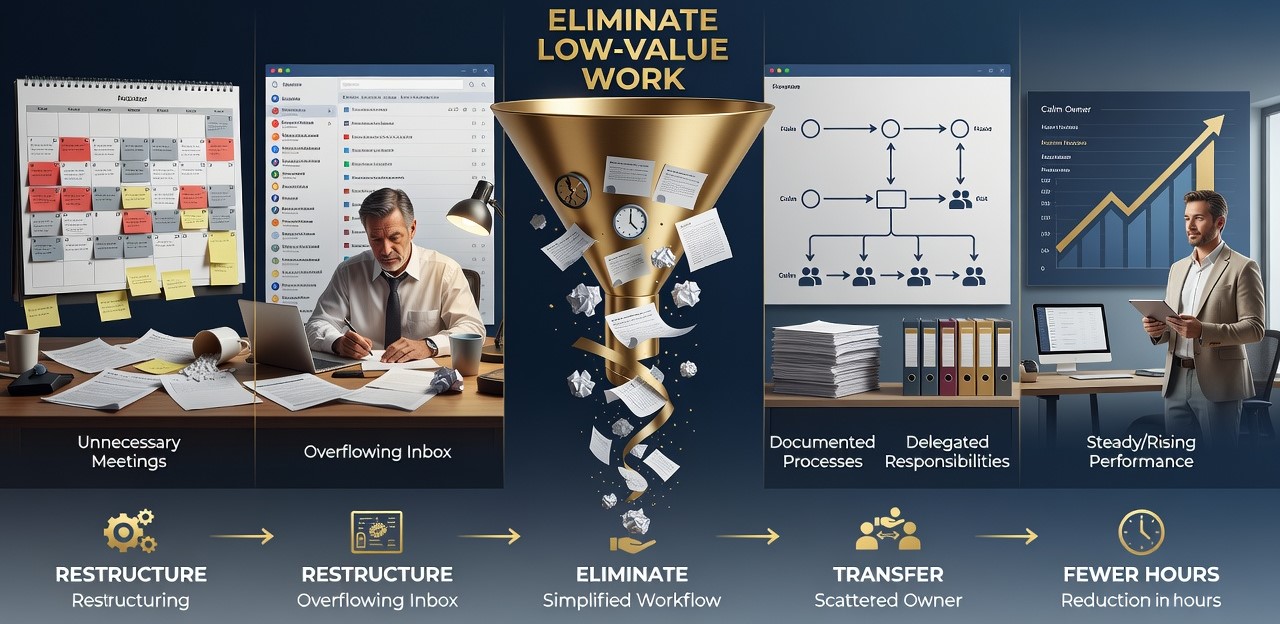
The evidence says hours and output can decouple but only when the work is restructured first.
The largest study to date, led by Wen Fan and Juliet Schor at Boston College and published in Nature Human Behaviour, has tracked 245 organisations and around 8,700 employees. Those moving to roughly 80% of standard hours at full pay generally reported productivity holding steady or improving.
The mechanism is the part worth borrowing. Participants got a preparation window of around eight weeks to restructure workflow and strip out low-value activity such as unnecessary meetings before hours came down. Schor has been explicit that the results weren't produced by making people work faster.
That inverts the usual assumption. The elimination came first. The reduced hours were the consequence. Which is what the 80/20 principle looks like applied properly rather than quoted at conferences.
David (name changed) arrived as a textbook bottleneck, brilliant at the work, completely trapped by it. Everything ran through him because everything could. He spent about 30 days getting his expertise into documented process and handed most of his inbox to his assistant. Then he took his first two-week holiday in five years, and revenue went up while he was away.
First two-week holiday in five years, and the business grew while he was gone. That's what happens when your expertise stops living in your head.
Data & Findings
Every figure cited in this article, in one place.
How owners define success. The most common definition of winning is a business that runs profitably without the owner. Fewer than 1 in 10 chose selling the company as the ultimate win. Intuit QuickBooks 2026 Business Owner Report, 1,305 US owners
The personal cost. 84% of owners have sacrificed health, sleep or relationships to keep the business running, and fewer than a quarter describe their mental health as thriving. Patriot Software 2026 survey, 1,000 US owners
Output per hour. Falls sharply once a working week passes roughly 50 hours, and so steeply after 55 that a 70-hour week produces roughly what 55 does. John Pencavel, Stanford, Diminishing Returns at Work
The health burden. Weeks of 55 hours or more carry elevated stroke and ischemic heart disease risk versus 35–40 hours; long hours are the occupational risk factor with the largest disease burden globally. WHO / ILO Joint Estimates, 2021
Shorter weeks. Across 245 organisations, productivity generally held steady or improved at roughly 80% of standard hours with workflow restructured and low-value activity removed first. Fan & Schor, Boston College, Nature Human Behaviour, 2025
Delegation and growth. CEOs with high delegator talent posted higher three-year growth and roughly a third more revenue than poor delegators, yet only around 1 in 4 entrepreneurs score high on the talent. Gallup, 143 Inc. 500 CEOs
Two caveats. The four-day-week research studied organisations, not solo practitioners; the transferable finding is the sequencing, not the schedule. And the Gallup data is correlational.
How Do You Redefine Success in Practice? The 5 Shifts to Freedom
The 5 Shifts to Freedom is the journey. The 3 Pillars are the mechanism underneath Performance Psychology, Freedom-First Business Strategy, and Freedom-First Business Structure. In that order, because strategy without psychology is another unfinished course, psychology without strategy is pleasant and pays nobody, and structure without both is a prettier prison.
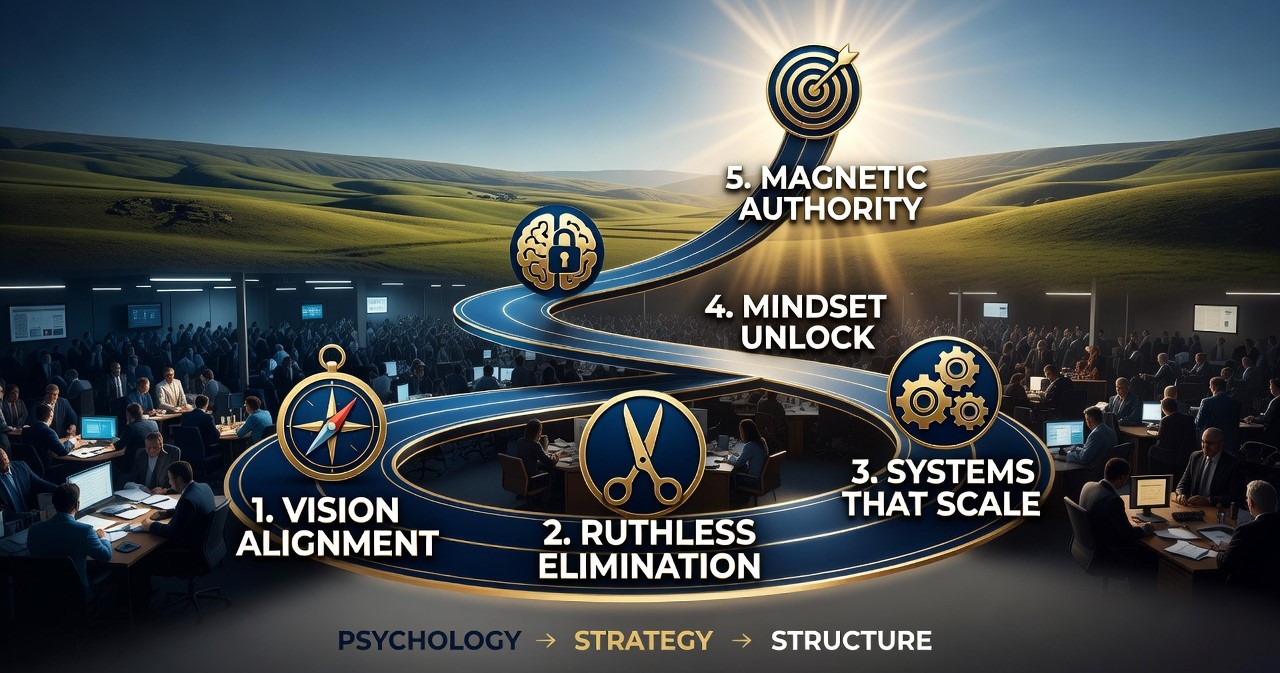
Step 1: Vision Alignment
What changes: You define success by what you actually want, not the version inherited from people whose lives you wouldn't swap for. Why it matters: Every later decision is downstream of this. Optimise toward the wrong target and you'll arrive efficiently at a life you don't want. What to stop doing: Setting goals by copying whoever is one tier ahead of you. What freedom looks like: You can describe your ideal week in specifics, not adjectives.
Marcus (name changed) arrived with an impressive business, a real team, respect in his market, and total misery. The business wasn't broken. It was pointed at the wrong summit. Realigning it took him from twenty clients to nine premium ones, and from sixty-hour weeks to thirty and revenue went up.
Twenty clients down to nine. Sixty hours down to thirty. Revenue up. Same man, different mountain.
Step 2: Ruthless Elimination
What changes: You cut roughly 80% of activity that consumes time and energy without moving the business. Why it matters: You can't systematise your way out of work that shouldn't exist. Elimination precedes automation or delegation. What to stop doing: Optimising tasks that should be deleted. What freedom looks like: Your calendar holds work only you can do, plus space.
Step 3: Systems That Scale
What changes: Your expertise moves out of your head into documented process. Why it matters: Where owner dependency actually breaks. Everything before reduces load; this transfers responsibility. What to stop doing: Being the only person who knows why. What freedom looks like: You can be unreachable for two weeks without anything degrading.
Step 4 Mindset Unlock
What changes: The programming behind I'll do it myself is addressed directly, through reconditioning rather than affirmations. Why it matters: Skip this and Step 3 unravels. The systems exist; you override them anyway. What to stop doing: Treating your inability to release control as a scheduling issue. What freedom looks like: Someone runs it differently to how you would, and you're genuinely fine.
Step 5: Magnetic Authority
What changes: You position precisely enough that the right clients recognise you immediately, and charge premium rates. Why it matters: Fewer, better clients only works if each is properly valued. What to stop doing: Competing on responsiveness and over-delivery. What freedom looks like: A pipeline that doesn't depend on you being permanently available.
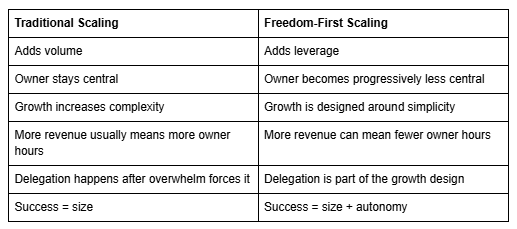
Traditional Scaling vs Freedom-First Scaling
Both grow a business. They differ on what growth costs the person running it, and where the ceiling sits.
Who Should Redefine Success This Way?
This fits you if you're a coach, consultant, or wellness practitioner who has already proven the business works. You have demand, results, a reputation. What you don't have is a week that belongs to you.
Specifically: you work 50 or more hours; the business would wobble during a two-week absence; you've hired people and somehow got busier, and you suspect the constraint isn't strategy you've read the strategy. It's whatever happens in you when it's time to let go. It also fits if you're willing to look at the psychology. That's the prerequisite, not an extra.
Who Should Avoid This Approach?
Four people should skip it, honestly.
You're still validating the market: If you haven't proven people will pay, you don't have an owner-dependency problem. You have a demand problem, which needs a different answer.
You want to build a venture-scale company: requiring extreme short-term intensity, clear-eyed about the trade and with an end date. Legitimate choice. Just not this one.
You love being deeply operational: Some people are happiest with their hands in the work, with no intention of becoming a CEO. Nothing here needs fixing.
You're unwilling to examine why you can't let go: With the psychology off the table, you'll get a beautifully documented set of systems that you override within a fortnight.
Frequently Asked Questions
What does redefining business success actually change day to day?
It changes what you measure. Instead of tracking revenue, clients and headcount alone, you track those alongside owner hours, decision load and how much of the business would stall if you disappeared for a fortnight. Decisions that look good on the first set of numbers often look expensive on the second.
Doesn't working fewer hours slow growth down?
Fewer hours aren't the intervention; reduced owner dependency is, and fewer hours are what it produces. Growth slows when the business can only expand as fast as one person can absorb decisions. Removing that constraint is what creates room to grow, which is why elimination and systems come before any change to your schedule.
How long does it take to stop being the bottleneck?
It depends on how much of your expertise currently lives only in your head. Documenting core processes and transferring genuine ownership of a function is realistically a matter of weeks rather than days. The psychological side actually leaving delegated work alone is usually the slower part, and it's the part most owners skip.
I've already hired people and I'm still overwhelmed. Why?
Because hiring added capacity without transferring responsibility. If every decision still routes back to you for approval, you've added cost and coordination without removing the constraint. The test isn't whether someone else does the work; it's whether the outcome happens when you aren't watching.
Is this just delegation advice with a different name?
No. Delegation is one component, and it's the one that fails most often when it's installed on top of unaddressed programming. This approach works in a fixed order: psychology, then strategy, then structure, because owners who can't tolerate someone else doing it differently will override any system you give them.
Who is this genuinely not right for?
Anyone still validating whether there's a market, anyone deliberately choosing a period of extreme intensity to build something venture-scale, anyone who loves being hands-on and doesn't want a CEO role, and anyone unwilling to examine why letting go feels unsafe. In each case, the constraint is something other than owner dependency.
The Real Question
Redefining business success comes down to one question: does a bigger business have to require a bigger share of your life? It doesn't. If growth is making things heavier, the problem usually isn't the growth. It's that the business is structured around you.
Fewer hours are the visible outcome. The real prize is a business that produces value without consuming the person who built it. Mine took 90 days to rebuild 80 hours down to 25, with substantially more revenue. These days the phone stays in another room at dinner, martial arts happens twice a week, and I take a 36-minute nap most afternoons without a flicker of guilt. Thirty-six. I've tested it. It's very precise.
If you want to find out what's actually keeping you stuck, book a Freedom Blueprint Call. Forty-five minutes. We'll find the one thing. No pitch unless you ask for one.