

How to Reclaim 15 Hours This Week Without Dropping Revenue
The average service-based founder wastes between 15 and 22 hours per week on activities that generate no revenue, advance no strategic goal, and could be eliminated, delegated, automated, or batched without any client noticing the difference. These hours are not lost to laziness, they are lost to a specific category of business activity called "invisible labour": the context-switching, reactive inbox management, repetitive admin, low-leverage client communication, and unnecessary internal meetings that fill a founder's calendar while producing no forward momentum. Reclaiming 15 hours this week requires four distinct moves applied in a specific sequence: Cut activities that should not exist at all, Delegate activities that a qualified team member can own, Batch activities that drain cognitive bandwidth through context-switching, and Protect the 20% of activities that generate 80% of your real results. None of these moves requires hiring, spending money, or reducing the quality of your service. They require only a ruthlessly honest audit of where your time is currently going — and the psychological courage to act on what the audit reveals.
Key Takeaways
15 Hours Is Conservative: For most founders working 55+ hours per week, the actual reclaim figure is closer to 20–25 hours. The 15-hour target is deliberately achievable within 7 days using only structural changes — no lifestyle overhaul required.
Invisible Labour Is the Real Thief: The hours are not lost in large, obvious blocks. They disappear in 4-minute email checks, 12-minute task-switching delays, 20-minute "quick" conversations, and 45-minute meetings that generated no decision. Individually invisible. Collectively devastating.
Revenue Does Not Drop, It Often Rises: The 15 reclaimed hours are not revenue-generating hours being removed. They are low-leverage hours being freed. When redirected to the 20% of activities that actually drive growth, they frequently produce more revenue than the 15 hours of activity they replaced.
Cut Before You Delegate: Delegating a task that should not exist creates a more efficient waste of two people's time instead of one. The audit sequence is non-negotiable: Cut first, then Delegate, then Batch, then Protect.
The Psychology Is the Obstacle: Most founders already know what they should eliminate or delegate. The barrier is not knowledge, it is the emotional resistance to letting go of control, status, and the familiar comfort of busyness.
The 15 Hours Are Already There
You do not need to find more time. You are already spending 15 hours. You are simply spending them on the wrong things.
The specific wrong things tend to cluster into four categories that appear almost universally across service-based businesses, regardless of industry, revenue level, or team size.
Category 1: The Invisible Admin Layer (Average: 4–6 hours per week)
Email management beyond what is genuinely necessary. Re-reading messages you have already read but not yet actioned. Writing emails from scratch that could be templated. Manually scheduling calls that could be handled by a booking link. Chasing invoices that an automated system should be chasing. Producing reports that either don't need to exist or could be auto-generated.
This category is invisible because each task takes only minutes. Collectively, across a week, it consumes an average of four to six hours of the founder's highest-cognitive morning time, the time when strategic thinking is most available.
Category 2: The Context-Switch Tax (Average: 3–5 hours per week)
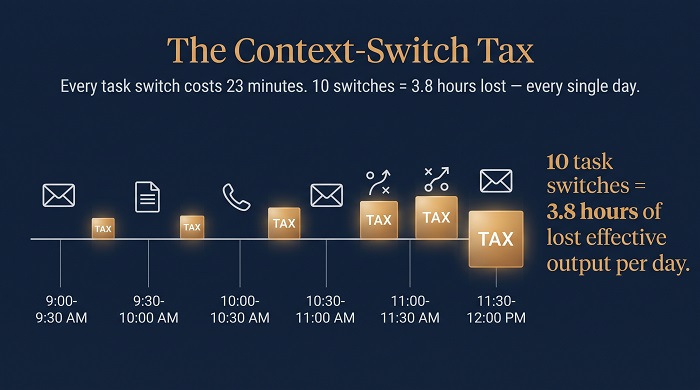
Every time you switch between a different type of task, from client work to email, from strategic thinking to administrative, from creation to communication, your brain pays a re-orientation cost. Research consistently shows this cost averages 23 minutes of productive output before full focus is restored. A founder switching task types 10 times per day loses an average of 3.8 hours of effective work time to the context-switch tax alone, without ever noticing where the time went.
Category 3: The Meeting Creep (Average: 3–5 hours per week)
Meetings that could have been emails. Update calls that add no new information and generate no new decisions. Internal check-ins with team members that happen weekly by habit rather than by strategic necessity. Discovery calls with prospects who were never qualified before the meeting was booked. Recurring calendar blocks that existed for a valid reason six months ago and have never been reviewed since.
Category 4: The Low-Value Client Communication Loop (Average: 3–4 hours per week)
Responding personally to questions that a well-constructed client portal or FAQ document would answer instantly. Sending manual progress updates that an automated reporting system could deliver. Providing reassurance to clients who need more structure in their onboarding experience rather than more access to the founder. Fielding enquiries that a team member should be handling under a clear response protocol.
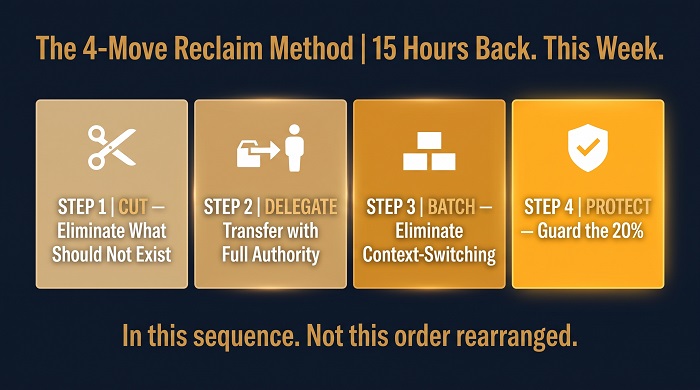
The 4-Move Reclaim Method
The 15 hours are recovered through four moves applied in strict sequence. Skipping steps or reordering them reduces both the speed and the sustainability of the reclaim.
Move 1 — CUT: Eliminate What Should Not Exist
Before delegating or batching anything, you must first identify the activities on your calendar that should simply stop existing. Not be done more efficiently. Not be handed to someone else. Stopped entirely.
Common candidates: The weekly all-hands meeting that produces no decisions. The manual PDF report you send clients that they never read. The custom proposal you write from scratch for every prospect (a standardised framework serves 95% of cases identically). The internal status update email chain where the status hasn't changed in three weeks.
Ask of every recurring task: "If this stopped happening today, what would break, and for whom?" If the honest answer is "nothing significant", cut it immediately.
Move 2 — DELEGATE: Transfer with Full Authority
Every activity that must continue but does not require your specific expertise or judgment should be transferred to a team member with full authority for the outcome, not just the execution of the steps. Delegation without authority transfer is a false delegation that will pull you back in within a week.
Priority delegation targets this week: inbox triage and first-response drafting, scheduling and calendar management, client progress update communications, invoice chasing and payment follow-up, social media scheduling (not creation, just scheduling).
Move 3 — BATCH: Eliminate Context-Switching
Every activity that must stay with you personally should be batched into dedicated time blocks where you do only that type of work. Email is processed twice a day, not continuously. Client calls are scheduled on specific days only, never scattered across the week. Strategic planning happens in a protected three-hour block, never in fractured 20-minute gaps between other tasks.
A batched calendar eliminates the 23-minute context-switch tax and converts scattered reactive hours into concentrated, high-output blocks. The same tasks take less time and produce better results when batched.
Move 4 — PROTECT: Guard the 20% That Drives 80% of Results
The hours reclaimed through Moves 1–3 create white space. This white space is not leisure time. It is the space into which your highest-leverage 20% of activities must be moved and fiercely protected. Premium client delivery. Content creation. Strategic relationship cultivation. Business architecture decisions. These are the activities that compound, every hour invested returns multiplied value over time. They must occupy your prime cognitive hours, not the fractured remnants of a reactive day.
The 15-Hour Reclaim Map
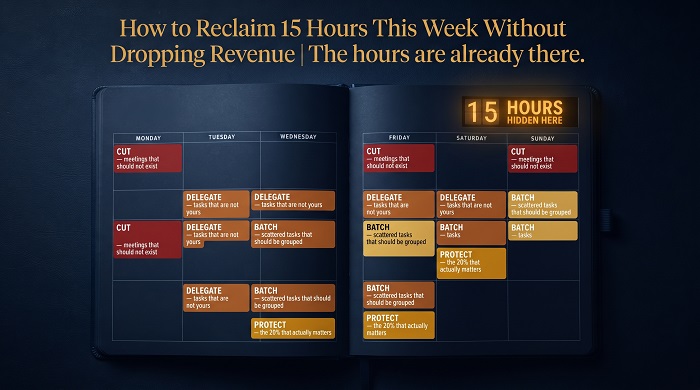
This is the complete blueprint — where the 15 hours come from, which Move applies, and the specific action that reclaims each block.
Time Block | Current Activity (The Drain) | Reclaim Move | Specific Action This Week |
3 hours | Recurring meetings that generate no decisions. Weekly status calls where nothing has changed. Internal updates by Zoom. | CUT | Cancel every recurring meeting that did not produce a specific decision or action in its last two occurrences. Replace with a shared async status doc. |
2 hours | Custom proposals written from scratch. Manual quote emails. Bespoke onboarding documents for each new client. | CUT / TEMPLATE | Build one standard proposal template today. 90% of what you write bespoke is identical across clients. Standardise it. The remaining 10% customisation takes 15 minutes, not 2 hours. |
3 hours | Inbox management. First-response emails. Calendar scheduling. Invoice follow-up. Booking confirmation messages. | DELEGATE | Assign inbox triage to a team member today. Provide a response template library for the 8 most common email types. Set up a calendar booking link (Calendly or similar) — remove all manual scheduling from your role. |
2 hours | Client progress updates. Check-in messages. "Just following up" communications that the client could access via a portal. | DELEGATE / AUTOMATE | Build a client update template. Delegate to a team member or set up an automated weekly email sequence. Your personal involvement in routine progress communication is a relationship bottleneck, not a relationship asset. |
3 hours | Reactive email checks throughout the day. Responding to messages as they arrive. Interruptions every 20–30 minutes derailing deep work. | BATCH | Set two fixed email windows: 9:00–9:30 AM and 4:00–4:30 PM. Close email and notifications outside these windows. The context-switch tax eliminated this week saves an average of 3 hours of effective productive time. |
2 hours | Client calls scattered across five days. Every day has at least one call, preventing full deep-work days. | BATCH | Move all client calls to two designated "Call Days" per week (e.g., Tuesday and Thursday). This immediately creates three full deep-work days per week — the precondition for any high-leverage strategic output. |
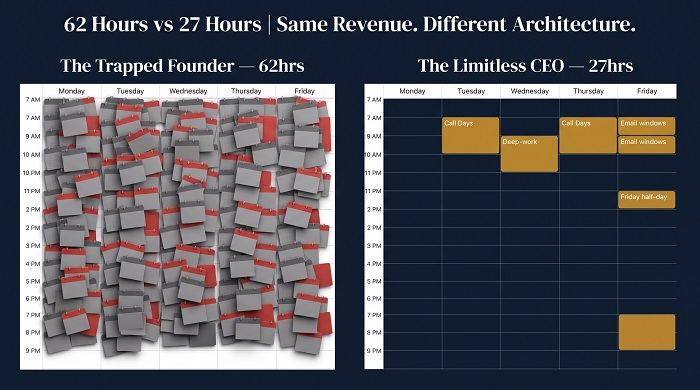
The Trapped Founder vs The Limitless CEO: A Week Compared
Day / Time Block | The Trapped Founder (62-Hour Week) | The Limitless CEO (27-Hour Week) |
Monday Morning | 2 hours clearing weekend emails. 45-min internal team update call. 30-min responding to a client question the team should have handled. | 90-min protected CEO strategy block. 30-min email window at 9 AM. Week's priorities set and written. Calendar locked. |
Tuesday | 3 client calls scattered through the day, breaking all deep focus. Custom proposal written from scratch (2 hrs). Invoice chased manually (30 mins). | Dedicated Call Day. 3 client calls back-to-back, 9–12. Afternoon: team handles all admin. Proposal sent using standard template in 20 minutes. |
Wednesday | Full day of reactive inbox management between interrupted content work. Two unplanned "quick calls" with clients. 1-hour internal meeting. | Deep Work Day. No calls. Email windows at 9 AM and 4 PM only. 3-hour uninterrupted content creation block produces the week's highest-leverage output. |
Thursday | More client calls. Manual progress updates sent to three clients (1 hr). Team questions escalated throughout the day (1.5 hrs of founder responses). | Second Call Day. Automated progress updates sent by system at 8 AM. Team handles all exceptions within decision framework — zero escalations to founder. |
Friday | Catch-up on everything that fell behind. Inbox at 200+ unread. Works through dinner to meet Monday deadline. | Half-day. Review weekly metrics dashboard (30 mins). Plan next week (30 mins). Done by 1 PM. 36-minute nap. Visit niece. |
The Framework: The 5 Shifts to Freedom & The 3 Pillars
Reclaiming 15 hours in Week 1 is achievable through structural moves alone. Sustaining a 25–35-hour working week, permanently, requires the full Limitless Entrepreneur architecture.
The 3 Pillars: What Makes the Reclaim Permanent
Pillar 1 — Performance Psychology: Without psychological rewiring, reclaimed hours will be quietly refilled. The founder's nervous system equates busyness with safety and productivity with worth. If the emotional need to be busy is not dissolved through NLP and Timeline Therapy, the 15 hours you free this week will be occupied by new low-leverage activities within 30 days.
Pillar 2 — Freedom-First Business Strategy: The 4-Move Reclaim Method addresses the tactical layer. Pillar 2 addresses the strategic layer — eliminating the offers, clients, and business model elements that structurally generate unnecessary founder hours in the first place.
Pillar 3 — Freedom-First Business Structure: The delegated tasks from Move 2 need permanent homes in documented systems with accountable owners. Without Pillar 3, delegation is temporary — the tasks migrate back to the founder when the team member moves on or when a non-standard situation arises.
The 5 Shifts: Where the 15-Hour Reclaim Sits
Phase 1: Clarity (Weeks 1–4)
Shift 1 — Vision Alignment: The 15-hour reclaim is the first concrete taste of what the fully freed business model feels like. The discomfort it produces (the white space, the guilt, the urge to fill the time with activity) is the data that Shift 1 uses to map the psychological work ahead.
Phase 2: Liberation (Weeks 5–11)
Shift 2 — Ruthless Elimination: The structural cuts of Move 1 (Cut) are deepened here — not just removing individual tasks but eliminating entire offer lines, client categories, and marketing channels that structurally produce founder-dependency.
Shift 3 — Systems That Scale: The delegation of Move 2 is formalised here into documented systems with quality benchmarks and accountable owners — converting temporary task transfers into permanent operational architecture.
Phase 3: Amplification (Weeks 12–16)
Shift 4 — Mindset Unlock: The psychological discomfort of the protected 20% (the white space, the visible absence from operational activity) is resolved neurologically. The founder settles into the 25-hour model without guilt or the compulsive urge to fill the space.
Shift 5 — Magnetic Authority: The protected 20% — the high-leverage CEO time reclaimed through Moves 3 and 4 — is invested in thought leadership, premium positioning, and strategic relationship building. This is where the reclaimed hours begin to compound into revenue growth rather than simply revenue maintenance.
Case Evidence: 15 Hours in Practice
Nik — 14 Hours Reclaimed in Week 1
Nik worked 58 hours per week and described himself as "not someone who wastes time." His calendar looked impressive, packed with meetings, client calls, and admin tasks. His time audit told a different story. He was spending 5 hours per week in recurring team meetings that produced no decisions. He was personally responding to all client emails, including routine questions answered in his welcome document that clients apparently never read. He was manually scheduling every call using back-and-forth email chains.
In Week 1, he cancelled four of five recurring team meetings, replacing them with a shared async status dashboard. He set up a Calendly booking link and removed himself from all scheduling. He created a client FAQ document and pinned it to the client portal, then delegated first-response emails to his virtual assistant with a template library. Total reclaim in Week 1: 14 hours. His client relationships were not damaged. Two clients commented positively on the new booking system.
David — The Call Day Transformation
David's core problem was not the number of calls he took, it was their distribution. Calls were scattered across every day of the week, ensuring he never had a single day of uninterrupted deep work. He tried to write strategic content and answer emails in between calls. He produced shallow versions of both. Through Move 3 (Batch), we consolidated all calls to Tuesday and Thursday. Wednesday became a deep-work-only day, no calls, no meetings, email windows at 9 AM and 4 PM only. In the first Wednesday under this structure, David produced the first piece of premium thought leadership content he had completed in six months. The context-switch tax had been consuming four productive hours every day. Batching recovered them entirely.
Decision Framework: Is the 15-Hour Reclaim Right For You?
✓ This is for you if: You are currently working more than 45 hours per week and have a nagging certainty that much of that time is not genuinely productive. You have at least a part-time team member or virtual assistant available for delegation. You are willing to make structural changes to your calendar this week — not next month.
✗ This is not for you if: You are in the first 60 days of business with no recurring processes, no team, and no established client base. In this stage, the 15 hours of "inefficiency" are often the experimental, iterative activity required to discover product-market fit. The reclaim framework is for established businesses, not pre-revenue founders still discovering what works.
Try This: The 60-Minute Time Audit
Step 1 Pull last week's calendar. Open your calendar for the last 7 working days. Every event, every recurring block, every impromptu meeting — list them all in a single column.
Step 2 Apply the 4-Move filter. Next to each event, write one of four labels: CUT (should not exist), DELEGATE (does not need to be you), BATCH (needs a dedicated time block), or PROTECT (genuine high-leverage work).
Step 3 Count the hours. Total the hours for each label. If your PROTECT column is less than 20% of your total weekly hours, you have found your bottleneck. The CUT + DELEGATE + BATCH total is your reclaim opportunity.
Step 4 Execute one move today. Do not plan next month's calendar restructure. Make one change today: cancel one meeting that should not exist, set up your booking link, or move all email to two fixed daily windows. One structural change today beats a perfect plan that starts Monday.
Further Reading
Harnessing Structure & Systems — converting delegated tasks into permanent autonomous systems.
Overcoming Procrastination — why founders unconsciously fill reclaimed hours with low-leverage "busy" work.
Mastering Mindsets for Business — the psychological rewiring required to keep reclaimed hours permanently free.
Entrepreneurial Mindset Through NLP — dissolving the identity fusion between busyness and self-worth.
American Psychological Association: The True Cost of Multitasking — external research on the 23-minute context-switch recovery cost and its cumulative impact on founder productivity.
Frequently Asked Questions
Is it really possible to reclaim 15 hours in one week without revenue dropping?
Yes, because the 15 hours being reclaimed are not revenue-generating hours. They are administrative, reactive, and low-leverage hours that produce no direct revenue. The revenue risk would only exist if you were removing high-leverage client-facing or strategic hours, which the 4-Move Reclaim Method specifically avoids. In most cases, revenue either holds steady or improves in the first week, because the reclaimed time is redirected toward activities that had been neglected due to the administrative overload.
What is "invisible labour" and why does it consume so many founder hours?
Invisible labour is operational activity that feels productive because it keeps you busy, but generates no meaningful progress toward your strategic or revenue goals. It includes email management beyond what is necessary, repetitive admin tasks, unproductive meetings, and low-value client communication that a system or team member could handle equally well. It is invisible because each individual instance takes only minutes, making it impossible to see the cumulative weekly total without a deliberate audit.
What should I do with the 15 hours once I've reclaimed them?
Specifically: protect them for your highest-leverage 20% of activities, the work that directly generates premium revenue, builds strategic authority, or compounds your market positioning over time. For most service-based founders, this means premium client delivery, thought leadership content, strategic relationship building, and business architecture decisions. If you fill the reclaimed hours with more administrative tasks, you have run the reclaim correctly but defeated its purpose.
I have no team, can I still reclaim 15 hours?
Yes, though the mix of moves is different. Without a team, Move 2 (Delegate) is replaced by Move 1 (Cut) and Move 3 (Batch) doing more of the work. Solo founders typically find the largest reclaim opportunities in meeting cancellation, template creation (eliminating custom writing time), calendar batching (call days), and email windowing. The context-switch elimination alone often reclaims 3–5 hours per week for a solo operator.
How do I stop the reclaimed hours from being slowly refilled over time?
This is the most important question, and the reason Pillar 1 (Performance Psychology) is the first pillar of the Limitless methodology. Without psychological rewiring, the emotional discomfort of white space drives founders to unconsciously fill it with new low-leverage activity. The NLP and Timeline Therapy work in Pillar 1 dissolves the nervous system's equation of "busy = safe and valuable" and recalibrates its baseline to genuine strategic focus. Without this, the structural reclaim is temporary. With it, the 25-hour week becomes the founder's permanent operating standard.
Conclusion: The Week That Changed the Trajectory
When James R. Elliot first ran his own version of this audit, he was working 80 hours a week on anxiety medication, convinced that every hour was essential. The audit revealed that 22 of those hours were consumed by activity that produced no revenue, served no strategic goal, and could be eliminated, delegated, or batched without a single client being affected.
He cancelled four meetings. He set up a booking link. He moved all email to two daily windows. He batched all client calls onto two days. In the first week, he reclaimed 18 hours. Revenue did not drop. In fact, two prospects, who had been stalled in his pipeline because he never had the headspace to follow up thoughtfully, converted to clients in the time he had protected for strategic outreach.
The 15 hours were not leisure hours. They were the hours he had been unable to spend on the work that actually moved the business forward, because every available slot was filled with the noise of invisible labour.
He reclaimed those hours. Within 90 days, his working week had dropped from 80 hours to 25. He visits his niece now. He takes a 36-minute nap every afternoon. His revenue grew. None of it required working harder. All of it required working on different things entirely.
Ready to reclaim your 15 hours? Book the Freedom Blueprint Call. We will run your time audit live and identify exactly which of the four moves delivers the fastest and most permanent reclaim for your specific business.