
How to Reclaim 10–30 Hours a Week Without Sacrificing Revenue
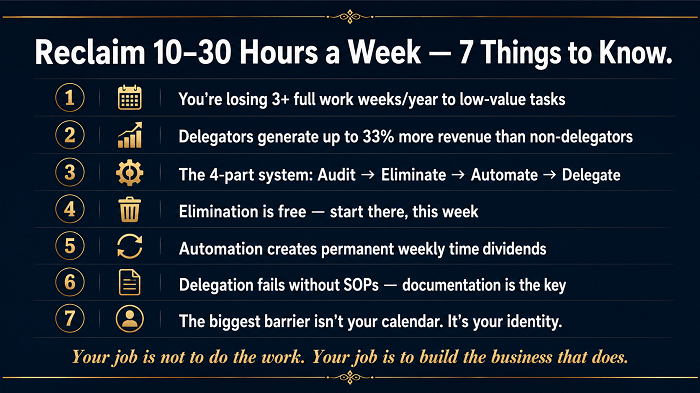
Entrepreneurs can reclaim 10–30 hours a week by following a four-part system: audit exactly where your time goes, eliminate tasks that shouldn't exist, automate what's repetitive, and delegate everything that doesn't require your unique judgment or authority. The common fear that stepping back will cost revenue is almost always wrong. Business owners who delegate effectively generate up to 33% more revenue than those who try to handle everything themselves. The hours you reclaim aren't lost productivity. They're the fuel for the strategic work that actually grows your business.
Here's a number worth sitting with: the average small business owner loses an hour and 36 minutes every single day to tasks they themselves classify as unproductive. That's eight hours a week, a full extra workday, evaporating into admin, reactive emails, status updates, and context-switching between tools that should be working for them, not the other way around.
Now add the hours spent on work that isn't unproductive, exactly, but still shouldn't be yours. Scheduling. Formatting documents. Chasing invoices. Answering support questions your team should handle. Creating social posts. Approving things that don't need your approval.
For most entrepreneurs I've worked with over 20+ years of coaching and NLP training, the real number isn't 8 hours. It's closer to 20, sometimes 30. A third of their week, quietly consumed by work that has nothing to do with why they started the business in the first place.
And here's the part that matters most: they're worried that reclaiming those hours will cost them revenue. That less involvement means less control, more mistakes, and a business that drifts without their hand on the wheel.
That fear is understandable. It's also, in almost every case, unfounded.
Business owners who delegate effectively generate up to 33% more revenue than those who don't. Not because delegation magically creates income, but because the hours freed up get reinvested in the high-leverage work that does. The vision, the relationships, the decisions, the growth architecture that only you can build.
This article gives you the exact system to reclaim those hours, starting this week, without sacrificing a single dollar of revenue.
Key Takeaways
The average small business owner loses the equivalent of more than three full work weeks per year to tasks they themselves classify as unproductive, and the real number, including misallocated time, is far higher.
Entrepreneurs who delegate effectively generate up to 33% more revenue, not because they work less, but because they reallocate their time to higher-value work.
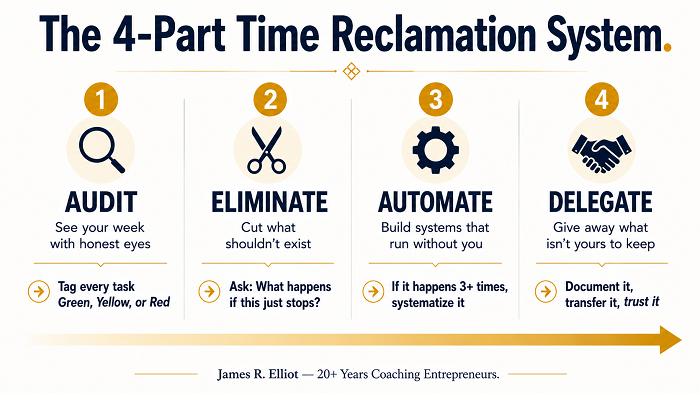
Reclaiming time requires four steps in order: Audit (see your week clearly), Eliminate (cut what shouldn't exist), Automate (systematize what repeats), and Delegate (hand off what doesn't require your judgment).
The delegation objection "I can't afford help" almost always inverts the actual math, 20 hours of misallocated high-value time per week costs far more than the cost of delegating it.
Systems alone aren't enough. The internal belief that your value equals your busyness will pull work back regardless of what your calendar says. The identity shift is where lasting change lives.
A realistic 90-day system can recover 15–25 hours per week, staged and sustainable, without disruption to revenue or client experience.
The goal isn't to do less. It's to do what's actually yours, at the level only you can operate, and build the business infrastructure that handles everything else.
Where Your Time Is Really Going (The Numbers Are Worse Than You Think)
Before you can reclaim your time, you have to see it clearly. Most entrepreneurs significantly underestimate how much of their week is consumed by low-value work, because the tasks happen in small increments, spread across the day, and each one feels necessary in the moment.
The Invisible Time Drain
A Slack survey of 2,000 small business owners found that the average entrepreneur loses over three full work weeks annually to tasks they consider unproductive. That's not a time management quirk; it's a structural problem.
Break it down across a typical entrepreneurial week, and the pattern is consistent:
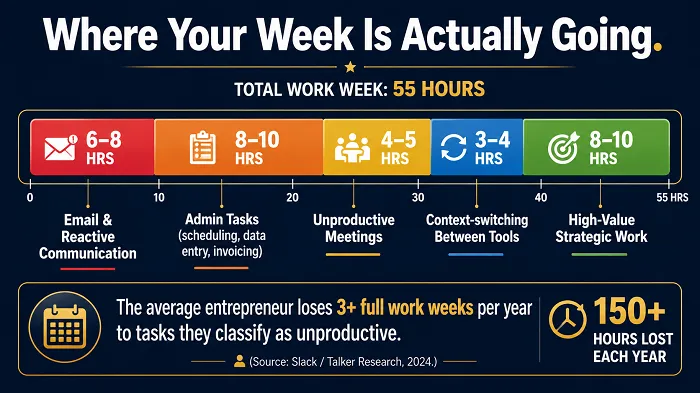
Email and reactive communication: Research shows that over 23% of the average workday disappears into inbox management alone, much of it on messages that could be filtered, templated, or handled by someone else
Admin tasks: A survey from Time etc. found that 36% of the average entrepreneur's working week goes to administrative tasks, scheduling, data entry, invoicing, expense logging, and similar work
Unproductive meetings: Up to 72% of meetings are considered unproductive by the people sitting in them, costing businesses an estimated $37 billion annually in lost time
Context switching: The average small business owner juggles four digital tools daily. Every switch between platforms interrupts focus, and recovery from a single interruption takes an average of 23 minutes
Run those numbers against a 55-hour work week, and it's not hard to see where 20 to 30 hours go. The question isn't whether the hours exist to reclaim. They do. The question is whether you have a system to reclaim them.
The Misperception That Keeps Entrepreneurs Stuck
Here's what makes this genuinely difficult: most of the time you're losing doesn't feel wasted while it's happening. Clearing your inbox feels productive. Jumping into a client issue feels responsible. Reviewing every deliverable feels like quality control.
The trap isn't laziness or poor intentions. It's the inability to distinguish between work that feels urgent and genuinely high-value work. Until you can see the difference clearly, in your own calendar, with your own data, you'll keep filling your hours with motion that looks like momentum.
Try This: For the next five business days, tag every task you work on as one of three things: Green (only I can do this), Yellow (someone could do this with clear instructions), or Red (this shouldn't be happening at all; it's duplication, unnecessary process, or pure habit). Don't change anything yet. Just see what's actually in your week. Most entrepreneurs find their week is 20–30% Green, 50–60% Yellow, and 10–20% Red. The Yellow and Red categories are your 10 to 30 hours.
The Real Cost of Not Reclaiming Your Time
Let's make this concrete, because the financial case for reclaiming your hours is far stronger than most entrepreneurs realize.
Your Hourly Value vs. What You're Actually Doing
If your highest-value work, strategic decisions, client relationships, and growth architecture is worth $300 to $500 an hour, and you're spending 20 hours a week on $25-per-hour administrative work, the math is brutal.
One business coach documented a client who was spending 18 hours weekly on tasks worth around $30 an hour. When those tasks were delegated to a virtual assistant at $50 an hour, she freed up time to take on three additional clients at $5,000 each. She invested $2,700 per month in support and generated $15,000 per month in additional revenue. The hours weren't a cost; they were trapped capital.
Multiply this across a year, and the picture becomes clear: reclaiming time isn't about working less. It's about unlocking the revenue that's currently invisible because you're too busy executing to pursue it.
The Compounding Cost of Staying Stuck
There's also the cost that doesn't show up on a P&L. Every hour you spend in reactive, operational mode is an hour you're not investing in the leverage work, the systems, relationships, strategic decisions, and growth initiatives that compound over time.
Entrepreneurs who delegate effectively grow their businesses 33% faster than those who try to handle everything themselves, according to delegation research. That gap doesn't come from doing less. It comes from doing the right work at the right level, consistently, with clarity, and without the cognitive drain of trying to be everywhere at once.
The good news: you don't need to reclaim 30 hours overnight. Reclaiming even 5 to 10 hours per week, and reinvesting them in high-leverage activity, creates a compounding effect that reshapes the trajectory of your business within months. Building this kind of entrepreneurial mindset through NLP, one that sees time as capital, not just effort, is the foundation everything else rests on.
The 4-Part Time Reclamation System
This framework has been developed and refined through over 20 years of coaching entrepreneurs, executives, and leaders, combining practical systems thinking with the identity and belief-level work that NLP uniquely provides. Most time management systems fail because they address scheduling without addressing the underlying beliefs that keep entrepreneurs doing work that isn't theirs to do. This one addresses both.
Part 1: Audit: See Your Time With Honest Eyes
You cannot optimize what you haven't measured. And you cannot measure it accurately from memory.
Block 30 minutes at the end of each workday this week and document exactly what you did in 30-minute increments. Don't estimate; reconstruct. Check your calendar, your email sent folder, your task history. Be honest. The goal isn't to feel efficient. It's to see clearly.
At the end of the week, categorize every block using the Green / Yellow / Red system from above. Then total the hours in each category. For most entrepreneurs, this single exercise is the most clarifying thing they've done in months, because it replaces vague feelings of being busy with concrete data about what's actually happening.
Research confirms most entrepreneurs find that 60–80% of their work falls below their actual value level. That's your starting inventory for reclamation.
Part 2: Eliminate: Cut What Shouldn't Exist at All
Before you delegate or automate anything, ask whether it should exist in the first place. Many entrepreneurs are efficiently executing processes that add no value to anyone.
Questions to ask about every recurring task in your Red and Yellow categories:
What happens if this simply doesn't get done? If the honest answer is "nothing significant," eliminate it.
Is this solving a problem that no longer exists? Many tasks are relics of earlier-stage business problems. The business evolved; the task didn't.
Am I doing this out of habit or out of genuine necessity? Habit is not a reason to keep a task. Neither is "we've always done it this way."
A conservative estimate from productivity research suggests that 10–15% of most entrepreneurs' recurring tasks can be eliminated without any business impact. That's potentially 5 to 8 hours per week recovered with zero cost, zero delegation, and zero systems work required.
Part 3: Automate: Build Systems That Work While You Sleep
Automation is the highest-leverage form of time reclamation for most entrepreneurs, because it doesn't just free up hours once; it frees up the same hours every week, permanently.
The most common high-ROI automation opportunities for growth-stage entrepreneurs:
Email and communication: Template responses to frequent inquiries. Set up filters and rules that route emails before they reach your inbox. Auto-responders for common requests. A 2024 Deloitte study found that businesses adopting process automation saw significant reductions in the time spent on routine communication, hours per week that previously required personal attention.
Scheduling: Eliminate the back-and-forth of calendar coordination with a scheduling tool. This single automation saves entrepreneurs an average of 5 to 7 hours weekly according to delegation research.
Client onboarding and follow-up: Sequence-based automations for onboarding new clients, delivering contracts, requesting information, and following up on outstanding actions can run entirely without your involvement once built.
Reporting and data: Any report you generate manually from data that already exists somewhere digitally is an automation candidate. SOPs combined with automation tools can systematically eliminate the documentation inefficiencies that consume 20–30% of productive time in many businesses, per a 2024 Deloitte analysis.
The principle is simple: if something happens the same way more than three times, document it and automate it. Every repetitive process you systematize becomes a permanent time dividend.
Try This: Identify the single task you do most frequently that follows a predictable pattern. This week, document exactly how you do it, every step, every decision, every resource used. That document is your first SOP. Once it exists, you can automate it, delegate it, or hand it to a team member with complete confidence. This is also the foundation of the optimize with smarter work approach, building once, benefiting permanently.
Part 4: Delegate: Give Away What Isn't Yours to Keep
Delegation is where most entrepreneurs feel the most resistance, and where the largest blocks of time are recovered. It's also where the internal belief work is most essential, because the practical mechanics of delegation are straightforward. The psychological barriers are not.
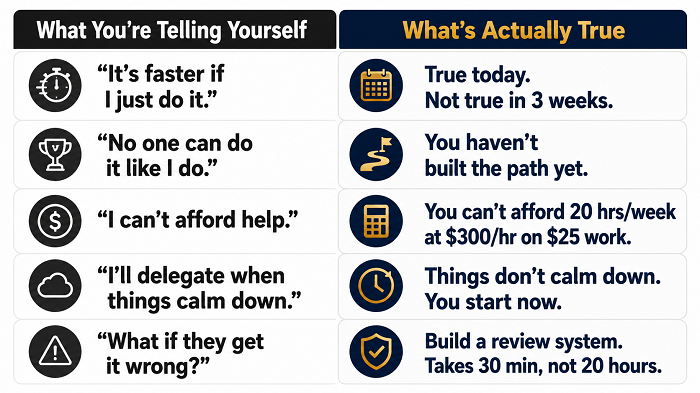
The three most common delegation objections and their honest reframes:
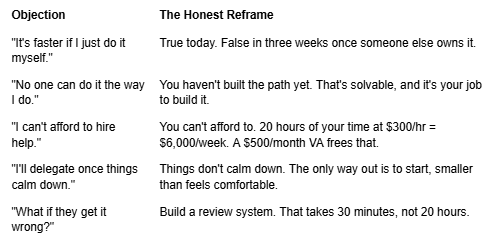
The practical delegation process comes down to three steps: document the task (your SOP from Part 3), transfer it with a clear, brief, and expected standard, and follow up with a feedback loop rather than micromanagement. The upfront investment is real. The long-term return compounds every week.
Entrepreneurs who delegate effectively reclaim an average of 12 to 20 hours per week, according to delegation operations research. Not all at once, iteratively, over the course of a quarter, as each task is properly handed off and the new owner builds competence and confidence.
This is the heart of corporate leadership coaching: building the systems and team capacity that let you operate at your highest value, sustainably.
The Belief Work: Why Systems Alone Aren't Enough
Here's what the productivity books don't tell you: you can have a perfect delegation system, a flawless automation stack, and a beautifully audited calendar, and still find yourself doing the same low-value work a month later.
Because the real barrier isn't the system. It's the identity.
When your sense of value is tied to how busy you are, or how much you personally handle, or how indispensable you feel, delegation doesn't just feel like a task handoff. It feels like giving up the thing that proves your worth. And the mind will find reasons to pull work back, even when the system says otherwise.
This is where NLP works at a level no calendar system can reach. Through techniques like belief reframing, identity-level work, and anchoring new states of confident, strategic leadership, entrepreneurs can permanently shift the internal operating system that keeps recreating the same overwhelmed patterns.
Alka S., a client James worked with, described the experience precisely: after coaching, she didn't just see her limiting patterns; she felt genuinely different. The changes weren't effortful maintenance. They were a new internal baseline. Working through these NLP techniques for growth with proper guidance produces that kind of structural shift, not a temporary discipline win.
The belief upgrade that makes time reclamation permanent: your job is not to do the work. Your job is to build the business that does the work. When you really own that at the identity level, the calendar almost manages itself.
How Much Time Can You Actually Reclaim? (The Real Numbers)
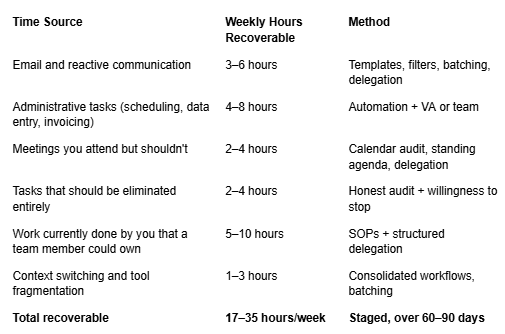
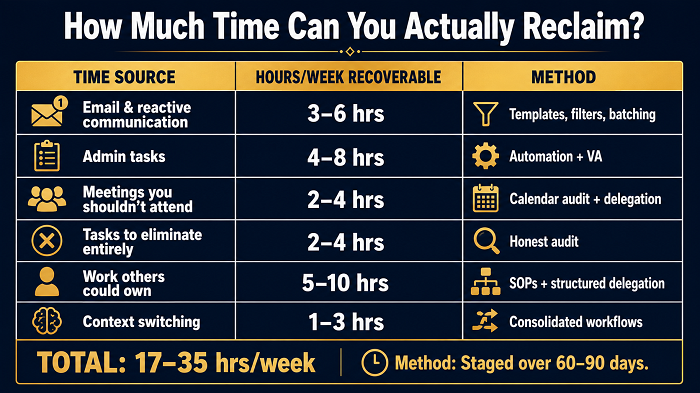
You won't reclaim all of these hours in week one. A realistic 90-day trajectory looks like this:
Weeks 1–2: Complete the audit. Identify your Green/Yellow/Red breakdown. Eliminate tasks. Identify your top 3 delegation candidates.
Weeks 3–4: Build your first 3 SOPs. Begin handing off the first task. Set up 2 automations.
Month 2: Delegate a second task. Review and tighten SOPs. Block strategic time newly freed. Target: 8–12 hours reclaimed.
Month 3: Delegation running smoothly on 4–6 tasks. Automations mature. Strategic time protected. Target: 15–25 hours reclaimed consistently.
The compound effect kicks in at month 3, when reclaimed hours become invested hours, and invested hours begin returning as business growth, clearer decisions, and the unmistakable feeling of leading rather than executing.
Frequently Asked Questions
Won't delegating tasks result in lower quality work and unhappy clients?
Only if you delegate without structure. The difference between delegation that works and delegation that fails is almost always the quality of the brief and the SOP behind it. When you document exactly how a task should be done, what "good" looks like, and how it will be reviewed, most capable people can meet or exceed your standard within a few weeks. Quality problems in delegation are documentation problems, not people problems.
Where should I start automation or delegation?
Start with elimination. Cutting tasks that don't need to exist costs nothing and frees immediate bandwidth. Then automate, because well-built automations create permanent time dividends with no ongoing cost. Delegate last, because delegation requires the most upfront investment in documentation and training. Doing it in this order means your delegation infrastructure is cleaner and your team spends time on genuinely valuable work rather than inheriting your inefficiencies.
How do I reclaim time if I'm a solopreneur without a team to delegate to?
Start with automation and elimination, which require no team at all. For delegation, virtual assistants and freelancers are accessible at almost any budget level. The question to ask isn't "can I afford a VA?" but "what is my time actually worth, and how does that compare to the cost of buying it back?" Even 5 hours per week of VA support, invested in the right tasks, can unlock strategic time worth multiples of the cost.
What tasks should I never delegate?
Your highest-value, irreplaceable contributions: the vision and strategic direction of the business, relationships that only you can own, decisions that require your unique authority or context, and the cultural tone that shapes your team. Everything else is a candidate for eventual delegation. The question isn't whether a task could be delegated; it's whether you've built the system to do it safely.
How do I deal with the guilt of working fewer hours as things get delegated?
This is an identity question, not a productivity question. When your self-worth is tied to your hours, working fewer of them feels irresponsible, even when your output and impact have increased. The reframe worth practicing: measure your contribution by what the business achieves, not by what you personally execute. A business that grows 30% while you work 40 hours rather than 60 is not a failure of effort. It's a success of leadership. James's work with clients on overcoming limiting beliefs with NLP specifically addresses the identity-level blocks that make this guilt feel true when it isn't.
Conclusion
The 10 to 30 hours you're looking for aren't hiding somewhere outside your business. They're already inside your week, occupied by tasks that feel necessary but aren't yours to keep, processes that should be automated but never have been, and work that's waiting for a system that would make delegation safe.
The shift from spending your hours to investing them isn't complicated. But it does require honesty about where your time actually goes, the willingness to build the systems your business has been waiting for, and the identity work that makes delegation feel like leadership rather than loss of control.
You have the capacity to lead a business that runs at a higher level than your personal bandwidth allows. The audit starts this week. The first delegation starts this month. The compound growth starts in 90 days.
When you're ready to accelerate this shift with coaching that works at both the systems level and the identity level, NLP-backed business coaching at Unleash Your Power is built precisely for entrepreneurs at this stage, with 20+ years of proof behind every session.