The Passive Income Myth vs Operational Freedom
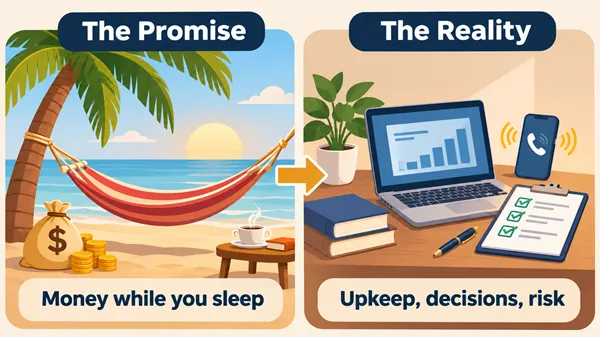
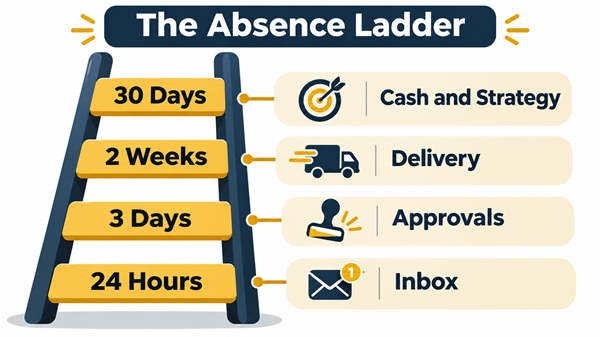
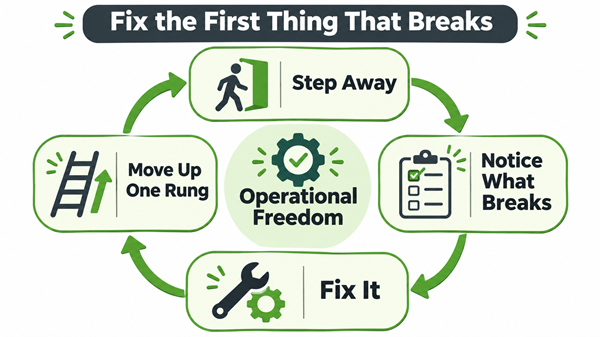
Passive income is rarely passive: most income streams need upkeep, decisions and oversight, so the label hides ongoing work. Operational freedom is a different goal. It means your business keeps delivering and making routine decisions while you're away, because systems and people carry the work. A simple way to measure it is the Absence Test: ask what breaks if you disappear for 24 hours, 3 days, 2 weeks and 30 days, then fix the first thing that breaks.
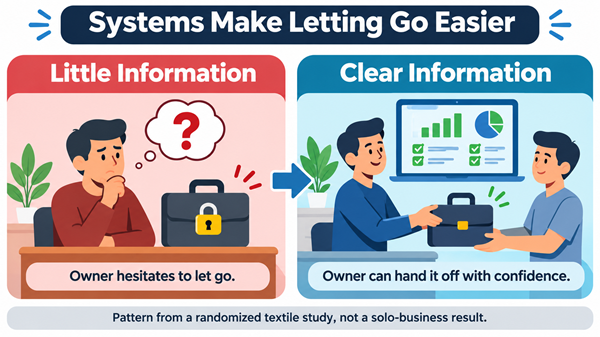
Survey data on owners' time off is sponsor-run and dated, but a randomized study of Indian textile firms found that better management systems led owners to delegate more authority. This is an operating model, not a get-rich shortcut, and results build with practice over months.
Key Takeaways
Most so-called passive income still needs upkeep, decisions and risk management.
Operational freedom means the business delivers and makes routine decisions without you in the room.
The Absence Test checks four rungs: 24 hours, 3 days, 2 weeks and 30 days away.
Fix the first thing that breaks, then move up one rung. Don't try to fix everything at once.
Evidence on owners' time off comes from sponsor-run surveys with limited detail, so treat the numbers as signals.
A randomized study of textile firms found that better management information made owners comfortable delegating more.
This is practice-based. Expect results to build over three to six months, not overnight.
Why "Passive" Misleads
You were told the dream was money arriving while you sleep. Then you launched, and you found yourself answering customer emails on a Sunday night, fixing a broken checkout page and wondering where the freedom went. If that sounds familiar, you didn't fail. The label promised something most income streams can't deliver.
Owner surveys point the same way, with limits. A CIBC survey reported in 2019 said 39% of small business owners took little or no vacation, and 65% said they worked more than they expected when they started. The article didn't report a sample size or method, and the sponsor is a bank, so read it as a signal, not a measurement.
An Australian survey of 430 small business owners from the same year told a similar story. About a quarter said they hadn't had a real break in at least four years, and among owners with no time off planned, more than half said the business depends on them. It was commissioned by a lender and covers one country, so again, treat it as a signal.
The goal worth chasing isn't zero work. It's a business that doesn't collapse when you step away. That's operational freedom.
Four Kinds of Income, Compared
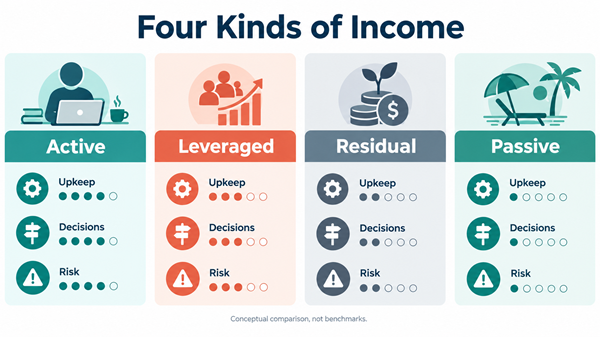
This comparison is conceptual. It shows where ongoing work hides, and it isn't a set of benchmarks.
Income type | Example | Ongoing upkeep | Decisions | Main risk |
Active | Hourly or per-project client work | Your time, every week | All yours | Stops when you stop |
Leveraged | A team delivers client work | Managing and quality checks | Shared with the team | Quality drifts if systems are thin |
Residual | A course, book or subscription | Updates, support and marketing | Product and pricing | Fades without refreshing |
"Passive" | A rental or dividend portfolio | Maintenance and oversight | Ongoing | Capital loss and surprises |
Notice the pattern. Every row has upkeep and decisions. What changes is who carries them and how often they land on you.
What Operational Freedom Actually Means
Operational freedom is the ability to be away while the business keeps serving customers, handling routine decisions and protecting cash. You still steer. You stop operating every day. It's the next stage after fixing the pain of being the bottleneck, which we cover in our guide to harnessing structure and systems.
You can measure it. That's what the Absence Test is for.
The Absence Test: Four Rungs
Start at the bottom rung and work upward. At each rung, ask what breaks if you disappear, then fix the first thing that breaks. Don't skip ahead. A weak lower rung will undo a higher one.
Run the test on paper first. For each rung, list every task, decision and person that would need you. Then circle the three items that would hurt most if they stalled. Those circles become your fix list. After that, try a real trial: block a day off, tell your backup person and watch what actually happens. Reality will surprise you, and that's the point.
Rung 1: Away for 24 Hours
What usually breaks. The inbox, scheduling and quick client questions. Nothing is fatal, but people wait and you feel it.
First fix. Write a one-page "if I'm unreachable" sheet with the five most common questions and their answers. Name one backup person for emergencies. Test it by taking a real day off. Afterward, write down every question that reached you, and add each answer to the sheet. Within a few rounds, the list gets short.
Rung 2: Away for 3 Days
What usually breaks. Approvals, refunds, vendor payments and routine decisions that only you can make.
First fix. Write decision rules: spend up to a set amount, refund within a set window, escalate beyond it. Expect a learning curve. DDI's leadership research found only 19% of manager candidates showed strong delegation skills, so plan to coach the people you hand decisions to. That data covers managers, not founders, and comes from a vendor.
Rung 3: Away for 2 Weeks
What usually breaks. Delivery quality, sales follow-up and onboarding. Small gaps turn into missed deadlines.
First fix. Name an owner for each core process, give each one a checklist, and hold one 30-minute weekly review. Better information is the lever here. In a randomized experiment in Indian textile plants, free advice on management practices raised productivity by 11%, and owners delegated more authority over hiring, investment and pay once better information made monitoring easier. Those were large manufacturing firms, so the exact numbers won't transfer to a solo consultancy. The pattern is the useful part: clear information makes letting go feel safer.
Rung 4: Away for 30 Days
What usually breaks. Cash visibility, strategy and key relationships. This is also where identity shows up.
First fix. Build a one-page monthly numbers sheet, a quarterly review and a map of who owns each key client relationship. On the personal side, Davidson's 2023 interviews with 37 founders described three phases of letting go: attachment, uncoupling and opportunity. It's a small qualitative study, so treat it as directional. NLP trainers like James R. Elliot often ask clients to chunk up: what does being needed give you, and what else could give you that?
Picture Jordan, a made-up consultant. Jordan's 24-hour and 3-day rungs hold, but a two-week trip stalls proposals because only Jordan follows up. Jordan builds a follow-up checklist and hands it to an assistant. That single fix moves the whole ladder. The example is hypothetical and not a result.
WHAT BREAKS FIRST IN YOUR BUSINESS? Bring your results from the Absence Test to a short call and plan your next rung together. Book a 30-minute connection call. |
Score Yourself
Rung 0: Even 24 hours away causes problems. Start with the one-page sheet.
Rung 1: You can step away for a day. Work on decision rules next.
Rung 2: Three days is fine. Add owners and checklists next.
Rung 3: Two weeks holds. Build numbers visibility and a review rhythm.
Rung 4: A month works. You're steering, not operating, so protect what you've built.
If your current systems feel shaky, our post on warning signs your systems are failing can help you spot weak points, and time management for leaders covers daily habits that support the rungs.
Who Should Chase Passive Income
People who already have capital or a product and want a hands-off complement to their main income.
Anyone willing to accept ongoing upkeep, risk and slower payoff in exchange for diversification.
Founders whose core business already passes the Absence Test and who want a second stream.
Who Should Build Operational Freedom First
Solo coaches, consultants and service owners whose income stops when they stop.
Founders who feel they can't take a week off without things slipping.
Anyone considering a passive product but with no free hours to build it. Fix the operating base first. For more on what coaches earn at different stages, see our guide to life coaching income and earnings.
Data & Findings
Here is what the sources show and where they fall short. We found no study that tests the Absence Test itself, so treat it as a practical method.
CIBC survey (2019): 39% of small business owners took little or no vacation, 60% struggled to get time off, and 65% said they worked more than expected. The article reports no sample size or method, and it's sponsor-run and dated.
AltFi and OnDeck survey, Australia (2019): Of 430 SME owners, 26% hadn't had a break in at least four years, and 55% of those with no break planned said the business depends on them. It's a commercial lender's survey in one country, and the article's framing is inconsistent in places.
Indian textile experiment: Randomized free management advice raised productivity by 11% and led owners to delegate more authority. The summary gives no sample size and covers large plants, not micro-businesses.
Founder letting-go study: 37 founders interviewed, with three phases from attachment to opportunity. It's small and qualitative.
Delegation skills: DDI's data from 10,796 leaders ranked delegation first among burnout-prevention skills, with only 19% of manager candidates showing strong delegation. It's a vendor's research on managers, not founders.
FAQs
Is passive income real?
Some income needs less daily effort than client work, but nearly all of it needs upkeep, decisions or risk management. Treat "passive" as a spectrum, not a switch.
What's the difference between passive income and operational freedom?
Passive income describes a type of revenue. Operational freedom describes how much your business depends on you to run. You can have one without the other.
How long does it take to build operational freedom?
It varies. Many owners see progress on the lower rungs within weeks and steadier change over three to six months of practice. Avoid promising yourself a fixed date.
Do I need a team to pass the Absence Test?
Not at first. Written checklists, decision rules and one reliable backup person go a long way. A team or contractors help most on the two-week and 30-day rungs.
Does operational freedom mean I stop working?
No. You move from running daily operations to steering the business. The work changes shape, and you gain choice about when and where it happens.
Conclusion
The passive income dream sells an exit from work. Operational freedom gives you something sturdier: a business that holds up when you step away. Take decisive action this week by running the 24-hour rung and fixing the first thing that breaks. When you'd like a partner for the next rung, book a 30-minute connection call.
Unleash Your Power: Stand Out, Take Action, and Create the Success You Want.