The Overwork Paradox: How to Scale Your Business by Doing Less
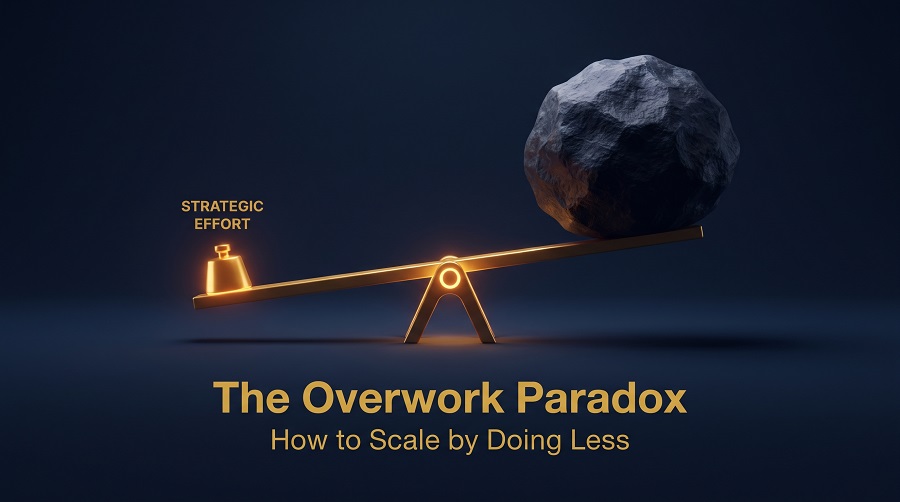
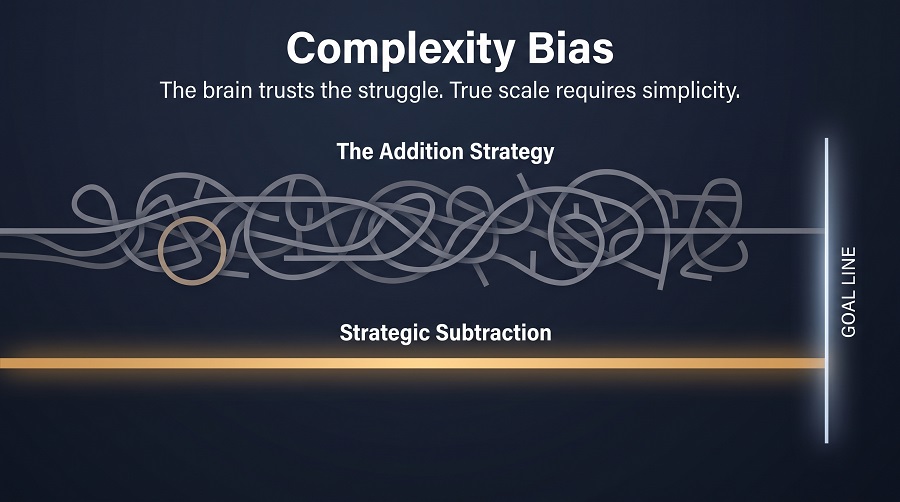
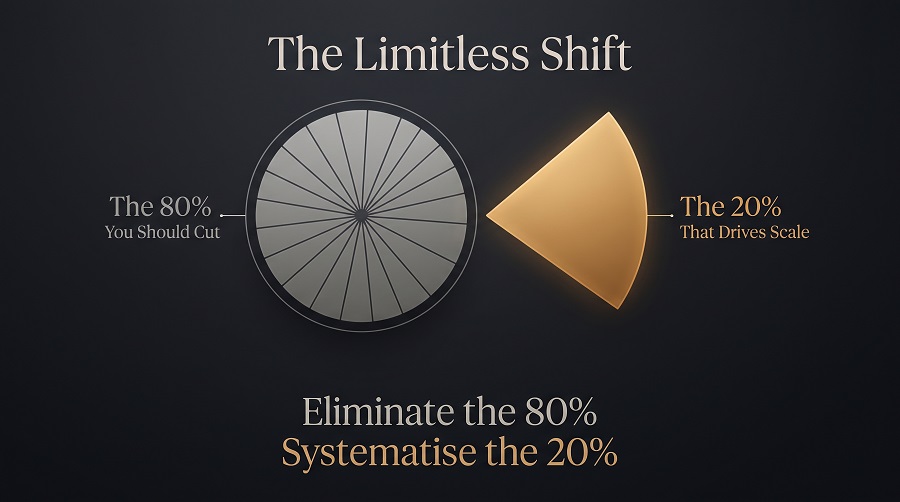
The Overwork Paradox states that past a certain threshold, the more hours a founder works, the slower the business grows. Most entrepreneurs attempt to scale by using "Addition Strategy"—adding more services, more marketing channels, and more working hours. However, true scaling requires "Strategic Subtraction." By ruthlessly eliminating the bottom 80% of tasks, offers, and clients that create friction, a founder concentrates their limited cognitive energy on the 20% of high-leverage activities that drive geometric growth. This paradox is difficult to implement because of "Complexity Bias"—a neurological flaw where the human brain equates effort and complexity with value. Overcoming this requires Performance Psychology to rewire the belief that success must be painful, combined with structural systems that allow the business to operate on less of your time while producing more revenue.
Key Takeaways
Complexity Bias Kills Scale: The human brain mistrusts simple, elegant solutions. We unconsciously overcomplicate our business models because struggling feels more "valuable" than ease.
Addition Creates Bottlenecks: Adding more products, tiers, or target audiences dilutes your authority and creates operational friction that traps you in the weeds.
Strategic Subtraction is the Lever: You do not scale by doing 100 things 10% better. You scale by doing 3 things exceptionally well and completely eliminating the other 97.
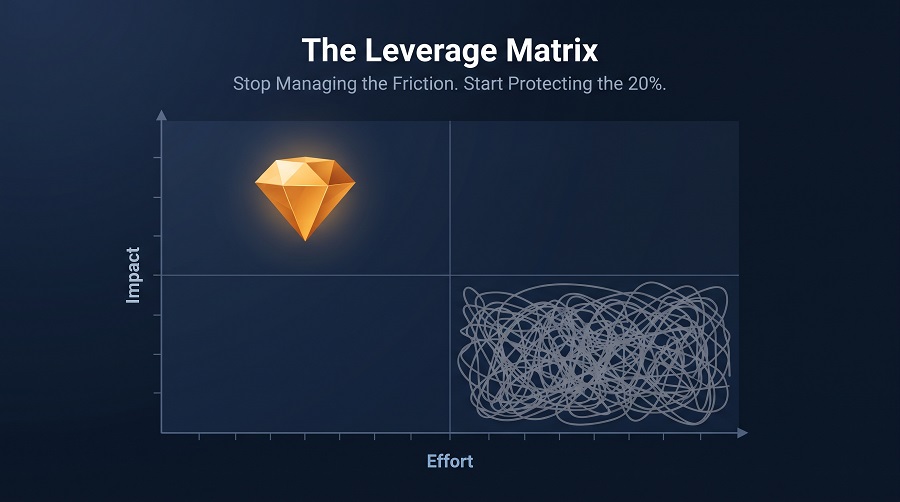
Protect the 20%: The Pareto Principle is absolute. 80% of your revenue and client results come from 20% of your effort. Scaling is the act of ruthlessly protecting that 20%.
Mindset Must Precede Structure: You will not let go of the 80% if your identity is tied to being "busy." Psychological rewiring must happen before you can successfully delegate or eliminate.
The Flawed Mathematics of "More"
There is a dangerous mathematical assumption woven into entrepreneurial culture: Output is directly proportional to Input. If you want double the revenue, you must put in double the hours, offer double the services, and talk to double the people.
This works when you are going from $0 to $50,000. It is the exact reason you stall when trying to go from $250,000 to $1,000,000.
At a certain point, the physics of your business change. You run out of hours. When you try to force growth by adding complexity (a new offer, a lower pricing tier, a new social media platform to manage), you don't multiply your results. You divide your focus. You become the central node through which all this new complexity must pass, effectively choking your own company's growth.
The Neuroscience of Complexity Bias
If doing less is the secret to scaling, why is it so terrifying to implement? Because your brain is actively fighting against simplicity.
The Illusion of Value in Suffering
Psychologists have heavily documented "Complexity Bias," a cognitive trap where individuals prefer complex explanations and systems over simple ones. In business, this manifests as an unconscious belief: If it isn't hard, it isn't valuable. When an entrepreneur considers cutting a service offering that takes 10 hours a week to fulfill, the brain sounds an alarm. It feels like "cheating" or "being lazy."
The Comfort of the Chaos
Chaos is predictable. When your calendar is packed with 15 back-to-back low-level tasks, your brain doesn't have to face the unknown. Strategic Subtraction creates "white space" on your calendar. For an over-stressed nervous system, white space feels terrifying because it forces you to face the big, intimidating CEO-level questions you've been using busywork to avoid.
The Limitless Framework: Scaling Through Subtraction
To scale past your current revenue ceiling without breaking your health, you must adopt the core Limitless Entrepreneur mechanism: The 5 Shifts to Freedom and The 3 Pillars.
The 3 Pillars of Leverage
Pillar 1 — Performance Psychology: We use NLP to dissolve "Complexity Bias" and the need for struggle. You learn to emotionally tolerate simplicity and detach your self-worth from your exhaustion level.
Pillar 2 — Freedom-First Business Strategy: We implement Radical Subtraction. We audit everything you do and cut, automate, or delegate the 80% of activities that generate friction instead of forward momentum.
Pillar 3 — Freedom-First Business Structure: The remaining 20% is systematised into an operational machine that runs independently of your mood or energy levels.
The Leverage Audit Matrix
To scale, you must move your daily actions from the top of this matrix to the bottom. Most founders spend 80% of their week trapped in Quadrants 1 and 2.
Task Category | Characteristics | Impact on Scale | The Limitless Fix |
1. Negative Leverage (Energy Drains) | Customizing low-ticket offers; arguing with bad-fit clients; endless email triage. | Actively shrinks the business by causing burnout and resentment. | Ruthless Elimination. Fire the client. Drop the offer. Do not automate; amputate. |
2. Zero Leverage (Maintenance) | Manual onboarding; scheduling; basic bookkeeping; fixing broken links. | Keeps the business alive but traps the founder at their current revenue ceiling. | Systematise & Delegate. Build an SOP and remove yourself entirely from the loop. |
3. Linear Leverage (Direct Delivery) | Fulfilling your core service 1-on-1; custom consulting; direct sales calls. | Predictable growth, but strictly capped by the hours in your week. | Productise & Elevate. Shift to group models, charge premium, or train a team. |
4. Geometric Leverage (CEO Assets) | Designing new systems; building key partnerships; market positioning; thought leadership. | Exponential growth. One hour of effort can generate revenue for years. | Protect & Expand. This is the 20% where you must spend 80% of your week. |
Addition vs. Subtraction Strategy
Here is how a struggling founder operates compared to a Limitless CEO when attempting to double their business:
The Goal: Double Revenue | The Addition Strategy (The Overwork Trap) | The Subtraction Strategy (The Limitless Method) |
Offer Structure | Creates a cheaper "down-sell" offer to capture more people. Now manages two complex fulfillment pipelines. | Kills the 3 lowest-performing offers. Focuses 100% of energy on the single highest-margin, best-result signature offer. |
Marketing | Starts posting on 3 new social platforms. Engagement drops across the board due to diluted focus. | Stops doing 4 things that aren't working. Doubles down investment and depth on the 1 channel driving real ROI. |
Team Dynamics | Hires a cheaper VA and spends 15 hours a week micromanaging them because "they don't get it." | Builds an ironclad SOP for onboarding, removes themselves from the process, and lets the system run. |

Case Evidence: The Power of Doing Less
Nik — Subtraction in the Offer Suite (Name Changed)
Nik ran a successful consultancy, but he was offering six different service tiers to try and capture every possible client budget. He was exhausted, working weekends to manage the disparate deliverables. Through Pillar 2 (Freedom-First Strategy), we forced a radical subtraction. We eliminated five of his six offers. He was terrified he would lose income. Instead, by focusing entirely on his single premium offer (Shift 5: Magnetic Authority), his marketing became razor-sharp. He stopped jumping between contexts. Within 90 days, his working hours dropped by 40%, and his revenue hit its highest quarter ever.
Tom — Subtraction in Fulfillment (Name Changed)
Tom was trapped doing highly customised, bespoke deliverables for every client. His business could not scale beyond 15 clients because he physically could not do the work. Through Shift 3 (Systems That Scale), we stopped customizing. We mapped out the exact 80/20 of his process that actually got clients results, standardised it into a clear methodology, and stripped out the bespoke "fluff" he was adding just to feel like he was working hard. He reclaimed 20 hours a week and was finally able to take on 40 clients without breaking a sweat.
Decision Framework: Is It Time to Subtract?
✓ This Approach Is Designed For: Founders who are already making money but feel like their business is a chaotic web of custom requests, fragmented marketing, and overwhelming admin. You are ready to simplify to scale.
✗ This Approach Is Not For: Those who are still trying to find product-market fit and need to test multiple offers, or those who refuse to let go of their low-paying, high-friction clients out of fear.
Try This: The "Kill One Thing" Audit
Step 1 Identify the Friction: Look at your business right now. What is the one service offering, marketing channel, or client type that causes the most headaches for the least amount of profit?
Step 2 Calculate the Hidden Cost: Factor in the mental energy, the context-switching, and the stress it causes you. That is its true cost.
Step 3 The Amputation: Send the email today. Discontinue the service. Drop the channel. Do not try to "fix" it. Just subtract it. Watch how much executive energy floods back into your system tomorrow morning.
Further Reading
Harnessing Structure & Systems — how to systematise the 20% that remains.
Why Goals Fail — how complexity bias ruins execution.
Mastering Mindsets for Business — rewiring the belief that success must be painful.
Strategies to Scale Your Business — real scaling mechanics over hustle culture.
Harvard Business Review: The Complexity Bias — external research on why we overcomplicate.
Frequently Asked Questions
If I stop offering my lower-tier services, won't I lose money?
You may lose some top-line vanity revenue, but your profit margins and time freedom will soar. Low-tier services often carry the highest operational friction. Removing them frees up the capacity to sell and deliver just one or two premium packages that more than replace the lost income.
How do I know if I'm suffering from Complexity Bias?
If your immediate reaction to a business problem is to buy a new software tool, hire another freelancer, or create a new 12-step funnel instead of asking "What can I remove to make this easier?"—you are suffering from complexity bias.
Can I scale by just hiring people to do the complex stuff?
No. Delegating a broken, overly complex system just makes it fail faster and more expensively. You must simplify and eliminate first. Only systematise and delegate what survives the cut.
Why does it feel so scary to do less?
Because you have unconsciously fused your self-worth with being "busy." Doing less threatens that identity. This is why Pillar 1 (Performance Psychology) is required to rewire your nervous system to feel safe in the white space.
I feel like my business requires me to do 100 different things. Is this framework for me?
Yes. Every founder feels their business is the exception. It isn't. The 100 things you are doing are a symptom of a lack of Strategic Subtraction. The 5 Shifts will help you find the 3 things that actually matter.
Conclusion: The Proof is in the White Space
For a decade, James R. Elliot was trapped in the Overwork Paradox. Running his fifth business, he believed that every new problem required a new, complex solution. He was working 80 hours a week on anxiety medication, managing a tangled web of offers and operations. His niece asked why he never visited anymore, exposing the truth: his complexity wasn't a business strategy; it was an ego defense.
He didn't scale by adding more. He scaled by taking a machete to his business model. Within 90 days of applying Radical Subtraction and Performance Psychology, his working week dropped from 80 hours to 25. He stripped away everything that wasn't geometric leverage. Revenue increased because the focus was finally pure.
He now takes a 36-minute nap every afternoon. He visits his niece. That is the power of doing less.
Ready to simplify your scale? Book the Freedom Blueprint Call (45 mins). We will find the 80% you need to cut today.