
Marketing Can't Fix Structure: Build Leadership Confidence
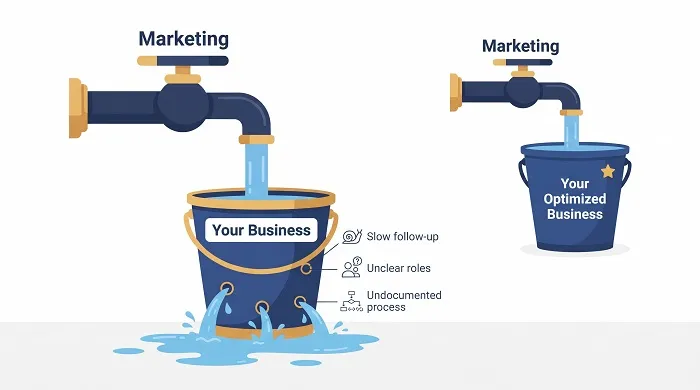
A better campaign cannot fix a weak structure because marketing only increases the volume of what your business already does. If your follow-up is slow, your roles are unclear, or your processes live in your head, more leads expose those gaps faster. Confidence in leadership grows when you fix the structure first. You know where each lead goes, who owns each outcome, and what happens when you are not in the room. Then you can upgrade your campaigns with certainty instead of hope. The practical path is to trace where leads and customers drop off, give each step one owner, write the step down, test it at your current volume, and only then spend more on marketing. Leaders who work in this order stop second-guessing every result, because the system shows them what is working and what is not.
What Does "Marketing Cannot Fix Structure" Actually Mean?
Structure is the set of roles, processes, and decisions that turn attention into delivered results. Marketing creates the attention. Structure decides what happens next.
When a campaign upgrade fails, the cause is rarely the ad, the copy, or the platform. One marketing consultant who audits sales, onboarding, and account management before building any campaign argues that unclear structure puts a hard ceiling on what advertising can do. That matches what I have seen in more than 20 years of working with business owners.
Picture a bucket with holes in it. Marketing pours in more water. Structure decides whether the bucket holds any of it.
Key Takeaways
Marketing amplifies whatever structure already exists, strong or weak.
Slow follow-up often passes for a lead quality problem, so check response time before changing the campaign.
Confidence in leadership grows when you can see what is working and step away without fear.
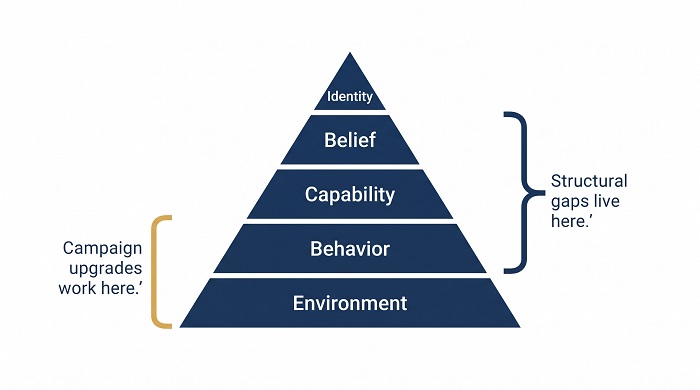
Campaign upgrades work at the level of environment and behavior, while structural gaps sit at capability and belief.
Document the five processes you repeat most before documenting anything else.
Test your structure for 30 days at current volume before raising spend.
Keep marketing running during the fix. Hold spend steady rather than stopping it.
Why Do Campaign Upgrades Fail Even When the Creative Is Good?
A campaign amplifies. Stronger creative sends more people into the same experience, and if that experience has gaps, the gaps get bigger. One operations-focused marketing team puts it plainly: marketing exposes and magnifies operational weakness.
Response speed is the clearest example. A widely cited Harvard Business Review study of 1.25 million sales leads, summarized here, found that companies who contacted inquiries within an hour were far more likely to reach a decision-maker. Slow replies rarely look like a systems problem. They look like "low-quality leads" or "a slow market."
So the owner buys a new campaign, more leads arrive, the same slow reply waits for them, and the numbers disappoint again. The cycle costs money and it costs belief in yourself.
The Three Gaps That Swallow Campaign Results
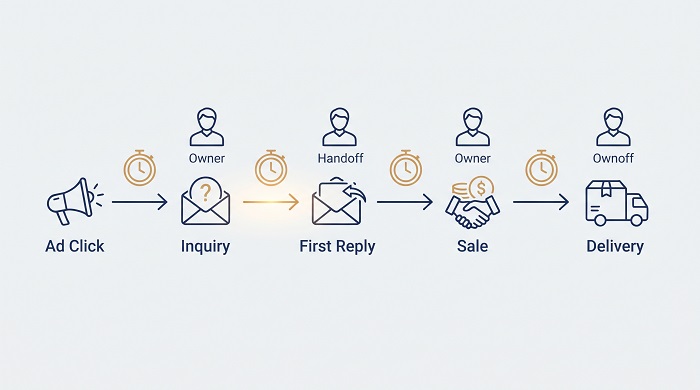
The handoff gap. A lead comes in and nobody knows who owns it.
The delivery gap. The promise made in the ad is not the experience the customer gets.
The knowledge gap. The answer to "how do we do this?" lives only in the owner's head.
How Does Weak Structure Erode Confidence in Leadership?
Here is what this means for you. When you cannot tell whether a result came from the campaign or the system, every number becomes a guess. Guessing leads to second-guessing, and second-guessing is where confidence goes to die.
It also traps you in the business. A study of 122 startup founders found that 58% were rated poor at delegating in 360 feedback, while the founders who delegated well outperformed on measures from team satisfaction to growth. Founders often hold on because nothing is written down. If only you know how it works, you cannot step away without feeling exposed.
Your leadership style carries weight here too. Gallup research estimates that managers account for at least 70% of the variance in team engagement. Your team takes its cues from how steady and clear you are, and a business without structure makes steadiness very hard.
Mike L. came to James carrying heavy self-doubt, constant second-guessing, and a mind full of noise that made it hard to listen. After working through NLP techniques aimed at that noise and the beliefs underneath it, he reported speaking with confidence at work and hearing people more clearly. Structure does the same job inside a business. It turns down the noise so you can see what is real.
Where NLP Logical Levels Fit In
NLP's Logical Levels model sorts any problem into environment, behavior, capability, belief, and identity. A campaign upgrade works at the level of environment and behavior. A structural gap usually lives deeper, at capability and belief. Do you know how to hand this off? Do you believe it will be done well without you?
Try This: Set a timer for five minutes and finish the sentence "I can't step away from my business because..." as many times as you can. Each answer points to either an undocumented process or a belief worth testing. Circle the ones you can fix this month.
What Are the Warning Signs That Structure Is the Real Problem?
Your marketing is probably asking structure to do a job it cannot do if you see several of these:
Leads arrive, but replies take hours or days.
Only you can answer routine customer questions.
Results swing from month to month with no clear cause.
New hires take months to become useful.
You blame the last agency, platform, or campaign in turn.
A week away creates a backlog or a crisis.
Our post on the warning signs your systems are failing goes deeper on each one. Spotting two or three of them is not a verdict against you. It is a clear starting point.
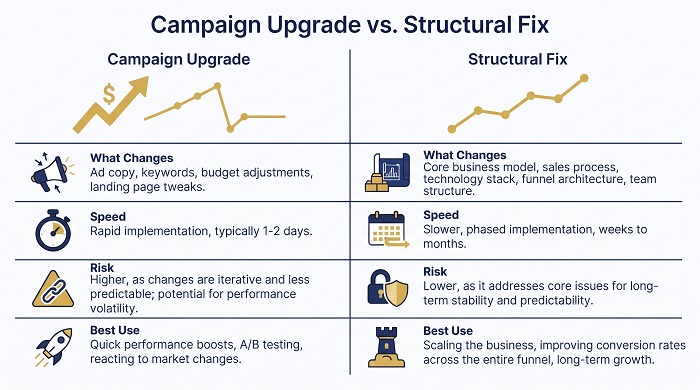
Campaign Upgrade vs. Structural Fix: How Do They Compare?
Campaign upgrades fit a business whose structure already holds. Structural fixes fit a business where results swing, or where everything depends on one person. Most growing companies need both, in a specific order.
Factor | Campaign Upgrade | Structural Fix |
What it changes | Volume and quality of incoming attention | What happens after attention arrives |
Typical time to see a signal | Days to weeks | Weeks to a few months |
Main risk | Amplifies existing gaps | Feels slow and invisible at first |
Best when | Follow-up, delivery, and roles already work | Results swing or depend on one person |
Effect on leader confidence | Short lift, then doubt if results slip | Builds steadily as results become predictable |
Cost pattern | Rises with every increase in spend | Front-loaded effort, small upkeep |
Data & Findings
No single study measures this exact question, so the table below collects the closest research. Read the vendor surveys with that in mind, since several come from software or consulting firms.
Finding | Source | Why It Matters |
37% of small businesses with revenue growth above 20% had at least 80% of their processes documented | Trainual, State of Small Business 2023 (software vendor survey) | Documented structure shows up in fast-growing companies |
58% of 122 founders were rated poor at delegating | Founder dependence is common, and it caps growth | |
Managers account for at least 70% of the variance in team engagement | Leader steadiness shapes team results more than company-wide programs | |
1.25 million leads analyzed, with faster response linked to more decision-maker contact | Slow handoffs waste campaign spend |
Client stories at Unleash Your Power point the same direction. When clients clear the beliefs behind their hesitation, they act, and acting is what makes a new system stick. Darren G. felt blocked from promotions and from starting his own business, even with a well-paying job. Exposing his goal blocks shifted his thinking and his behavior, which is the same pattern leaders show when they finally write their processes down.
The 5-Step Foundation First Framework
This framework gives you an order of operations. It ties directly to the pillars of Massive Success: clarity, courageous action, and continuous growth.
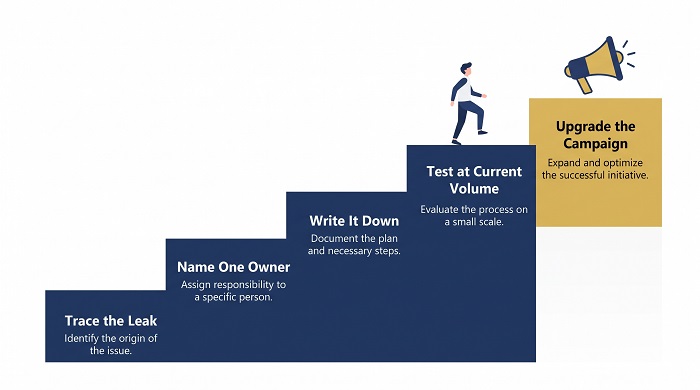
Step 1: Trace the Leak
Follow one real lead from first contact to delivered result. Write down every handoff and every wait. This is Pillar 1, Clarity of Vision, applied to your own operation.
Step 2: Name One Owner
Give every handoff one responsible person. If that person is you for now, say so out loud. Shared ownership is the same as no ownership.
Step 3: Write It Down
Document the five processes you repeat most. A rough checklist beats a perfect manual that never gets written. Our post on why structure and systems accelerate growth shows how to start small.
Step 4: Test at Current Volume
Run the system for 30 days with no new ad spend. Watch response time, handoff delays, and customer complaints. This is Pillar 3, Courageous Action, because it asks you to look at real numbers instead of hopes.
Step 5: Upgrade the Campaign
Now spend more. You have a baseline, so you can tell whether the new campaign helped or whether something else changed. This is Pillar 5, Continuous Growth, working the way it should.
Who Should Use This Approach?
Owners who are the bottleneck for replies, decisions, or delivery
Leaders whose monthly results swing without a clear reason
Teams of 2 to 30 people who are hiring or about to hire
Anyone planning to raise ad spend in the next quarter
Founders who feel confident on good days and shaky on slow ones
Who Should Avoid This Approach?
Pre-launch founders who have not yet tested whether anyone wants the offer. You need market testing first, not systems.
Businesses whose tested structure already works and whose data shows the creative is the weak point. A campaign upgrade is the right call there.
Leaders looking for a guaranteed quick sales spike. This work builds predictable results over months, not overnight ones.
Owners unwilling to hand any ownership to someone else. The framework needs at least one real handoff.
Frequently Asked Questions
Should I stop marketing while I fix my structure?
No. Keep your current campaigns running and hold spend steady. You need real leads to test your system against, so pausing marketing removes your best source of data.
How do I know whether the problem is my campaign or my structure?
Compare how leads convert when you answer them within an hour versus the next day. If fast replies convert much better, your structure is the bottleneck. If both convert about the same, the campaign itself deserves a closer look.
How long does it take to see results from fixing structure?
Many owners see a first signal, such as faster replies and fewer dropped handoffs, within 30 days. With practice, steadier and more predictable results often show up over three to six months.
Do I need special software to build structure?
No. A shared document with owners, steps, and deadlines works well to start. Add software later, once you know which steps are worth automating.
How does this connect to building confidence in leadership?
Confidence comes from knowing what happens in your business whether or not you are watching. Structure gives you that knowledge, and the exercises in our daily confidence post help you build the mindset to match it.
Conclusion
You do not need a bigger campaign to feel more confident. You need a business that holds up when attention arrives. Trace the leak, name the owners, write the steps, test at current volume, and then upgrade your marketing with real numbers behind you.
If second-guessing is part of what keeps you from taking this on, you are not alone, and I have walked this path myself. Self-doubt can be mastered, and structure is a good place to start. To build both the mindset and the system, explore NLP training for business or book a conversation about leadership training built for entrepreneurs like you.