
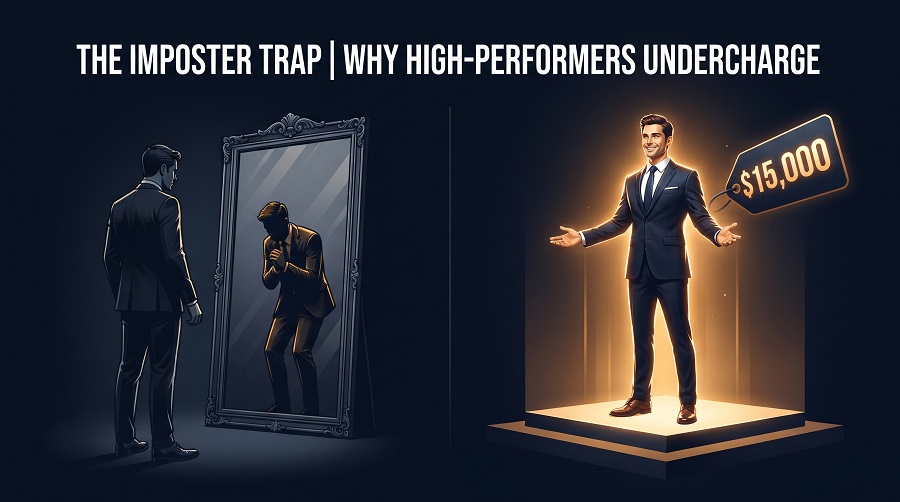
The Imposter Trap: Why High-Performers Undercharge
Undercharging is rarely a marketing problem; it is a neurological risk-mitigation strategy. The "Imposter Trap" occurs when a highly skilled entrepreneur intellectually knows their value, but unconsciously associates premium pricing with severe social or identity risk. When you charge $500, a dissatisfied client is a minor disappointment. When you charge $5,000, your unconscious mind perceives a dissatisfied client as a threat to your professional identity and reputation. To protect you from this high-stakes scrutiny, the amygdala triggers a fear response precisely at the moment of quoting a price, causing your voice to drop and your rates to heavily discount. Solving this requires more than just "knowing your worth" or reading a new sales script. It requires Performance Psychology to decouple your personal self-worth from the prospect's reaction, allowing you to establish True Magnetic Authority.
Key Takeaways
The Neurological Safety Net: Lowering your price is your brain's way of lowering expectations, thereby protecting you from the pain of potential criticism or failure.
Information vs. Wiring: Reading high-ticket sales scripts will not work if your nervous system is wired to interpret premium pricing as a threat.
The Cost of the Trap: High-performers trapped in imposter syndrome typically work 30-50% more hours to make up for revenue lost to chronic undercharging.
Decoupling Identity from Output: Sustainable premium pricing requires separating your intrinsic human value from the outcome of a specific client engagement.
Pricing as Positioning: Premium pricing is not just a revenue lever; it is a psychological filter that repels uncommitted clients and attracts those ready to do the work.
The Disconnect Between Expertise and Revenue
You have the credentials. You have the case studies. You deliver exceptional results. You have spent weeks mapping out a new, premium-priced offer that accurately reflects the value you provide.
Then, you get on the sales call. The prospect asks for the investment. In a fraction of a second, your chest tightens, your throat restricts, and you quote a price that is 40% lower than the one written on the notepad in front of you. You justify it immediately: "I want to make it accessible. They seemed hesitant. I'll raise the price on the next one."
You haven't made a strategic business decision. You have just succumbed to the Imposter Trap.

The Neuroscience of the Imposter Trap
The business coaching industry often frames undercharging as a "lack of confidence." This is intellectually lazy. Many founders who undercharge are fiercely confident in their actual skills. The problem is neurological.
The Amygdala's Calculation of Scrutiny
Your brain is a prediction machine designed to keep you safe from social exclusion. When you contemplate charging a premium price, the amygdala (the brain's threat-detection centre) calculates the risk. High prices raise the stakes. They invite higher expectations, deeper scrutiny, and a much sharper fall from grace if you fail to deliver. The brain interprets this elevated scrutiny as "danger."
The "Discount" as a Defense Mechanism
By spontaneously discounting your price, you are unconsciously buying an insurance policy against criticism. If they only paid a fraction of the value, they cannot be truly angry if the outcome isn't perfect. Your nervous system prioritises immediate psychological safety over long-term business scale.
The "Not Enough" Identity Fusion
At the core of the Imposter Trap is Identity Fusion: the unconscious belief that a "no" from a prospect, or a failure in delivery, means that you are fundamentally flawed or fraudulent. Until your pricing is decoupled from your personal identity, charging what you are worth will always feel like putting your life on the line.
The Framework: The 5 Shifts to Freedom & The 3 Pillars
You cannot cure the Imposter Trap with a new PowerPoint deck or a bolder sales script. The Limitless Entrepreneur methodology attacks the root cause using a tri-part architectural mechanism.
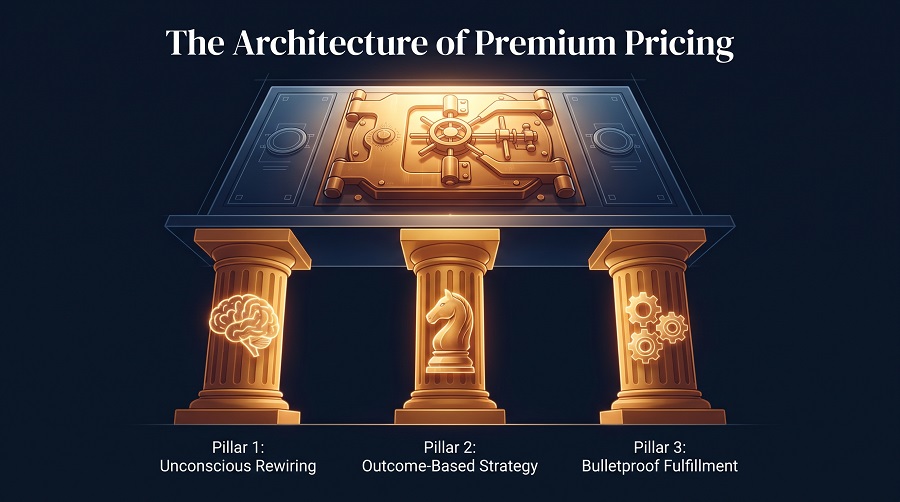
The 3 Pillars of Pricing Power
Pillar 1 — Performance Psychology: We use Neuro-Linguistic Programming (NLP) and Timeline Therapy to dismantle the unconscious belief that high prices equal high danger. We rewire the nervous system so that quoting a premium rate feels neutral and safe.
Pillar 2 — Freedom-First Business Strategy: We restructure your offers. You stop charging for your time (which inherently limits your price) and begin charging for the transformation.
Pillar 3 — Freedom-First Business Structure: We build the fulfillment systems that guarantee delivery, so your brain has empirical proof that the premium price is backed by a rock-solid operational engine.
The 5 Shifts: From Imposter to Authority
Phase 1: Clarity (Weeks 1-4)
Shift 1 — Vision Alignment: Defining exactly who your premium client is and acknowledging the massive value you actually bring to the table.
Phase 2: Liberation (Weeks 5-11)
Shift 2 — Ruthless Elimination: Stripping away the low-ticket, high-friction offers that keep you exhausted and validate the imposter narrative.
Shift 3 — Systems That Scale: Externalising your expertise into a methodology that justifies the premium investment.
Phase 3: Amplification (Weeks 12-16)
Shift 4 — Mindset Unlock: Neutralising the "fraud" fear. This is where the physical flinch on the sales call disappears.
Shift 5 — Magnetic Authority: Owning your market position so completely that prospects arrive pre-sold on your premium rates.
Data & Findings: The Quantifiable Cost of Imposter Syndrome
Benchmark | Statistic (Source) | What It Costs You | What Changes When Resolved |
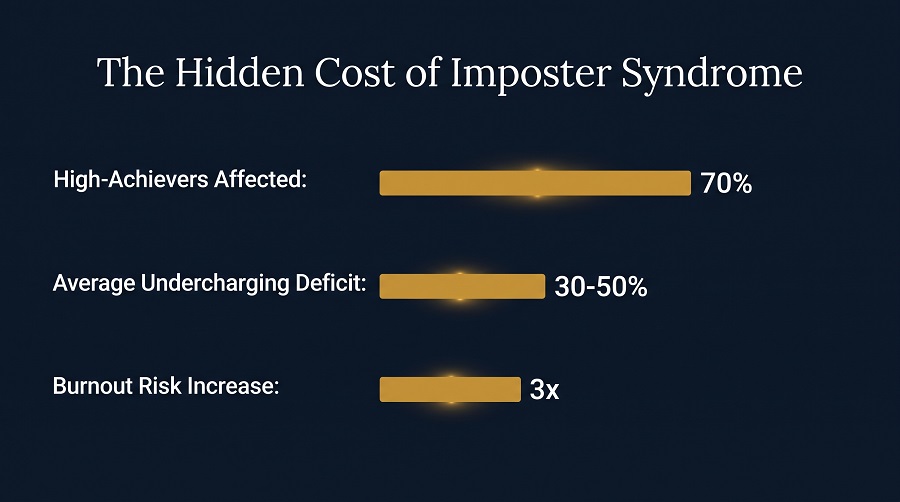
Prevalence of Imposter Syndrome | Over 70% of high-achievers experience imposter syndrome (Intl. Journal of Behavioral Science) | Chronic self-doubt limits market visibility | Unapologetic thought leadership and market presence |
The Undercharging Deficit | Service providers typically undercharge by 30-50% of market value early in their scaling phase (Industry Benchmarks) | Working 60 hours to earn what should take 30 hours | Revenue doubles without adding a single extra working hour |
Burnout Correlation | Entrepreneurs working 50+ hours are 3x more likely to burn out (Gallup) | Resentment toward clients and eventual business failure | Operating purely in the Zone of Genius with high-margin clients |
Comparison Matrix: Three Approaches to Pricing
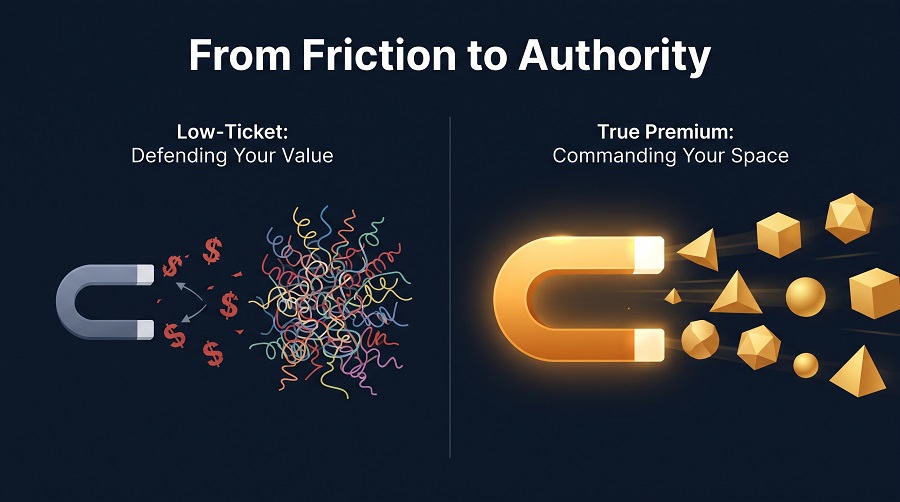
Dimension | The Volume Trap (Low-Ticket) | The Fake "High-Ticket" (Strategy Only) | True Magnetic Authority (The 5 Shifts) |
Core Philosophy | Compete on price; be accessible to everyone | Just "raise your prices" and read a script | Align internal psychology with premium external value |
Sales Call Experience | Exhausting, dealing with constant price objections | High-anxiety, feels manipulative or forced | Calm, grounded, an invitation rather than a pitch |
Client Quality | High-friction, demanding, uncommitted | Skeptical, demanding proof to justify the leap | Highly committed, resourceful, ready to do the work |
Owner's Reality | Overworked, underpaid, resentful | Anxious about delivering on the inflated promise | Working 25-35 hours/week, delivering massive impact |
Case Evidence: Owning the Value
Jennifer — Breaking the Undercharging Ceiling (Name Changed)
Jennifer had over a decade of specialised expertise and genuine results, yet her rates were embarrassingly below market value. She had downloaded every high-ticket sales script she could find, but the moment a prospect hesitated, her rate dropped involuntarily. The issue was an unconscious belief that charging premium prices would cause rejection. Through Pillar 1 reconditioning, we decoupled her self-worth from prospect reactions at the neurological level. Within 60 days, she restructured her offer suite around outcome-based pricing. She doubled her prices. Her revenue more than doubled, and her client load stayed the exact same.
Nik — From Selling Time to Selling Transformation (Name Changed)
Nik was a brilliant consultant who sold his time by the hour. He hit an absolute income ceiling because he simply ran out of hours in the week. His imposter trap told him that clients were paying for his sweat, not his solutions. By running him through Shift 2 (Ruthless Elimination) and Shift 5 (Magnetic Authority), we repackaged his intellectual property into a premium methodology. He stopped competing on hours and started pricing on outcomes. He reclaimed his weekends and significantly increased his take-home profit.
Decision Framework: Is Your Pricing a Psychological Problem?
✓ This Approach Is Designed For: Highly competent coaches, consultants, and service providers who know their work changes lives, but consistently freeze, discount, or over-deliver to justify their fees.
✗ This Approach Is Not For: Beginners who have not yet developed a skill worth a premium price, or individuals looking for manipulative sales tactics to overcharge for subpar work.
Try This: The Sales Call "Flinch" Audit
Step 1: Record Your Pitch. On your next three sales calls, record the audio (with permission).
Step 2: Locate the Flinch. Listen to the exact 10 seconds where you reveal your price. Does your pitch suddenly speed up? Does your tone go up at the end of the sentence like a question? Do you immediately start talking again to fill the silence?
Step 3: Identify the Protection Mechanism. That verbal flinch is your nervous system trying to protect you. Recognise that your problem is not your offer—your problem is the neurological threat response attached to your offer. Once you see the flinch, you can begin the work of rewiring it.
Further Reading
Effective Decision Making — how to make CEO-level choices without second-guessing.
Entrepreneurial Mindset Through NLP — the science of rewiring self-sabotage.
Mastering Mindsets for Business — shifting from imposter to absolute authority.
Strategies to Scale Your Business — structural leverage beyond trading time for money.
Harvard Business Review: Overcoming Imposter Syndrome — external insights on high-achiever psychology.
Frequently Asked Questions
Why do I feel like a fraud when asking for high-ticket prices?
Because your unconscious mind has fused your personal worth with the client's outcome. Charging a high price raises the stakes, and the brain perceives this increased scrutiny as a threat to your identity. This is a neurological safety response, not a lack of actual competence.
Won't raising my prices scare away all my clients?
It will scare away the uncommitted, high-friction clients who drain your energy. Premium pricing acts as a psychological filter. It attracts resourceful, highly committed clients who actually do the work and achieve better results, which in turn reinforces your authority.
I've tried sales scripts, but they feel sleazy. Why?
Because reciting a script without changing the underlying psychological wiring creates cognitive dissonance. Your body is screaming "danger" while your mouth is saying "$10,000." When you resolve the psychological block using Performance Psychology, you don't need manipulative scripts; you simply state a fact.
How do I transition existing clients to premium pricing?
You do not just raise the price; you elevate the offer. By applying Freedom-First Business Strategy, you restructure the engagement from an hourly or transactional model to a transformative, outcome-based model that mathematically justifies the new investment.
Is imposter syndrome something I just have to live with?
Absolutely not. Imposter syndrome is a learned neurological pattern. What is learned can be unlearned. Through the 16-week methodology of The 5 Shifts to Freedom, we actively rewire that pattern so you can operate with calm, grounded certainty.
Conclusion: The Proof of True Authority
For years, James R. Elliot was the ultimate high-performer trapped in his own success. Running his fifth business, he was the centre of every client engagement, working 80 hours a week on anxiety medication. He was heavily undercharging for his expertise, convinced that if he just worked harder, the revenue would eventually reflect the effort.
It didn't. The shift only occurred when his niece asked why he never visited anymore. That question shattered the illusion. He realised that his undercharging and overworking were two sides of the same imposter coin: a desperate need to constantly prove his worth.
Within 90 days of addressing the psychology underneath the pricing and restructuring his business operations, his working week dropped from 80 hours to 25. Revenue increased massively. He now takes a 36-minute nap after lunch without guilt. He visits his niece. That is the difference between surviving on sweat equity and scaling on Magnetic Authority.
Ready to break the Imposter Trap? Book the Freedom Blueprint Call (45 mins). We will map the exact path to unapologetic premium pricing.