The "Grinder" Trap: How to Step Out of the Weeds and Into Your CEO Authority
The "grinder" trap is when a successful entrepreneur stays locked in day-to-day operations, doing, fixing, and executing, instead of leading strategically. It feels productive, but it quietly caps business growth. The shift to CEO authority isn't a scheduling fix; it's an identity shift. When you change how you see your role, your decisions, your delegation, and your impact all change with it.
You started your business to build something- freedom, impact, income on your terms. But somewhere between the hustle of year one and where you are now, something quietly flipped. You became your business's most overworked employee.
You're the one answering emails at 10 p.m. You're the one who "just jumps in" to fix what someone else should handle. Your calendar is full, your to-do list never ends, and the strategic work, the vision, the growth, the big moves, keeps getting pushed to "next week."
This isn't a work ethic problem. You've got plenty of that. This is the grinder trap.
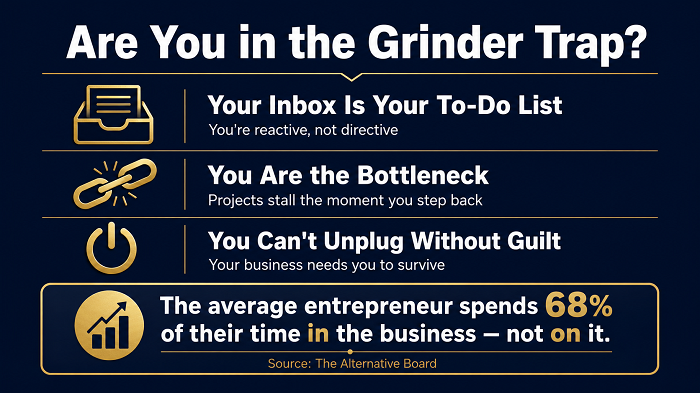
And here's the uncomfortable truth: the same mindset that built your business is now the ceiling on it. Research from The Alternative Board shows that the average entrepreneur spends 68% of their time working in their business, handling day-to-day tasks and putting out fires, and only 32% working on it. That gap is costing you momentum you'll never get back.
The good news? The way out isn't about working harder. It's about stepping fully into the CEO authority that was always yours to claim. In the next few minutes, you'll understand exactly why the grinder trap is so hard to escape, what the real shift requires, and how to start making it today.
Key Takeaways
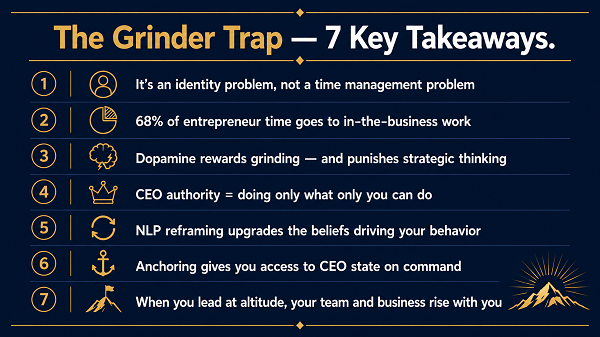
The grinder trap is not a time management problem; it's an identity problem rooted in who you believe you are in your business.
The average entrepreneur spends 68% of their time in the business rather than on it, and that ratio is the single biggest constraint on growth.
Staying in the weeds delivers a dopamine reward that makes it feel productive while real CEO work waits.
CEO authority means doing only what you can do: vision, strategy, key decisions, and leadership- and building systems for everything else.
NLP techniques like reframing, anchoring, and identity-level work give you the internal tools to make this shift stick, not just look good on a calendar.
The shift compounds: when you operate at altitude, your team rises, your decisions improve, and your business gains momentum it cannot generate when everything runs through you.
The most powerful question you can ask daily: "Is this mine to do, or is the grinder talking?"
What Is the "Grinder" Trap: And Are You In It?
The grinder trap isn't laziness or poor planning. It's the logical outcome of doing everything right in the early stages, and then failing to evolve.
The Hustle That Built Your Business Is Now Holding It Back
In the beginning, grinding was survival. You wore every hat, solved every problem, built something real out of nothing. That identity, the person who shows up, rolls up their sleeves, and gets it done, was your greatest asset.
But businesses grow. Roles evolve. The problem is that identity doesn't automatically evolve with them. You're still wired to do even when your highest value is to lead. The trap closes quietly, and most entrepreneurs don't notice until the business plateaus and they're exhausted with no clear reason why.
As one business advisor put it plainly: businesses often hit a ceiling not because of the market or the product, but because the CEO is too deep in the weeds to steer the company forward. The business reflects the CEO's habits. Until those evolve, neither will the business.
Three Unmistakable Signs You're Still Operating as the Operator
1. Your inbox is your to-do list. You're reactive, not directive. The day owns you before you've had your first cup of coffee.
2. You are the bottleneck. Projects stall when you step away. Revenue slows when you take a day off. Revenue stops when you stop. If that's true, your business is structurally built around your constant involvement, and that's a fragility problem, not a strength.
3. You can't take a real day off without guilt or chaos. If disconnecting feels irresponsible, you're not running a business; the business is running you.
If even one of these resonates, you're in the grinder trap. Welcome to the majority, and to the starting line of something better.
Why Smart Entrepreneurs Stay Stuck (It's Not What You Think)
Here's what surprises most of the high-performing entrepreneurs I've worked with: the grinder trap isn't a time management problem. It's an identity problem. And it runs deep.
The Identity Problem: You Still See Yourself as the Grinder
At the neurological level, your brain has linked "productivity" with "hands-on doing." For years, checking things off the list meant progress. That wiring doesn't just vanish because your business grows.
This is where NLP becomes a game-changer. Neuro-Linguistic Programming works precisely at the identity level, helping you examine the internal representations that shape your behavior. When your internal story is still "I am the person who gets things done," every delegation feels like abandonment, every strategic afternoon feels like laziness, and every moment of rest triggers guilt.
The shift to CEO authority doesn't start on your calendar. It starts with who you believe you are.
How the Dopamine Hit of "Doing" Keeps You From Leading
There's a neurological reason you keep gravitating toward low-value tasks: clearing your inbox feels amazing. Ticking boxes creates a dopamine response that strategic thinking, which is messy, uncertain, and open-ended, simply doesn't match.
Research confirms this pattern. According to a survey by Time etc., 27% of entrepreneurs admit they keep doing small admin tasks simply because they enjoy it, not because no one else could. That enjoyment is the trap. It gives you the feeling of progress while your business waits for real leadership.
CEO work strategy, vision, hard conversations, building systems- often feels uncomfortable, slow, and unproductive in the moment. But it's the work that compounds. One business owner shared that stepping away from day-to-day operations for just four days to attend a strategic event generated an immediate $200,000 gain for her business. That's the altitude you're missing when you're answering support emails.
The Fear Beneath the Delegation Resistance
Peel back the "no one does it as well as I do" story, and something more vulnerable usually sits underneath it.
Fear that if you let go, things will fall apart. Fear that your team isn't capable. Fear that if you stop grinding, your identity disappears with the busyness. Fear that stepping back means losing control of the thing you built.
These fears are valid. And they're also beliefs, not facts. In over 20 years of working with entrepreneurs and leaders, I've seen this pattern repeat itself more times than I can count. The belief that "I have to do it all" is almost never true. But it feels true, and until it's examined and upgraded, it drives behavior regardless.
Try This: The next time you catch yourself thinking "I'll just do it myself, it's faster," pause. Ask: "Is this actually mine to do, or is this the grinder talking?" That one question, practiced consistently, begins rewiring the pattern.
What CEO Authority Actually Looks Like
CEO authority isn't a title on a business card. It's an operating altitude. And the difference between being busy and being effective at that altitude is everything.
The Difference Between Being Busy and Operating at Altitude
A busy entrepreneur has a full schedule and a chaotic week. A CEO operating at altitude has a full schedule and a business that moves without them in every seat.
The distinction: are you spending your time on work that only you can do? Or are you filling hours with work that someone else could do better, faster, and at a fraction of your hourly value?
If your highest-value work is worth $500 an hour, and you're spending ten hours a week on tasks you could delegate for $30 an hour, you're losing $470 for every one of those hours. Multiply that across a year. The math is uncomfortable, and clarifying.
What Only You Can Do
The work that belongs at CEO level falls into a clear set of categories:
Setting and communicating vision
Making decisions that only you have the authority, context, or relationships to make
Building key partnerships and high-level relationships
Hiring, developing, and leading your leadership layer
Designing the strategic architecture of where the business is going
Everything else is a candidate for delegation, systemization, or elimination. That's not abdication; it's what NLP training for business teaches you to do with clarity and confidence rather than guilt.
Try This: The Highest-Value Hour Audit
For seven days, set a timer every 30 minutes and write down what you're doing. Don't judge it, just track it. At the end of the week, color-code each block by value tier: CEO-level work, mid-level management work, and below-grade execution.
Most entrepreneurs find that 60–80% of their week sits in the lowest tier. That's not failure, that's data. And data is where transformation begins.
The 4-Step CEO Identity Upgrade
This isn't a productivity framework. It's an identity-level shift grounded in proven NLP techniques developed over 20+ years of working with entrepreneurs, executives, and leaders. The work that gets you out of the weeds for good happens here.
Step 1: Audit Your Identity, Not Just Your Calendar
Before you rearrange a single meeting, ask a deeper question: Who do you believe you are in your business?
Write down ten words that describe how you show up at work. How many of them are about doing, executor, problem-solver, go-to person? How many are about leading, visionary, strategist, culture-setter?
Your calendar is a reflection of your identity. Change the identity, and the calendar will follow. This is the foundation of the entrepreneurial mindset through NLP, working from the inside out, not the other way around.
Step 2: Reframe the Belief That's Keeping You in the Weeds
NLP reframing is one of the most powerful tools for this exact transition. The core technique: identify the limiting belief, examine what it's protecting you from, and consciously install a more empowering interpretation.
Common grinder beliefs and their CEO reframes:
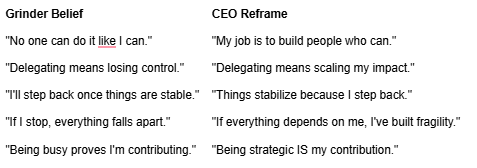
Sit with the reframe that challenges you most. That's the one doing the most work. For more on uncovering and dismantling the beliefs underneath these patterns, the work James walks clients through on overcoming limiting beliefs with NLP is where real traction begins.
Step 3: Anchor Your CEO State Daily
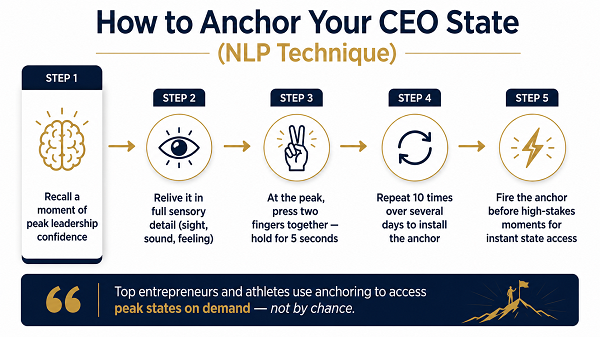
NLP anchoring is a technique that creates a direct neurological trigger for a specific emotional state. Elite athletes use it. Top executives use it. And it's one of the most practical tools you'll ever apply as an entrepreneur making this transition.
Here's the simple version: think of a moment when you felt most powerfully yourself as a decisive, calm, clear, influential leader. Relive that moment in full sensory detail. At the peak of that feeling, press two fingers together and hold for five seconds.
Repeat this process ten times over several days to install the anchor. Then, before a high-stakes meeting, a critical decision, or any moment that calls for CEO authority, fire the anchor. You're training your nervous system to access that state on command rather than hoping it shows up.
This is the difference between reacting to your business and leading it.
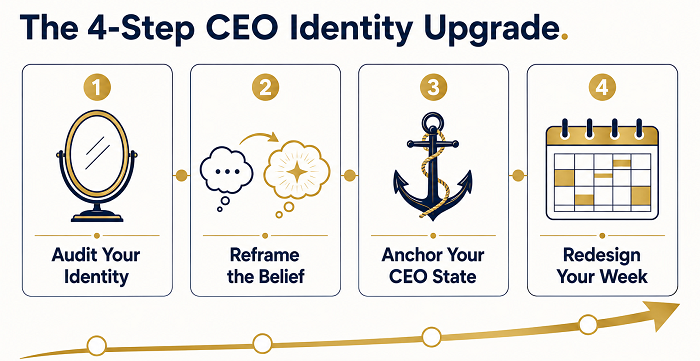
Step 4: Redesign Your Week Around Authority, Not Activity
Once the identity is shifting and the state is accessible, the structural work becomes easier. Block your highest-value time first. Protect strategic thinking time the same way you'd protect a meeting with your most important client, because it is.
The goal isn't to do less. It's to do what matters at the level that only you can. That's transforming your leadership style, not from the outside in, but from the inside out.
What Happens When You Stop Grinding and Start Leading
The results of this shift aren't subtle. They compound.
The Compounding Return of CEO-Level Work
CEOs who manage their time effectively and delegate well see up to 33% higher revenue than those who don't. That's not because they work more; it's because they work at the right altitude.
When you step into CEO authority, something else shifts too: your team rises. People who have been waiting for ownership finally get it. Decision-making speeds up. Bottlenecks dissolve. The business starts running with momentum instead of on fumes.
This is what corporate leadership coaching consistently shows: leadership elevation isn't just about the leader; it transforms the entire organization around them.
From Blocked to Breakthrough: A Real Shift
Darren G. came to James feeling purposeless and stuck, despite holding a well-paying job. He wanted promotions, a raise, his own business, and abundance in every form. Nothing was moving. Through the work of identifying and eliminating his goal blocks, the limiting beliefs operating underneath his conscious ambitions, everything shifted. His thinking changed. His behaviors changed. His relationships improved. His career and business began moving again, not because the external circumstances changed first, but because he changed first.
That's what stepping out of the grinder trap looks like. The shift isn't about the to-do list. It's about the person running it.
Try This: Find a leader you deeply respect, someone operating at the altitude you want to reach. Study them. How do they speak? How do they decide? What do they protect their time for? NLP modeling allows you to internalize those patterns of excellence and apply them in your own context. You don't copy the person; you adopt the mindset architecture that's producing their results.
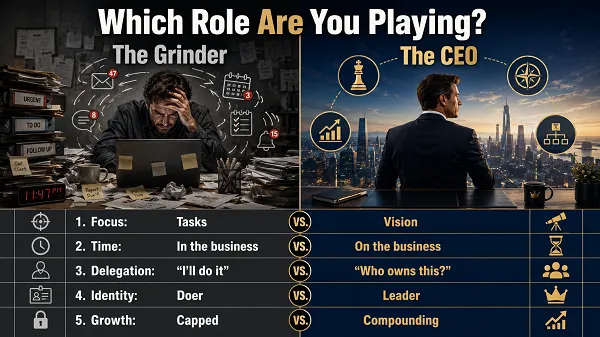
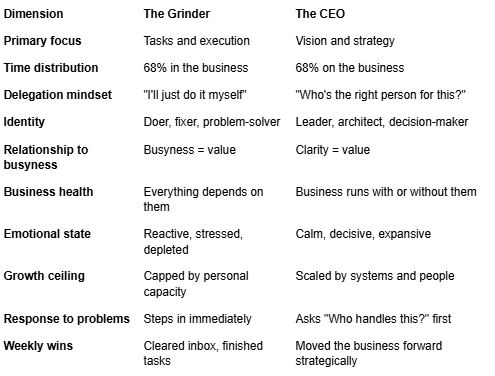
Grinder vs. CEO: What's the Real Difference?
Frequently Asked Questions
What does "stepping out of the weeds" actually mean for a small business owner?
It means shifting your primary role from doing the work to leading the people and systems that do the work. For a small business owner, this doesn't require a large team. It means identifying which tasks genuinely require your expertise and authority, and delegating, automating, or eliminating everything else. Even a one- or two-person operation can begin this shift by auditing where time goes and asking whether each hour of work is truly CEO-level.
How do I know which tasks to delegate first?
Start with tasks that are recurring, low-decision, and don't require your specific judgment or relationships. Administrative work, scheduling, routine communication, data entry, and repetitive processes are strong starting points. A useful filter: ask yourself, "Could someone else do this with clear instructions?" If yes, it's a delegation candidate. Prioritize tasks that consume the most time relative to the strategic value they return.
Can I really trust my team to handle things without me?
Trust is built through systems, not hope. Start by building clear SOPs (standard operating procedures) for the tasks you're stepping away from. Give your team a framework for decisions: what they can handle independently, what requires escalation, and what success looks like. Trust earned through this structure is sustainable. Trust hoped for without it isn't.
How long does it take to make the CEO mindset shift?
The structural changes, delegating tasks, blocking strategic time, can happen within weeks. The identity shift, the internal work of no longer seeing yourself as the grinder, typically takes longer and is more meaningful. With focused coaching and NLP-supported identity work, clients regularly report a noticeable shift in how they show up within 30 to 90 days. The shift begins the moment you decide the grinder is a role you're willing to outgrow.
Is it possible to step up as CEO if I'm a solopreneur?
Absolutely. CEO authority isn't about having a team; it's about how you allocate your own time and mental energy. A solopreneur operating at CEO altitude invests in systems, tools, and contractors that handle execution, while protecting personal time for vision and growth work. The identity shift matters just as much when you're a team of one.
Conclusion
The grinder trap is one of the most common, and most invisible, ceilings in entrepreneurship. You built it from your greatest strength: the drive to show up, work hard, and make things happen. But growth asks something different of you now. It asks you to lead.
The shift from grinder to CEO isn't about doing less. It's about doing what's actually yours to do, and building the identity, systems, and team that carry everything else. You have the power to make that shift. The tools are proven, the path is clear, and the only thing standing between where you are now and the business you actually want to be leading is the decision to start.
If you're ready to stop being the bottleneck in your own business and start operating with real CEO authority, explore how NLP-based business coaching can accelerate this transition for you, with 20+ years of proven results behind every session.
Unleash Your Power: Stand Out, Take Action, and Create the Success You Want.