
Ditch the Passive Income Myth: How to Build True Freedom
Passive income, as sold by the online business and personal finance industry, is a myth for the vast majority of service-based entrepreneurs. Not because earning money without working is impossible, but because the premise is wrong: the goal of building a sustainable, impactful, premium business is not to make income require zero effort. It is to make income require only high-leverage, strategically chosen founder effort, effort that is focused, chosen, and proportionate to the genuine value being created, not effort that is reactive, operational, and consumed by tasks that a system or team member should be handling. The correct goal is not passive income. It is autonomous revenue, income generated by documented systems, a capable team operating under clear authority, and a business model designed to produce outcomes rather than founder hours. Autonomous revenue still requires the founder's involvement: strategy decisions, relationship cultivation, methodology innovation, and periodic quality oversight. But that involvement is strategic and chosen, not operational and compulsory. True freedom is not earning money while you sleep. True freedom is a business that runs its operations without you so that your working hours are exclusively spent on the work only you can do, and then genuinely stop.
Key Takeaways
Passive Income Is a Marketing Concept, Not a Business Model: The phrase "passive income" was popularised by financial media and online course sellers, not by entrepreneurs who built lasting, premium service businesses. It is a compelling concept that consistently leads service-based founders toward the wrong goal and therefore the wrong architectural decisions.
The Real Goal Is Autonomous Revenue: Autonomous revenue is income generated by the business's systems and team, not by the founder's personal daily effort. It still requires the founder's high-leverage involvement, but that involvement is strategic, chosen, and time-bounded, not operational, compulsory, and unlimited.
Chasing Passive Income Typically Increases Founder Workload: The most common passive income strategies recommended to service businesses, digital courses, affiliate programmes, membership sites, require significant ongoing founder involvement to build, market, and maintain. They often add a second workload on top of the existing service business rather than replacing hours within it.
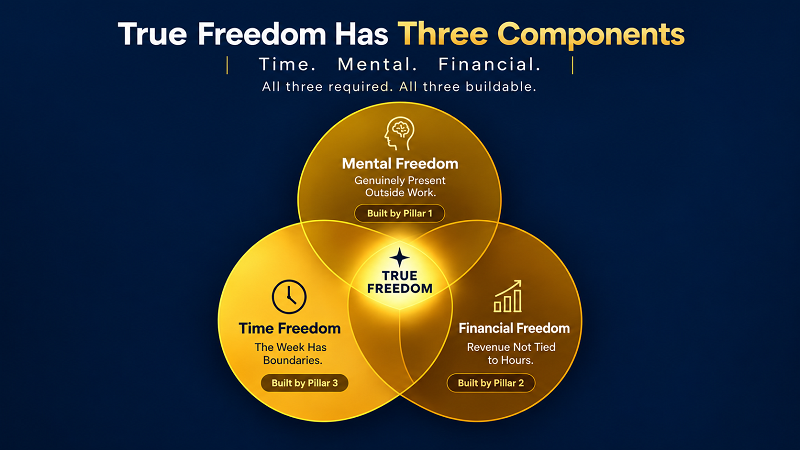
True Freedom Has Three Components: Time freedom (the working week has defined boundaries and guilt-free white space), mental freedom (the founder is not mentally on call outside working hours), and financial freedom (revenue is not directly correlated with founder hours, so it can grow while working hours stay constant or reduce).
The Freedom Architecture Is Built, Not Found: True freedom does not arrive at a revenue milestone, a team headcount, or the completion of a digital product launch. It is the designed output of a deliberately built business architecture, the same 3-Pillar Blueprint that converts a founder-dependent operation into a genuine autonomous company.
The Passive Income Fantasy and Why It Fails Service Entrepreneurs
The passive income concept has an intuitive appeal that is almost impossible to argue with on the surface. Who would not want income that arrives without requiring daily effort? Who would not choose financial return without the proportionate time input?
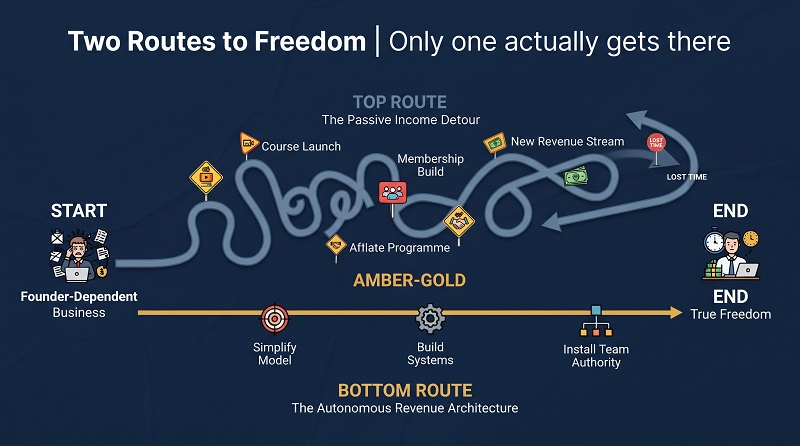
The problem is not the aspiration. It is the implementation advice that follows it, which almost universally directs service-based entrepreneurs toward one of three paths that consistently fail to deliver the freedom they promise.
Path 1 — The Digital Product Detour
The founder is advised to convert their service into a course, template, or digital product. This product, once created, will sell on autopilot, generating passive income while the founder sleeps. The reality: creating a high-quality digital product requires 3–6 months of intensive development effort. Marketing it to the point of consistent sales requires either significant paid advertising spend or a substantial content marketing engine, both of which require ongoing founder time and financial investment. The conversion rate from service to product is rarely sufficient to replace service revenue without a large existing audience. The result: the founder now has two workloads, their original service business and a digital product business, and less freedom than when they started.
Path 2 — The Membership Model Mistake
The founder is advised to build a membership community or subscription programme. Recurring revenue sounds like passive income. The reality: membership programmes require continuous content production, community management, member engagement, and churn management to maintain their subscriber base. The moment content stops, churn accelerates. The moment community management lapses, members leave. A membership programme is one of the highest-maintenance business models available. It is recurring revenue, which is genuinely valuable, but it is absolutely not passive.
Path 3 — The Affiliate Illusion
The founder is advised to add affiliate revenue to their business by recommending other companies' products. The reality: affiliate income at meaningful scale requires either a very large audience or very high-ticket, high-margin products. For most service-based founders with an audience of under 10,000, affiliate revenue represents a negligible contribution to total income, but it consumes the founder's credibility, capital and content attention to generate it.
"The passive income fantasy sends service entrepreneurs in exactly the wrong direction — away from their existing business and toward a second business they do not yet know how to run. True freedom is built inside the business you already have, not alongside it." — James R. Elliot
The Correct Goal: Autonomous Revenue
Autonomous revenue is income generated by a business that runs on documented systems, a capable team with genuine authority, and a model designed around outcomes rather than founder hours. It is not passive, the founder's involvement is still present and important. But that involvement is strategic, chosen, and defined, not operational, reactive, and unlimited.
The distinction matters enormously because it changes the entire architectural target.
Chasing passive income leads to: adding new revenue streams, building digital products, creating audience-dependent marketing machines, and diversifying the business away from its highest-leverage core.
Building autonomous revenue leads to: simplifying the business to its highest-leverage offer, systematising every delivery process, installing a team with genuine decision authority, and redesigning the founder's role from operational executor to strategic owner, all within the existing business, not alongside it.
The Three Components of True Freedom
Freedom 1 — Time Freedom
The working week has defined start and end points. The work stops when the calendar says it stops, not when the founder has finished everything on the list, because on a properly structured business the list never empties. There is guilt-free white space: afternoons, evenings, weekends, and holidays that are genuinely free because the operational machinery runs without needing the founder's presence to keep it moving.
Time freedom is not achieved by working less on the same work. It is achieved by building systems that do the operational work, so that the founder's hours are exclusively spent on the strategic work — and then stop.
Freedom 2 — Mental Freedom
Mental freedom is the state in which the founder is not mentally rehearsing tomorrow's client call during dinner, not checking the inbox during a family evening, not constructing responses to messages during a walk. It is cognitive presence, the ability to be fully where you are, without a background processing thread consuming attention on operational concerns.
Mental freedom is the most frequently overlooked of the three components, and the one most founders underestimate how much they lack until they experience it for the first time. It is also the component most dependent on Pillar 1 (Performance Psychology): the operational systems can handle the operational concerns, but only the psychological rewiring of Pillar 1 can switch off the mental monitoring thread that persists even when no operational concern actually exists.
Freedom 3 — Financial Freedom (As It Actually Works for Entrepreneurs)
Financial freedom for a service-based entrepreneur does not mean unlimited passive income. It means decoupling revenue from founder hours, so that the business can grow its revenue line without requiring a proportionate increase in the founder's working time. It means pricing models that reflect outcome value rather than hourly input. It means recurring revenue that continues without requiring the founder's presence in every delivery interaction. And it means the business could, in principle, be sold for meaningful value, providing a capital event that the founder controls, at the moment of their choosing.
The Autonomy Equation: True freedom = (Systems that run operations) + (Team with genuine authority) + (Founder in strategic role only) + (Psychology that allows genuine release). This equation has no "passive income product" variable. The freedom is built inside the existing business, by redesigning how it runs, not by building a second business alongside it.
The Income Freedom Spectrum: Where Is Your Business?
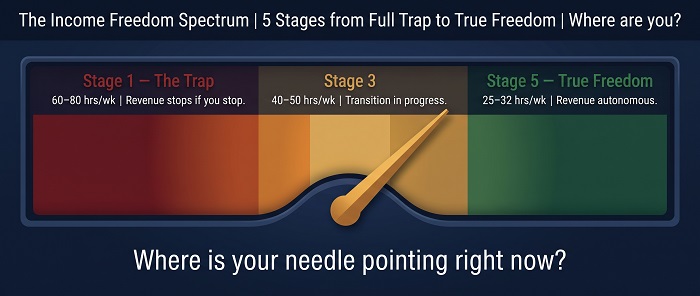
Most service businesses exist somewhere on a spectrum between full founder-dependence and genuine autonomous operation. Identifying your current stage determines the precise architectural work required to reach true freedom.
Business Dimension | Stage 1 — The Trap | Stage 2 — The Hustle Ceiling | Stage 3 — The Transitional | Stage 4 — The Near-Free | Stage 5 — True Freedom |
Revenue Source | 100% founder hours. Revenue stops if founder stops. | Mostly founder hours. Some recurring but still delivery-dependent. | Mix of personal and team delivery. Revenue holds at reduced founder hours. | Primarily team-delivered. Founder's hours are strategic, not operational. | Autonomous. Revenue generated by systems and team. Founder hours are optional input. |
Working Hours | 60–80+ hrs/wk. No genuine off days. | 50–65 hrs/wk. Weekends partially consumed. | 40–50 hrs/wk. Some reclaimed evenings but still reactive. | 30–40 hrs/wk. Hard daily finish. Guilt-free evenings. | 20–32 hrs/wk focused strategic work. Hard weekly boundary. Guilt-free. |
Decision Authority | All significant decisions = founder. Team executes only. | Routine decisions delegated. Anything unusual hits founder immediately. | Decision frameworks exist. Some escalation still happens. Improving. | Team owns all routine and semi-routine decisions. Founder = strategic only. | Team owns full operational decision-making. Founder consults weekly summary. |
Client Relationship | Clients require personal founder access at most touchpoints. | Founder is primary client contact. Team handles admin only. | Team handles routine communication. Founder at key strategic moments. | Team manages most client relationships. Founder visible at high-value moments. | Clients buy the methodology. Team delivers. Founder at annual strategic reviews only. |
Mental Presence | Mentally "at work" 16+ hrs/day. Background thread always running. | Hard to switch off. Evenings disrupted by operational concern. | Improving. Some genuine off-time. Still checks inbox out of habit. | Mostly present outside work hours. Occasional thread. Manageable. | Genuinely present outside work. Mental thread off. Naps without guilt. |
Your Stage | The Trap | The Hustle Ceiling | Transitional | Near-Free | True Freedom |
Seven Passive Income Myths — and the Autonomous Revenue Truth
# | ⚠ The Passive Income Myth | ✓ The Autonomous Revenue Truth |
1 | "Build a course and earn while you sleep." A digital course replaces your service income on autopilot once it is created. | Courses require continuous marketing to generate consistent sales. Without an audience of 10,000+, course revenue is supplemental at best, and building that audience requires significant ongoing content effort. |
2 | "Memberships create passive recurring revenue." A subscription model means predictable income without the work. | Memberships with churn under control require constant content delivery and community management. They are recurring revenue, genuinely valuable, but among the highest-maintenance models available. |
3 | "Hire a team and step back." The answer to founder burnout is adding people. | A team without documented systems, decision frameworks, and quality benchmarks creates more founder involvement, not less. You must build the architecture before the team can operate autonomously. |
4 | "Reach a revenue milestone and freedom follows." At $X per year, you can hire your way to freedom. | Revenue milestone thinking fails because a founder-dependent business at $300K is structurally identical to one at $1M, just with more clients and more complexity. The milestone is not the trigger. The architectural redesign is. |
5 | "Automate everything." Technology tools can replace human judgment and produce truly passive output. | Automation handles repetitive, rule-based tasks excellently. It cannot replace the human judgment required for client relationships, quality decisions, and strategic pivots. Automation is a component of autonomous revenue, not a substitute for the full system architecture. |
6 | "Freedom means not working." The goal is to eventually not have to work at all. | Most high-performing entrepreneurs who achieve true freedom choose to keep working, because they enjoy it. The goal is not zero work. It is chosen work: the freedom to work only on what matters, for the hours you define, with the complete ability to stop when you choose. |
7 | "Freedom is a future state." Once the business is big enough, I will have the freedom I want. | Freedom is not a destination. It is an architecture. A business does not spontaneously become autonomous as it grows, it becomes more complex and more founder-dependent without deliberate structural redesign. Freedom must be built deliberately, not waited for. |
The Framework: The 5 Shifts to Freedom & The 3 Pillars
Building autonomous revenue — true freedom — is the explicit outcome that the Limitless Entrepreneur 3-Pillar Blueprint is designed to produce. Every element of the methodology maps to one of the three freedom components.
The 3 Pillars Mapped to the Three Freedoms
Pillar 1 — Performance Psychology → Mental Freedom: The subconscious monitoring thread that keeps founders mentally at work outside hours is a psychological pattern — not an operational necessity. The NLP and Timeline Therapy work of Pillar 1 switches it off at the neurological level. Mental freedom does not arrive by solving all the operational concerns. It arrives by dissolving the anxiety that generates the monitoring thread whether or not operational concerns exist.
Pillar 2 — Freedom-First Business Strategy → Financial Freedom: The strategic redesign of the offer model — premium pricing, outcome-based positioning, methodology extraction, decouples revenue from founder hours. When the business sells documented outcomes rather than founder time, revenue can grow while working hours stay constant or reduce. This is financial freedom in its genuine, service-business form.
Pillar 3 — Freedom-First Business Structure → Time Freedom: The Four-Component System Architecture, documented process, decision framework, quality benchmark, accountable owner, is the operational machinery that allows the working week to have genuine, defended boundaries. Time freedom is impossible without Pillar 3, because without autonomous systems the work expands to fill all available time regardless of intent.
The 5 Shifts and the Freedom Architecture
Shift 1 — Vision Alignment: Defines what true freedom looks like for this specific founder, the working week, the revenue model, the team structure, the client relationships. Without a concrete vision, the freedom is aspirational rather than architectural. Shift 1 converts "I want more freedom" into "I want a 28-hour working week, a team-run delivery system, and three premium clients who buy the methodology, not my personal time."
Shift 2 — Ruthless Elimination: Removes every offer, revenue stream, and operational activity that makes the freedom architecture more complex rather than simpler. Includes, specifically — the digital product detours, membership distractions, and diversification strategies that the passive income narrative consistently recommends. The path to freedom is subtraction, not addition.
Shift 3 — Systems That Scale: Builds the operational machinery that generates autonomous revenue. Every delivery process is documented, decision-framed, benchmarked, and owned. This is the direct construction of Time Freedom, the structural mechanism that allows the working week to end when the founder chooses.
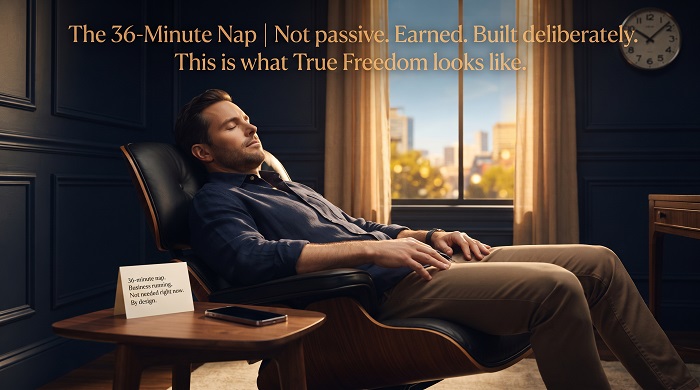
Shift 4 — Mindset Unlock: Resolves the residual psychological resistance to genuine freedom, the guilt of the 36-minute nap, the anxiety of the uncontacted holiday, the compulsive check-in that happens not because the business needs it but because the founder's nervous system has not yet updated its baseline. This shift completes the Mental Freedom component.
Shift 5 — Magnetic Authority: Redirects the founder's freed cognitive bandwidth toward the highest-leverage strategic activities, thought leadership, premium relationship building, market positioning, that compound the business's Financial Freedom over time without requiring additional operational hours.
Case Evidence: From Passive Income Chase to Autonomous Revenue
Nik — The Course Launch That Made Things Worse
Nik came to us immediately after a failed passive income attempt. He had spent eight months building and launching an online course on his core methodology, on top of running his existing coaching practice at full capacity. The launch generated good initial sales but required a level of marketing effort Nik had not anticipated: weekly email campaigns, social media content, webinar-based launches, and paid advertising, all while continuing to serve existing clients. His working week went from 55 hours to 72. His existing clients noticed the reduced availability. Two left. The course generated supplemental revenue at the cost of primary revenue and personal wellbeing.
We worked through Shifts 1 and 2. The course was paused. The coaching practice was simplified. A team member was trained to deliver Nik's documented methodology under supervision, then independently. By Week 12, Nik's working week was 32 hours. Revenue from the core practice exceeded the pre-course baseline. The autonomous revenue he had been trying to build via a digital product was built inside the existing service business, by systematising delivery and installing a capable team, not alongside it.
Marcus — Revenue Grew While Hours Fell
Marcus's transformation illustrates the Financial Freedom component precisely. When we began the Blueprint, Marcus's revenue was directly correlated with his personal working hours. Every additional client required proportionate additional founder time. There was no model for growth that did not require more of Marcus personally.
Through Pillar 2, Marcus restructured his offer to three premium clients at a significantly higher per-client engagement value — with delivery managed through a documented methodology his associate could execute. Through Pillar 3, the delivery systems were built and the associate had full operational authority. Marcus's working hours reduced from 60 to 26 per week. Revenue per working hour increased by a multiple that made the absolute revenue comparison the wrong metric entirely. He was no longer trading hours for income. He was running a system that generated income proportionate to outcomes, not effort.
Decision Framework: Passive Income Strategy vs. Autonomous Revenue Architecture
Consider a passive income strategy if: You already have a fully operational autonomous business (Stage 4 or Stage 5 on the Income Freedom Spectrum) and you are looking for additional capital deployment opportunities. At that point, adding a digital asset, investment portfolio, or scalable product makes strategic sense, because the primary business is already free and the new venture does not create a second operational burden.
Build autonomous revenue first if: Your primary business is at Stage 1, 2, or 3 on the spectrum. Every hour spent building a passive income product while in the Trap or Hustle Ceiling stage is an hour taken from building the autonomous architecture inside the existing business, which is the faster, more reliable, and higher-leverage path to the same freedom goal.
Try This: The True Freedom Audit (10 Minutes)
Freedom 1 — Time Last week, what time did you genuinely stop working each day? Write the actual time — not when you planned to stop, but when you actually stopped engaging with anything work-related (including mental rehearsal of tomorrow's agenda). If the average is past 7 PM on most days, Time Freedom is your most immediate target.
Freedom 2 — Mental During your last full weekend day, how many times did your mind turn to a business concern? Count the interruptions, the inbox checks, the mental problem-solving, the background processing. More than three = Mental Freedom is significantly constrained. Pillar 1 is your primary tool.
Freedom 3 — Financial If you worked 40% fewer hours next month, what would happen to your revenue? If the honest answer is "it would drop proportionately", your revenue is still directly correlated with your hours. Financial Freedom requires decoupling this relationship through Pillar 2 strategy and Pillar 3 systems.
Your most constrained freedom is your starting point. The architecture that builds it is already mapped. The only remaining variable is when you begin.
Further Reading (Internal & External Links)
Strategies to Scale Your Business — the Pillar 2 strategic moves that decouple revenue from founder hours and build Financial Freedom.
Harnessing Structure & Systems — building the Pillar 3 operational architecture that delivers Time Freedom.
Entrepreneurial Mindset Through NLP — the Pillar 1 tools that produce Mental Freedom by dissolving the background monitoring thread.
Why Goals Fail — why the freedom goal consistently fails when pursued through passive income strategies rather than autonomous revenue architecture.
Harvard Business Review: The Power of Saying No to Growth That Costs Freedom — on the strategic discipline of subtraction — removing complexity to build genuine sustainable scale — the direct antidote to passive income diversification thinking.
Frequently Asked Questions
What is the difference between passive income and autonomous revenue?
Passive income, as typically defined, is income that requires zero ongoing effort, a digital product that sells itself, an investment that compounds automatically, a business that runs without any engagement. Autonomous revenue is income generated by a business whose operations run through documented systems, a capable team, and a clear decision authority structure, without requiring the founder's personal daily involvement. Autonomous revenue still involves the founder in high-leverage strategic roles. The distinction is that the involvement is chosen and defined, not operational and compulsory. For service-based entrepreneurs, autonomous revenue is achievable. Genuinely passive income at meaningful scale is almost universally not.
Is it wrong to build a digital course or membership programme?
No, but timing matters critically. A digital course or membership programme built on top of an existing Stage 1 or Stage 2 business (still fully founder-dependent) creates a second workload without solving the primary constraint. These vehicles make strategic sense when the primary business is already at Stage 4 or Stage 5, when the autonomous revenue architecture is installed and the additional product sits alongside a business that already runs without the founder, not as an escape route from one that does not.
How do you decouple revenue from founder hours in a service business?
Through three simultaneous architectural moves: (1) Pricing redesign, shifting from time-based to outcome-based pricing, so that the revenue per engagement is no longer a function of the hours spent on it. (2) Methodology extraction, documenting the delivery process into a named, replicable framework that a team member can execute at the same standard. (3) Team installation, giving a qualified associate or team member the systems, authority, and quality benchmarks to deliver the methodology independently. These three moves together decouple the revenue line from the founder's personal hours, the defining feature of autonomous revenue.
What does "mental freedom" mean and how is it achieved?
Mental freedom is the state in which the founder is cognitively present outside of working hours, not replaying client conversations, not mentally composing emails, not running background operational processing threads during family dinners or weekend activities. It is achieved through two simultaneous interventions: the operational systems (Pillar 3) that remove the genuine operational concerns that generate the mental threads, and the psychological rewiring (Pillar 1) that dissolves the anxious monitoring habit that persists even after the operational concerns are removed. Many founders discover that even after their operational systems are running well, the mental thread continues, because it was never about the operational concerns. It was about the psychological pattern. Pillar 1 addresses this directly.
At what revenue level does autonomous revenue become achievable?
Revenue level is not the determining variable, business stage is. A $200,000 service business at Stage 4 (Near-Free) has more autonomous revenue than a $1,000,000 business at Stage 1 (The Trap). The architectural redesign that produces autonomous revenue is available at any revenue level where the business has at least one replicable delivery process and at least one team member (full-time, part-time, or contracted) who could execute it. The Limitless Entrepreneur methodology has been applied successfully at annual revenues ranging from $150,000 to $2,000,000. The starting point is the architecture, not the revenue.
Conclusion: The Nap That Proved the Point
James R. Elliot spent years chasing versions of the passive income dream, building products, diversifying revenue streams, adding business lines, each one promising the freedom that the primary business never seemed to deliver. Each attempt added complexity, added working hours, and ultimately added to the prison rather than removing it.
The freedom he eventually built had nothing passive about it. It required four years of deliberate architectural work across three domains: the psychological rewiring that made stepping back possible, the strategic redesign that decoupled revenue from his personal hours, and the structural build that gave the business an operational machinery capable of running without him.
The moment he knew the architecture was installed was not a revenue milestone. It was a Tuesday afternoon. He took a 36-minute nap after lunch. Not because he was exhausted. Because he chose to. Because there was nothing operationally requiring his attention. Because the business, right now, in real time, without him, was running exactly as it was designed to run.
That nap was the evidence. And it had nothing passive about it. It was the earned output of a deliberately built, precisely architected, genuinely autonomous business. That is what true freedom looks like. Build it inside the business you already have. Not alongside it. Inside it.
Ready to identify which of the three freedoms is your most immediate target — and map the architecture that builds it? Book the Freedom Blueprint Call (30 mins). We will run the True Freedom Audit together and design the precise building sequence for your business.