
High-Ticket Sales Psychology: Charge Premium Prices
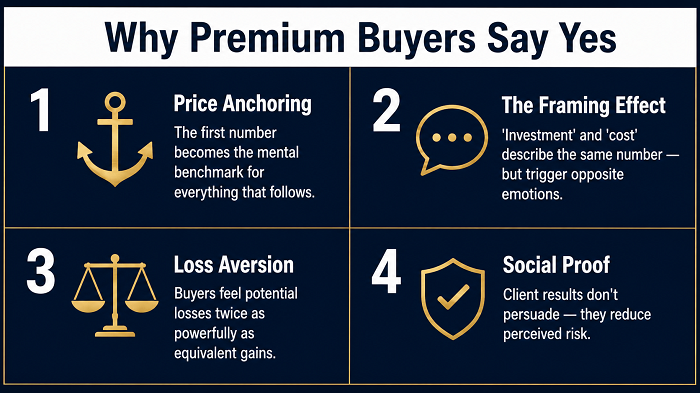
High-ticket sales psychology is the study of how buyers make decisions at premium price points, and how entrepreneurs can price, position, and present their offers in ways that align with those decisions. Premium buyers are not primarily driven by price. They're driven by perceived transformation, certainty of outcome, and trust in the seller. Four cognitive biases shape every high-ticket buying decision: anchoring (the first number frames all comparisons), framing (how you describe the investment changes how it lands), loss aversion (fear of missing results outweighs the stated cost), and social proof (others' results reduce perceived risk).
For most entrepreneurs, the real barrier to charging premium prices is not market resistance, it is an internal identity belief: "I'm not the kind of person who charges that much." NLP-based coaching is particularly effective at dissolving this belief because it works at the level where the belief was formed, not just at the surface-level sales script.
Key Takeaways
High-ticket sales psychology works at two levels simultaneously: the external conversation structure (anchoring, framing, tiering) and the internal identity state required to hold the position without flinching.
The first number in any conversation becomes the psychological anchor. Always introduce your premium tier before your core offer, this makes your target price feel accessible, not aspirational.
"That's too expensive" is almost never about the number. It signals uncertainty about outcome, timing, or fit, each of which is a conversation, not a ceiling.
Value-based pricing anchors your fee to transformation, not time. Buyers who are thinking in terms of outcomes don't calculate your hourly rate; they evaluate whether the result justifies the investment.
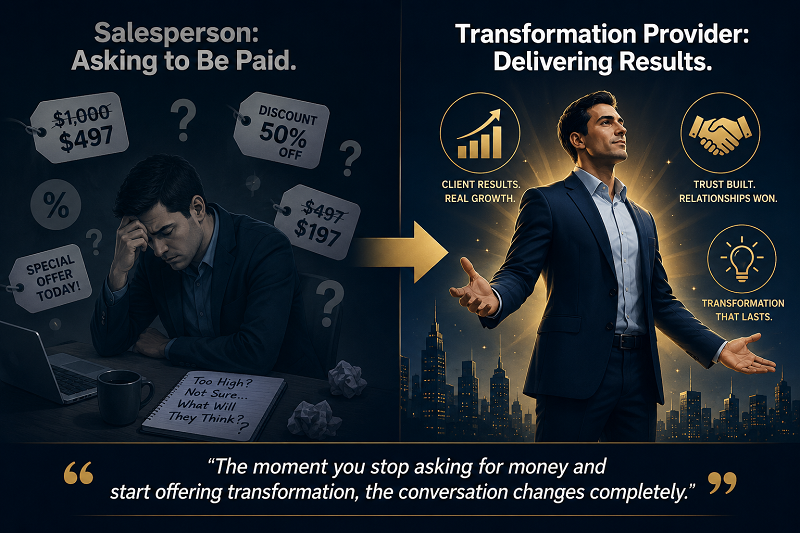
The identity shift from "salesperson" to "transformation provider" changes the entire sales conversation. Confidence stops feeling like performance and becomes service.
Goal blocks, unconscious beliefs opposing your conscious goals, are the hidden reason entrepreneurs undercharge even after learning the tactics. NLP-based coaching dissolves these at the source.
Premium pricing is not right for every stage. Clarity of offer and consistent results come first. Price elevation follows, not the other way around.
Proof elevates; pressure deflects. Share specific, measurable client outcomes and give the buyer space to connect your result with their desire. That combination closes premium deals with integrity.
The Real Reason You're Not Charging Premium Prices
Most entrepreneurs who undercharge don't have a pricing problem. They have an identity problem.
You've probably told yourself the story: "The market won't pay that." "My clients can't afford it." "I need more experience before I can justify that fee." These feel like pragmatic assessments. In most cases, they're not, they're identity beliefs dressed up as market research.
It's Not Your Market — It's Your Identity
When your internal sense of worth hasn't caught up to the value you actually deliver, you unconsciously price to match how you feel, not what you're worth. You hedge. You discount before anyone asks. You brace for the objection that may never come.
Research into entrepreneurial mindset patterns consistently shows that the gap between what an expert charges and what they could charge is almost never driven by market limits, it's driven by the story the expert holds about their own value.
The "Only I Can Do It Right" Trap Applied to Pricing
There's a specific belief pattern James sees repeatedly in high-performing entrepreneurs: "If I charge that much, people will expect perfection, and I'm not perfect." This belief conflates premium pricing with an obligation to be flawless, which makes raising rates feel genuinely dangerous.
The reframe that breaks this open is straightforward: premium clients aren't paying for perfection. They're paying for transformation, access, and certainty. Your job isn't to be flawless, it's to deliver a result they can't reliably get anywhere else.
Try This: The next time you feel the urge to lower your rate before a conversation, pause and ask yourself: "Am I pricing based on what I deliver, or based on how I feel about myself today?" That NLP meta-model question surfaces the belief running beneath the behaviour. Explore more on how to overcome mindset blocks to start working on it at its root.
The 4 Buyer Psychology Principles Behind Every High-Ticket Sales Decision
High-ticket buying decisions are not primarily rational. They're emotional, then justified with logic. Understanding the four cognitive biases that drive premium purchases lets you structure your positioning and conversations to work with the buyer's psychology, not against it.
Price Anchoring — The First Number Wins
Anchoring is the cognitive bias where the first number a person encounters becomes the unconscious reference point for everything that follows. Pricing psychology analysis from Omnia Retail confirms that anchoring and value framing are the central mechanisms shaping perceived worth, before a buyer consciously processes a figure at all.
In practice: if you present a $20,000 premium engagement before introducing a $9,500 core offer, the $9,500 feels accessible. If you lead with $9,500 as your highest option, it becomes the ceiling the buyer pushes back on. Always anchor above your target.
The Framing Effect — Investment vs. Cost Language
Identical information lands differently depending on how it's presented. "This costs $12,000" and "This investment returns clarity, revenue, and time within 90 days" describe the same transaction — but one triggers resistance and the other triggers desire. Every word you use in a sales conversation either reinforces or erodes your premium signal.
The 2025 Capital One Shopping pricing report found that psychological pricing strategies, including deliberate framing, can lift sales conversion by up to 60%. That's not a marginal improvement. That's a structural one, available to any entrepreneur willing to adjust their language.
Loss Aversion — The Fear of Staying Stuck
Buyers respond roughly twice as strongly to potential losses as to equivalent gains, a principle from Kahneman and Tversky's foundational prospect theory research, documented extensively in behavioural economics. In high-ticket sales, this means your most powerful conversion tool isn't describing what they'll gain, it's helping them feel the cost of staying where they are.
"Without this, what does the next 12 months look like?" is not a pressure tactic. It's an honest, empowering question that helps buyers make a fully informed decision.
Social Proof as Risk Reduction
At premium price points, scepticism rises proportionally. Buyers aren't doubting your credentials, they're managing perceived risk. Client stories, outcomes, and testimonials don't function as flattery at this level; they function as risk reduction. They answer the buyer's unspoken question: "Has someone like me done this and come out ahead?"
Charge for the Outcome, Not the Hour: Value-Based Pricing Explained
Value-based pricing means anchoring your fee to the transformation you deliver, not the time you invest. Hourly billing commoditises expertise. It makes buyers think in terms of "is this worth X per hour?" instead of "is this result worth the investment?"
How to Quantify the Transformation You Deliver
The starting point is a specific, honest answer to: "What measurable result does my work reliably produce?" Not "better communication", but "decision-makers who previously avoided difficult conversations now initiate them within 90 days." Not "more confidence", but "entrepreneurs who were stuck at the same revenue ceiling for two years break through it."
Industry data on high-ticket coaching and consulting is clear: the defining characteristic of a premium sale is always the nature of what's being sold, an outcome, not a deliverable or a unit of time. When you price the outcome, you remove the buyer's instinct to calculate your hourly rate.
What ROI-First Selling Looks Like in Practice
ROI-first selling means leading every conversation with quantified business impact before you ever mention a number. Walk the buyer through the cost of their current problem. Help them articulate what a solution is worth in real terms, revenue recovered, time freed, decisions made with clarity instead of anxiety.
Darren came to James feeling genuinely stuck, blocked from the income, abundance, and business results he knew he was capable of. The issue wasn't his skill or his market. It was a set of deep goal blocks anchoring his sense of worth to a ceiling he hadn't chosen consciously.
Once James helped him dissolve those blocks, the shifts were immediate across his business and his relationship with money. That's the practical result of combining ROI-first positioning with internal identity work, and it's available to you too.
Explore the crucial keys to increasing money as the complement to the external pricing strategy you're building here.
How to Present Your Premium Price Without Flinching
The moment you say your price is the moment the entire conversation either holds or collapses. Most entrepreneurs lose the sale in their own body before the buyer says a word, a slight hesitation, a downward inflection, a preemptive justification. Buyers read all of it.
The Three-Tier Architecture (The Goldilocks Effect)
Offering three clearly defined engagement tiers redirects the buyer's mental question from "Should I hire this person?" to "Which option fits me best?", a fundamentally different conversation. Psychological pricing research on tiered consulting models shows that the middle tier captures 60–70% of buyers when it's positioned as the "most popular" choice.
Structure your tiers with intention: the premium tier sets the anchor and signals the ceiling of what's possible. The core tier becomes the obvious, intelligent choice by comparison. The entry tier creates a low-friction path into your ecosystem for buyers who aren't yet ready to go all in.
What to Say Before You Name the Number
The most common pricing mistake is revealing the number before you've established the value. The sequence matters: diagnose the problem first, articulate the cost of the current state, demonstrate what the outcome looks like, then present the investment.
A practical frame that works: "Based on everything we've discussed, here's what I'd recommend, and here's what it takes to get there." You're not quoting a fee. You're presenting a prescription. That framing change alone shifts the conversation from negotiation to collaboration.
How to Handle "That's Too Expensive" Without Caving
"That's too expensive" is almost never really about the number. It's about one of three things: uncertainty about the outcome, concern about the timing, or unresolved doubt about whether you're the right fit. Each of these is a conversation, not a ceiling.
The NLP-grounded response is to get curious before you get defensive. "Help me understand, is it the investment itself, or is there something about the outcome that still feels unclear?" That question separates the real objection from the surface statement, and it keeps you in an advisory role rather than a selling one.
Try This: Before any high-stakes pricing conversation, use NLP anchoring exercises to set your state. Recall a moment when you delivered a result that genuinely changed someone's trajectory. Anchor that feeling, not the transaction, but the transformation, and carry it into the conversation. Your certainty is contagious. So is your doubt.
The NLP Mindset Layer: Why High-Ticket Sales Psychology Tactics Alone Won't Fix Undercharging
Tactics are the outer layer. Identity is the foundation. You can memorise every anchoring script, perfect your three-tier structure, and frame your offer as a premium investment, and still flinch at the close, discount under pressure, or attract clients who negotiate you down every time.
That happens when the external strategy hasn't been matched by internal work.
Goal Blocks and the Identity Anchor Keeping You at Low Prices
A goal block is an unconscious belief that opposes a goal you consciously hold. In pricing, the most common version sounds like: "People like me don't charge that." Or: "If I charge more, I'll lose the clients I have." These beliefs feel like professional caution. They're actually identity anchors, and NLP is specifically designed to work at that level.
The block isn't the price. The block is the story. And the story lives below the level where a sales script can reach it.
Reframing from "Salesperson" to "Transformation Provider"
In over 20 years of working with entrepreneurs and business leaders as a Board Designated NLP Trainer, James has observed the same pattern consistently: the moment a client shifts their internal identity from "person asking to be paid" to "provider of a transformation the buyer genuinely needs," the sales conversation changes completely. Confidence stops feeling like performance and starts feeling like service.
Mike came to James struggling with self-doubt and internal noise that showed up in every professional conversation, hesitation, second-guessing, a persistent sense that he wasn't quite qualified to take up space. After working through the NLP process with James, that internal static cleared. He began showing up in conversations with natural, unforced presence. The same internal shift that transformed his career conversations is what transforms a pricing conversation, because both require the same thing: the ability to occupy your own authority without apology.
Who Is High-Ticket Sales Psychology Right For?
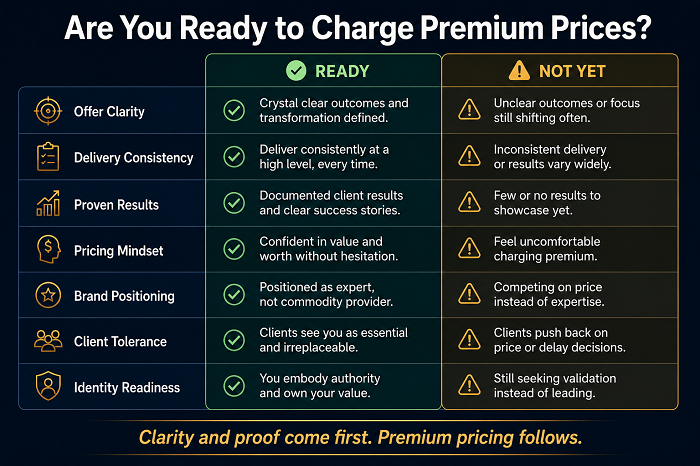
High-ticket sales psychology principles apply when all of the following are true:
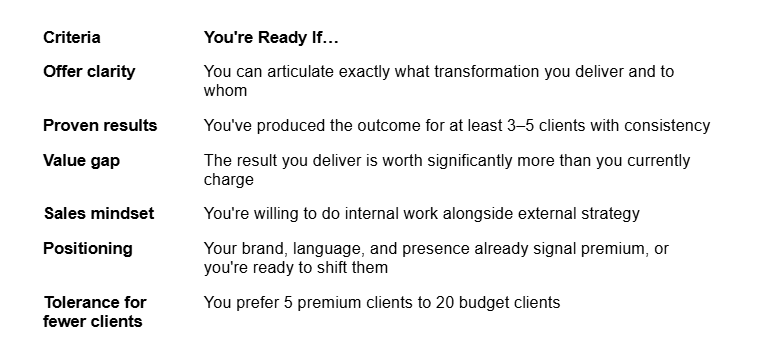
If you can confirm each of these, you're not just ready to charge premium prices, you're leaving significant money on the table by not doing so.
Who Should Focus Elsewhere First?
High-ticket pricing is not the right next move if any of these apply:
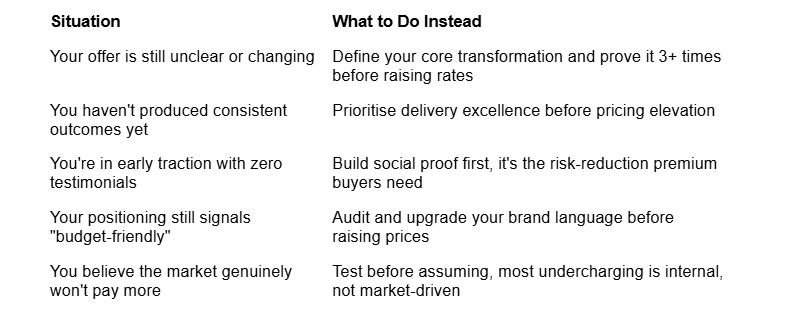
The entrepreneurs who struggle most with premium pricing are those who try to apply high-ticket sales psychology as a workaround for unclear positioning or inconsistent delivery. It doesn't work in that sequence. Clarity and proof come first. Pricing elevation follows.
The PRICE Framework: A 5-Step System for Charging Premium Confidently
The PRICE Framework integrates high-ticket sales psychology with NLP-based identity work. It addresses both the external conversation and the internal state required to hold a premium position without flinching.
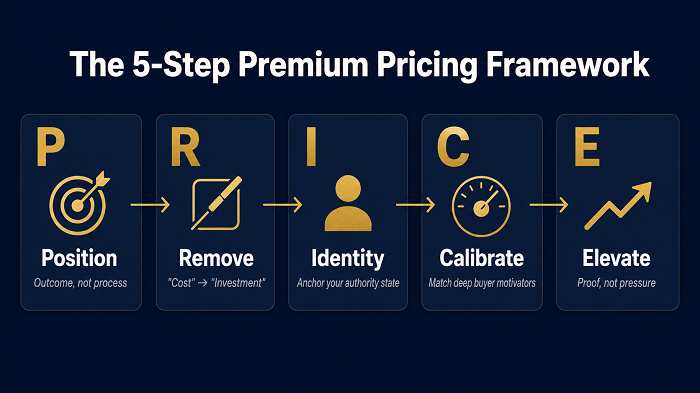
Step 1 — P: Position Your Outcome, Not Your Process Buyers at premium price points don't pay for methodology. They pay for results. Rewrite your offer language to lead with the transformation — what life, revenue, or clarity looks like on the other side, and move your process to the supporting details. This immediately separates you from providers who compete on deliverables and shifts the conversation to outcomes.
Step 2 — R: Remove Cost-vs-Investment Language Audit every client-facing surface, your website, discovery call script, proposals, and follow-up emails, for the word "cost." Replace it with "investment." This isn't wordplay. It's a framing signal that primes the buyer's psychology before the conversation even begins. Consistent language across all touchpoints eliminates the cognitive dissonance that erodes trust at premium price points.
Step 3 — I: Anchor Your Identity Before Every Call Before any pricing conversation, deliberately set your internal state. Use an NLP anchoring technique to access the felt memory of a result you're genuinely proud of, a client who transformed, a conversation that changed a trajectory. That state is what your buyer needs to feel from you. Certainty and authority are not performed; they're accessed. Pillar 2 of James's framework, Confident Communication, begins here, internally, before a word is spoken.
Step 4 — C: Calibrate to the Buyer's Deep Motivators Premium buyers are not primarily motivated by features or deliverables. They're motivated by outcomes connected to identity, who they want to become, what they want to stop feeling, what they want their business or life to represent. Ask the questions that surface these motivators: "What would change for you if this problem were fully resolved?" Then reflect their own language back to them. This creates a psychological connection that makes your premium offer feel personally designed, not generically priced.
Step 5 — E: Elevate with Proof, Not Pressure Social proof at premium price points functions as risk reduction, not persuasion. Share client outcomes in specific, measurable terms, the conversation that shifted, the revenue that moved, the decision that finally got made. Then stay silent. Pressure closes doors. Proof, followed by patience, closes deals. The buyer needs space to connect your result with their desire. Give it to them.
Data & Findings
Based on 2025–2026 industry research and Unleash Your Power client performance observations:
On premium pricing and conversion:
Psychological pricing strategies, including deliberate anchoring and framing, are associated with sales conversion lifts of up to 60%, per the 2025 Capital One Shopping pricing report
The average close rate for high-ticket deals across coaching and consulting sits at 29%, per industry benchmarks, meaning skilled positioning and state management have significant room to move outcomes
The coaching industry maintains gross profit margins of 46–90% at high-ticket pricing levels, per BusinessDojo 2026 data, compared to substantially lower margins at volume-based, lower-price models
On the identity and mindset gap:
The most common reason entrepreneurs override their own premium positioning is an identity belief, not a market limitation (Unleash Your Power client observations, 2026)
Entrepreneurs who actively address internal frameworks, goal blocks, identity anchors, and self-worth beliefs, alongside external sales strategy are significantly more likely to sustain premium pricing without reverting under pressure
On high-ticket buyer psychology:
High-ticket buyers close on trust, value, and ROI, not price or convenience, per 2026 high-ticket sales research
Premium buyers have typically completed substantial independent research before any sales conversation; by the time they're on a call with you, price is rarely the primary unresolved question, certainty of outcome is
Frequently Asked Questions
What is high-ticket sales psychology?
High-ticket sales psychology is the application of cognitive and behavioural science principles to the sale of premium-priced products and services, typically $1,000 and above for B2C and $10,000 and above for B2B. It covers how buyers make decisions at premium price points (anchoring, framing, loss aversion, social proof), how sellers can structure conversations and positioning to align with those decisions, and the internal identity work required to sustain premium pricing without reverting under pressure.
Why do entrepreneurs undercharge even when they're highly skilled?
Undercharging is almost always an identity issue, not a market issue. Most skilled entrepreneurs hold an unconscious belief, often formed early in business, that links their pricing to their sense of personal worth rather than the value of their outcomes. When that belief is active, no amount of external pricing strategy holds consistently. NLP-based coaching is particularly effective here because it works at the level of the belief itself, not just the surface behaviour.
What is the difference between value-based pricing and hourly pricing?
Hourly pricing ties your fee to your time and effort, which commoditises expertise and invites buyers to calculate whether your rate is competitive. Value-based pricing ties your fee to the outcome, the transformation, result, or shift the buyer will experience, which makes the conversation about ROI rather than cost. At premium price points, value-based pricing is almost always more effective because it matches how premium buyers evaluate investments: in terms of return, not expenditure.
How do you handle price objections in high-ticket sales without discounting?
Price objections at premium price points rarely mean "this is too expensive." They typically signal one of three things: uncertainty about the outcome, unresolved concerns about fit, or timing constraints. The most effective NLP-grounded response is to get curious before you get defensive, ask which of these is the actual concern, then address it as an advisor, not a closer. Discounting under pressure signals low confidence in your own value, which compounds the problem rather than resolving it.
Can NLP training improve high-ticket sales performance?
Yes, and the mechanism is specific. NLP addresses the internal patterns (identity beliefs, goal blocks, unconscious rules) that determine whether an entrepreneur actually holds their premium position under pressure. Most high-ticket sales training focuses exclusively on external technique: what to say, how to structure a proposal, how to handle objections. NLP adds the internal layer: who you're being when you say it. Both layers are required for sustainable premium pricing. Mastering sales with NLP covers the NLP techniques most directly applicable to sales confidence and pricing conversations.
Conclusion
High-ticket sales psychology isn't a set of manipulation tactics. It's a framework for aligning how you present your value with how buyers actually process decisions at premium price points. The external work, anchoring, framing, tiering, proof, creates the conversation structure. The internal work, dissolving goal blocks, anchoring your identity as a transformation provider, showing up with genuine authority, is what makes it sustainable.
You've built expertise worth charging for. The question isn't whether the market will pay. The question is whether you're ready to hold the position once you set it.
If you're ready to build that inner foundation alongside the outer strategy, working with James as your business coach in Toronto gives you both, proven NLP-based methods and the experienced guidance to apply them where it counts most.
Unleash Your Power: Stand Out, Take Action, and Create the Success You Want.