How to Shift From a High Stress Job to a Real Business
You shift from a high stress job to a real business by moving yourself out of the role of the main worker and into the role of the owner who builds systems, sets direction, and leads others. A high stress job disguised as a business depends on your daily effort, so income stops when you stop. A real business produces value through repeatable processes, a team or partners, and pricing that pays both a fair salary and a separate profit. The shift happens in stages: recognizing which role you play, pricing for a business instead of a wage, systemizing your core offer, making your first leverage hire, and gradually stepping into the owner seat. Most owners can see meaningful change within six to twelve months, and the result is a company that can grow, support you, and eventually run without you.
You left your old job for freedom. More control over your time, your income, and the kind of work you do. A few years later, you work longer hours than you ever did as an employee, you answer to more people than your old boss ever was, and taking a week off feels impossible.
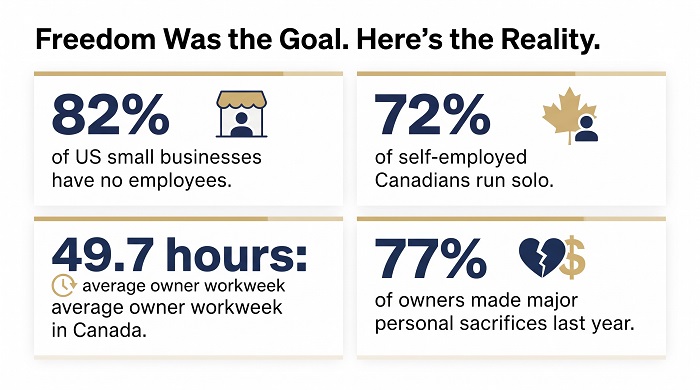
If that sounds like your life right now, you’ve hit one of the most common patterns in small business. Statistics Canada found that autonomy and control over hours were the top reason Canadians chose self employment, yet a BDC workload survey shows the average owner now works close to 50 hours a week, and over 40% feel overwhelmed.
After more than 20 years of coaching entrepreneurs, I’ve seen that the problem usually isn’t effort or talent. It’s structure. In this guide, you’ll learn how to tell whether you own a job or a business, why so many owners get stuck, and a five stage plan to shift from a high stress job to a real business.
Key Takeaways
• A business you can’t step away from is a job, even if you own it.
• Most self employed Canadians run businesses with no employees, which makes the owner the entire operation.
• The core shift is moving from doing the work to designing how the work gets done.
• Pricing for a wage keeps you trapped. Pricing for a business funds a salary, profit, and growth.
• Your first leverage hire is usually the turning point between a job and a business.
• The belief that “it’s faster if I do it myself” keeps more owners stuck than any market condition.
What Is the Difference Between a Job and a Real Business?
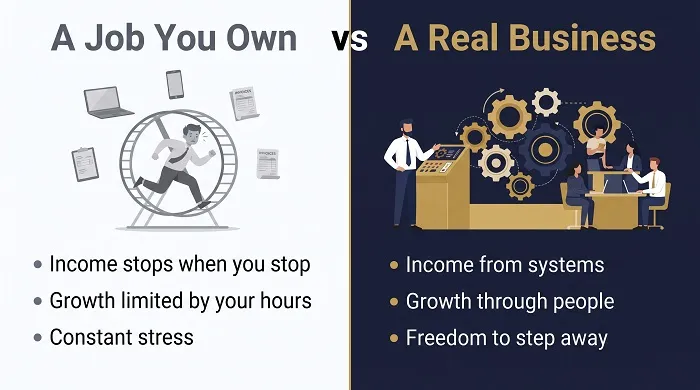
The difference between a job and a real business is whether value depends on your personal effort or on a system that works without you. If your income stops when you stop working, you own a job. If the business keeps serving clients and earning revenue while you’re away, you own a business.
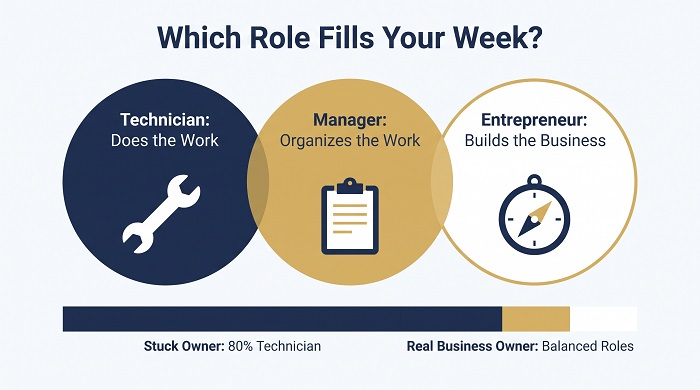
Business author Michael Gerber described this in The E Myth Revisited. He argued that most small businesses are started by skilled technicians who know how to do the work, such as designers, consultants, trades people, or therapists. They leave their jobs, open a business, and keep doing the same work, only now they also handle sales, admin, billing, and everything else.
The result is a job with more responsibility, more risk, and often less pay per hour. A real business separates the work from the owner. The owner’s job becomes building and improving the machine, not being the machine.
Factor | High Stress Job You Own | Real Business |
Source of income | Your hours and personal effort | Systems, team, and repeatable offers |
What happens when you’re away | Revenue slows or stops | Clients are served, work continues |
How you price | Based on what you’d earn as an employee | Based on value, covering salary, profit, and growth |
Your main role | Doing the work | Designing, leading, and improving the work |
Growth limit | Your available time | Your systems, team, and market |
Value if sold | Little or none | Can be sold, financed, or passed on |
Stress level | High and constant | Demanding at times, yet manageable |
Why Do So Many Owners End Up Owning a Job?
Most owners end up owning a job because they build the business around the skill they already have instead of around a system that can grow. Early on, that makes perfect sense. You’re the best person to do the work, and you can’t afford help yet.
The trap closes slowly. Each new client adds more work to your plate. You get faster and better, so you take on more. Without noticing, the business becomes shaped entirely around your capacity.
The numbers show how common this is. According to the SBA Office of Advocacy, about 82% of US small businesses have no employees. In Canada, Statistics Canada reports that roughly 72% of self employed workers run businesses with no employees. There’s nothing wrong with running solo by choice. The trouble comes when you want growth, freedom, or stability, and the structure can’t provide it. If you’re just getting started, our guide to the stages of starting a business shows how structure should evolve over time.
What Are the Signs You’ve Built a High Stress Job?
The clearest sign you’ve built a high stress job is that the business can’t function for more than a few days without you. Other signs show up in your finances, your energy, and your calendar.
Watch for these patterns:
• You pay yourself whatever is left over, and some months that’s nothing.
• Clients hire you specifically, not your company.
• You can’t name a single process that’s written down.
• Your calendar is full of delivery work, with no time for planning.
• You earn less per hour than you did in your last job once you count all your hours.
• You feel relief, not excitement, when a client cancels.
If several of these sound familiar, the long hours are a symptom. Our guide on why working 60 hours prevents business scaling explains how those hours keep the cycle going.
Try This: Add up every hour you worked last month, including admin, email, and evenings. Divide your take home pay by that number. Compare the result with the hourly rate of your last employed position. That single number often reveals whether you’ve built a job or a business.
How Does Stress Change When You Build a Real Business?
Stress changes from constant pressure to occasional challenge when you build a real business. You still face hard decisions, yet you’re no longer the single point of failure for every task, client, and deadline.
In a job you own, stress comes from overload. Too many tasks, too little time, and no one to share the weight. Over time, that pressure affects your health, your relationships, and the quality of your decisions. A 2026 Bluevine survey found that nearly half of owners question whether running a business is worth it at least once a month.
In a real business, stress becomes more strategic. You worry about the right hire or the next market instead of whether you can finish tonight’s deliverables. That’s a far healthier kind of pressure. For practical tools to manage stress during the transition, see our guide to NLP for stress management in business.
The 5 Stage Job to Business Shift Framework
The Job to Business Shift Framework is a five stage plan for moving from a business that depends on your effort to one that runs on systems, people, and healthy pricing. Each stage builds the foundation for the next, so work through them in order.
Stage 1: Name Your Role
Track a typical week and sort your hours into three roles from Gerber’s model: technician (doing the work), manager (organizing the work), and entrepreneur (building and growing the business). Most owners stuck in a job spend 80% or more of their time as the technician. Seeing the split clearly is the starting point for changing it.
Stage 2: Price for a Business, Not a Wage
Set a fair salary for the work you personally do, then price your offers so they cover that salary, a separate profit, and money to reinvest. If your prices only cover your own pay, there’s no room to hire or grow. Our article on why reinvesting profits matters for small businesses explains how that extra margin fuels growth, and our 80/20 revenue audit helps you find which offers deserve a price increase first.
Stage 3: Systemize Your Core Offer
Choose the offer that brings in the most profit and document exactly how it gets delivered. Use checklists, templates, and short screen recordings. The goal is a process someone else could follow to deliver 80% of your quality on the first try.
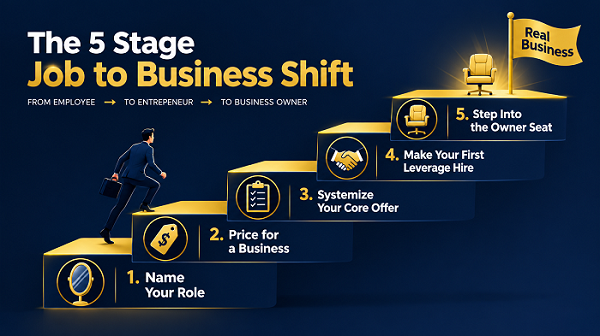
Stage 4: Make Your First Leverage Hire
Hire for the tasks that drain your time but don’t need your specific expertise, such as admin, scheduling, bookkeeping, or first drafts. A part time assistant or contractor is often enough at this stage. This hire is the turning point, because it’s the first time the business produces value without your direct effort. This is Pillar 3, Courageous Action, in its most practical form.
Stage 5: Step Into the Owner Seat
Gradually move your time from technician work to manager and entrepreneur work. Block weekly time for strategy, hiring, and improving systems. Then test your progress by stepping back for longer periods. Our guide to the 30 day walkaway test shows exactly how to measure how much the business still depends on you.
What Mindset Keeps Owners Stuck in a Job?
The mindset that keeps owners stuck is usually the belief that doing the work yourself is faster, cheaper, and safer than building a system or trusting someone else. In the short term, it often is. In the long term, it caps your income and your freedom.
In NLP, we look at the identity sitting under the behaviour. Many owners see themselves as “the designer,” “the consultant,” or “the expert,” not as a business owner. As long as that identity stays in place, every attempt to delegate feels like a loss of who you are. Shifting your identity to “I build businesses that deliver great work” makes the practical changes far easier. You can explore this idea further in our article on what an entrepreneurial mindset does.
One client, Jeff, came to me struggling with low energy and weight issues that he hadn’t connected to his mindset. As we worked on the beliefs behind his habits, his energy returned, and the change spilled into his business, bringing in new customers and higher income. Shifts in how you think about yourself rarely stay in one area of life. When owners change how they see their role, the business tends to follow.
Try This: Finish this sentence five times without stopping: “I’m the only one who can…” Then, next to each answer, write what someone would need in order to do it instead. A skill, a checklist, an introduction, or simple permission. Those notes become your delegation plan.
Who Should Use This Approach?
This framework fits you if:
• You’ve been self employed or running a small business for at least a year.
• Your income depends almost entirely on your own billable hours.
• You want to grow beyond what you can personally deliver.
• You’d like the option to step back, sell, or take real time off one day.
• You’re willing to invest some short term income in long term structure.
Who Should Avoid This Approach?
This approach may not suit you right now if:
• You love doing the work yourself and choose to stay small on purpose. A well run solo practice can be a great life.
• You haven’t yet proven that clients will pay consistently for your offer.
• Your cash flow can’t support even a small part time hire yet. Focus on pricing and profit first.
• You’re in the middle of a personal or financial crisis. Stabilize first, then build.
Frequently Asked Questions
What does it mean to own a job instead of a business?
Owning a job means your business depends on your personal effort to produce income. If you stop working, the revenue stops too. A real business has systems, people, and offers that keep creating value even when you step away.
How long does it take to turn self employment into a real business?
Most owners see meaningful change within six to twelve months of focused work on pricing, systems, and a first hire. Building a business that runs largely without you usually takes two to three years. Progress speeds up once your first processes are documented.
Do I need employees to have a real business?
Not always, but you need leverage. That can come from contractors, partners, automation, or products that sell without your direct time. What matters is that value is produced by systems, not only by your hours.
Should I quit doing client work completely?
Not right away. Most owners keep doing some client work during the shift, especially high value work they enjoy. The goal is to reduce technician time gradually while increasing time spent building the business.
What is the first step to shift from a job to a business?
Track how you spend a typical week and sort your hours into doing, managing, and building. That simple audit shows where your time goes and which tasks to systemize or hand off first.
Your Next Step From Job to Business
Shifting from a high stress job to a real business comes down to one change. You move from being the person who does everything to the person who builds the machine that does it. With the right pricing, documented systems, a first leverage hire, and a new view of your role, the business starts working for you instead of the other way around.
You started this journey for freedom, and that goal is still within reach. I’ve walked this path with many entrepreneurs, and the moment they see themselves as owners instead of workers, everything starts to change. If you’re ready to take decisive action, book a strategy session with a Toronto business coach and let’s map out your shift together.