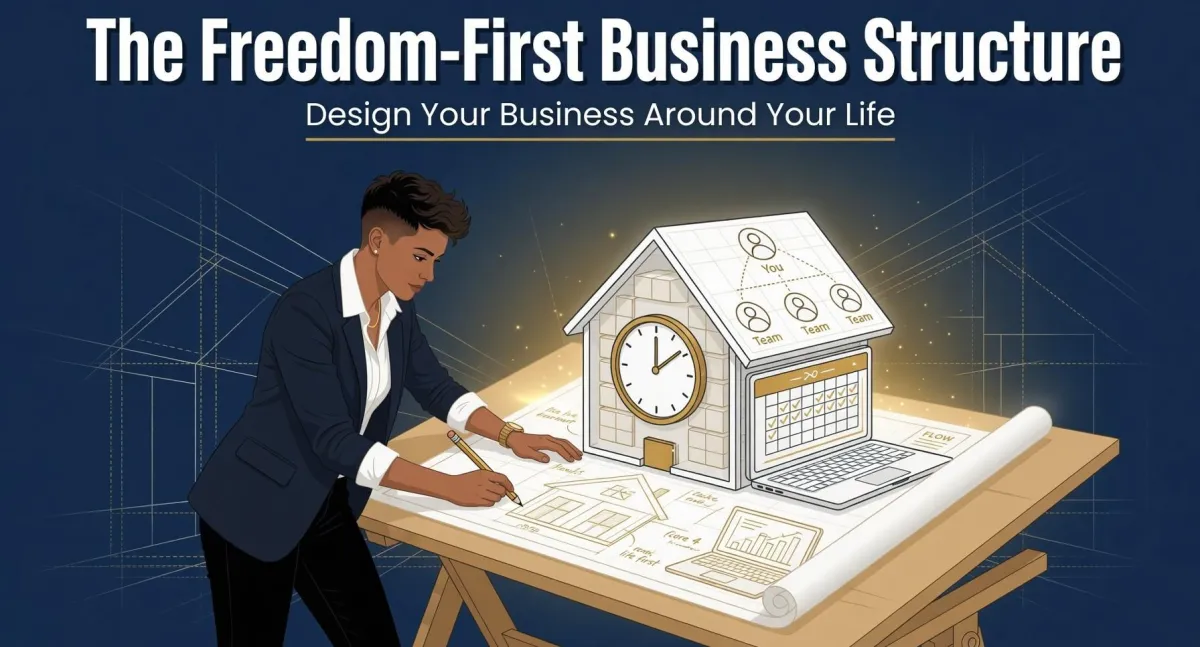
The Freedom-First Business Structure: Designing Operations Around Your Life
A freedom-first business structure is a business model designed around the founder's desired lifestyle where operations, systems, and client relationships actively support long-term freedom rather than requiring constant owner involvement. Instead of building a business and hoping freedom follows, you define your non-negotiable life commitments first, then design every offer, system, and hire to fit within them. The result is a business that runs without you at the centre of every decision, generating revenue, serving clients, and growing, while you live the life you actually built it for.
You started your business to be free.
Free from the nine-to-five grind. Free from a boss dictating your hours. Free to build something on your own terms and finally live the life you actually wanted. So why does it feel like your business has quietly become the new prison?
If you're working 60-hour weeks, answering messages on weekends, and watching vacations slip off your calendar year after year, you're not running a freedom business. You're running a stress machine with your name on the door.
Key Takeaways
Freedom is a design principle, not a destination. Build it into your business structure from the start; don't wait for "enough" success to earn it.
70% of business owners do everything themselves (SCORE), making themselves the biggest bottleneck to their own freedom.
A freedom-first business starts with your life, not your market. Define your non-negotiable lifestyle commitments before making operational decisions.
Productize your methodology. If your service requires you every time, you've built a job, not a business.
Systems beat willpower. Documented processes, clear decision trees, and trained team members create freedom that doesn't depend on your discipline.
Boundary-led client agreements protect your time and actually improve client relationships; clarity builds trust.
A weekly time audit reveals that 30–40% of most owners' hours go to tasks that could be delegated, automated, or eliminated.
The Identity Trap is real. If your worth is tied to busyness, structural freedom will feel threatening before it feels liberating. Mindset work is non-negotiable.
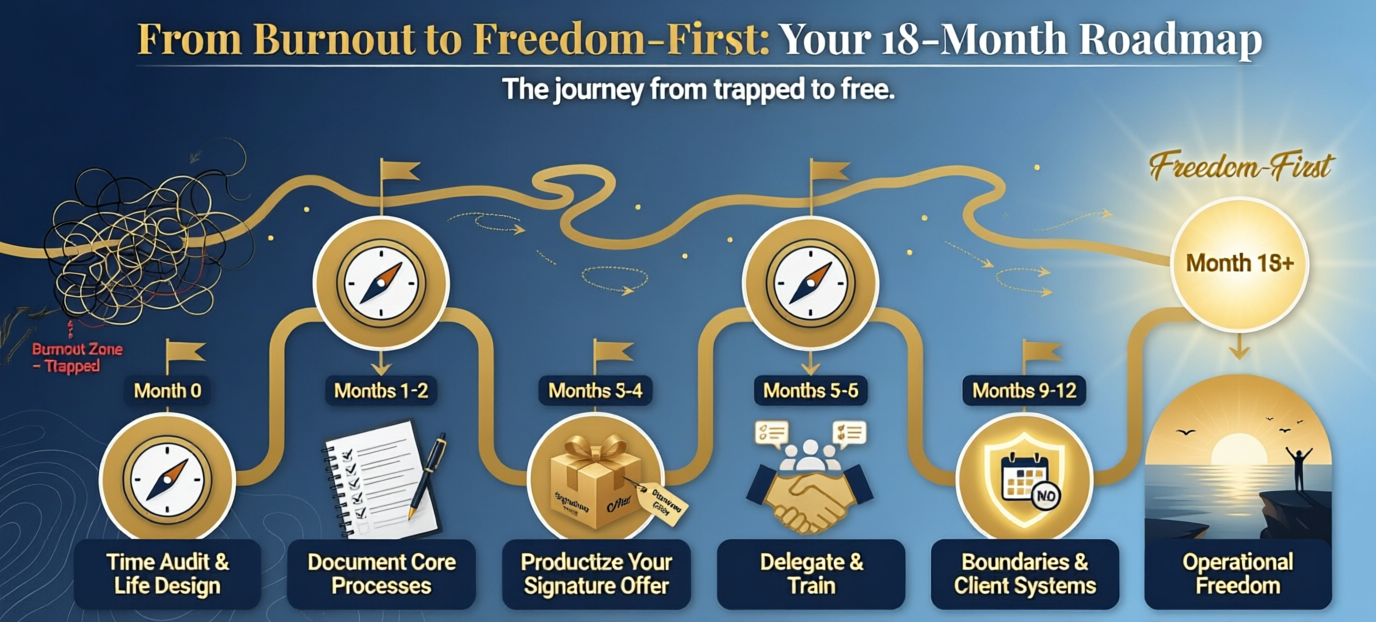
Meaningful freedom is visible in 3–6 months with consistent structural changes. Full operational independence typically takes 18–24 months.
Your Freedom Score is the fastest self-diagnostic: score 0–1 means burnout risk; score 5 means you've built what most entrepreneurs only talk about.
Here's the truth: most entrepreneurs build their lives around their business. But the ones who actually achieve freedom? They build their business around their life. That flip in thinking simple as it sounds, changes everything. It reshapes your offers, your team, your systems, and your daily schedule.
Over the next few minutes, you'll learn how to design a freedom-first business structure that gives you real operational independence not the kind you'll get to "someday," but the kind you can start building today.
Why Most Entrepreneurs End Up Trapped Instead of Free
The data is striking. According to SCORE, 33% of small business owners work more than 50 hours per week, and 25% clock more than 60 hours weekly, double the average employee. More revealing: that same research found that 70% of business owners prefer to do everything themselves, citing being "the most capable option" as their primary reason.
And the toll is real. A 2023 Gallup workplace study found that burned-out founders experienced a 23% drop in productivity, with startup failure rates running 35% higher among those in sustained burnout. Meanwhile, Aflac's national workforce survey found that by 2025, 72% of entrepreneurs were experiencing moderate to very high stress not an outlier group, but the majority.
This isn't a discipline problem. It isn't a mindset problem. It's a structural problem.
The Bottleneck Effect: When You Become the Ceiling
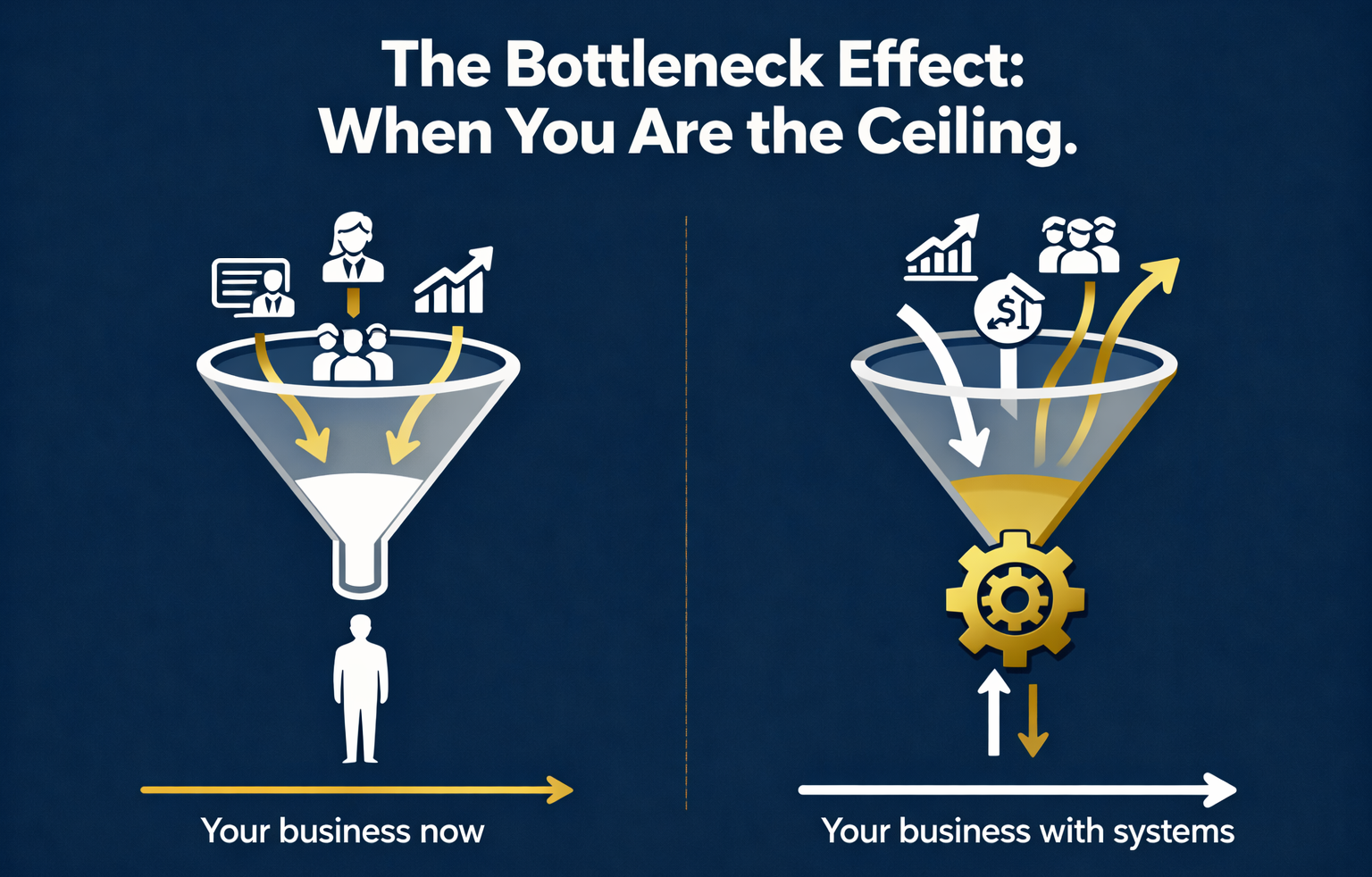
When your expertise is the delivery mechanism for everything your business offers, you've set a hard ceiling on your growth and your freedom. You haven't built a business; you've built a high-income job with no HR department and no one to complain to.
The shift requires more than good intentions. It requires a structural redesign, one that starts not with your product suite or your revenue goals, but with your life.
Traditional Business vs. Freedom-First Business
Before diving into how to make the shift, it helps to see the difference clearly:
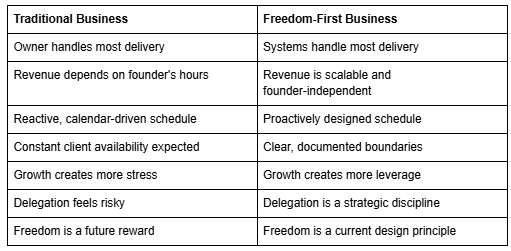
The question isn't which column looks better; it's which column your business currently resembles.
What a Freedom-First Business Structure Actually Means
Freedom-first business structure: A business model designed around the founder's desired lifestyle, where operations, systems, and client relationships support long-term freedom rather than constant owner involvement.
That means before you design your offers, set your schedule, or hire your next team member, you've defined what freedom looks like for you specifically. Not a generic lifestyle fantasy but concrete, non-negotiable commitments to how you want to spend your time and energy.
Entrepreneurs who design their ideal lifestyle first and then build their business model to support it scale smarter, make better decisions, and avoid the cycles of burnout that trap so many founders. They don't get to freedom eventually. They engineer it from the start.
Freedom Isn't a Reward: It's a Design Principle
One of the most powerful reframes in my 20+ years working with entrepreneurs is this: freedom isn't something you earn after the business succeeds. It's a constraint you build the business within.
When you treat freedom as a design principle, not a destination, you stop tolerating systems, clients, and commitments that violate it. You start asking a different question: Does this decision move me closer to the life I'm building, or further from it?
Try This: Before your next business planning session, write down three non-negotiable lifestyle commitments. Not aspirations, commitments. Something like: "I do not work past 6 pm." "I take Fridays off." "I am present for every school pickup." These become your decision filters for every operational choice that follows.
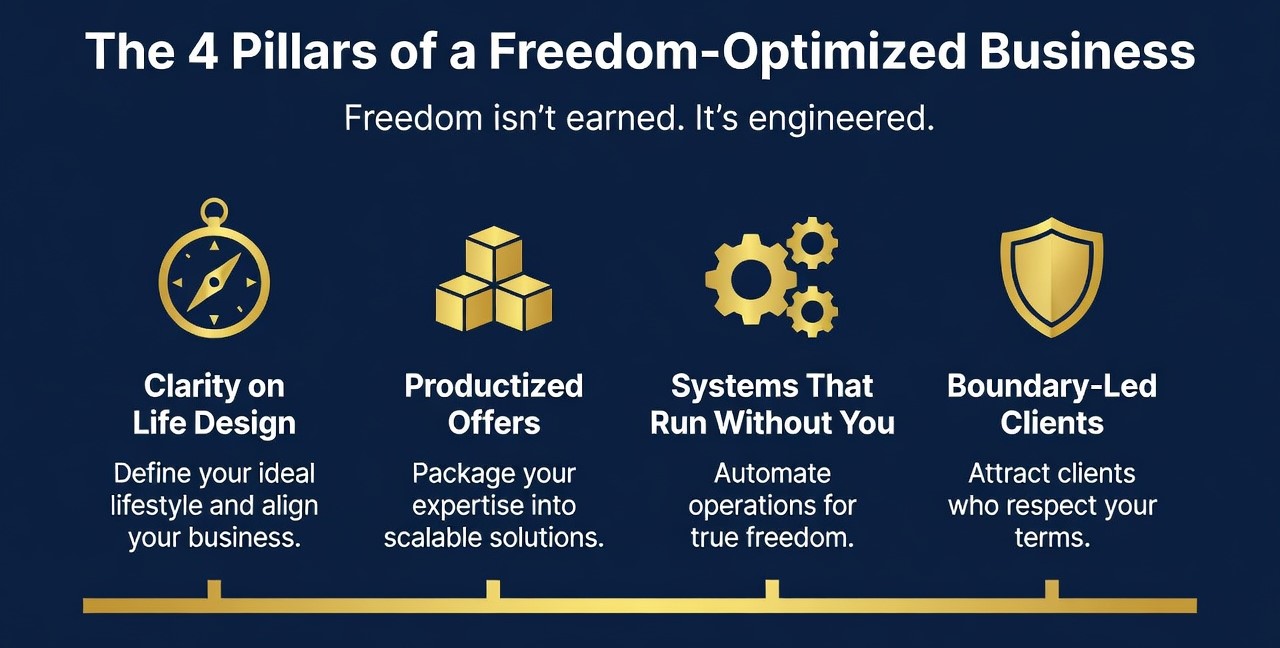
The 4 Pillars of a Freedom-Optimized Operation
Redesigning your business structure for freedom isn't about working less. It's about working in a fundamentally different way. Here's the framework that makes it possible.
Clarity on Your Life Design
Every freedom-first business starts with a clear picture of the life you're building. Not a vague vision board, but a specific, written commitment to how you want to spend your days, your energy, and your best hours.
Ask yourself: What does a perfect Tuesday look like? Where are you working from? Who are you spending time with? How many hours are you in the business versus on it?
This isn't indulgent dreaming. It's strategic planning. Building a business around your values and lifestyle requires knowing exactly what those values are before you make a single operational decision. Clarity of Vision: understanding what you want and aligning your actions with it is the foundation everything else is built on.
Productized, Scalable Offers
If your service delivery requires you specifically to show up every time, your business can't grow without consuming more of your life. The solution is productization: turning your methodology into a repeatable system that someone else can run, or that runs automatically.
This is where entrepreneurs often feel resistance. "My clients want me specifically." Maybe. But they want your results and results can be systematized. When Darren G. came to me feeling blocked from the business growth and abundance he wanted, one of his first breakthroughs was recognizing that his attachment to doing everything himself was the ceiling. Removing that belief block opened up new thinking, new behaviours, and within six months he had reduced his direct-delivery hours significantly, delegated client onboarding, and more than doubled his time available for strategy and growth.
Your best offer should be your most leveraged one, not your most time-intensive.
Systems That Run Without You
Freedom requires infrastructure. That means documented processes, clear decision trees, and tools that allow your team or your automated workflows to keep moving without requiring your input on every task.
As SCORE notes, most small business owners struggle with delegation because they're habitual doers. Even when they do delegate, they micromanage, defeating the purpose entirely. The path forward is trusting documented systems rather than your constant presence.
Block one hour per week not to do client work, but to document one process that currently lives only in your head. Within 90 days, you'll have a foundation your business can actually stand on without you holding it up.
Try This: Identify the three questions your team asks you most often. Write a one-page answer to each. You've just removed yourself from three recurring bottlenecks and created the beginning of your operations manual.
Boundary-Led Client Relationships
The clients you accept, the scope you agree to, and the expectations you set at the start of a relationship are either freedom-supporting or freedom-destroying. There's rarely a middle ground.
A freedom-first structure includes a clear client agreement explicit about your availability, your deliverables, and what falls outside scope. Not because you don't care, but because you care enough about your work to deliver it sustainably.
How to Restructure Your Business for Freedom: A Practical Starting Point
You don't overhaul your business overnight. You redesign it decision by decision. Here's where to begin.
Start With a Time Audit
Before you change anything, track exactly how you spend your time for two weeks. Not what you plan to do, but what you actually do. Here's what a typical unexamined business owner's week often looks like:
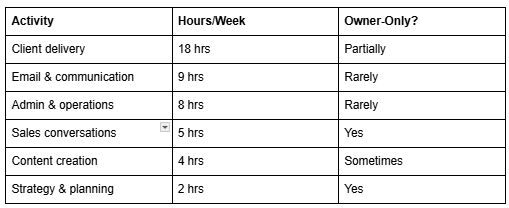
Now ask yourself honestly: Which of these genuinely requires my specific expertise, my relationships, my judgment?
Most entrepreneurs discover that 30–40% of their weekly hours go toward tasks that could be delegated, automated, or eliminated. That's two to three full workdays absorbed by the wrong activities. Reclaiming even half of those hours doesn't just reduce stress it fundamentally changes what you can build.
Identify Your Highest-Value Activities
Once you know where your time goes, isolate the two or three activities that generate the most revenue, impact, or creative energy when you specifically do them. These are your "owner-only" activities. Everything else is a candidate for delegation.
This connects directly to Courageous Action, the pillar that separates those who plan their freedom from those who actually build it. Letting go of tasks you've always handled yourself takes real courage. But it's the move that creates leverage, and it starts by breaking through the limiting beliefs that keep you at the centre of everything.
Design Your Ideal Week Then Protect It
Map out what your ideal work week looks like before it fills up with everyone else's priorities. When do you do deep creative work? When do you take calls? When are you offline, recovering, and recharging?
Then and this is the part most entrepreneurs skip, block that calendar first. Let everything else fit around your priorities, not the other way around. Your entrepreneurial mindset is what determines whether those protected blocks stay protected or quietly disappear under the pressure of incoming demands.
What Stops Entrepreneurs from Building Freedom-First?
Understanding the obstacles is half the battle. Here are the most common ones and why they're so persistent.
Common Mistakes to Avoid
Delegating before documenting. Handing off tasks before you've written them down creates confusion, rework, and frustrated team members, which makes you less likely to delegate in the future.
Hiring before simplifying. More people don't fix a broken process. They amplify it. Simplify first, then scale.
Saying yes to every client. Every wrong-fit client costs you more than the revenue they bring in: time, energy, and the opportunity cost of better work.
Measuring hours instead of outcomes. A 40-hour week full of low-value activity produces less than a 25-hour week anchored to your highest-impact work.
Confusing being busy with being productive. Busy feels safe. But busyness that doesn't move the business forward is just expensive noise.
The Identity Trap runs deeper than any tactical mistake. Many entrepreneurs have wrapped their sense of worth so tightly around being needed and being busy that slowing down feels like shrinking. If your identity is tied to how much you do, a freedom-first structure will trigger real discomfort before it produces results. Recognizing and shifting these limiting beliefs is essential groundwork and it's where mindset training pays dividends that no productivity system can replicate.
Your Freedom Score: Where Do You Stand?
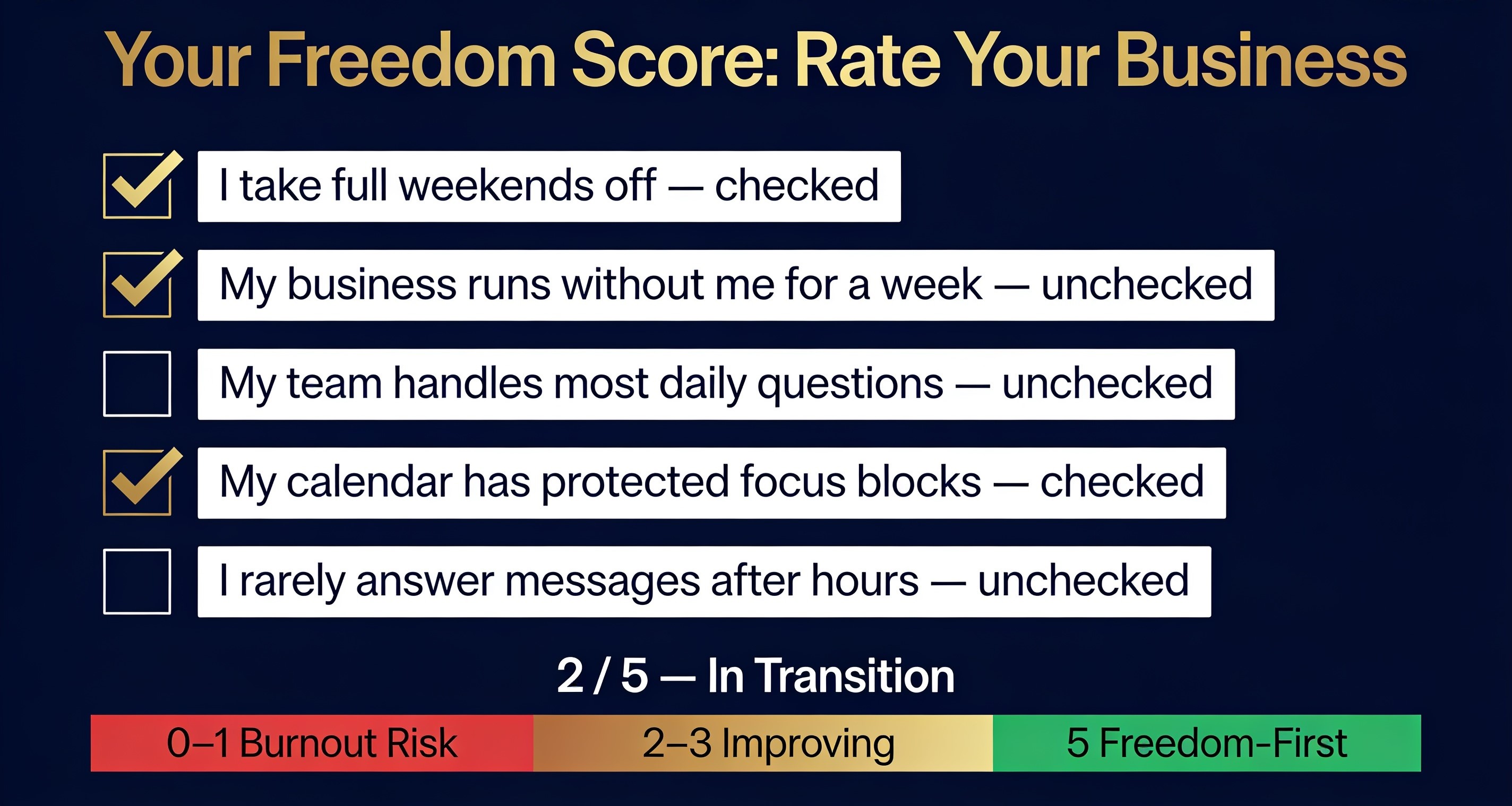
Rate yourself honestly across these five markers:
I take full weekends off without checking messages
My business could run without me for one full week
My team handles most day-to-day questions without me
My calendar has protected focus blocks I rarely break
I rarely respond to client messages outside business hours
0–1 → Burnout Risk. Your business depends on you for almost everything. This is the first place to focus. 2–3 → In Transition. You've started building structure, but key dependencies remain. Identify them and build systems around them. 4 → Improving Steadily. Strong foundation. One or two structural gaps to close. 5 → Freedom-First. Your operations reflect your values. Now optimise and scale.
Most entrepreneurs score 1 or 2 on their first honest pass. That's not failure; that's your starting point.
Frequently Asked Questions
What is a freedom-first business structure?
A freedom-first business structure is a model where the founder's desired lifestyle anchors every operational decision; offers, systems, hiring, schedules, and client agreements are all designed to protect and expand personal freedom rather than consume it.
How do I know if my business is structured for freedom or for burnout?
If you regularly work more than 50 hours per week, can't take time off without the business suffering, or are the default answer to most problems in your company, your structure is built around you as the bottleneck. A two-week time audit will show exactly where the dependencies are and which ones to tackle first.
Can I restructure an existing business for freedom, or is this only for new businesses?
Absolutely for existing businesses. Restructuring happens through incremental decisions: productizing one offer, documenting one process, setting one new client boundary. Small structural changes, sustained over 90 to 180 days, produce significant operational freedom — regardless of how long you've been in business.
How long does it take to build a freedom-first business?
With consistent effort and the right support, meaningful operational changes are typically visible within three to six months. Full structural freedom where the business runs reliably without your constant input is usually an 18-to-24-month process for most entrepreneurs.
What do I delegate first?
Start with repetitive, low-value tasks that don't require your unique expertise: scheduling, invoicing, customer support follow-up, routine admin, and standard client communications. These are the easiest to document, the fastest to hand off, and they free up your highest-value hours for strategy and revenue-generating work.
What role does mindset play in building a freedom-first business?
A critical one. Most structural constraints have a mindset root: the belief that delegation means losing quality, that saying no costs clients, or that personal worth equals productivity. NLP-based coaching tools are particularly effective at identifying and removing these belief-level barriers so that structural changes can actually stick in the long term.
Is a freedom-first business the same as a lifestyle business?
They overlap but aren't identical. A lifestyle business is typically small by design and prioritises quality of life. A freedom-first business can scale significantly; the distinction is that freedom remains a core design constraint at every stage of growth, not just when the business is small.
Build the Business That Builds Your Life
Here's what I've seen across 20+ years of coaching and training entrepreneurs: the ones who achieve genuine freedom aren't the ones who worked hardest or sacrificed the most. They're the ones who got intentional about structure.
They stopped letting their business make decisions about their life. They started making decisions about their business from the clarity of the life they wanted.
Your business should be the vehicle that gives you freedom, not the reason you never experience it. Every system you build, every process you document, and every boundary you set is a step toward a business that supports your life instead of consuming it. That shift is available to you. Not someday. Now,
If you're tired of building a business that depends on you every hour of every day, the next step isn't working harder; it's redesigning how your business operates. Business coaching can help you identify bottlenecks, remove limiting beliefs, and build systems that create lasting, structural freedom.