

How to Escape the Successful Prison You Accidentally Built
The successful prison is a business that generates real revenue, serves real clients, and employs real people, but requires the founder's daily presence, personal judgment, and emotional energy to function. It is called a successful prison specifically because the conventional metrics of success are all present: income, reputation, a growing team, satisfied clients. What is absent is freedom, the ability to disengage from operational management without the business degrading, the ability to take an uncontacted week away, and the ability to look at the business as an asset that works for you rather than a system you are trapped inside working for. Escaping the successful prison is not a matter of working harder, hiring more people, or implementing a new project management tool. It is a four-phase dismantling process: first, identifying the specific layers of the prison that have been built (most founders can name the prison but not its structure); second, dissolving the psychological identity that requires the prison to exist; third, systematically removing each structural layer in the correct sequence; and fourth, rebuilding the liberated architecture, a business structure that is genuinely autonomous, premium, and designed to operate without the founder at its operational centre.
Key Takeaways
The Prison Is Built From Success, Not Failure: Every bar of the successful prison was placed there by a decision that felt right at the time, taking the client call personally, adding a new service, keeping final approval for yourself. The prison is not evidence of incompetence. It is evidence of a business that outgrew the founder's original architecture without being redesigned.
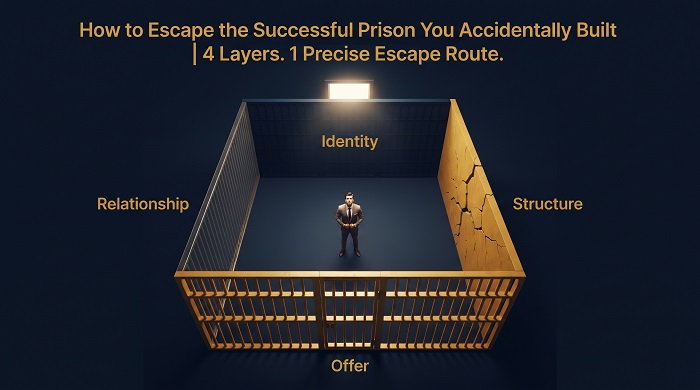
There Are Four Distinct Prison Layers: The Identity Layer (your sense of worth is tied to being operationally needed), the Structural Layer (the business is architecturally founder-dependent), the Offer Layer (your service model produces personal dependency by design), and the Relationship Layer (clients expect and require personal access to you). Each requires a different dismantling approach.
The Escape Sequence Is Non-Negotiable: Most founders attempt to escape by starting with structural changes — new systems, new team members, new tools. This fails because the Identity Layer is still intact, and the founder unconsciously rebuilds the prison walls faster than the structural changes can remove them. Psychological rewiring must precede structural redesign.
Nothing Valuable Is Destroyed in the Escape: The clients, the revenue, the reputation, the team — none of these are sacrificed in the escape. What is removed are the structural mechanisms that make delivering those results contingent on the founder's personal daily involvement. The escape makes the valuable things more durable, not less.
The Prison Is Invisible Until You Name Its Layers: Founders trapped in a successful prison rarely experience it as a prison. They experience it as being busy, being needed, and being successful. The moment each layer is named and its structural mechanism is understood, the escape becomes a precise engineering project rather than an overwhelming life change.
The Paradox of the Successful Prison
There is a particular kind of entrepreneurial suffering that never gets talked about in the rooms where entrepreneurs gather, because it does not look like suffering from the outside.
It looks like a full calendar. It looks like a growing team. It looks like client testimonials and a respectable revenue figure and a business that, by any external measure, is working. And yet the person at the centre of it all cannot take a three-day weekend without their phone. Cannot sit through a dinner without calculating how many messages will need answering afterward. Cannot imagine what a Tuesday morning would look like if they were not at their desk by 7 AM.
This is the successful prison. The revenue is real. The reputation is real. The trap is equally real.
The cruelest feature of the successful prison is that the same decisions that created it were the right decisions at the time. Taking every client call personally was appropriate when the business was establishing its reputation. Reviewing every deliverable was appropriate when the team was learning the standard. Maintaining full operational control was appropriate when the systems were not yet built. The mistake was not in making those decisions. The mistake was in never revisiting them, allowing what was once a temporary survival mechanism to calcify into a permanent structure that now runs your life.
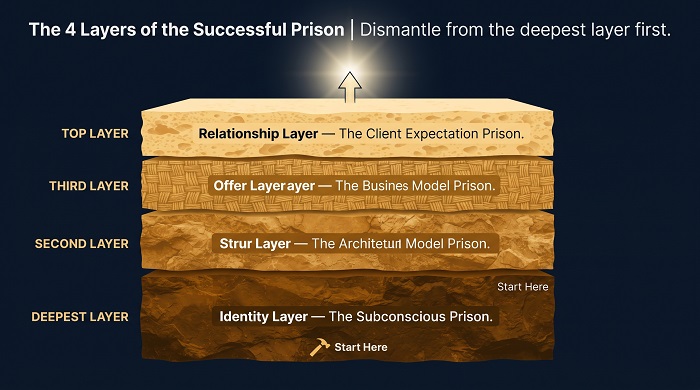
The Four Layers of the Successful Prison
A successful prison is not a single problem with a single solution. It is a four-layer structure, each layer reinforcing the others, each requiring a different dismantling tool. Most founders who attempt to escape address only one or two layers and wonder why the prison re-forms.
Layer 1 — The Identity Layer (The Deepest Wall)
The Identity Layer is the set of unconscious beliefs that equate professional worth with operational indispensability. "Being needed is being valuable." "The business depends on me because I am irreplaceable." "If I step back and the business runs without me, what does that say about my importance?"
This layer is the most powerful because it is invisible. The founder does not experience it as a belief. They experience it as a natural feature of the world, the way things simply are. It drives them to re-enter every system they delegate, to personally respond to every client message, and to unconsciously undermine every structural improvement that would reduce their operational centrality.
The Identity Layer must be dismantled first, through deliberate psychological work, before any structural change can hold.
Layer 2 — The Structural Layer (The Architectural Prison)
The Structural Layer is the operational architecture of the business, the absence of documented systems, the absence of decision frameworks, the absence of quality benchmarks and accountable owners. Without these structures, the founder's personal judgment is required at every decision point. The business is architecturally designed around the founder's presence.
This is the layer most founders recognise first, and attempt to fix first. They hire a team member, implement a project management tool, or write a few SOPs. These attempts partially succeed and then stall, because the Identity Layer is still intact and quietly ensures that the structural changes never fully remove the founder from the operational loop.
Layer 3 — The Offer Layer (The Business Model Prison)
The Offer Layer is the structure of what the business sells. Many service-based businesses have drifted into offer architectures that are structurally impossible to systematise or deliver without the founder — highly bespoke, highly customised, highly relationship-driven service models that were designed implicitly around the founder's personal genius rather than a replicable methodology.
No amount of operational improvement will make a fully bespoke, founder-personalised service scalable. The offer itself must be redesigned, around a documented methodology that the team can deliver, before the structural layer can be fixed.
Layer 4 — The Relationship Layer (The Client Expectation Prison)
The Relationship Layer is the set of client expectations that have been cultivated over time, expectations of personal founder access, personal founder attention, and personal founder responsiveness. These expectations were typically created by the founder's own behaviour: always being available, always responding personally, always being the face that clients interact with.
Clients who expect personal access are not wrong for expecting it, the founder trained them to. Dismantling this layer requires a carefully managed transition: communicating the evolution of the business as an elevation of the service experience, not a reduction of it.
"The successful prison is built one reasonable decision at a time. It is dismantled one deliberate decision at a time. The difference is that the dismantling requires a map, and the courage to follow it." — James R. Elliot
The Anatomy of Each Prison Layer
Prison Layer | How It Was Built | How It Holds You | The Dismantling Tool |
Layer 1 — Identity | Years of validation from being the person who solved every problem, closed every deal, and held every relationship personally. | Unconsciously undermines every structural improvement. Re-enters every delegated system. Answers every message that should stay with the team. | NLP and Timeline Therapy — dissolving the subconscious equation of indispensability with worth. Replacing it with identity rooted in outcomes, not operational presence. |
Layer 2 — Structure | Never taking the time to document processes, build decision frameworks, or install quality benchmarks. The business grew faster than the architecture. | Every non-routine situation escalates to the founder. Quality review requires the founder's eye. No team member can fully own an operational outcome. | The Four-Component System Architecture — documented process + decision framework + quality benchmark + accountable owner with full authority for every critical business function. |
Layer 3 — Offer | Services were designed around the founder's personal genius rather than a replicable methodology. Bespoke delivery became the brand promise. | The service cannot be delivered by anyone else. The founder must be personally present for every client engagement. Capacity is capped at the founder's available hours. | Methodology Extraction — identifying the 70–80% repeatable core of the delivery and building a named, documented methodology around it that any trained team member can execute. |
Layer 4 — Relationship | The founder cultivated personal access and personal responsiveness as the service differentiator. Clients were trained to expect the founder at every touchpoint. | Clients resist team-delivered service. Complaints arise when the founder is not personally handling their account. Founder cannot step back without risking key relationships. | Strategic Client Transition — communicating the business's evolution as a premium experience enhancement, repositioning team delivery as a feature of the methodology rather than an absence of the founder. |
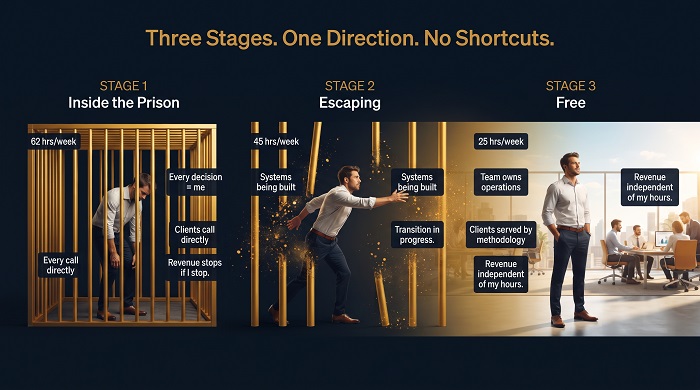
The Escape Route: Inside → Escaping → Free
Dimension | Inside the Prison | The Escaping Stage | Outside the Prison |
Identity | Worth is measured by how needed you are. Stepping back feels dangerous, like becoming irrelevant. | Psychological work is active. Identity is being consciously recalibrated. Discomfort is present but understood. | Worth is measured by outcomes the business produces. Stepping back feels correct, the evidence of a well-built company. |
Working Hours | 55–80+ hours per week. Every evening and weekend at partial operational readiness. Holidays are anxiety events. | Hours reduce as systems are built. 45 → 35 → 28. Some days feel lighter. Others still pull hard. | 25–35 focused strategic hours. Hard daily finish. Guilt-free evenings. A 4-day week is the standard. Holidays are offline. |
Decision Flow | All significant decisions escalate to the founder. Team members do not trust their own judgment without founder confirmation. | Decision frameworks being built and tested. Team making increasing numbers of decisions independently. Some escalations are still occurring. | The team owns all routine and semi-routine decisions. Founder receives performance summaries. Escalations reserved for genuinely strategic or novel situations. |
Client Relationship | Clients expect personal founder access. Complaints when the team handles communication. The founder is the product. | Client transition protocol active. Key clients being introduced to the methodology and the team. Early adopters responded positively. | Clients buy the methodology. The team delivers the experience. Founder visible at strategic relationship moments only. Client satisfaction is equal or higher than before. |
Revenue Stability | Revenue is a function of founder hours. When the founder is absent, revenue performance is anxiously monitored. | Revenue holding steady as systems replace founder involvement. Occasional minor dips are quickly corrected as systems are refined. | Revenue generated by systems. Founder absence has no measurable impact on revenue performance. Business grows while the founder is on holiday. |
The Framework: The 5 Shifts to Freedom & The 3 Pillars
The Limitless Entrepreneur methodology maps directly onto the four prison layers, addressing each one in deliberate sequence across 16 weeks.
The 3 Pillars Mapped to the Prison Layers
Pillar 1 — Performance Psychology → dismantles Layer 1 (Identity): Through NLP and Timeline Therapy, we dissolve the subconscious programming that equates operational indispensability with professional worth. The founder's nervous system is recalibrated — from threat response when stepping back, to genuine comfort with strategic distance. This is the prerequisite for everything that follows.
Pillar 2 — Freedom-First Business Strategy → dismantles Layer 3 (Offer): The offer architecture is redesigned around a named, documented methodology. The bespoke, personal-genius delivery model is simplified and systematised. The business becomes one that sells an outcome delivered by a process, not a founder's personal hours.
Pillar 3 — Freedom-First Business Structure → dismantles Layers 2 and 4 (Structural + Relationship): The Four-Component System Architecture is built for every critical business process. The Strategic Client Transition protocol is executed. The business's operational infrastructure is rebuilt to function without the founder's personal presence at its centre.
The 5 Shifts: The 16-Week Escape Sequence
Shift 1 — Vision Alignment (Weeks 1–4): The founder articulates the precise architecture of the business after the escape, what it delivers, who delivers it, what the founder's role is, and what their week looks like. This vision is the design blueprint for every structural decision that follows. Without it, there is no agreed destination and the escape has no direction.
Shift 2 — Ruthless Elimination (Weeks 5–7): Every offer line, client type, and service configuration that is structurally incompatible with the liberated architecture is eliminated. The business is simplified to the minimum viable offer suite that can be systematised, delegated, and delivered at premium without founder dependency.
Shift 3 — Systems That Scale (Weeks 7–11): The Four-Component Architecture is built for every remaining business process. Founder knowledge is extracted. Decision frameworks are documented and tested. Quality benchmarks are created and validated. Accountable owners are installed with full authority. This is the primary structural escape.
Shift 4 — Mindset Unlock (Weeks 11–14): The residual psychological resistance, the guilt of stepping back, the anxiety of absence, the compulsive check-in urge, is resolved neurologically. The founder settles into the role of strategic owner rather than operational executor. The Identity Layer is fully dismantled.
Shift 5 — Magnetic Authority (Weeks 14–16 and beyond): The freed founder redirects their full attention to the highest-leverage CEO role, thought leadership, strategic relationships, premium market positioning, and the compound activities that grow a real company without ever requiring the founder's operational presence again.
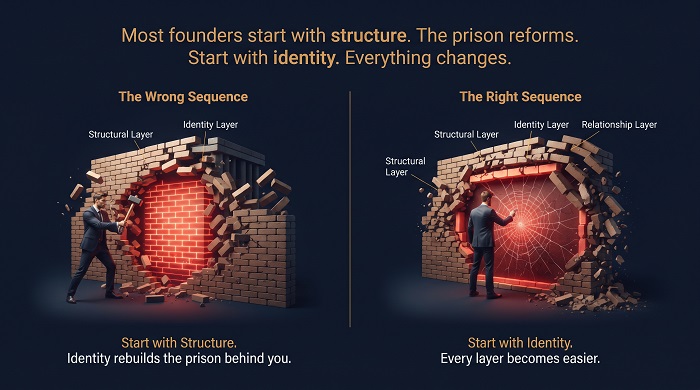
Case Evidence: Two Escapes, Two Approaches
Tom — The Four-Layer Escape Attempted in Wrong Order
Tom came to us having already spent eight months attempting to escape on his own. He had hired two team members, implemented a project management system, and documented fifteen processes. His working hours had not changed. If anything, they had increased — he was now managing a team in addition to doing all the work himself.
The diagnosis was immediate: Tom had attempted to dismantle the Structural Layer first. His Identity Layer was completely intact. Every system he built, he quietly re-entered. Every team member he hired, he micromanaged so comprehensively that their net contribution to his workload was negative. The structural investment was wasted entirely because the psychological work had been skipped.
We spent the first four weeks exclusively on Pillar 1 — the identity work. Tom was resistant: he had come for systems, not psychology. But by Week 4, something had shifted. When we revisited the existing systems he had built, he found he could actually trust them. He stopped re-entering the review chain. He stopped answering the questions his team was now empowered to answer. Within six weeks of the psychological shift, he had reduced his working week from 62 hours to 38 — using systems he had already built eight months earlier. The systems were not the problem. The identity was.
Marcus — The Clean Escape
Marcus followed the correct escape sequence from the start. Layer 1 first: four weeks of intensive psychological work through the programme's NLP methodology. Layer 3 second: his service offering was rebuilt around a documented, named framework that his team could deliver. Layer 2 third: the Four-Component Architecture was built for every delivery process. Layer 4 last: a three-month strategic client transition, communicated as a quality elevation, repositioned team delivery as the premium experience.
At the end of the 16 weeks, Marcus ran the 30-Day Walkaway. He took four consecutive days away in Week 2, increasing to five days in Week 3. Nothing broke. Revenue held. His two senior team members handled every client situation within the decision framework. Three clients proactively commented on the improved responsiveness of the team during his absence.
He had escaped. The prison still looked identical from the outside — same revenue, same clients, same brand. But the walls were gone.
Decision Framework: Where Is Your Prison Most Solid?
If Layer 1 (Identity) is your dominant layer: You know what needs to change structurally, but you keep pulling yourself back in. You re-enter delegated systems. You answer messages you have told yourself you would stop answering. You feel vaguely guilty or anxious when the business runs without you. Start with Pillar 1. Everything else will become easier once the identity shift occurs.
If Layer 2 (Structure) is your dominant layer: You are psychologically ready to step back but the systems do not yet exist to allow it. Your team wants autonomy but lacks the decision frameworks and quality benchmarks to exercise it safely. Start with Shift 3, build the Four-Component Architecture for your three most founder-dependent processes this month.
If Layer 3 (Offer) is your dominant layer: Your business model itself produces founder dependency. No amount of operational improvement will fix a service that is designed around your personal presence. Start with Shift 2, extract your delivery methodology into a documented, named framework that your team can deliver.
If Layer 4 (Relationship) is your dominant layer: Your clients have been trained to expect you personally. The fix is a carefully sequenced transition communication, framing team delivery as a quality elevation, not a founder withdrawal. This layer is the easiest to dismantle once the first three are addressed.
Try This: The Prison Layer Identifier (10 Minutes)
Question 1 Identity Layer check: In the last 30 days, how many times did you re-enter a process you had already delegated, answer a message your team should have handled, or personally review a deliverable that a system was supposed to quality-check? More than five times = Identity Layer is active and must be your first priority.
Question 2 Structural Layer check: Pick your most important operational process. Can your team execute it from start to finish, including all common exception scenarios, without asking you a single question? If not = Structural Layer. Build the decision framework this week.
Question 3 Offer Layer check: Could a well-trained team member with no unique personal relationship with your clients produce the same results your clients pay for? If the honest answer is no, the problem is the offer design, not the team. Your Offer Layer is intact.
Question 4 Relationship Layer check: In the last quarter, how many client escalations came to you directly, bypassing your team, because the client specifically requested or required your personal involvement? More than three = Relationship Layer is a live constraint that needs a structured transition protocol.
The layer where you scored most honestly is your starting point for the escape.
Further Reading
Entrepreneurial Mindset Through NLP — the psychological tools required to dismantle the Identity Layer without losing the drive that built the business.
Harnessing Structure & Systems — building the operational architecture for the Structural Layer escape.
Why Goals Fail — why structural escape attempts without psychological rewiring consistently fail to hold.
Overcoming Procrastination — understanding the avoidance behaviours that keep founders inside the prison even when they know the escape route.
Harvard Business Review: The CEO's Role in Leading Transformation — external research on how founders successfully transition from operational executor to strategic leader — the defining move of the prison escape.
Frequently Asked Questions
What is a "successful prison" in business?
A successful prison is a business that produces genuine external success metrics, revenue, clients, team, reputation, while simultaneously trapping the founder in an operational role that consumes their time, limits their freedom, and would collapse without their daily personal involvement. It is called a "successful" prison specifically because the conventional markers of business success are all present, making it difficult to identify as a prison from either the inside or the outside. The trap is in the structural dependency, not the revenue figure.
How do I know which of the four prison layers is my biggest constraint?
Run the Prison Layer Identifier exercise above. The clearest diagnostic signal for each layer: Identity Layer, you keep re-entering systems you have already delegated, and feel anxious when the business runs without you. Structural Layer, your team cannot make decisions independently and escalates routine situations to you. Offer Layer, your service cannot be delivered at the same quality by a team member following a documented process. Relationship Layer — clients specifically request your personal involvement and resist team-handled communication.
If I escape the prison, will I lose the clients who value my personal attention?
In isolated cases, a small number of clients who were primarily purchasing the founder's personal presence, rather than the business's methodology and results, may choose to leave. This is not a loss. These clients represent the Relationship Layer of the prison in its purest form. The clients who stay are those who value the outcomes and the methodology, and these relationships become more durable, not less, when they are no longer dependent on the founder's personal availability. The majority of founders who execute the strategic client transition correctly report that client satisfaction scores hold or improve.
How long does it take to escape a successful prison?
Within the Limitless Entrepreneur 16-week programme, the structural escape is typically complete, all four layers addressed, by Week 14. The full psychological settlement (the founder genuinely comfortable in their new role, without residual urge to re-enter the prison) typically completes within 90–120 days of beginning Pillar 1. Tom's case above illustrates both the shortcut (skip the identity work) and the result (wasted 8 months on structural fixes that did not hold). Marcus's case illustrates the full sequence completed in 16 weeks.
Can I escape the prison without hiring more people?
Usually yes, because the prison is rarely a people problem. It is an architecture problem. Tom had two team members and fifteen documented processes and had not escaped at all. The escape requires the right psychological and structural interventions applied in the correct sequence — not necessarily a larger team. In some cases, the escape actually reduces team size, because the simplified offer architecture (Shift 2) eliminates the service complexity that required multiple under-utilised team members in the first place.
Conclusion: The Day the Walls Came Down
James R. Elliot built his successful prison across five businesses and 24 years of entrepreneurship. He was skilled enough, driven enough, and commercially successful enough to keep rebuilding increasingly elegant prisons, each one larger than the last, each one more convincingly disguised as freedom.
The fifth business was the one that broke him. Eighty hours per week. Anxiety medication. A team that needed him for every significant decision. Clients who called his personal number directly. A revenue line that required his physical presence to exist. His niece asked why he was never around. He did not have an honest answer.
The escape took 90 days. Not because the structural work was complicated, it was not. The prison walls were thinner than they had appeared. What took time was the identity work: dismantling 24 years of self-concept built on being the person everything ran through. The belief that stepping back meant becoming less. The fear that a business running without him was a business that did not need him, and therefore evidence that he was not exceptional.
The truth was the opposite. A business that runs without you is the most sophisticated thing a founder can build. It is not evidence of your irrelevance. It is evidence of your mastery.
He visits his niece now. He takes a 36-minute nap every afternoon. He works 25 hours per week. The prison still stands, because from the outside, a real company and a trap look identical. But the walls are gone. And he will never build them again.
Ready to identify which layer of your prison is the strongest, and map the precise escape sequence? Book the Freedom Blueprint Call. We will diagnose your dominant prison layer and design the escape route together.