Turn Entrepreneurial Stress Into Strategic Focus
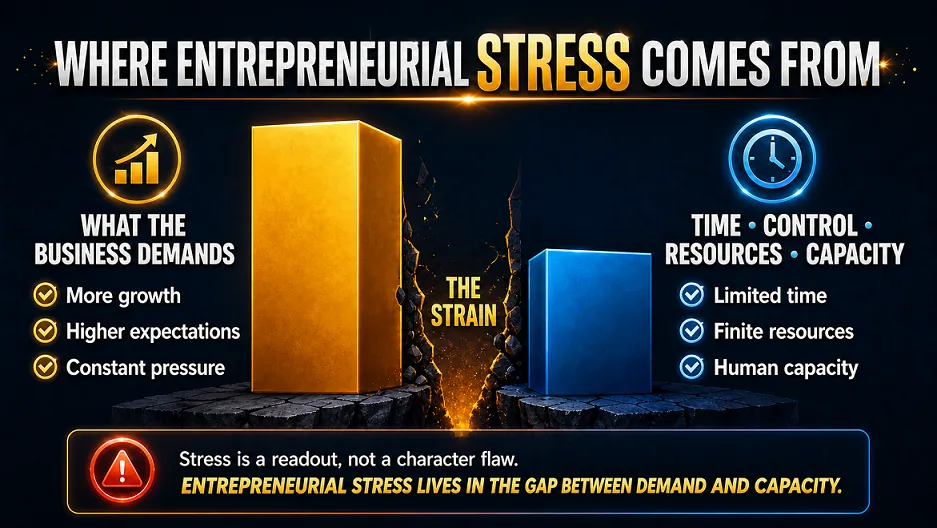
Entrepreneurial stress is the strain that can arise when business demands exceed the time, control, resources, or capacity available to meet them. It's a response to conditions, not a character defect. When that strain persists, the solution may not be better stress management; it may be redesigning the business creating the stress.
Regulation changes how a founder responds to a demand. Structural redesign changes whether the demand exists at all.
Key Takeaways
Entrepreneurial stress is a mismatch between business demands and available control, capacity, and resources, not a personal failing.
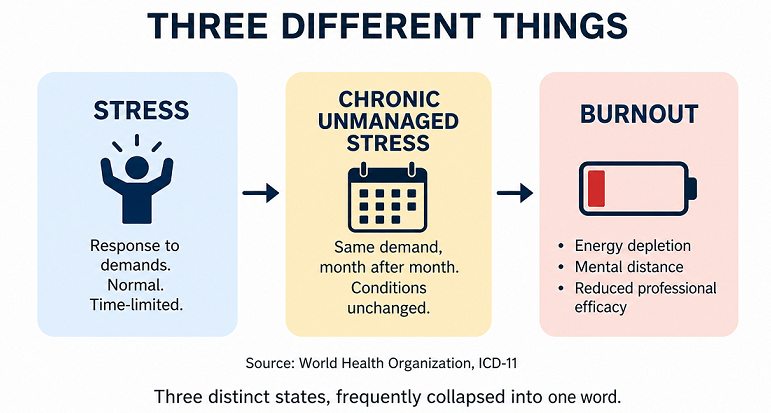
Stress, chronic unmanaged stress, and burnout are three distinct states. Collapsing them is why generic advice misses.
Reframing works on acute stress. It does not remove a structural demand.
Autonomy appears to buffer emotional demands against burnout. Job satisfaction, in the same study, did not.
Fragmented attention is expensive because of reload cost, not hours.
If the demand is temporary, manage it. If it's structural, redesign it. Most founders misdiagnose which they have.
Structure without psychology doesn't hold; the old programming rebuilds the workload.
I used to think 80-hour weeks were evidence I was building something important. Then my niece asked why I didn't visit anymore.
That question did what no amount of entrepreneurial stress management ever had. I wasn't simply stressed; I'd built a business structure that required too much of me, and I was calling it success while on anxiety medication, heading for burnout.
Here's the distinction that changed everything: managing your response to pressure isn't the same as changing the conditions producing it. Get that right and entrepreneurial stress becomes the most useful diagnostic your business gives you and the route to strategic focus.
What Causes Entrepreneurial Stress in Coaches and Consultants?
Entrepreneurial stress is usually caused by a mismatch between what the business demands and the control, capacity, and resources the founder has to meet it. Volume alone doesn't explain it; two practitioners can work identical hours and experience completely different strain.
Karasek's job demand–control framework holds that strain rises when high demands meet low decision latitude: you carry the pressure but not the authority over how, when, or whether the work happens.
For coaches and consultants, the mismatch is usually self-installed. You said yes to the client who drains you. You kept the invoicing because handing it over felt like more work than doing it. That isn't a discipline problem; it's the residue of decisions made by a version of you who feared disappointing someone more than being buried.
Which is why managing the hours you do control only goes so far; you're optimising inside a container you never designed on purpose.
What's the Difference Between Entrepreneurial Stress and Burnout?
Stress is a response to demands. Burnout is a specific occupational syndrome that can develop when stress becomes chronic and goes unmanaged.
The World Health Organization classifies burnout in ICD-11 as an occupational phenomenon rather than a medical condition, defining it as a syndrome resulting from chronic workplace stress that has not been successfully managed. Three dimensions: energy depletion, increased mental distance or cynicism toward the work, and reduced professional efficacy.
That definition does what most stress advice avoids: it locates the cause in the work conditions, sustained over time, not in the resilience of the person doing it.
So the useful question isn't "how stressed am I?" It's "how long has this been true?" Strain before a launch is normal. The same strain in month fourteen is a design.
Can Entrepreneurial Stress Actually Improve Performance?
Yes, acute stress can improve performance, and that research deserves credit rather than dismissal.
Stanford's Alia Crum and colleagues tested whether beliefs about stress change the response itself. In one workplace study, employees at a financial institution watched videos framing stress as either debilitating or enhancing, and the framing measurably shifted outcomes. In a follow-up, people holding a stress-is-enhancing mindset showed more moderate cortisol reactivity under a public speaking task and greater openness to feedback, markers of a more adaptive response.
That's real and worth using, as are stress tools that work on the nervous system rather than just the calendar. Here's the boundary, though: that work concerns how you appraise a demand in the moment. It was never a claim that interpretation removes the demand.
Why Reframing Stress Isn't Enough to Fix Entrepreneurial Burnout
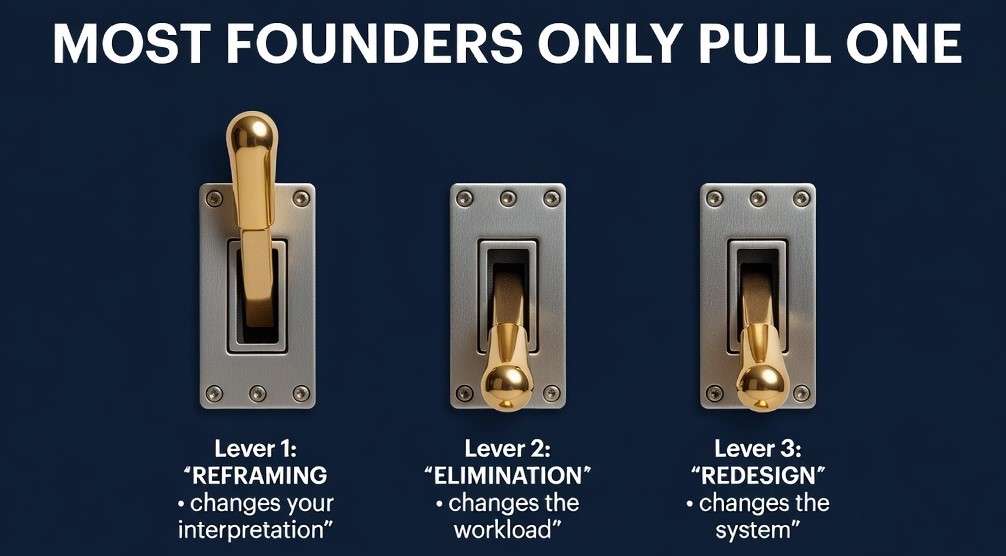
Reframing changes your interpretation of a demand. It doesn't change the workload producing it, or the system regenerating that workload. Three different levers and most founders only ever pull the first.
Here's the uncomfortable version, and then I'll be kind again: you can become genuinely excellent at handling a business that is badly designed. That is not the same as designing a business that stops demanding so much from you. One of those gets applauded. The other gets you your evenings back.
I know because I got very good at the first. I taught this material and was still on medication at 80 hours a week, because no amount of interpretation shortens a client list you should have cut nine months earlier.
Why Do Entrepreneurs Feel Out of Control When They Own the Business?
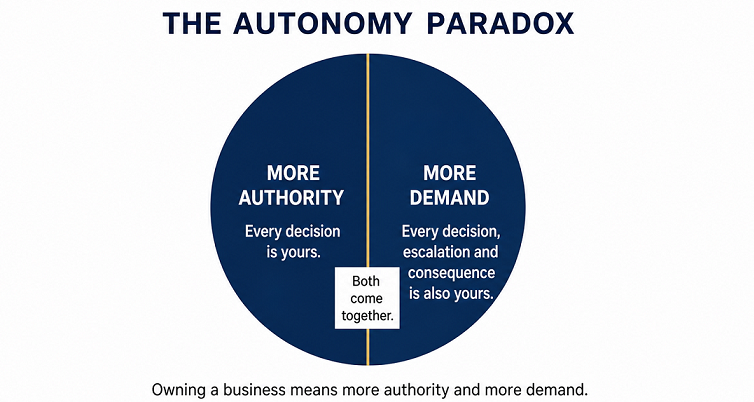
Because ownership increases decision-making authority and the volume of decisions, demands, and consequences at the same time. More control on paper, less in practice.
The Autonomy Paradox
You left the job for autonomy. Then you built something where every unresolved question routes to you, and the only person who can approve anything is already at capacity. The authority arrived. The latitude didn't.
A study of 273 entrepreneurs in Small Business Economics found autonomy buffered the effect of emotional demands on entrepreneurial burnout while job satisfaction did not. Sit with that second half, because it answers the question that stops most founders cold: but I love what I do, so why do I feel like this? Loving the work did not protect people. Real control over it did.
David (name changed) was brilliant at the work and completely trapped by it; every decision ran through him. That's structural dependency, and it produces recurring stress by design. After thirty days of getting his expertise into documented process and his assistant absorbing most of his inbox, he took his first real two-week holiday in five years.
First two-week holiday in five years, and the business grew while he was gone. That's what happens when your expertise stops living in your head.
How Fragmented Attention Turns Stress Into Lost Focus
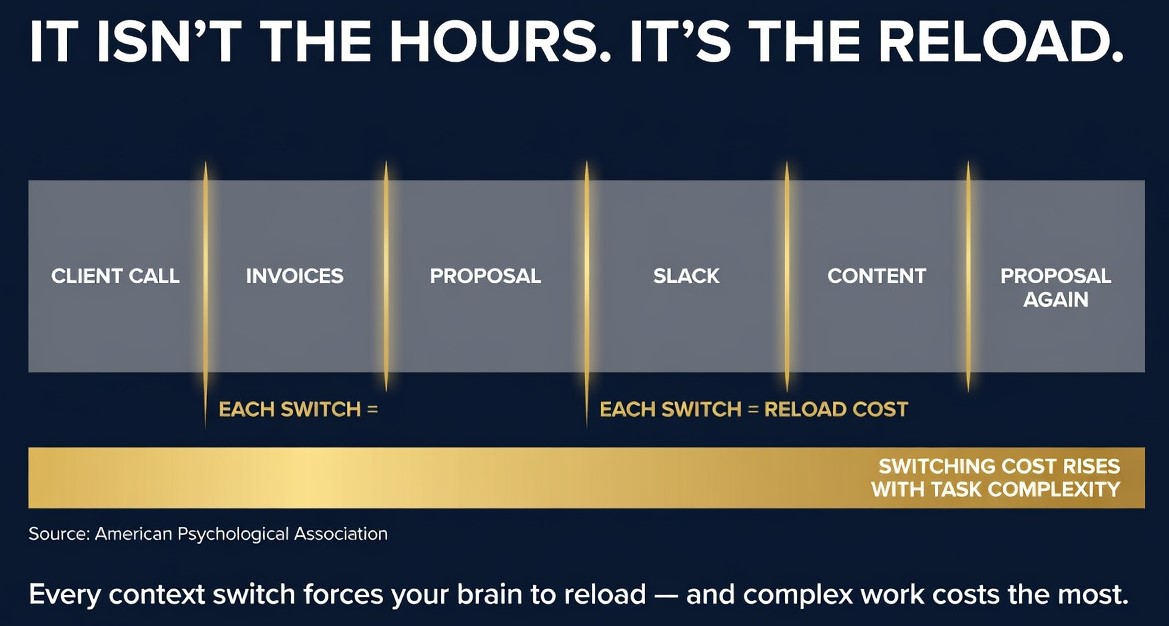
Stress fragments attention, and fragmented attention is expensive in a way that never appears on an invoice. The cost isn't the hours. It's the reload.
Research on executive control found that switching between tasks carries a time cost that grows with task complexity and unfamiliarity, and one of its authors has estimated that switching can consume a substantial share of productive time.
Count the switches in your Tuesday. Client call, invoice chase, a proposal you'll rewrite twice, three Slack interruptions. Every one is a reload and complex creative work, the kind you charge for, carries the highest switching cost of all.
Which explains what makes no sense on paper: you clear an afternoon and nothing comes out of it. Focus is a structural outcome, not a willpower outcome.
Nik (name changed) had built seven income streams, chasing stability, seven sets of demands competing for one pool of attention. She eliminated five. Within 90 days, revenue had nearly tripled, on fewer hours and fewer clients.
Seven revenue streams down to two, and revenue nearly tripled. Less complexity, more money. Exactly how this is supposed to work.
How to Turn Entrepreneurial Stress Into Strategic Focus
Turning entrepreneurial stress into strategic focus is a sequence, not a technique: regulate, diagnose, eliminate, redesign, sustain. Regulation gets you calm enough to think clearly. Everything after it changes what you're thinking about.
That sequence is The 5 Shifts to Freedom, and its mechanism is the 3 Pillars: Performance Psychology, Freedom-First Business Strategy, Freedom-First Business Structure. Strategy without psychology is another unfinished course; structure without both is a prettier prison.
Vision Alignment: Decide what the business is actually for, not what you should want. Stress is only diagnostic if you have something to measure the demand against.
Ruthless Elimination: Cut the work producing the strain: work that shouldn't exist, shouldn't be yours, or no longer deserves priority. Nik's shift, and where relief first shows up.
Systems That Scale: Remove yourself as the bottleneck. Move expertise, decisions, and process out of your head into something that runs without you. David's shift.
Mindset Unlock: Rewire the programming that rebuilt the workload last time. Staying busy is often fear wearing a productivity costume; skip this and you'll refill the calendar within a quarter.
Magnetic Authority: Position yourself so the right clients recognise you immediately and premium pricing becomes normal. Fewer clients, properly priced, keep the space you created.
Stress Management vs. Structural Redesign
Complementary, not competing. The error is using only stress management on a structural demand.
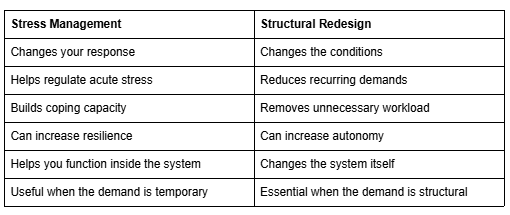
You need both when necessary. Regulation helps you think clearly enough to redesign the structure.
Who Should Use This Approach?
Coaches, consultants, and wellness practitioners who've proven the business works and are now being consumed by it. It fits especially well if demands recur rather than spike seasonally, if you're the single point of failure for most decisions, or if you've tried productivity systems and mindset work separately and neither held.
Who Should Avoid It?
Avoid this if you're pre-revenue or still testing the offer. There's nothing structural to redesign yet, and elimination requires something to eliminate.
Avoid it if what you're experiencing is a health issue rather than a business one. Chronic exhaustion has causes unrelated to business structure, and a coaching programme is not a substitute for a doctor. My own recovery involved medical support, and I'd say the same to anyone in that position.
Avoid it, too, if you want the structure fixed without touching the psychology. Two of three pillars won't hold.
Data & Findings
Burnout is an occupational phenomenon from chronic unmanaged workplace stress: exhaustion, mental distance, reduced efficacy — WHO, ICD-11
Among 273 entrepreneurs, autonomy buffered emotional demands against burnout; job satisfaction did not — Ben Tahar et al., Small Business Economics (2023)
A stress-is-enhancing mindset was linked to moderate cortisol reactivity and greater openness to feedback — Crum, Salovey & Achor (2013)
Task-switching costs rise with task complexity and unfamiliarity — American Psychological Association
FAQs
What causes entrepreneurial stress?
It arises when business demands exceed the time, control, resources, or capacity available to meet them. Occupational research links strain to high demands combined with low decision latitude, which is why two founders working identical hours can feel very different pressure.
How is entrepreneurial stress different from burnout?
Stress is a response to demands. Burnout is classified by the WHO as an occupational phenomenon arising from chronic workplace stress that has not been successfully managed exhaustion, mental distance, and reduced professional efficacy. Duration is the distinguishing factor.
Can stress improve entrepreneurial performance?
Acute stress can. Research on stress mindsets found that viewing stress as enhancing was linked to more moderate cortisol reactivity and greater openness to feedback. That applies to how you respond in the moment; it doesn't remove a demand that recurs weekly.
How can entrepreneurs reduce stress without slowing growth?
By eliminating work that shouldn't exist or shouldn't be theirs, and moving expertise and decisions out of the founder's head into documented systems. Both reduce demand while increasing autonomy.
Conclusion
Entrepreneurial stress is information. Read as personal weakness, it produces guilt and another resilience routine. Read as a readout of how the business is built, it tells you which demand to eliminate and which dependency to dismantle and that's where strategic focus comes from.
My rebuild took 90 days. What it bought wasn't a mood improvement. It was dinner at home with my phone in another room, a 36-minute nap I no longer apologise for, and a niece who doesn't have to ask anymore.
If your weeks have looked identical for a year, that's the signal and the things that stall a business that's already working are rarely the things founders are busy fixing.
Book a Freedom Blueprint Call. 45 minutes. We'll find the one thing that's actually keeping you stuck. No pitch unless you ask for one.