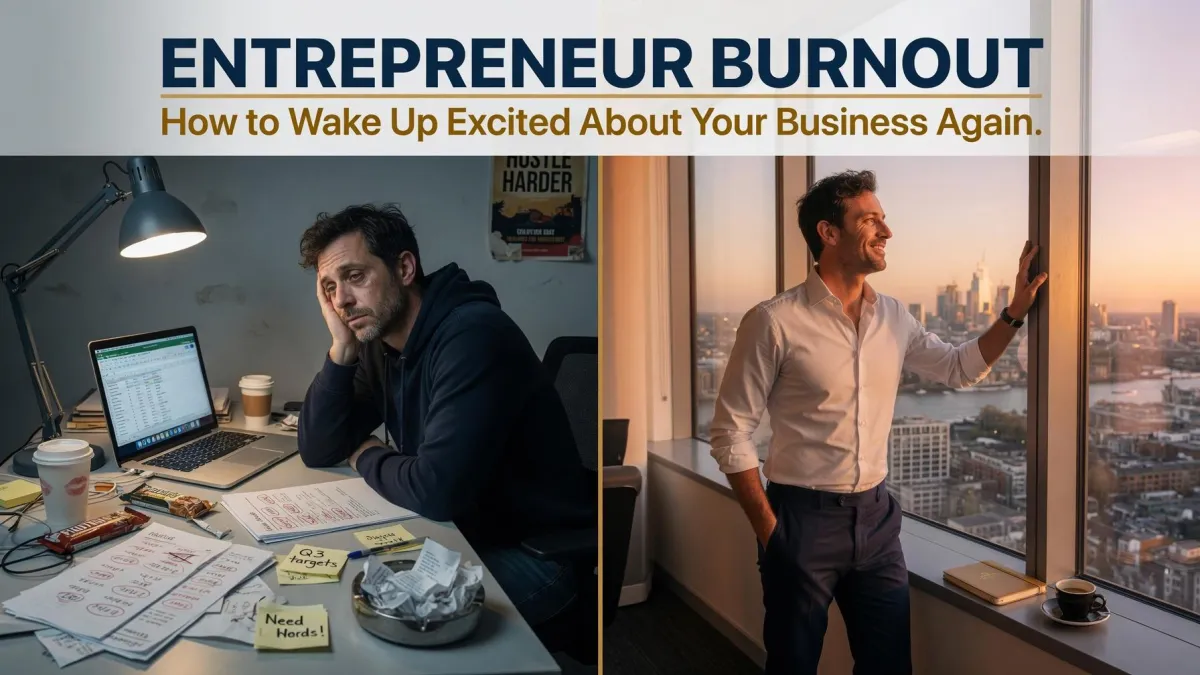
Entrepreneur Burnout: How to Wake Up Excited About Your Business Again
Entrepreneur burnout is a state of physical, emotional, mental, and identity depletion caused by prolonged high-stress business ownership without sufficient recovery. Unlike ordinary tiredness, it doesn't resolve with a weekend off. Recovery requires reconnecting with your original purpose, eliminating the core energy drains in your business, and rebuilding your identity beyond performance metrics.
NLP techniques including anchoring, reframing, and future-self visualisation are particularly effective because they work at the subconscious level where burnout takes root. Many entrepreneurs begin to feel genuine excitement about their business again within weeks, though recovery timelines vary with the depth of depletion and the degree of structural and mindset changes made.
Key Takeaways
Entrepreneur burnout is a physical, emotional, mental, and identity-level depletion not simply tiredness or lack of motivation
72% of entrepreneurs report burnout symptoms annually (ZipDo, 2023); 42% experienced it in the past month (Startup Snapshot, 2025)
Burnout changes brain function, weakening the connection between emotional reactivity and rational decision-making
The most common hidden causes are drifting from your "why" and fusing your personal identity with business performance
Rest alone doesn't resolve burnout; structural changes and mindset reprogramming are required for lasting recovery
NLP techniques (anchoring, reframing, meta-model challenges, future-self visualisation) interrupt the subconscious loops that sustain burnout
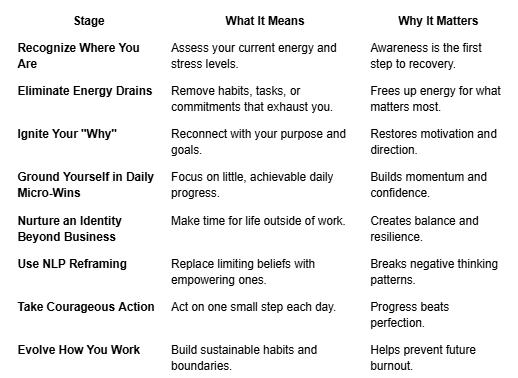
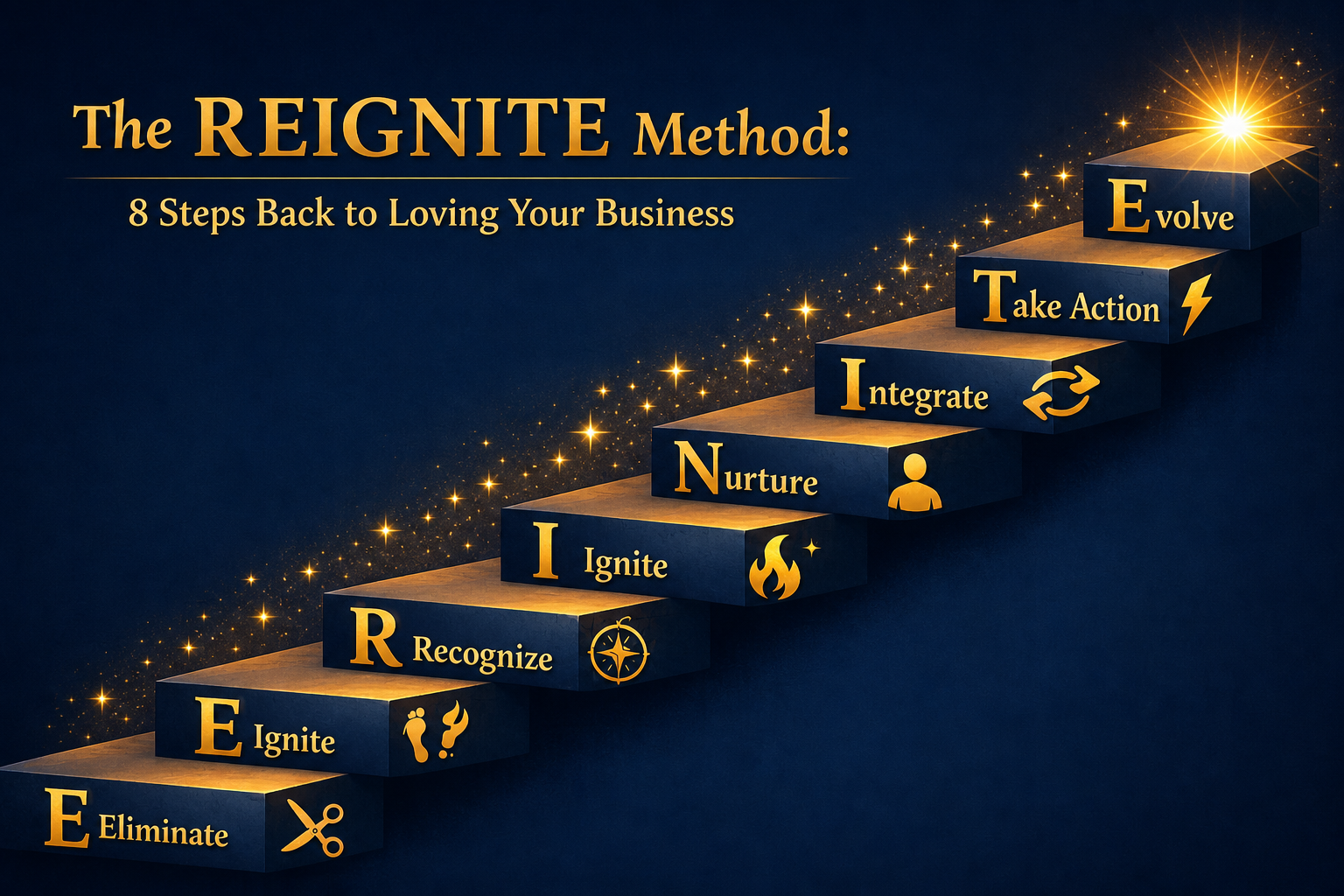
The REIGNITE Method addresses burnout across all eight dimensions: Recognize, Eliminate, Ignite, Ground, Nurture, Integrate, Take action, Evolve, each targeting a different layer of depletion
You don't need to feel motivated to act; action is what recreates motivation
You remember the feeling. Waking up before the alarm because you couldn't wait to get started. Your business wasn't just work; it was a mission. Energy felt unlimited. Problems felt like puzzles, not prison bars.
Now your alarm goes off and something heavier than tiredness settles in your chest. You drag yourself to the desk. The tasks that once felt meaningful now feel mechanical. You look at your to-do list and feel nothing, or worse, a quiet dread.
If this sounds familiar, you're not weak. You're not a failure. You're burned out and you're far from alone.
Research from a ZipDo survey shows that 72% of entrepreneurs experience burnout symptoms in any given year, with a Startup Snapshot study finding 42% reporting active burnout in the past month alone. Burnout isn't a character flaw. It's a measurable, physiological state of depletion and it has a proven path out.
In this article, you'll learn what entrepreneur burnout actually is (it's more complex than most advice suggests), why founders are uniquely vulnerable to it, and a step-by-step NLP-backed framework to help you reconnect with your purpose and genuinely wake up excited about your business again.
What Is Entrepreneur Burnout And Why It's Not What You Think
The Difference Between Tired, Stressed, and Burned Out
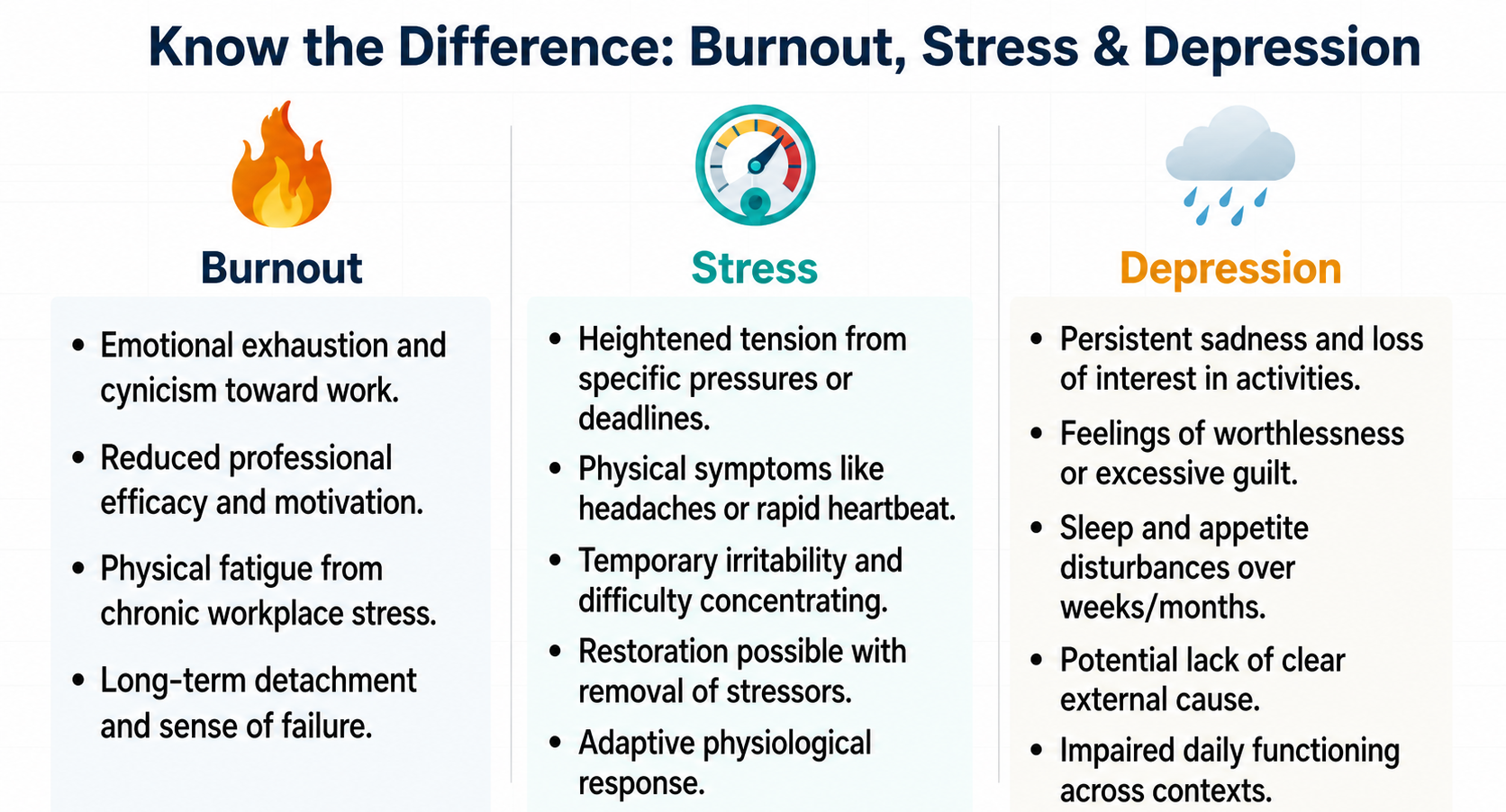
Burnout is one of the most misdiagnosed states in entrepreneurship because it overlaps with stress, exhaustion, and sometimes depression. Understanding the difference matters because the recovery strategy for each is different.
Although burnout, stress, and depression can share similar symptoms, they aren't the same experience. Understanding the differences helps you choose the right recovery approach.
Why Entrepreneurs Are Especially Vulnerable to Burnout
Entrepreneurship carries a unique set of stressors that make burnout far more likely than most people realize. According to a CEREVITY review of UC San Francisco research, entrepreneurs are 50% more likely to report mental health conditions than the general population, yet only a fraction ever seek support.
Why are founders so vulnerable? Several compounding factors work against you:
Decision fatigue: Every day you make dozens of high-stakes decisions, often alone. Over time, this constant output drains your mental reserves far faster than any single task.
Boundary collapse: When the business is yours, it's never really "off." The line between work and recovery disappears, and with it, your ability to regenerate energy.
Identity fusion: You didn't just start a company; you became it. When the business struggles, you feel like you're failing. That psychological weight is exhausting in a way a salaried employee rarely experiences.
Financial uncertainty: The chronic low-grade anxiety of not knowing if this month will hold payroll, rent, and clients activates your stress response in ways that compound over time.
These pressures don't just make you tired. They change how your brain functions.
Are You Actually Burned Out? A Quick Self-Assessment
Before diving into recovery, it helps to name where you are honestly. Check any of the following that feel true right now:
I dread starting work most mornings
Tasks that used to energize me now feel like obligations
I feel emotionally detached from my business and its outcomes
Rest doesn't fully restore me; I wake up tired
I've become more cynical or irritable with my team, clients, or family
I'm working harder but feeling like I'm achieving less
I've lost interest in the goals that once excited me
I feel guilty when I'm not working but can't engage when I am
I question whether any of this is worth it
Scoring: 1–3 checks early warning signs; time to be proactive. 4–6 checks moderate burnout; structural changes are needed now. 7–9 checks significant burnout; prioritize recovery before continuing at this pace.
How Does Entrepreneur Burnout Actually Feel? Signs You Might Be Missing
The Productivity Paradox: Working More, Achieving Less
One of the most disorienting signs of burnout is that you're still putting in the hours but the output has quietly collapsed. You're busy all day and have nothing meaningful to show for it. This isn't laziness. Research confirms that burned-out founders experience a significant drop in productivity metrics even as their work hours remain high or increase.
This happens because burnout affects the brain neurologically. Studies show that chronic stress weakens the connection between the amygdala the brain's threat-detection center and the prefrontal cortex, which governs rational decision-making and creativity. When that connection degrades, you become reactive instead of strategic. Problems feel bigger. Solutions feel further away.
The result? You spend more time firefighting and less time building. The business stalls. And you interpret that stall as evidence that you're the problem, which deepens the burnout cycle.
When Your Business Feels Like a Cage, Not a Choice
There's a particular kind of despair that sets in when the thing you built to give you freedom starts to feel like a trap. You can't leave; too much is riding on it. But you can't stay without losing more of yourself each week.
This is one of the clearest hallmarks of deep entrepreneur burnout: the shift from ownership to entrapment. You're no longer running your business. You're serving a sentence.
If this resonates, it's a signal that burnout has moved from surface exhaustion into identity depletion and that's where the deeper recovery work begins.
What Causes Entrepreneurs to Lose Excitement for Their Business?
Drifting Away From Your Original "Why"
Every entrepreneur starts with a reason that goes beyond revenue. You wanted freedom. To help people. To prove something. To build something that mattered. That "why" was the emotional engine that made 12-hour days feel worth it.
But as your business grows, the day-to-day reality of operations, admin, payroll, client disputes, and hiring gradually buries that original purpose under layers of obligation. You stop leading your mission and start managing your workload. And without a clear connection to your purpose, the work slowly hollows out.
As one Forbes contributor put it, losing your passion often happens because you've gotten lost in "when" and "how" and forgotten entirely about "why." The "why" is the voltage your motivation runs on. When it's disconnected, everything dims.
The Identity Trap: When You Became Your Business
This is the most overlooked cause of entrepreneur burnout and the hardest to untangle.
Over time, many founders fuse their personal identity so completely with the business that the two become indistinguishable. Your worth is measured in revenue. Your value as a person fluctuates with client reviews. A bad quarter doesn't just mean financial strain it means you have failed.
The consequences of this identity fusion are profound:
You feel guilty when you rest, because "the business needs you." You can't celebrate wins because there's always something more to do. You become emotionally fragile around business feedback because it feels like personal judgment. And you lose the ability to recover, because recovery requires separating yourself from the business something that feels impossible when they've merged completely.
Understanding and breaking through the limiting beliefs that tie your self-worth to business performance is one of the most powerful shifts you can make and it's precisely where NLP-based coaching delivers results that other approaches can't match.
What Research Says About Entrepreneur Burnout Recovery
Before introducing a recovery framework, it's worth grounding your expectations in what the evidence actually shows.
Burnout isn't fixed with a vacation: Research is clear that recovery from significant burnout requires structural change, not simply time away. Taking two weeks off and returning to the same conditions will restore you temporarily, then deplete you again, often faster than before.
Recovery timelines vary with severity: Mild to moderate burnout, when addressed proactively with both mindset and structural changes, can show meaningful improvement within 4–8 weeks. Severe, long-term burnout can take considerably longer. The key variable is whether you're willing to change how you operate, not just how hard you push.
The brain needs repatterning, not just rest: Studies on burnout neuroscience indicate that fully resetting your brain's stress-response patterns ideally requires four to six weeks of genuine disconnection from the stressor a reality most entrepreneurs can't access. That's exactly why working at the mindset and subconscious level through NLP techniques becomes so valuable. It offers a way to interrupt the burnout loop without requiring you to step away entirely.
Entrepreneurs who make structural changes recover faster: Those who audit and eliminate energy drains, set meaningful boundaries, and reconnect with purpose see dramatically better outcomes than those who rely on willpower and optimism alone.
The REIGNITE Method: How to Wake Up Excited About Your Business Again
This is a framework I've developed across 20+ years of working with entrepreneurs, founders, and leaders who've found themselves at the edge of burnout and come back stronger. It works because it addresses burnout at every level: physical, structural, emotional, and identity.
Each letter maps to a specific stage in the recovery process:
Recognize Where You Actually Are
Recovery starts with honest acknowledgment. Not dramatic self-criticism, just clarity. Use the self-assessment above. Name your current state without judgment. "I'm burned out, and I've been running on empty for months" is a powerful, grounding statement. It's not defeat. It's the starting line.
Try this: Take 10 minutes today to write down, without filtering, the three things in your business that drain you the most and the three things that still give you energy. This simple audit begins to separate signal from noise.
Eliminate the Core Energy Drains
Burnout doesn't just come from working too much. It comes from working on the wrong things tasks that drain your energy without advancing your mission. Research on NLP stress management for business owners consistently shows that identifying and eliminating these drains produces faster recovery than any amount of rest.
For each drain you identified above, ask one question: Can this be delegated, automated, or eliminated in the next 30 days? You don't need to solve everything at once. You need to reduce the load enough to create breathing room for the recovery that follows.
Ignite Your "Why" With a Purpose Audit
This is where the real momentum begins. Block two uninterrupted hours not to plan, but to remember. Go back to the beginning. Why did you start? Who were you trying to help? What did you imagine your business making possible?
Then ask: Is that purpose still alive somewhere in this business even if it's buried? Most of the time it is. It's just been covered over by obligations.
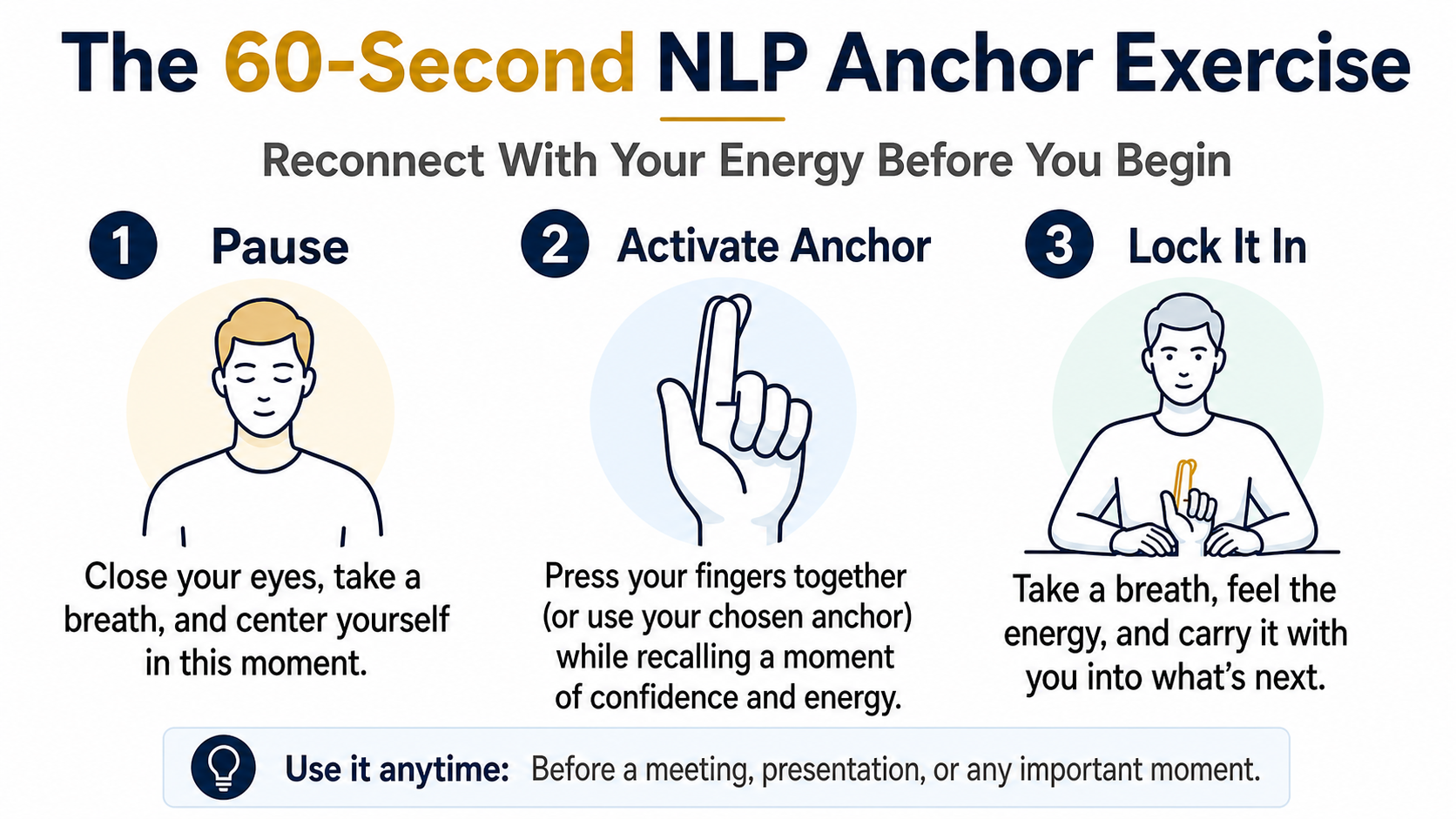
Try this (NLP Anchoring Exercise): Close your eyes and recall the most energized, purposeful moment you've ever experienced in your business. Feel it fully: the excitement, the clarity, the sense that what you're doing matters. Now press your thumb and forefinger together firmly while holding that feeling. Repeat this three times. You've just created an anchor. The next time you start your workday, activate that anchor before opening your laptop and notice the shift.
Ground Yourself in Daily Micro-Wins
Burnout distorts your perception of progress. Everything feels like it's standing still or sliding backward even when it isn't. Rebuilding your sense of momentum requires deliberately tracking small, daily evidence that things are moving.
Each evening, write down three things that moved forward today, no matter how small. A client responded well. You completed a task you'd been avoiding. You had one honest conversation. Over time, this practice rewires your brain's reward system to recognize progress again, which restores the natural dopamine cycle that burnout suppresses.
Nurture an Identity Beyond Your Business
This step is non-negotiable. You are not your revenue. You are not your client count. You are not your conversion rate. You are a whole human being whose worth exists independently of any business metric.
The fastest path back to sustainable entrepreneurial energy is rebuilding your identity outside the business: investing in relationships, physical health, creativity, and experiences that have nothing to do with output. This isn't indulgence; it's the foundation of continuous growth and long-term resilience.
When Mike came to James overwhelmed by anxiety, second-guessing, and mental noise, the work wasn't just about confidence tactics; it was about reconnecting him to a fuller sense of who he was. The anxiety diminished. The mental noise cleared. And for the first time, he could hear what people were saying because he was no longer drowning in his own internal static.
Integrate NLP Reframing to Break the Burnout Loop
Burnout is sustained not just by circumstances but by the story you're telling yourself about those circumstances. "I'm falling behind." "I'm not good enough for this." "Everyone else seems to have it figured out." These internal narratives aren't facts; they're unconscious programs running on autopilot.
NLP reframing interrupts these loops by changing the meaning you assign to your experiences. When a client churns, the burned-out narrative says: I'm failing. The reframed version asks: What is this showing me about how to serve my best clients better? Neither denies the reality but one opens a door, and the other locks it shut.
When Darren came to James struggling with a deep sense of purposelessness, unable to progress despite running a well-paying business, it was this exact reframing work that created the breakthrough. Once James helped him identify the goal blocks running beneath the surface and eliminate them using NLP techniques, the shifts were rapid and far-reaching. His thinking changed. His relationships improved. His business started moving again.
Try this (Meta-Model Challenge): The next time you catch yourself thinking "this never works" or "I always fail at this," stop and challenge the language directly. "Never? Not once? What about the time when..." Questioning the absolute language in your internal narrative exposes it for what it is: a generalisation, not a truth.
Take Courageous Action: Even One Small Step
This is where many entrepreneurs stall. They wait to feel excited before they act, not realizing that action creates excitement, not the other way around. The Unleash Your Power approach to building an entrepreneurial mindset is rooted in exactly this principle: courageous action precedes motivation. You don't need to feel ready. You need to move.
Identify one meaningful action you've been avoiding not the biggest item on your list, but the one that matters most. Take it today. That single step begins to rebuild the neural pathway between intention and momentum that burnout erodes.
Evolve How You Work So Burnout Can't Take Root Again
Recovery without redesign is just delay. The final stage of the REIGNITE Method is examining how your business is structured and building in the boundaries, systems, and breathing room that prevent the next spiral before it starts.
Ask yourself: What operating patterns created this burnout in the first place? Where did you say yes when you needed to say no? Which responsibilities have you held onto that belong to someone else? Applying NLP tools for stress management at this structural level, not just as a personal coping strategy, is what transforms recovery into redesign.
This isn't a one-time fix. It's a commitment to treating your energy as the most valuable resource in your business. Because without it, nothing else works.
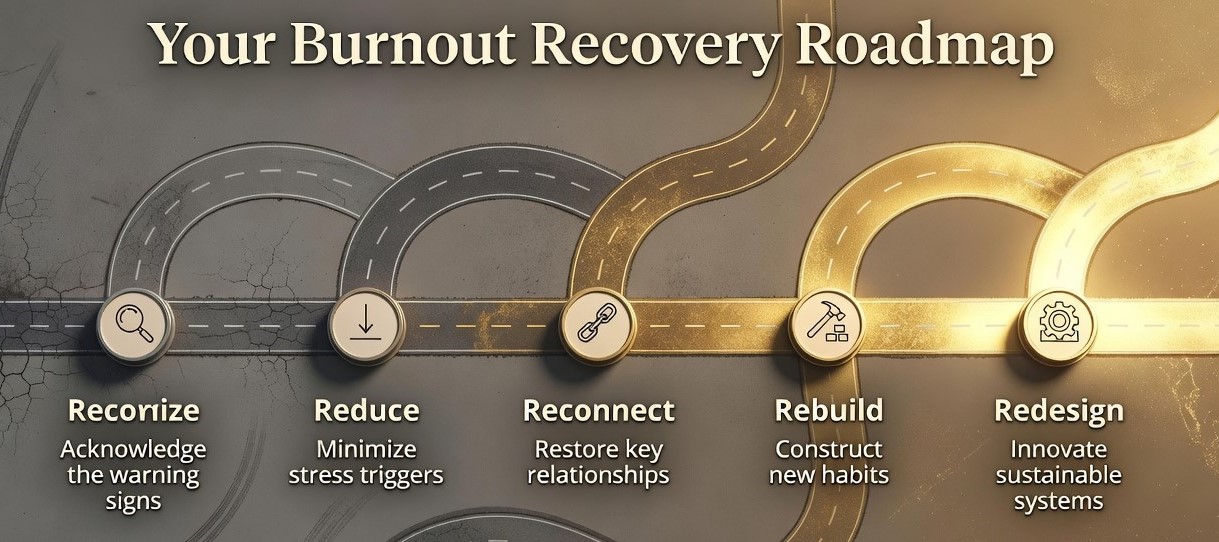
Burnout Recovery Roadmap
A clear, sequential path forward:
Recognize: Name your current state honestly (use the self-assessment)
Reduce: Eliminate or delegate the three biggest energy drains immediately
Reconnect: Spend two hours on a purpose audit; use the NLP anchoring exercise
Rebuild: Track daily micro-wins; nurture your identity beyond the business; reframe your internal narrative
Redesign: Evolve how you work so burnout can't take root again
This isn't a five-day fix. It's a five-stage transformation. Many entrepreneurs who commit to all five stages report meaningful shifts within three to four weeks, though the full arc of sustainable change typically unfolds over three months or more, depending on the depth of depletion.
Frequently Asked Questions About Entrepreneur Burnout
How long does entrepreneur burnout last?
Recovery timelines depend on severity and approach. Mild burnout addressed with structural changes and mindset work can improve meaningfully within 4–8 weeks. Moderate to severe burnout typically requires three to six months of sustained effort. Attempting to recover through rest alone without changing underlying patterns often leads to relapse. The most important variable isn't time; it's whether you're willing to change how you operate, not just how hard you push.
Is burnout a sign I should quit my business?
Not necessarily. Burnout often signals that how you're running your business needs to change not that the business itself is wrong. The identity fusion and operating patterns that created the burnout can be addressed without abandoning what you've built. That said, it's worth asking honestly: does excitement return when you imagine the business running differently, or has the core purpose genuinely run its course? Both answers are valid and both deserve clarity, not panic.
What's the difference between entrepreneur burnout and depression?
Burnout is primarily work-related and tends to improve when workload and meaning are addressed. Depression is a clinical condition that affects mood, interest, and energy across all areas of life, not just work. The two can coexist, and if your symptoms extend beyond your business into relationships, physical health, and daily function or if you're experiencing persistent hopelessness, please consult a healthcare professional. This article addresses burnout, not depression, and is not a substitute for clinical support.
How do I talk to my team when I'm burned out?
You don't need to share every detail but honesty about needing to recalibrate is almost always better received than disappearing behind a mask of false enthusiasm. Consider saying: "I've been running hard and I'm making some deliberate changes to how I'm operating. Here's what that means for the team over the next few weeks." Clarity and calm leadership during your own recovery actually models exactly the kind of boundaries and self-awareness you want your team to have.
Can NLP help with business burnout?
Yes and it's particularly effective because burnout is sustained by subconscious patterns, not just external circumstances. NLP techniques like anchoring, reframing, meta-model challenges, and future-self visualisation work directly at the level where those patterns run. Unlike strategies that address only the surface (take a holiday, meditate, delegate more), NLP helps you interrupt the internal narrative and belief systems that keep burnout in place even after conditions improve.
Conclusion
Burnout isn't proof you've failed as an entrepreneur. It's often a signal that the way you've been operating is no longer sustainable and that a better version of how you work is ready to emerge.
You built something from nothing. That took a level of courage, creativity, and commitment that most people never summon. Those resources didn't disappear. They got buried under the weight of doing too much, for too long, without enough recovery, and without staying connected to why any of it matters.
The path back isn't about pushing harder. It's about getting smarter about your energy, your identity, your purpose, and the stories you tell yourself when things get hard.
If you're ready to rebuild your excitement, your clarity, and your momentum with the support of proven NLP and business coaching strategies, explore what working with James R. Elliot looks like here.