
Confidence in Leadership: Reclaim 15 Hours a Week
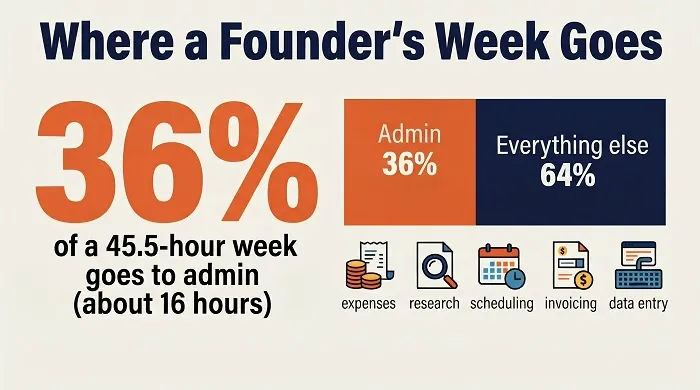
Confidence in leadership is trust in your own judgment, enough that you can hand work to other people without hovering over it. For entrepreneurs, it is also the fastest way to get time back. Surveyed founders report spending about 16 hours a week, roughly 36% of their time, on admin work, and the most common reasons they keep it are enjoyment and the belief that doing it themselves is faster. Confident leaders replace that habit with clear outcomes, short check-ins and trained people. You can reclaim up to 15 hours a week by moving admin and low-value work off your plate in stages, while keeping control of the decisions that drive revenue. Expect steady gains over three to six months, not overnight results.
Key Takeaways
Confidence in leadership shows up as clear outcomes and short check-ins, not tighter control.
Founders in one survey spent about 16 hours a week on admin, so most of the 15 hours sits in work someone else can learn.
Enjoyment and speed beat distrust as reasons for holding on: 27% and 25%, against 12% for trust.
Overconfident CEOs were 10 to 15% less likely to delegate, so too much confidence costs hours too.
Hand off in order of risk, and keep pricing, sales and key accounts with you until results hold.
Treat 15 hours as the top of a 7 to 16 hour range, reached over three to six months.
What Confidence in Leadership Sounds Like
Confidence in leadership is the steady belief that your judgment, your standards and your people can carry the business without you checking every detail. You can hear it in what a founder says.
Control says: "I'll just do it myself." Confidence says: "I need the invoices out by Friday, and you choose how."
Control says: "Send me everything before it goes out." Confidence says: "Show me the result on Thursday, and flag anything odd before then."
Control says: "Nobody else knows this client." Confidence says: "Let's write down what I know so someone else does."
This is Pillar 2 of the 5 Pillars of Massive Success, Confident Communication. I once felt invisible in meetings, and learning to say exactly what I wanted changed how people responded to me. It works the same way when you hand work off.
Why Founders Hold On, and What Loosens Each Reason
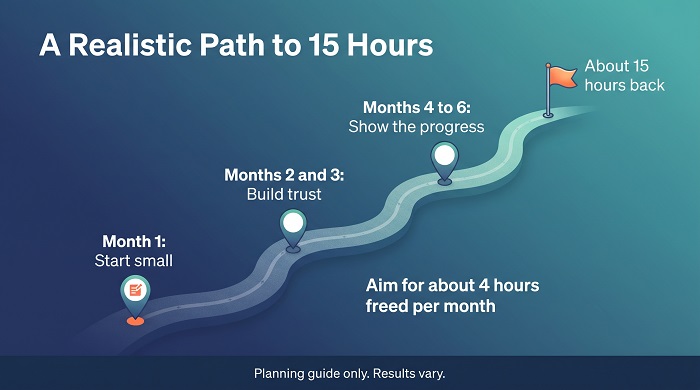
Habit and speed beat distrust. In a Time Etc/Censuswide survey of 251 U.S. founders, reported by Stealth Agents, 27% kept tasks because they enjoy them and 25% because it is faster to do it themselves. Another 17% had no one to hand work to, 12% didn't trust others to get it right and 7% wanted to stay in control.
Each reason needs its own fix. Enjoyment needs a time limit, since you can keep a task you like and still cap it. Speed needs an honest price tag: your hour costs more than an assistant's hour, so a task you finish faster can still be the more expensive choice. Having no one to hand work to calls for written steps first, which also makes the eventual hire quicker. Distrust gets small, low-risk tests. Control gets scheduled check-ins in place of constant oversight.
Toastmasters' delegation guidance adds fear of mistakes and of looking foolish, and cites a Stanford survey in which more than a third of executives named delegation a skill to improve. If fear is your real driver, overcoming a mindset block is a skill you can train.
How Many Hours Can You Actually Get Back?
Somewhere between 7 and 16 hours a week, depending on how much admin you carry. The 16 comes from the same survey: founders spent about 36% of a 45.5-hour week on admin. The 7 comes from a Breeze estimate cited by Lonely Entrepreneur, which doesn't state its sample size.
So 15 hours is a fair target if admin eats a big share of your week, and a stretch if it doesn't. Two more numbers show why the hours matter. Founders spend about 68% of their time working in the business and 32% working on it. And a five-year First Round Review study of 17,784 logged hours found CEOs using roughly 70% of their time in ways they could improve.
The goal isn't to work less for its own sake. It's to move that 32% up. Track one full week before you pick your number.
Delegating Without Dropping Revenue: Three Gates and a Safe Order
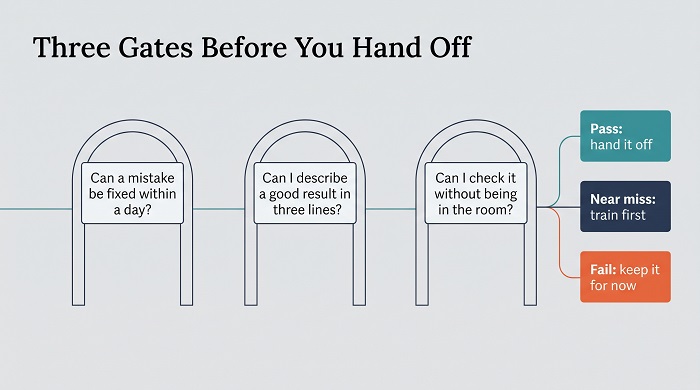
Run every task through three gates before it leaves your desk. Can a mistake be fixed within a day? Can you describe a good result in three lines? Can you check the result without sitting in the room? A task that clears all three is safe to hand off now. One that fails a gate waits, or gets trained first.
That test sorts most work into an order. Expense logging, scheduling, invoicing and data entry go first, and these are the admin tasks founders in the survey most often still do themselves. Reporting and client follow-up come next. Sales conversations, pricing and key accounts stay with you until results hold.
The data points the same way, with a caveat: it shows association, not cause. In 2014 Gallup research on 1,446 employer entrepreneurs, summarized by Stealth Agents, high delegators averaged about $8 million in revenue against $6 million for the rest, and created 21 jobs against 17. Only about one in four had high delegation talent.
The short verdict: delegating with clear outcomes returns your time at the lowest revenue risk.
Approach | Your time | Revenue risk | Best for |
Do it yourself | Stays high | Growth stalls behind you | Work only you can do |
Delegate with clear outcomes | Falls after setup | Low, if you start with low-risk tasks | Admin, reporting, routine client work |
Hand off with no oversight | Falls fast | High, since errors surface late | Rarely a good fit |
People make better calls when they know the outcome and the boundaries. Our guide to empowering your team shows how to set both.
When Confidence Tips Into Overconfidence
The trait that carries you through hard calls can also make you hold on too tight. Researchers Matthew Josefy, Jared Smith and Daniel Greene studied 3,690 acquisitions by public companies from 2000 to 2019, covering 1,634 CEOs. They judged confidence by how each CEO exercised stock options, and about 41% came out overconfident. Those CEOs were 10 to 15% less likely to delegate, and the gap grew when the target sat in an unfamiliar industry. NC State reported the findings, published in the Journal of Management Studies.
These are large public companies, not owner-run businesses, so read the result as a pattern to watch. When a team member knows more than you do about something, do you let their judgment lead? Confidence says yes without flinching.
A Realistic Timeline for Building the Confidence
With practice, most leaders start to see results within three to six months. Confidence grows from small, repeated proof, so this timeline is built around collecting it. It leans on IMD's seven practices for leadership confidence, which are practical guidance without cited research.
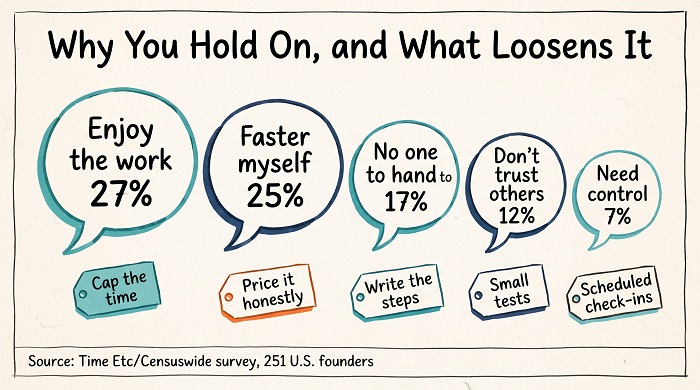
Month 1: Start small. Pace yourself and pick one or two low-risk tasks. Write the outcome down, hold a short weekly check-in, and let a clean result teach you something.
Months 2 and 3: Build trust. Invite questions and repeat your key messages. Mike L. came to me struggling with self-doubt and second-guessing that spilled into his work and relationships. After working through NLP techniques to quiet the mental noise, he began speaking with confidence and listening more closely to the people around him.
Months 4 to 6: Show the progress. Remind your team where you started and what has changed, then take on one bigger handoff.
Try this before a handoff conversation. Recall a recent good call you made under pressure and replay what you saw, heard and felt. At the peak, press your thumb and index finger together. Do it three times. This is anchoring, and our daily NLP confidence exercises go further.
Who Should Use This Approach?
You're a good fit if you work 45 or more hours a week with a big share going to admin, your revenue is steady enough to absorb a learning curve, and you have a person or a budget to hand work to. You'll also recognize yourself if you've said "it's faster if I do it" this month.
Lubcheck L. came to me for confidence and accountability coaching. As he stopped comparing himself with other people, his anxiety eased and he trusted his own value more. That shift is what lets an owner trust their judgment enough to let go.
Who Should Avoid This Approach for Now?
Hold off in these four situations:
You have nobody to hand work to. Hiring takes about six months on average from start to first day, according to Centumsearch 2025 data cited by Lonely Entrepreneur, so document tasks and use tools while you hire.
You're in your first months and still shaping a repeatable process.
Cash is tight enough that one error could hurt payroll.
You plan to hand off everything in week one. Staged change holds up better.
Data & Findings
The time problem. A Time Etc/Censuswide survey of 251 U.S. founders found 36% of the week, about 16 of 45.5 hours, went to admin, per Stealth Agents. Breeze estimates about 7 hours a week of delegable low-value work, and First Round Review's 17,784 logged hours showed roughly 70% of CEO time used sub-optimally, both via Lonely Entrepreneur.
The delegation gap. Gallup's 2014 data on 1,446 employer entrepreneurs found one in four with high delegation talent, averaging $8 million in revenue against $6 million (a 33% gap) and 21 jobs against 17. In the Time Etc survey, 82% of 60 self-described expert delegators reported revenue growth, against 66% of the other 191 founders.
The confidence factor. Across 3,690 deals and 1,634 CEOs, overconfident leaders were 10 to 15% less likely to delegate, per NC State.
Read with care. Most figures are survey-based and show association, not cause. Some arrive through vendor pages, the Gallup data is from 2014, the expert delegators labeled themselves, and the CEO study covers large public companies.
The 4-Step Handoff Loop
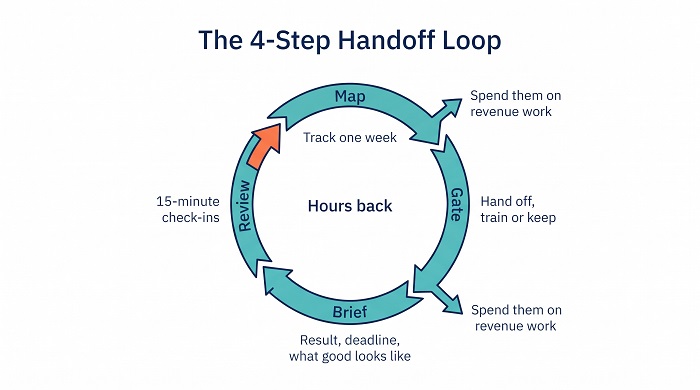
This framework runs as a loop, so each cycle frees hours and sets up the next. It draws on three of the 5 Pillars: Clarity of Vision, Confident Communication and Courageous Action.
Map. Track one week in 30-minute blocks and tag each block as revenue work, leadership, admin or other. Our guide to time management for leaders helps you set this up.
Gate. Run a task through the three gates above. A pass means hand it off, a near miss means train first, and a fail means keep it for now.
Brief. Write the result, the deadline and what good looks like in three lines, and let the other person choose the method.
Review. Check in for 15 minutes weekly during the first month, then every two weeks as results hold.
Then spend the freed hours before they disappear, on revenue work or strategy, and return to Map with the next task. As a planning guide, not a research finding, aim to free about 4 hours a month, which puts you near 15 within four months. Your results will vary.
Frequently Asked Questions
Is 15 hours a week realistic?
For some founders, yes. The research supports 7 to 16 hours of movable work, so 15 sits at the top. Heavy admin loads get closest, and your own time audit gives your number.
What if quality dips at first?
It often does for a few weeks. Start with low-risk tasks, write the outcome down and review early, so you can fix the instructions before you take the work back.
How can I tell confidence from overconfidence?
Watch what you do when someone else knows more. If you still decide, even outside your expertise, you may be showing the pattern in the NC State research.
Which tasks should I keep longest?
Pricing, sales conversations and key accounts, until your team has delivered steady results on lower-risk work.
Can NLP help me let go?
It can help you spot the thought behind the hold, such as "it's faster if I do it," and change it. Anchoring and reframing support the habit shift, and they work best alongside the loop above.
Conclusion
Your first move can be small. This week, run one task through the three gates and write its three-line brief. Unleash your potential by letting someone else carry the part of the business that doesn't need you, and take decisive action on the part that does. I've walked this path, and I know how hard the first handoff feels.
If you want a guide through it, explore my leadership training in Canada.