
Busy But Not Growing? The Overwhelm Is the Plateau
Busy But Not Growing? The Overwhelm Is the Plateau
If you're busy but not growing, the busyness isn't a symptom of the plateau. It's what's producing it.
Research on procrastination shows that avoidance is primarily emotional, not logistical. When a task carries the risk of exposure, rejection or failure, the brain reaches for something that relieves the discomfort right now. For most business owners that relief doesn't look like scrolling or napping. It looks like work, real, legitimate, defensible work you happen to be good at. Emails. Tweaks. A new offer. Another platform.
That's why the plateau holds. The one move that would break it is the one move that feels exposed, so it gets postponed behind an endless queue of tasks that never do.
Time management doesn't fix this, because the calendar was never the problem. The programming underneath it is. Change the programming and the schedule reorganises itself around the work that actually moves things.
Key Takeaways
Being busy but not growing is a causal relationship, not a coincidence, the busyness is what's holding the plateau in place.
Avoidance is emotional, not logistical. It targets discomfort, not difficulty.
Your brain avoids using work you're good at, which is why it never registers as avoidance.
Idleness aversion means any defensible task will do, your brain needs a justification, not a priority.
The tell for real work is exposure: if it could go badly in front of someone, it's probably the one.
Delegation fails as a willpower project. Structure follows psychology, not the other way round.
Elimination without the psychology work restocks itself within weeks.
Why am I busy but not growing?
Because staying busy works. It just doesn't work at what you think.
Procrastination research from Fuschia Sirois and Timothy Pychyl reframed delay as a short-term mood repair strategy, the brain prioritising how you feel in the next ten minutes over what your future self will inherit. The task you're avoiding isn't hard. It's uncomfortable. Those are different problems, and only one of them responds to a better calendar.
Here's the part that keeps smart people stuck for years: the relief doesn't have to come from doing nothing. It comes from doing anything else. And "anything else" gets to be productive, urgent-looking and genuinely useful.
So you don't experience it as avoidance. You experience it as a demanding week.

Is busy the same as productive?
No. Busy is a measure of volume. Productive is a measure of consequence.
Asana's global work index found that knowledge workers spend roughly 58% of the working day on "work about work", coordinating, chasing, updating, searching, rather than the skilled work they were actually hired to do. Owner-operators have it worse, because there's nobody upstream deciding what matters. You are the filter, and the filter is exhausted.
There's also a social payoff nobody admits to. Researchers at Columbia, Georgetown and Harvard found that in North America, a visibly overworked schedule reads to other people as high status, evidence of competence and demand. "Slammed right now" is a humblebrag with a business card.
Which means the loop pays out twice: relief on the inside, credibility on the outside. No wonder it's hard to interrupt. This is the procrastination that doesn't look like procrastination, and it's why so many capable operators end up busy but not growing.
What does the research say about busyness as avoidance?
Three findings, taken together, explain most of it.
First, avoidance is emotion regulation, Sirois and Pychyl's work established that we delay aversive tasks to escape the feeling, then hand the bill to a future version of ourselves.
Second, idleness is intolerable. A 2010 study in Psychological Science by Christopher Hsee and colleagues found that people dread being idle but need a justification to be busy, and that even a thin, invented justification is enough to get them moving. Your brain doesn't require the task to matter. It requires the task to be defensible.
Third, the reward is social as well as internal, per the status research above.
Put those three together and you get a very specific pattern: a capable person, generating a continuous supply of justifiable work, feeling relief and looking impressive, while the actual constraint on the business goes untouched for years.
Which tasks does your brain use to keep you from the scary move?
It uses the ones you're good at. That's the whole trick.
Avoidance doesn't send you to something you hate, you'd notice. It sends you to competence, where the feedback is fast and the risk is zero. In practice it shows up as five recognisable behaviours:
You can't delegate without micromanaging, so the work comes back to you and the day fills itself.
You undercharge, which means you need more clients, which means there's always more to do.
You over-deliver, because disappointing someone feels unbearable, so scope creeps and evenings disappear.
You rebuild things nobody asked for, the site, the deck, the onboarding sequence, again.
You "research" instead of deciding, and call the delay diligence.
Nik (name changed) had built seven separate income streams chasing stability. Every one of them was justifiable on paper. She was exhausted and barely moving. In the first phase of our work she eliminated five, and within 90 days her revenue had nearly tripled, on fewer hours and fewer clients.
Seven revenue streams down to two, and revenue nearly tripled. Less complexity, more money. Exactly how this is supposed to work.
Seven streams wasn't a strategy. It was seven justifications.

Why doesn't hiring a VA or fixing your calendar solve it?
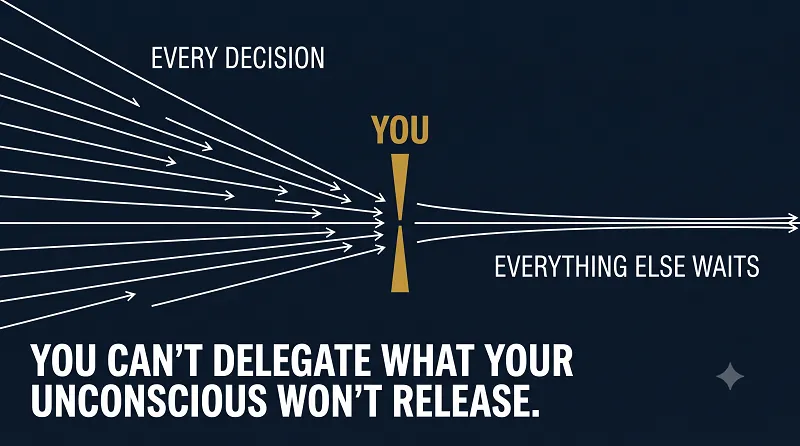
Because you can't delegate what your unconscious won't release.
Gallup studied the entrepreneurial talent profiles of 143 Inc. 500 CEOs and found that high-delegator founders grew dramatically faster than their peers, a three-year growth rate more than 100 percentage points ahead. The same research found only about one in four owners with employees actually has that trait. Three-quarters are running a business bounded by their own attention span.
That's not a skills gap. Delegation isn't complicated; you've read the frameworks. It's that handing something over means it might be done differently, done worse, or done fine without you, and if it's done fine without you, a quiet question opens up about what you're for.
So the VA gets hired and then gets given the work that doesn't matter. Time management for leaders helps you fit more into the container. It doesn't tell you the container is the wrong shape.
David (name changed) was brilliant at the work and completely trapped by it. Everything ran through him. Thirty days of getting his expertise out of his head and into documented process, and his assistant took over most of his inbox. He took his first real two-week holiday in five years, and revenue went up while he was gone.
First two-week holiday in five years, and the business grew while he was gone. That's what happens when your expertise stops living in your head.
How do you tell high-leverage work from avoidance work?
Run every task on this week's list through three questions.
1. Does this expose me?
If a task carries any chance of visible rejection, the pitch, the price increase, the partnership ask, the offer you've been "refining" since spring, it's a candidate for the real work. Comfort is the tell.
2. Is it reversible?
Reversible decisions are cheap and you're probably over-thinking them. Irreversible ones are where the leverage lives, and where the delay is quietly costing you.
3. Could anyone else do this?
Not as well as you. At all. If yes, you're not doing it because it's important. You're doing it because it's available.
Then do the uncomfortable thing first, before the inbox opens. Not because mornings are magic, because your justifications haven't warmed up yet.
Symptom-level fixes vs. cause-level fixes
Most advice for the overwhelmed owner treats the schedule. The schedule is downstream.

What actually breaks the plateau?
The 5 Shifts to Freedom, the vehicle, run on The 3 Pillars, which are the mechanism: Performance Psychology, Freedom-First Business Strategy, and Freedom-First Business Structure. Strategy without psychology is another unfinished course. Psychology without strategy is a nice feeling that doesn't pay. Structure without either is a prettier prison.

Step 1 — Vision Alignment.
Get specific about what you actually want, not what you decided you should want in year two.
Step 2 — Ruthless Elimination.
Cut the 80% of activity consuming your time and energy, including the parts you're good at.
Step 3 — Systems That Scale.
Get the expertise out of your head so the business stops routing through you.
Step 4 — Mindset Unlock.
Dismantle the programming that regenerates the busyness. Skip this and the calendar refills.
Step 5 — Magnetic Authority.
Position properly and charge premium rates, so fewer clients can support more life.
That's the order for a reason. Elimination without the psychology work is a diet, it holds for six weeks, then the old patterns quietly restock the shelf. If you want the deeper version of that, start with the mindset blocks underneath the behaviour.
Data & Findings
68% of small business owners delayed or avoided a major decision, hiring, expanding, in the past twelve months, according to a 2026 Bluevine survey of 781 US owners. Avoidance of the big move is the norm, not the exception.
~58% of the working day goes to work about work, per Asana's global index.
~1 in 4 owners with employees shows high delegator talent (Gallup).
Researchers surveying 308 entrepreneurs globally found that compromised wellbeing tracked with measurably lower productivity, innovation and persistence. Overwork doesn't just cost you evenings. It degrades the judgement the business depends on.
Who should use this?
You, if: you're a coach, consultant or wellness practitioner working 50–60+ hours a week; the business produces real results; you've already installed the systems and the plateau held anyway; and there's a specific move you've been circling for months without making.
Who should avoid this?
You, if: you're pre-revenue and genuinely need volume right now, early traction really does require hours. Or if you're looking for a tactic and nothing else. This work asks you to examine why you built it this way, and if that question irritates you rather than interests you, the timing's wrong. That's information, not a failure.
The part I don't enjoy telling you
By my fifth business I was working 80-hour weeks on anxiety medication and calling it success. I'd built a prison with a nice view.
What I want you to notice isn't the hours, it's what filled them. I wasn't hiding in Netflix. I was hiding in work I was excellent at, which is exactly why it took years to see. It took my niece asking why I don't visit anymore.
Ninety days later I was working 25 hours a week with more revenue coming in. I run the business from wherever I am now, Southeast Asia for a good chunk of last year, on 25 to 35 hours. Not because I finally earned a break. Because working less turned out to be the mechanism, not the reward.

Frequently Asked Questions
Is being busy a form of procrastination?
Yes, when the busyness is doing an emotional job. Procrastination research treats avoidance as short-term mood repair, escaping discomfort now and billing your future self. It doesn't require idleness. Productive, defensible work relieves the same discomfort, which is why it rarely registers as avoidance.
Can I be busy and still growing my business?
Yes. Launches and early traction genuinely require hours, and that's a season, not a plateau. The difference is direction: if hours climb and results climb with them, you're investing. If hours have climbed for three quarters while results sat flat, the hours stopped being an investment.
Why doesn't time management fix feeling busy but not growing?
Because the calendar was never the constraint. Time management changes what fits into the container; it doesn't change the programming that generates the tasks. Clear the gaps without addressing why the important move feels unbearable, and equally defensible work refills them within weeks.
Will cutting my working hours reduce my revenue?
Usually not, because the hours cut first are the ones with the weakest link to results, rebuilding a page, refining an unlaunched offer, personally managing an inbox. Removing those removes camouflage, not capacity. Working less is the mechanism that makes high-leverage moves possible, not the reward for making them.
How do I know if I'm burned out or avoiding something?
Burnout is depletion, the work feels heavy across the board and rest helps. Avoidance is discomfort, capacity exists, but one specific task keeps sliding while everything around it gets handled. If a free afternoon triggers anxiety rather than relief, it's avoidance.
Busy but not growing isn't a capacity problem
You've already proven you can build something. That's not in question, the evidence is the exhausting business you're currently running.
What's in question is whether you keep paying for it with your life. Being busy but not growing isn't a sign you need more hours. It's a sign the hours are the thing in the way, and there are strategies that actually scale a service business that start somewhere other than your calendar. If you want to see what genuine output looks like when the avoidance work is gone, that's what real productivity actually looks like.