
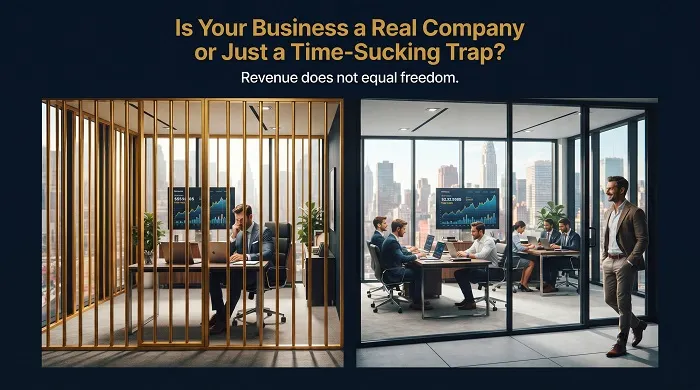
Is Your Business a Real Company or Just a Time-Sucking Trap?
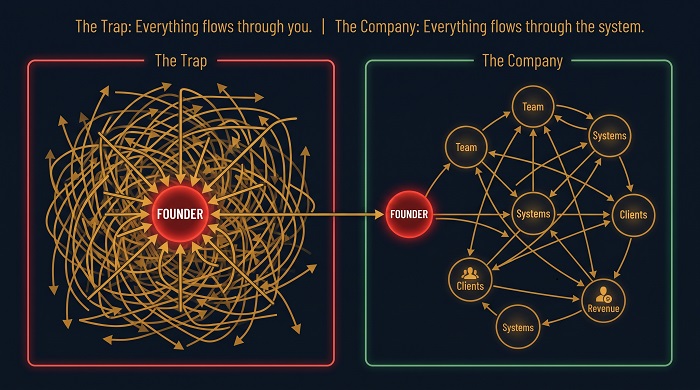
A real company is a legal, operational, and financial entity that generates value independently of its founder's daily presence. A time-sucking trap is a revenue-producing operation that requires the founder's personal time, attention, judgment, and emotional energy to function, making it, by any honest definition, an extremely demanding, high-stress job. The distinction is not determined by revenue, headcount, or how long the business has been running. It is determined by a single, unambiguous test: remove the founder for 30 consecutive days with zero access. Does the business produce revenue, serve clients adequately, and continue operating? If yes, it is a company. If the answer is no, or if the question itself triggers anxiety, it is a trap. Most service-based entrepreneurs who believe they own a business are, on honest examination, trapped inside a system that would stop the moment they did. This is not a character flaw. It is a structural failure, one that can be diagnosed precisely, corrected systematically, and converted into a genuinely autonomous company through the right psychological and architectural interventions.
Key Takeaways
The Revenue Illusion: High revenue does not mean you own a company. A founder generating $500,000 annually in a fully founder-dependent model owns a lucrative trap, not a business. Revenue is generated by the founder's hours, not by an autonomous system.
The 7-Question Reality Test: There are seven diagnostic questions that separate a real company from a time-sucking trap with clinical precision. Most founders answer honestly and discover they are closer to the trap end of the spectrum than they ever imagined.
The Trap Is Built Gradually: Nobody decides to build a trap. It is assembled through hundreds of individually reasonable decisions, taking the client call personally, not documenting the process, skipping the team briefing. Collectively, these decisions harden into structural dependency.
Escaping the Trap Requires Two Simultaneous Moves: A structural redesign of the business (systems, delegation, offer architecture) and a psychological rewiring of the founder's identity. Structural change without the psychological shift creates a business that looks autonomous but is subtly undermined by the founder who cannot let go.
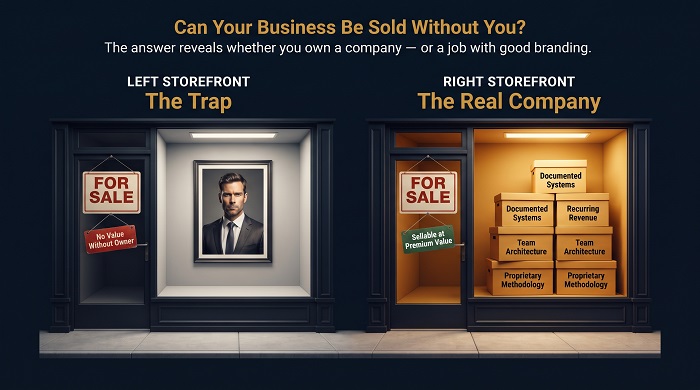
The Exit Is Defined Before It Is Built: The clearest signal that you own a real company is that it could be sold for meaningful value, because the value exists in the systems, the brand, and the methodology, not in your personal involvement. Building toward saleability, even if you never sell, is the surest path to genuine freedom.
The Question Most Founders Cannot Answer Honestly
Take a moment and answer this question as directly as you can:
If you removed yourself from your business completely, no access, no check-ins, no "just one quick message", for the next 30 days, what would happen?
Be specific. Which clients would leave? Which deliverables would stop? Which revenue streams would dry up? Which operational decisions would go unmade?
Most founders who sit with this question honestly experience an immediate and familiar sensation: low-grade anxiety. The business they describe when answering this question sounds less like a company and more like a precision-engineered personal dependency — one that requires their presence to function, their judgment to make decisions, and their energy to stay alive.
That sensation is important data. It is not evidence of a successful business. It is evidence of a structural trap.
How the Trap Gets Built
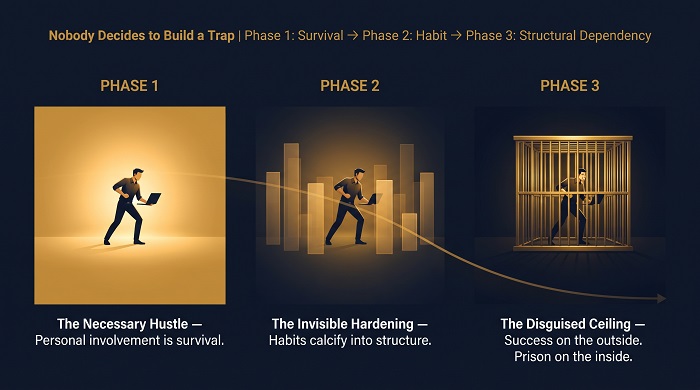
Phase 1 — The Necessary Hustle
In the beginning, personal involvement in everything is not a trap. It is survival. You have no systems because you have not yet discovered which processes are worth systematising. You have no team because there is no proven process to delegate. Personal involvement is appropriate and necessary.
Phase 2 — The Invisible Hardening
As the business grows, the personal involvement continues past the point where it is necessary. You keep taking the client calls yourself, not because nobody else could take them, but because you are good at them and clients respond well to you personally. You keep reviewing the deliverables, not because your team is incapable, but because it is faster to check than to build a quality benchmark. You keep managing the inbox, not because it requires your expertise, but because you have always done it.
Each of these decisions is individually rational. Collectively, they harden into a structure where the business cannot function without you, and removing you would cause it to fail within days.
Phase 3 — The Disguised Ceiling
By the time the trap is fully built, it often looks impressive from the outside. The revenue is significant. The client roster is real. The team exists (even if they cannot operate independently). The founder looks successful. But the founder is also working 60-plus hours per week, unable to take a holiday, unable to sell the business for meaningful value, and quietly terrified of what would happen if they got sick.
The trap does not announce itself. It disguises itself as success.
"A prison with excellent revenue is still a prison. The cell is larger, but the walls are just as real." — James R. Elliot
The 7-Question Business Reality Test
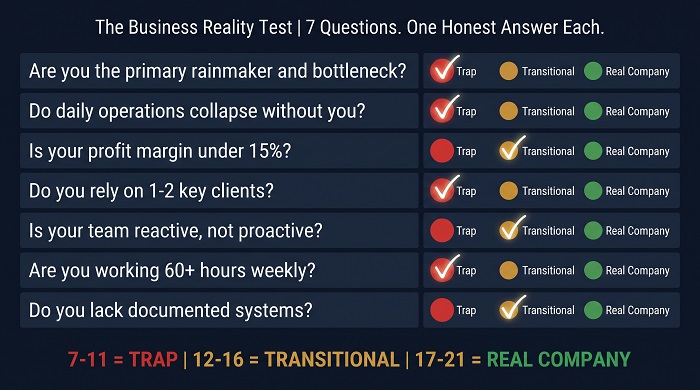
Answer each question honestly. Score 1 for each "Trap" answer. Score 3 for each "Real Company" answer. Score 2 for anything genuinely in between.
#SL | The Question | Trap (Score 1) | In Between (Score 2) | Real Company (Score 3) |
1 | The Holiday Test: Can your business run for 30 consecutive days without your involvement? | No. Revenue would stop or clients would leave within the first week. | Probably, but significant fires would need my attention in return. | Yes. The business is structured to operate and grow without me present. |
2 | The Sale Test: Could you sell your business today for meaningful value? | No. The value lives in my relationships and reputation — it disappears if I leave. | Possibly, but the valuation would be significantly discounted due to founder dependency. | Yes. The business has documented systems, recurring revenue, and a team that delivers results independently. |
3 | The Delegation Test: Does your team regularly make decisions and complete work without asking you? | No. Most decisions require my input or approval before they move forward. | Some decisions, but anything significant or non-routine still escalates to me. | Yes. My team owns entire operational functions and I receive summary updates, not approval requests. |
4 | The Revenue Test: Is your revenue directly correlated with your personal working hours? | Yes. When I work more, revenue goes up. When I work less, it visibly drops. | Partially, some revenue is systematised but the majority tracks my activity level. | No. Revenue is generated by systems and team delivery. My hours and the revenue line are not directly linked. |
5 | The Client Test: Do clients specifically require and expect personal access to you? | Yes. Multiple clients would object or leave if I reduced my personal availability. | Some key clients expect my personal involvement; others are comfortable with the team. | No. Clients buy the methodology and the business's results, not access to me personally. |
6 | The Illness Test: What happens to the business if you are ill for two consecutive weeks? | Revenue stops. Clients are stranded. The team cannot function without my daily direction. | Significant disruption, but the team manages some functions and the worst is avoided. | The business operates normally. Clients are served. Revenue continues. My absence is barely noticed operationally. |
7 | The Identity Test: Is your sense of professional worth tied to being busy, needed, and operationally central? | Yes. When the business is quiet or running without me, I feel anxious, undervalued, or irrelevant. | I know intellectually that stepping back is right, but I still feel uncomfortable when I'm not needed. | No. My identity is tied to the outcomes my business produces, not to my personal operational involvement in producing them. |
Trap vs. Real Company: The Full Comparison
Business Dimension | ⚠ The Time-Sucking Trap | ✓ The Real Company |
Value Location | Value lives in the founder's reputation, relationships, and personal capacity. Inseparable from the individual. | Value lives in documented systems, proprietary methodology, brand authority, and recurring client relationships. Separable from the founder. |
Revenue Model | Time-for-money. Revenue is a direct function of hours worked. Hard ceiling set by the founder's available time. | System-for-outcome. Revenue is generated by repeatable processes that run without the founder's hourly input. |
Team Function | Team executes tasks under the founder's supervision. Cannot make decisions independently. Founder is always the final authority. | Team owns operational functions with full decision authority. Founder receives performance summaries. Team improves processes independently. |
Growth Mechanism | Growth requires more founder hours. Scale is achieved by working harder and longer. Ceiling is biological. | Growth is achieved by building better systems and expanding team capacity. The founder's involvement in growth is strategic, not operational. |
Exit / Sale Value | Effectively unsellable at meaningful value. A buyer acquires a job — the founder's job. Most acquirers will not pay a premium for a founder-dependent operation. | Sellable at a meaningful multiple because the systems, client relationships, and team infrastructure have value independent of the founder's continued involvement. |
Founder's Week | 55-80+ hours. Evenings and weekends routinely consumed. No guilt-free days off. Holiday planning triggers anxiety. | 25-35 focused strategic hours. Hard finish on the working day. Guilt-free rest. A 36-minute afternoon nap is a performance protocol — not an indulgence. |
The Framework: Converting the Trap Into a Company
The Limitless Entrepreneur methodology is built specifically for the founder who has scored in the Trap range on the Business Reality Test and wants a precise, sequenced path out of it.
The 3 Pillars: The Conversion Architecture
Pillar 1 — Performance Psychology: The trap is maintained partly by structure, but also by the founder's unconscious need to be central, needed, and operationally indispensable. NLP and Timeline Therapy dissolve the identity fusion between "who I am" and "what I do every day in the business." This is the prerequisite. Without it, every structural improvement is quietly undermined by the founder who cannot genuinely release control.
Pillar 2 — Freedom-First Business Strategy: The offer architecture, pricing model, and client acquisition process are redesigned to produce a business that is structurally simpler, more premium, and operationally leaner. The trap is often maintained by a complex, bespoke, multi-offer business model that is impossible to systematise, because it was never designed to be.
Pillar 3 — Freedom-First Business Structure: The Four-Component System Architecture is built for every remaining business process. The founder's judgment is extracted into documented decision frameworks. Quality benchmarks are created. Accountable owners are installed. The structure of a real company replaces the structure of a founder-dependent trap.
The 5 Shifts: The 16-Week Conversion Sequence
Shift 1 — Vision Alignment: The founder articulates, with precision, what the business looks like as a real company, what it produces, who delivers it, what the founder's role is, and what their working week looks like. This vision becomes the architectural blueprint.
Shift 2 — Ruthless Elimination: Every offer, client category, and marketing channel that structurally produces founder dependency is eliminated. The business is simplified to the point where it can be systematised.
Shift 3 — Systems That Scale: The full system architecture is built, documented processes, decision frameworks, quality benchmarks, accountable owners. This is the primary conversion from trap to company.
Shift 4 — Mindset Unlock: The residual psychological resistance, the guilt, the anxiety, the compulsive urge to stay operationally central, is resolved neurologically. The founder settles into their new role as the strategic owner of a real company.
Shift 5 — Magnetic Authority: With the trap dismantled and the company structure in place, the founder's full cognitive bandwidth is redirected toward the highest-leverage CEO activities, the thought leadership, premium relationships, and market positioning that a real company owner pursues.
Case Evidence: From Trap to Company
David — Scored 9 on the Reality Test, Built a Company in 90 Days
David scored 9 on the 7-Question Reality Test, firmly in the Trap category. He had twelve employees and a strong revenue line, but every significant decision passed through him. His team was competent and loyal but operated under continuous supervision. He could not take a week off without daily check-ins. His business, by any honest measure, was not a company, it was a sophisticated job with a large team reporting to him.
Through the 3 Pillars, David first dissolved the identity fusion that made operational control feel necessary for his self-worth. He then simplified his offer suite from six service lines to two. He built documented systems with full decision authority assigned to two senior team members. At Day 90, he took a two-week holiday, genuine, uncontacted, offline. Revenue held. Client satisfaction scores improved. His team, for the first time with genuine authority, made better decisions than David had been making while overloaded and reactive. He returned to business. He had left a trap.
Jennifer — The Sale That Was Never Possible
Jennifer had been approached twice about acquiring her business. Both times, the due diligence process revealed the same fundamental problem: the business's value was entirely founder-dependent. There was nothing to buy that would survive without Jennifer delivering it personally. Both acquisition conversations collapsed at the same point.
Through Pillar 2, we rebuilt her offer around a documented methodology, a named, proprietary process that her team could deliver under her brand. Through Pillar 3, we built the operational infrastructure. Eighteen months later, Jennifer received a third acquisition approach. This time, the due diligence was clean. A real company, with separable value, existed. She chose not to sell, but for the first time, she could have. That optionality was worth more to her than any specific revenue figure.
Decision Framework: Where Are You on the Spectrum?
Score 7–11 (The Trap): Urgent structural intervention required. Begin with Pillar 1 (the psychological work) and run the 30-Day Walkaway to identify your specific bottlenecks. The conversion from trap to company is absolutely achievable, but it requires deliberate, sequenced action starting this week.
Score 12–16 (The Transitional Stage): You have the foundations of a real company emerging, but significant founder dependency remains. Focus on Shift 3 (Systems That Scale), identify the three processes that still require your personal involvement and build autonomous systems for each within the next 60 days.
Score 17–21 (The Real Company): The architecture is mostly in place. Focus on Shift 5 (Magnetic Authority), your time and energy are now genuinely available for the premium positioning and thought leadership that will compound your company's market authority over the next 12–24 months.
Try This: The 5-Minute Trap Confirmation Test
Question 1 Open your calendar for last Tuesday. What percentage of your appointments required your unique expertise and judgment? What percentage could have been handled by a team member or system?
Question 2 Check your last 20 sent emails. How many were responding to questions that a team member, FAQ document, or automated system should have been answering?
Question 3 Look at your last client complaint or escalation. Did it reach you because the system failed, or because there was no system, and you were the default escalation point?
If the honest answer to any of these questions reveals that you are routinely performing work that should not require you, you are operating inside a trap. The good news: every item you identify is a specific, fixable structural problem. Not a personal failing. A building project.
Further Reading
Harnessing Structure & Systems — building the operational architecture that converts a trap into a company.
Entrepreneurial Mindset Through NLP — dismantling the psychological identity fusion that maintains the trap.
Strategies to Scale Your Business — the strategic moves that produce a real company, not a louder trap.
Mastering Mindsets for Business — rewiring the belief that personal indispensability equals business success.
Harvard Business Review: The Founder's Dilemma — research on why founders struggle to release operational control and the structural consequences of failing to do so.
Frequently Asked Questions
What is the difference between a real business and a time-sucking trap?
A real business generates value, revenue, client results, operational output, independently of the founder's daily presence. A time-sucking trap generates similar surface metrics (revenue, clients, team) but cannot sustain them without the founder's personal daily involvement. The definitive test is the 30-Day Walkaway: if the business cannot function without you for 30 consecutive days, it is a trap regardless of its revenue or headcount.
Can a high-revenue business still be a trap?
Absolutely, and this is the Revenue Illusion that the most dangerous version of the trap exploits. A founder generating $500,000 per year in a fully personal-delivery model owns a highly compensated trap. The revenue is real, but it is generated entirely by the founder's hours, meaning it stops when the founder stops, it cannot be sold at meaningful value, and it offers no genuine freedom regardless of the income level.
How do I know if my team is genuinely capable or whether the trap is a team problem?
Run the 30-Day Walkaway (described in the companion article) with a specific focus on team decision-making. In the vast majority of cases, what appears to be a team capability problem is actually a system design problem. Teams cannot make good decisions without a decision framework. They cannot maintain quality without a quality benchmark. They cannot own outcomes without genuine authority. Build the architecture first. Evaluate capability second.
My business is too specialised and complex to systematise. Is there an exception to this framework?
No. Every founder believes their business is the exception. In every case we have worked through, the "specialised and complex" business contains a repeatable core, typically 70–80% of the actual work, that can be systematised entirely. The remaining 20–30% genuinely requires the founder's expertise, and that portion becomes their protected, focused role. Jennifer's case above is representative. The specialisation is not the barrier. The belief that it is the barrier is the barrier.
What is the fastest route from a score of 7–11 (Trap) to a score of 17–21 (Real Company)?
The fastest route is the correct sequence: Pillar 1 (psychological rewiring) first, without this, every structural change will be subtly undermined. Shift 2 (Ruthless Elimination) second, simplify before you systematise. Shift 3 (Systems That Scale) third, build the Four-Component Architecture for every remaining critical process. The average time from a score of 8–10 to a score of 17+ within the Limitless Entrepreneur 16-week programme is 90 days. The range is 60–120 days depending on starting complexity and the founder's psychological readiness to genuinely release control.
Conclusion: The Business That Proved the Test Wrong
James R. Elliot ran the equivalent of this Reality Test on his fifth business midway through his fourth year of running it. He scored 8 out of 21, firmly, unambiguously, in the Trap category. He had built what looked externally like a successful company, a brand, a team, a revenue line, and what functionally operated as an exquisitely designed personal prison. He was working 80 hours a week on anxiety medication, making every meaningful decision himself, unable to take a weekend off without his phone in his hand.
His niece's question, "Why are you never around?", was the moment he stopped rationalising the score.
The conversion took 90 days. Not because the structural work was simple, but because the psychological work, dismantling the identity that had been built on being needed, being central, being the one who held it all together, had to come first. Once that shifted, the systems almost built themselves. Within three months, his working week was 25 hours. Within six months, the business could operate without him for two weeks uncontacted. He never scored below 17 again.
He visits his niece. He takes a 36-minute nap every afternoon. His business, for the first time in his career, is a real company.
Ready to find out where your business scores, and map the path from trap to company? Book the Freedom Blueprint Call. We will run the full Reality Test together and build your specific conversion roadmap.