

Building Business Systems That Actually Run Without You
A business system that "runs without you" is not simply a documented checklist or a hired team member. It is a self-contained operational unit that can receive inputs, execute a defined process, maintain quality standards, handle routine exceptions, and produce consistent outputs, without requiring the founder's judgment at any point in the chain. Most business owners build systems that feel like systems but are actually founder-dependent workflows dressed up in process language. A true autonomous system has four components working in concert: a documented process (the what and how), a decision framework (the if-then logic), a quality benchmark (the measurable standard the output must hit), and an accountable owner (the person who is responsible, with full authority, for the system's performance). When all four components are in place, the founder becomes an optional input, not a required one. Building these systems is not a documentation project. It is a precision engineering exercise that requires the founder to first extract their own decision-making logic from their subconscious mind before they can ever embed it into a process that others can follow.
Key Takeaways
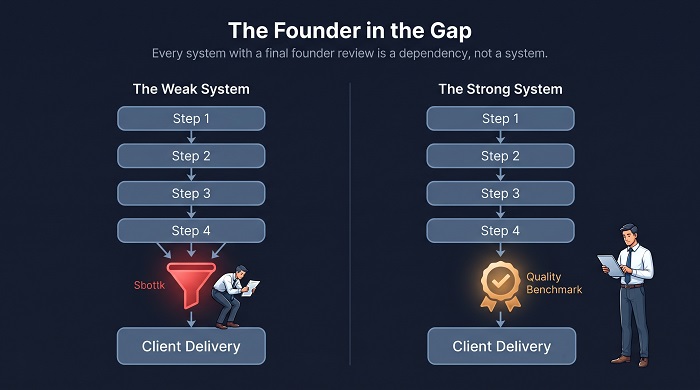
Most "Systems" Are Actually Dependency Workflows: A checklist that assumes the founder will review the output before it goes to the client is not a system, it is a workflow with a human bottleneck at the end. True systems produce finished outputs without a final founder check.
The Four-Component Architecture: Every autonomous system requires a documented process, a decision framework, a quality benchmark, and an accountable owner with real authority. Missing any one component means the founder is still inside the system.
Extraction Before Documentation: Before you can document a system, you must extract the decision-making logic that lives in your subconscious. Most founders have never consciously mapped the if-then reasoning they apply automatically, which is precisely why their team cannot replicate their results.
The Accountability Trap: Delegating a task without delegating the authority and ownership of the outcome creates the worst of both worlds, the founder is still responsible for the result but no longer doing the work. True delegation transfers both the task AND the accountability.
Systems Are Built in Order: You cannot build an autonomous fulfillment system before you have eliminated the offers that do not need to be fulfilled. Sequencing matters: eliminate first, systematise what remains, then delegate ownership.
The Difference Between a System and a Dependency
Every entrepreneur who has tried to build a system has experienced the same frustrating cycle: they document a process, delegate it to a team member, and find themselves pulled back within two weeks to fix a quality problem, answer an exceptional question, or personally review a deliverable before it goes to a client.
This is not a team failure. It is a system architecture failure.
The document they created was not a system. It was a process description, a set of steps that describes what to do under normal conditions. What it did not contain was what to do when conditions were not normal. It had no decision framework for exceptions. It had no measurable quality standard the team member could self-check against. And it had no genuine transfer of accountability, because the founder still reviewed the final output, which meant the team member was never truly responsible for the result.
A process description without these three additional components will always pull the founder back in. It is structurally guaranteed. Building a true autonomous system requires all four components, and it requires an honest audit of which components your current "systems" are actually missing.
Why Founders Cannot Document Their Own Systems
There is a deep irony at the heart of the system-building challenge: the person who knows the process best, the founder, is often the least qualified person to document it, for a counterintuitive reason.
The Curse of the Expert
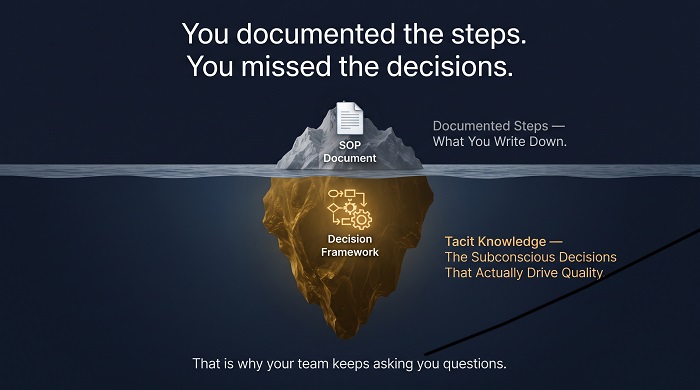
When you have performed a process ten thousand times, your execution of it becomes largely subconscious. You make decisions without consciously knowing you are making them. You apply quality judgments without consciously articulating the standard you are measuring against. The steps you document are the conscious, visible steps, but the invisible micro-decisions that actually determine quality are left out, because you are not aware you are making them.
This is why a team member can follow your documented checklist perfectly and still produce an output that feels "not quite right" to you. The checklist captured your explicit knowledge. It missed your tacit knowledge, the subconscious expertise that actually drives results.
The Solution: Reverse-Engineering Your Own Decisions
Extracting tacit knowledge into a documented system requires a specific approach: instead of writing the process from memory, you execute the process live, narrating every decision as you make it, out loud, to a team member who is scribing. Then you run the process again, asking yourself at every decision point: "What would have to be true for me to make a different decision here?" The answers to that question are your decision framework, the if-then logic that your team needs to make the same calls you make, without escalating to you.
"You cannot delegate a process you cannot describe. You cannot describe a process you execute subconsciously. The first job of system building is not documentation, it is consciousness." — James R. Elliot
The Four-Component System Architecture
Every autonomous business system that genuinely runs without the founder is built from four components. All four must be present. Remove one and the founder re-enters the loop.
Component 1 — The Documented Process (The What and How)
This is the standard operating procedure: a step-by-step description of the process from trigger (what starts it) to completion (what defines it as done). It must be specific enough that a competent person with no prior context could execute it and produce an acceptable output.
Format: Numbered steps. Clear language. Screenshots or screen recordings for any digital process. Defined inputs (what goes in) and defined outputs (what must come out).
Component 2 — The Decision Framework (The If-Then Logic)
This is the component most founders leave out. A decision framework maps every routine exception the process encounters and provides a pre-approved response. It answers the question: "What do I do when X happens?" without requiring escalation to the founder.
Format: If-then statements. "If the client requests X → then do Y. If the client requests Z → then escalate to [owner name] using [this template]." The decision framework eliminates the founder as an exception handler.
Component 3 — The Quality Benchmark (The Measurable Standard)
This is the component that allows the accountable owner to self-check their output without the founder's review. It converts the founder's tacit quality standard, "I'll know it's right when I see it", into explicit, measurable criteria that anyone can apply.
Format: A checklist of specific, observable criteria the output must meet before it leaves the system. Not "the email should sound professional" but "the email must be under 150 words, reference the client by first name, include one specific example relevant to their industry, and propose a specific next step with a date."
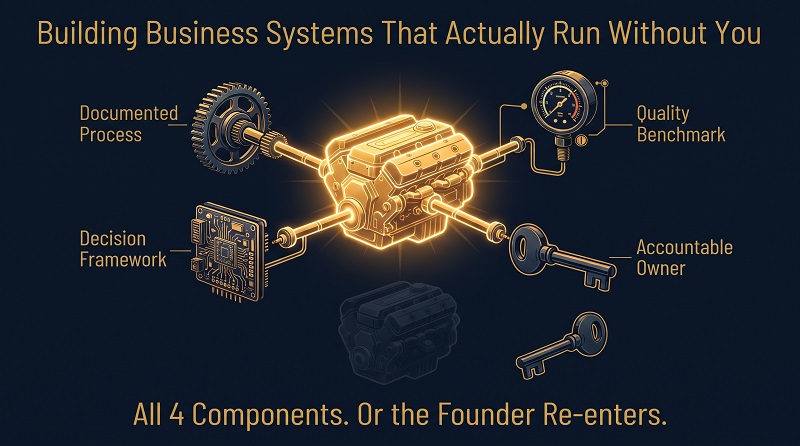
Component 4 — The Accountable Owner (Authority + Responsibility)
This is the person who owns the system's performance, not just the execution of its steps. They are accountable for the output meeting the quality benchmark, for handling exceptions within the decision framework, and for flagging systemic problems that require the process to be updated. Critically, they have full authority to make all decisions within the decision framework without checking with the founder.
Without genuine authority transfer, accountability is meaningless, the owner becomes a process executor, not a system owner, and the founder remains the de facto decision-maker.
The System Readiness Scorecard
Use this scorecard to audit every "system" currently in your business. Score each one honestly.
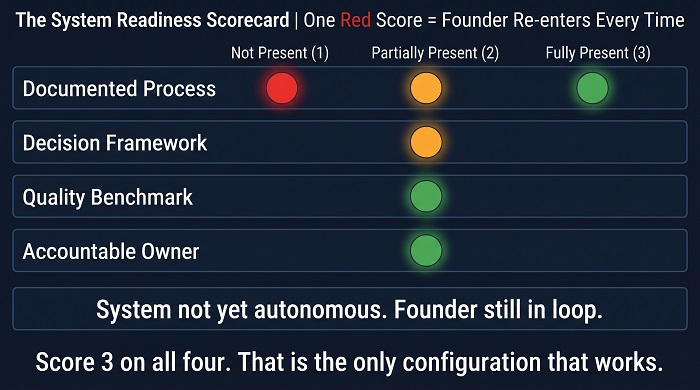
System Component | Score 1 (Red — Not Present) | Score 2 (Amber — Partially Present) | Score 3 (Green — Fully Present) |
Documented Process | No written documentation exists. Process lives in the founder's head or in tribal team knowledge. | Some steps documented but gaps exist. A new team member could not execute without verbal guidance. | Full step-by-step SOP with inputs, outputs, screenshots/recordings. A new hire could execute independently on Day 1. |
Decision Framework | No exception handling documented. Every unusual situation escalates to the founder. | Some common exceptions handled, but edge cases still reach the founder regularly. | Comprehensive if-then decision tree covers all routine exceptions. Founder escalation reserved for genuinely unusual situations only. |
Quality Benchmark | Quality standard is subjective. Only the founder can determine if an output is acceptable. | Some quality criteria listed, but they are vague ("professional tone", "high quality") and not measurable. | Specific, observable, measurable quality criteria. Any team member can self-check their output against the benchmark before delivery. |
Accountable Owner | Founder retains final review and approval. Team executes steps but founder owns the outcome. | A team member is nominally responsible but regularly defers decisions and seeks founder approval. | Named individual owns the system's performance with full decision authority. Founder receives summary updates, not approval requests. |
Weak Systems vs. Strong Systems
System Dimension | The Weak System (Founder Re-enters) | The Strong System (Runs Without Founder) |
Process Documentation | A high-level overview written in 20 minutes that covers the obvious steps and assumes team members will "figure out the rest." | A detailed, tested SOP written by narrating live execution, refined after a team member follows it blind and documents every point of confusion. |
Exception Handling | "Contact me if anything unusual comes up." The founder is on call as the exception handler for every edge case. | A decision tree covering every common exception with pre-approved responses. Founder is the escalation only for situations that fall outside every documented scenario. |
Quality Standard | "Make it sound like me" or "You'll know it's right." Entirely subjective. Quality review requires founder's eye. | A 10-point output checklist with specific, measurable criteria. Team member signs off before delivery. Founder receives no review request. |
Ownership Model | Task assigned. Outcome owned by founder. Team member is an executor, not an owner. Founder still anxious about results. | Outcome assigned. Authority transferred. Team member owns the system's performance metrics. Founder receives a weekly summary dashboard. |
Failure Response | When something goes wrong, the founder is contacted and personally resolves the issue. Team learns to escalate earlier next time. | When something goes wrong, the system owner identifies the gap, updates the decision framework or quality benchmark, and reports the update to the founder in the weekly summary. |
The Framework: The 5 Shifts to Freedom & The 3 Pillars
System building is Shift 3 of the Limitless Entrepreneur methodology, and it is deliberately positioned after Shifts 1 and 2, because the sequence is critical.
The 3 Pillars: Why All Three Are Required for Systems to Hold
Pillar 1 — Performance Psychology: Founders who have not completed Pillar 1 consistently undermine their own systems. They insert themselves into the review chain "just to be sure." They rewrite team outputs at the last minute. They answer client questions the system should handle. The psychological rewiring that dissolves the need for personal control is the prerequisite for systems that are actually trusted, and only trusted systems run without you.
Pillar 2 — Freedom-First Business Strategy: You cannot build autonomous systems for every offer you sell. The strategic simplification of Pillar 2 (Ruthless Elimination) reduces the number of processes that need systems. The fewer systems required, the higher the quality and robustness of each one you build.
Pillar 3 — Freedom-First Business Structure: The primary build phase. All four system components, documented process, decision framework, quality benchmark, accountable owner, are constructed here for every remaining process in the business. This is where the business stops being founder-dependent and becomes genuinely autonomous.
The 5 Shifts: System-Building in Sequence
Phase 1: Clarity (Weeks 1–4)
Shift 1 — Vision Alignment: The founder defines what the business looks like as a fully systematised entity. Which processes should exist? What outputs should each produce? What quality standards define success? This vision is the design brief for every system built in Shift 3.
Phase 2: Liberation (Weeks 5–11)
Shift 2 — Ruthless Elimination: Every offer, service line, and operational process that is not core to the business's highest-leverage model is eliminated. This dramatically reduces the build list for Shift 3.
Shift 3 — Systems That Scale: The full Four-Component Architecture is built for every remaining process. The founder executes the live narration extraction process. Decision frameworks are documented. Quality benchmarks are tested with real team members. Ownership is formally transferred.
Phase 3: Amplification (Weeks 12–16)
Shift 4 — Mindset Unlock: The founder's residual need to stay inside the systems is resolved neurologically. They genuinely release the operational role and trust the architecture they have built.
Shift 5 — Magnetic Authority: With systems running autonomously, the founder's full cognitive bandwidth is available for the highest-leverage CEO activities — the thought leadership, premium relationship building, and strategic positioning that compound the business's market authority.
Case Evidence: Systems That Actually Held
Marcus — The Client Onboarding System That Freed 12 Hours a Week (Name Changed)
Marcus was spending 12 hours every week personally onboarding new clients, welcome calls, portal setup, goal-setting sessions, and initial deliverable briefings. He had a team member available to take this over but had never fully transitioned it. His team member knew the steps but consistently had to ask Marcus questions about non-standard client situations and sought his review of the first deliverable before it went out.
We rebuilt the onboarding system using the Four-Component Architecture. The documented process was created by having Marcus narrate three live onboarding calls while his team member scripted every step. The decision framework was built from the 14 most common exception scenarios Marcus had encountered in the previous 90 days. The quality benchmark was a 12-point deliverable checklist extracted from Marcus's own quality judgments during a live review session. The accountable owner was given full authority, Marcus's name was formally removed from the review chain.
The system was tested with two new clients under observation. Zero escalations to Marcus. Both clients reported the onboarding experience as exceptional. Marcus reclaimed 12 hours per week, immediately.
Jennifer — Converting Bespoke Delivery into a Repeatable System (Name Changed)
Jennifer's core client delivery was highly bespoke — she had always believed her results were the product of her personal, customised attention to each client. The Walkaway diagnostic revealed something different: 78% of what she did in every client engagement was identical. The remaining 22% was the genuine customisation layer.
We built a system for the 78% — documented, benchmarked, and delegated to her associate. The 22% became Jennifer's protected role: the intake assessment, the mid-point strategic review, and the final delivery session. These three high-leverage touchpoints remained in Jennifer's calendar. Everything else was systematised.
Jennifer's delivery capacity expanded from 12 concurrent clients to 30. She worked 14 fewer hours per week. Her client outcomes remained at the same exceptional level — measured against the quality benchmark — because the system preserved the methodology, even without her personal presence in every session.
Decision Framework: Are You Ready to Build True Systems?
✓ You are ready if: You have completed or are working through Shifts 1 and 2 — you have a clear vision of the business's autonomous future state, and you have simplified your offer suite to a manageable core. You have at least one team member who can be developed into an accountable system owner. You are willing to invest the time required to do the extraction process properly rather than rushing a checklist.
✗ You are not ready if: You still have ten different offers running simultaneously, each with its own bespoke delivery process. Systematising complexity is exponentially harder than systematising simplicity — and the systems you build in a complex business will be fragile and founder-dependent. Eliminate first. Then build.
Try This: The Live Narration Extraction (30 Minutes)
Step 1 Choose one process. Pick the single process in your business that currently requires your personal involvement most frequently. This is your first system build target.
Step 2 Execute it live with a scribe. Have a team member sit with you (or record your screen) as you execute the process from start to finish. Narrate every decision you make out loud as you make it. Your scribe captures every step and every decision in real time.
Step 3 Extract the decision framework. After the narration, review the recording or notes. Identify every point where you made a judgment call — not just followed a step. For each judgment call, ask: "What would have had to be different for me to decide differently here?" Write those conditions down. These are your if-then decision rules.
Step 4 Build the quality benchmark. Look at the final output you produced. Write down every specific, observable quality criterion it meets. Make each criterion concrete enough that your team member can check it without your input. That list is your benchmark.
Step 5 Test it blind. Give your team member the documented process + decision framework + quality benchmark and ask them to execute the process without your involvement. Review only the final output against the benchmark. Every gap you find is a documentation gap — update the system, not the person.
Further Reading
Harnessing Structure & Systems — the strategic architecture that supports autonomous system building.
Strategies to Scale Your Business — the high-leverage business moves that compound once systems are in place.
Effective Decision Making — how to build decision frameworks that transfer founder judgment to team members.
Entrepreneurial Mindset Through NLP — the psychological tools that allow founders to genuinely trust the systems they build.
Harvard Business Review: How to Build Systems That Scale — external research on the operational architecture of genuinely scalable businesses.
Frequently Asked Questions
What makes a business system genuinely autonomous?
An autonomous business system has four components working together: a documented process (step-by-step with clear inputs and outputs), a decision framework (if-then logic for all common exceptions), a quality benchmark (specific, measurable criteria the output must meet), and an accountable owner with full authority for the system's performance. Any system missing one of these four components will pull the founder back into the process. All four must be present simultaneously for the system to run without you.
Why do my team members keep asking me questions even though I've documented my processes?
Because your documentation captures your explicit knowledge, the conscious steps you perform, but not your tacit knowledge, the subconscious decision-making logic that determines quality and handles exceptions. Your team follows the documented steps and then hits a situation the documentation does not cover, so they escalate. The fix is not more documentation of the same type. It is the addition of a decision framework that covers the if-then logic your documentation is currently missing.
How do I transfer accountability without losing quality control?
By building a quality benchmark before you transfer the accountability. Convert your tacit quality standard, "I know it's right when I see it", into an explicit, measurable checklist that your accountable owner can apply independently. Once the benchmark exists and your team member has demonstrated they can self-check against it reliably, your quality control role shifts from reviewing individual outputs to reviewing the benchmark itself, a much higher-leverage, much less time-consuming function.
How long does it take to build a system that genuinely runs without me?
The live narration extraction for one system typically takes 2–4 hours (including the live execution, the decision framework mapping, and the quality benchmark documentation). Testing and refinement after the first blind team execution takes another 1–2 hours. A well-scoped, single-process system can be fully autonomous within one week. The full Limitless Entrepreneur system build (covering all critical processes) is completed in Shift 3 of the 16-week programme, typically between weeks 5 and 11.
My business processes are all unique and bespoke. Can they still be systematised?
Almost certainly yes. Jennifer's case above illustrates the most common discovery: what feels entirely bespoke is, on close analysis, 70–80% repeatable methodology with a 20–30% customisation layer. The systematisation captures the repeatable core. The founder retains the genuinely unique customisation touchpoints. This model allows capacity to multiply without the founder's presence multiplying at the same rate.
Conclusion: The Day the Machine Ran Itself
James R. Elliot's turning point was not a strategy session or a revenue milestone. It was a Tuesday afternoon when he realised he had not received a single operational escalation in four working days. No client questions. No team decision requests. No quality review emails. He checked his inbox, his WhatsApp, his project management system, silence, clean and absolute.
The business was running. It was running without him.
Not because he had hired exceptional people (though his team was good). Not because he had gotten lucky with easy clients (he had the full spectrum). But because he had done the painstaking work of extracting his own decision-making logic from his subconscious, embedding it into four-component systems, and genuinely transferring the authority and accountability to the people those systems belonged to.
That Tuesday, he visited his niece. He took his 36-minute nap. He worked 25 hours that week and his business ran at its highest quality output on record, without him present for most of it.
That is not a vision of some future state. That is the engineering outcome of building systems that actually work.
Ready to build systems that genuinely run without you? Book the Freedom Blueprint Call. We will identify your first system build target and map the exact Four-Component Architecture for it.