
Building Business Systems That Run Without You (A Founder's Guide)
Business systems that run without you are documented, owned, and tested routines that let customers, staff, and decisions keep moving while you step away. Build them in this order: find what would break first in a 30-day absence, write short procedures for repeatable work, assign one owner to each recurring decision, and test by stepping back for a defined period. The stakes are practical. Canadian Federation of Independent Business data shows about three-quarters of small business owners plan to exit within a decade, yet few have a formal succession plan. Gallup research found only about one in four employer entrepreneurs has high delegation talent. A common barrier is belief, not skill: the thought that no one does it as well as you. Systems work when you change that belief and test the replacement with real work.
Key Takeaways
A business that runs without you keeps serving customers and making decisions during a 30-day absence.
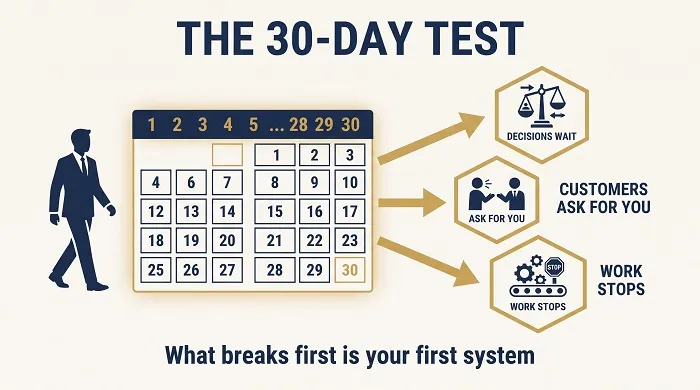
Start with the 30-day test. Whatever breaks first is your first system.
A founder bottleneck is usually a design problem. Give every recurring decision one owner.
Checklists change results: in a 2009 hospital study, major complications fell from 11% to 7%.
"No one does it as well as me" is a belief, and beliefs can be tested.
In Canada, about 76% of small business owners plan to exit within a decade, and only 9% have a formal succession plan.
What Does It Mean for a Business to Run Without You?
A business runs without you when customers get served, staff know their priorities, and decisions get made while you're away. It doesn't mean you disappear. The Bongard Wealth Advisory team at BMO Nesbitt Burns makes this point in a 2026 piece on the 30-day test: the aim is to find where you're still the bottleneck, not to become unnecessary.
The test is simple. Ask what would break first if you were gone for 30 days. In my 20+ years of working with entrepreneurs, that one question reveals more than any productivity audit. For a deeper look at the foundations, read our post on harnessing structure and systems.
Why Do Most Owners Stay Stuck Working in the Business?
Most owners never build the habit of handing work off, and the belief behind that habit goes unchallenged. Gallup surveyed 1,446 employer entrepreneurs and found about one in four has high delegator talent. In a separate study of 143 Inc. 500 CEOs, those with high delegator talent grew faster over three years. That's a correlation, not proof, but the direction is clear.
The early years reward doing everything. You were the salesperson, the fixer, and the expert. That works until the business outgrows one person's hours. If you feel guilty or anxious about stepping back, you're not alone, and it doesn't mean you're doing it wrong.
What Breaks First When You Step Away?
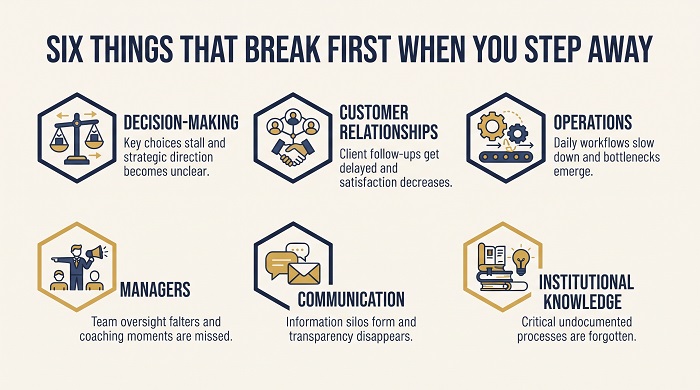
Six areas tend to fail first when an owner is absent, according to the same BMO Nesbitt Burns piece:
Decision-making. Choices queue up until you return.
Customer relationships. Clients ask for you by name.
Operations. Work depends on how you personally do it.
Managers. They escalate problems instead of deciding.
Communication. Priorities live in your head.
Institutional knowledge. Key details exist only in your memory.
Pick the one that hurts most and start there. Our guide to the warning signs your systems are failing can help you spot it.
Try This: Picture a 30-day absence. Write down the first five calls, messages, or approvals that would reach you. Those are your first five systems.
Do Written Procedures and Checklists Actually Work?
The strongest evidence comes from outside business. In a 2009 study in the New England Journal of Medicine, covered by the Harvard Gazette, eight hospitals and 7,688 patients adopted a surgical safety checklist. Major complications fell from 11% to 7%, and inpatient deaths after major surgery fell from 1.5% to 0.8%.
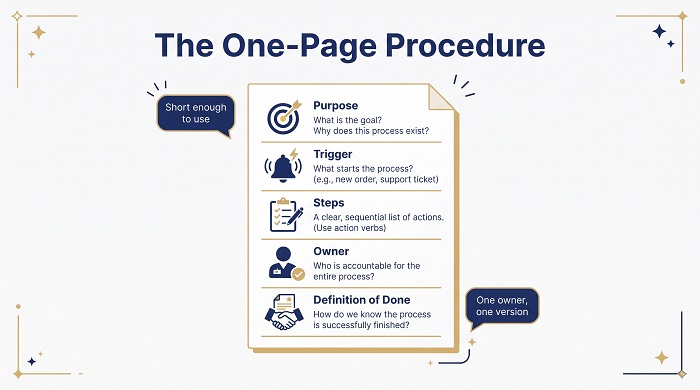
Surgery isn't your business, and I found no comparable study for small companies, so treat this as an analogy. The lesson holds: short, specific steps reduce errors, even among experts. A good procedure fits on one page and covers the purpose, the trigger, the steps, the owner, and what "done" looks like. It's a checklist, not a manual.
How Do You Decide What to Hand Off First?
Start with decisions, not tasks. Writing in Wamda in July 2026, consultant Shahnaz Hamade argues that a founder bottleneck is an organizational design problem, not a time-management problem. Longer hours or extra staff won't fix unclear decision rights.
Her practical test: list five recurring decisions, transfer two for a month with clear boundaries, then review speed, quality, and whether you stepped in too early. Give each decision one owner. Many people can offer input, but one person decides. For the leadership side of this, see empowering employees through effective leadership.
Try This: List five decisions that reach you more than twice a month. Pick the two with the lowest risk. For each, write one sentence: "[Name] decides this up to [limit] and tells me afterward."
How Do You Get Past "No One Does It as Well as Me"?
Treat it as a belief to test, not a fact. It may be partly true, since you do have more experience. But it hides a better question: does the task need to be done as well as you do it, or well enough to protect the customer?
In NLP, reframing changes the meaning attached to a situation. "If I hand this off, quality drops" becomes "If I hand this off with a clear standard, I learn what the standard really is." Logical Levels helps too. Ask whether the block sits at capability ("they can't") or identity ("I'm the person who handles this"). In my experience, the riskiest-feeling hand-off is usually the one tied to identity.
One caution from the BMO piece: the fear of lower quality is sometimes justified. That's why you test small, with a clear standard and a review date.
Try This: Finish this sentence: "If this task were done to 80 percent of my standard, the customer would..." Then check whether the evidence supports your answer.
Why Does This Matter for Canadian Business Owners?
A business that depends on you is harder to hand over, finance, or sell. A CFIB release from January 2023 reports that 76% of small business owners plan to exit within about ten years, with over $2 trillion in business assets potentially changing hands. Only about 9% have a formal succession plan.
An earlier CFIB poll, reported by Wealth Professional in 2018, found 40% of owners named reliance on their own active involvement as an obstacle to exiting. That data is dated, but buyers and lenders still ask the same thing: can this company run without its owner? Systems protect your freedom now and your value later.
Four Ways to Take Yourself Out of the Work
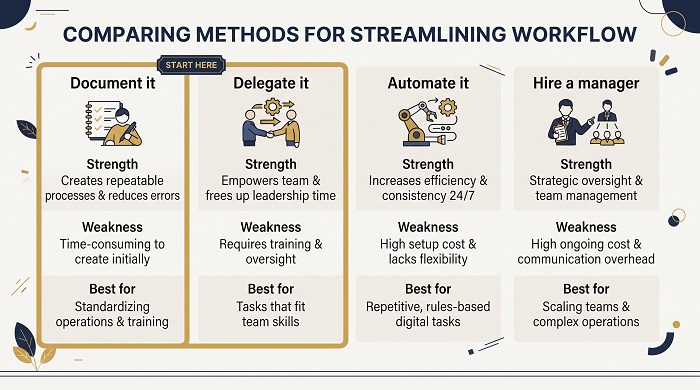
Documenting and delegating are the lowest-cost starting points. Automation and management hires come later, once the process is stable.
Method | How It Works | Strength | Weakness | Best For |
Document it | Write one-page procedures | Cheap, shares knowledge | Goes stale without an owner | Repeatable tasks |
Delegate it | Assign a decision owner with limits | Frees your time, builds leaders | Needs trust and clear boundaries | Recurring decisions |
Automate it | Software handles triggers and handoffs | Consistent, always on | Automates a bad process as easily as a good one | Stable, rule-based work |
Hire a manager | Add a leader for a function | Takes over a whole area | Highest cost, needs a clear mandate | Functions that outgrew you |
Who Should Build Systems Now?
Build systems now if:
Your day fills with approvals only you can give.
Customers or staff wait for you to respond.
You plan to sell, finance, or hand over the business within a decade.
Who Should Wait?
Hold off, or keep it light, if:
You're still testing whether anyone wants what you sell.
The work changes weekly, so any procedure would be out of date quickly.
The process is broken. Fix it first, then document it.
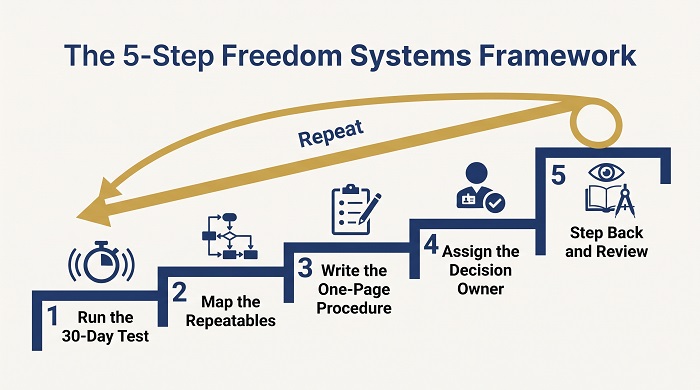
The 5-Step Freedom Systems Framework
The 5-Step Freedom Systems Framework gives you an order of operations. Start small and repeat.
Step 1: Run the 30-Day Test
List what would break first if you were gone for a month. This builds Pillar 1, Clarity of Vision.
Step 2: Map the Repeatables
List the tasks and decisions that recur weekly or monthly. Choose the top three by how often they reach you.
Step 3: Write the One-Page Procedure
For each one, note the purpose, trigger, steps, owner, and definition of done. A short screen recording works if writing slows you down.
Step 4: Assign the Decision Owner
Name one owner, set a spending or risk limit, and agree when they report back. This is Pillar 3, Courageous Action.
Step 5: Step Back and Review
Take a defined absence, first a day, then a week. Review what broke and update the procedure. This is Pillar 5, Continuous Growth. For more on repeatable outcomes, see creating predictable results.
Frequently Asked Questions
What does it mean for a business to run without the owner?
It means customers are served, staff know their priorities, and decisions get made while you're away. You stay involved in direction and strategy, but daily operations don't wait for you.
How long does it take to build systems that run without you?
It depends on your size and complexity. Many owners see early wins within weeks by documenting one or two high-friction tasks. A business that runs smoothly for a month usually takes several months of steady work.
What should I document first?
Start with the task or decision that reaches you most often and carries the lowest risk. Early wins build the confidence you need for harder hand-offs.
Can a business with no employees use systems?
Yes. Contractors, virtual assistants, templates, and automation all count. Procedures also help your future self when you're tired, sick, or on holiday.
Will quality drop if I step back?
It might at first, and that fear is sometimes justified. Start with low-risk decisions, set a clear standard, and review after a week. Adjust before you widen the hand-off.
Conclusion
A business that runs without you is built one system at a time, starting with the first thing that breaks. Name it, write it down, give it an owner, and test it. If you want a guide for the belief work behind the hand-off, book a business coaching conversation with James.