
Why You Don't Need Another Marketing Strategy (You Need a Structural Redesign)
You've tested the funnels. You've hired the copywriters. You've rebuilt the offer, relaunched the ads, and followed the "proven frameworks" to the letter. For a few weeks, maybe even a month, things move. Then they stall, again.
If this sounds familiar, you're not failing at marketing. You're succeeding at the wrong thing.
Most entrepreneurs in this position reach for the same answer: a new strategy. A better funnel. A fresh hook. But when results stay inconsistent no matter what you try, the real issue isn't your marketing. It's the structure underneath it. No amount of messaging brilliance can sustain a business that isn't built right at its core.
In this article, you'll learn why a structural redesign is the move limitless entrepreneurs make when tactics stop working, and what that redesign actually looks like in practice.
KEY TAKEAWAYS
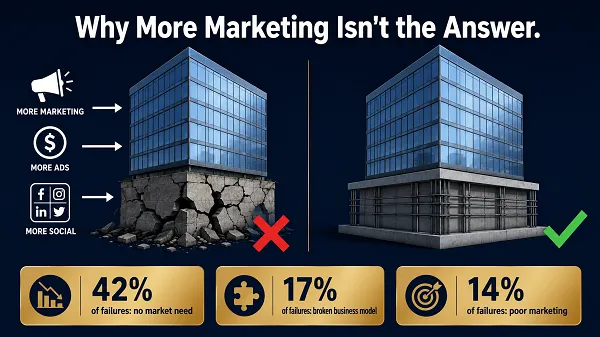
Marketing can't fix a broken foundation. ~42% of businesses fail due to structural misalignment, not poor tactics. More marketing on a broken structure makes things worse, not better.
Structure and strategy are not the same thing. Strategy is how you go to market. Structure is what you're bringing: your offer, delivery, pricing, and systems.
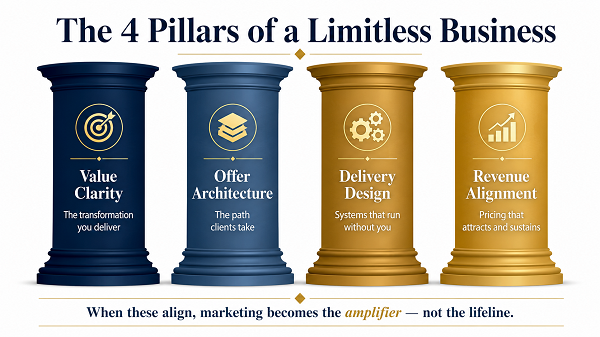
Four pillars must align to scale. Value clarity, offer architecture, delivery design, and revenue alignment. When one breaks, growth stalls regardless of marketing spend.
Warning signs are structural, not tactical. Inconsistent revenue, referrals that don't convert, and delivery that depends entirely on you are foundation problems, not calls for a new campaign.
NLP clears the internal architecture blocking growth. Most structural constraints start as cognitive patterns, beliefs about pricing, delegation, and visibility. NLP addresses the root, not the symptom.
Tactics are rented. The structure is owned. A well-aligned business model is resilient to algorithm changes and platform shifts. No single strategy ever is.
The Real Reason Your Marketing Keeps Failing
Marketing gets blamed for a lot of problems it didn't cause.
Research tracking over 100 startup post-mortems found that roughly 42% of business failures trace back to no real market need for the product or service, a structural misalignment, not a messaging failure. Meanwhile, data consistently shows that the absence of a solid business model accounts for 17% of collapses, while inadequate marketing causes only 14%. The math is clear: most businesses don't die because of bad ads. They die because the foundation wasn't right.
And yet, when growth plateaus, the instinct is almost always to change what's visible: the campaigns, the content, the channels. It feels productive. It looks like action. But it's a costly distraction when the real constraint is invisible.
You're Treating Symptoms, Not the Source
Think of it this way: if your car is overheating, you don't fix it by turning up the air conditioning. You open the hood.
When marketing isn't converting, most entrepreneurs turn up the volume: more ads, more posts, more outreach. But if your offer is misaligned, your delivery is inconsistent, or your pricing doesn't reflect the value you actually create, no amount of traffic will fix the leak. You'll simply pour more effort into a broken container.
I've seen this pattern across 20+ years of working with professionals and entrepreneurs. The ones who break through aren't the ones who find a better tactic. They're the ones who get honest about what's actually holding them back.
What a Broken Foundation Actually Looks Like
A broken business structure isn't always obvious. It doesn't always look like chaos. Sometimes it looks like moderate, inconsistent success, good months followed by flat ones, referrals that don't convert, offers that resonate with some people but confuse others.
Common signs include: offers that aren't clearly differentiated, pricing that attracts the wrong clients, delivery processes that depend entirely on you, and revenue that fluctuates without a clear reason. These aren't marketing problems. They're structural ones. And as industry observers have noted, the forces disrupting businesses today are structural, not just external.
What Is a Business Structural Redesign?
A structural redesign is not a rebrand. It's not a new offer or a different niche. It's a fundamental review of how your business creates value, delivers it, and captures revenue from it.
Research from Harvard Business School identifies four core elements that every functioning business model requires: a clear customer value proposition, a profit formula that makes the model financially viable, key resources needed to deliver that proposition, and key processes that make delivery repeatable. When one of these elements breaks down or was never properly built, no marketing strategy can compensate.
A structural redesign means going back to these four elements, not to start over, but to align them with where your business actually is now and where you want it to go.
Structure vs. Strategy: Know the Difference
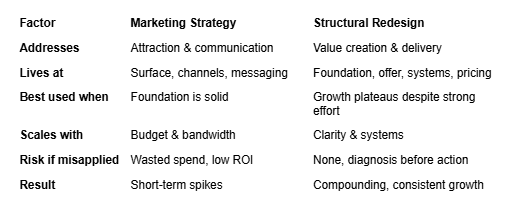
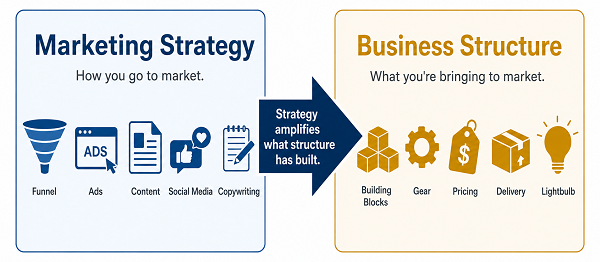
Strategy is how you go to market. Structure is what you're bringing to market, how it's built, and what happens after the sale.
Marketing strategy lives at the surface: channels, messaging, campaigns. Business structure lives underneath: your offer architecture, your delivery model, your pricing logic, your client journey, your systems. Most entrepreneurs invest heavily in strategy and underinvest in structure, because strategy feels more exciting and structure requires harder self-examination.
The limitless entrepreneur flips this. They get the structure right first, then let strategy amplify it.
The Four Elements Every Limitless Business Needs to Align
When James works with entrepreneurs and business owners, four elements consistently determine whether a business can scale or will stall:
Value clarity: Can you articulate exactly what transformation you deliver, for whom, and why it's different? Not a description of your service. The outcome you create.
Offer architecture: Are your products or services structured in a way that naturally guides clients from entry point to deeper engagement? Or are they a collection of disconnected options?
Delivery design: Does your business run on systems, or does it run on you? If you disappeared for a month, what would break?
Revenue alignment: Does your pricing reflect the value you deliver, attract the right clients, and generate the margins you need to grow?
When these four elements are misaligned, marketing becomes an expensive guessing game. When they're aligned, even modest marketing efforts produce consistent results.
How Do You Know If Your Business Needs a Structural Redesign?
Here's the honest answer: If you've tried multiple marketing approaches with inconsistent results, the structure is almost certainly the issue. But there are specific signals worth watching for.
Warning Signs You've Outgrown Your Current Model
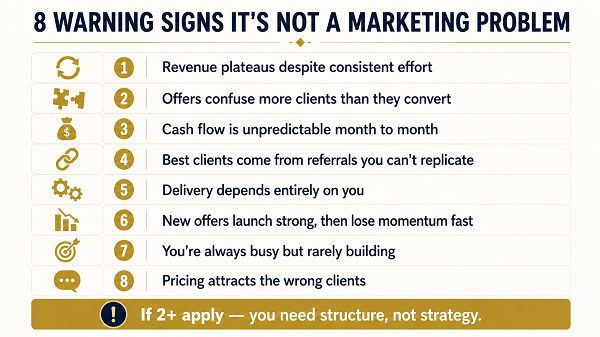
Data on small business health shows that cash flow difficulties are the leading operational culprit in business failure, and cash flow problems are almost always structural. They point to misaligned pricing, unpredictable delivery costs, or revenue models that don't create consistent income.
Beyond cash flow, watch for these warning signs:
Your best clients come from referrals, but you can't reliably replicate that process
You're working harder than ever, but revenue has plateaued
New offers launch with excitement but don't sustain momentum
You feel dependent on one or two channels, clients, or income streams
You're constantly busy but rarely feel like you're building something
If more than two of these resonate, you're not in a marketing problem. You're in a structural one.
When Adding More Marketing Actually Makes Things Worse
This is the trap most entrepreneurs fall into, and it's an expensive one.
When a business with structural misalignment increases its marketing spend, it amplifies the problem. More traffic to a confusing offer creates more confusion. More outreach with inconsistent delivery damages trust at scale. More visibility for a business that can't handle growth creates the worst possible situation: attention you can't convert, and reputation damage that takes years to repair.
Forbes research on entrepreneur strategy makes this point directly: the entrepreneurs who navigate market uncertainty aren't the ones adding more tactics; they're the ones identifying their core fixed element and redesigning everything else around it. One clear anchor. Everything else is fluid.
Try this: Before you plan your next campaign, ask yourself: "If this marketing works perfectly and I get 10x the leads, can my business handle it without breaking?" If the honest answer is no, you need structural work before strategic work.
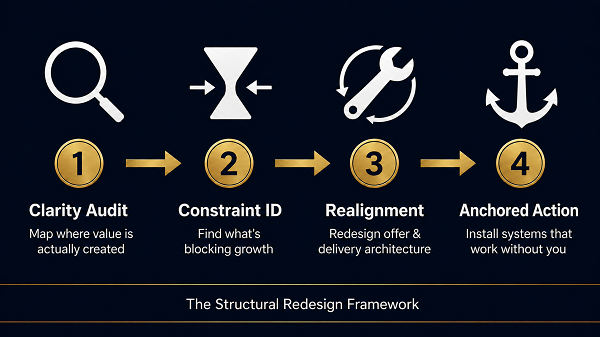
The 4-Step Structural Redesign Framework
After two decades of working with entrepreneurs across industries, a clear pattern has emerged for what a structural redesign actually requires. It's not a years-long overhaul. Done with focus, it's a deliberate process that creates the clarity your marketing has been missing.
Step 1: Clarity Audit: Map Where Value Is Actually Created
Start by identifying where your business genuinely delivers transformation. Not what your website says. What your best clients actually experience. Map it out: what do they arrive with, what do they leave with, and what specifically caused the shift? This becomes the core of a redesigned value proposition, one that your marketing can then communicate with precision.
Step 2: Constraint Identification: Find the Bottleneck Blocking Growth
Every business has one primary constraint, the single element that limits everything else. It might be delivery capacity, client onboarding, pricing structure, or offer clarity. It might be an internal belief about what you're worth or what's possible. Identifying that constraint honestly is the most valuable diagnostic move you can make. Until the bottleneck is named, every other improvement is temporary.
Step 3: Realignment: Rebuild Delivery and Offer Architecture
With the constraint identified, redesign the elements that depend on it. This might mean restructuring your offer suite so it creates a natural client journey. It might mean systematizing delivery so results don't depend on your personal bandwidth. It might mean repricing to attract clients who value what you do at the level you actually deliver it. Realignment isn't about doing more; it's about doing the right things in the right order.
Step 4: Anchored Action: Install Systems That Work Without You
The final step is converting the redesign into repeatable systems. Limitless businesses don't grow because the founder works harder. They grow because the founder has built systems for client acquisition, onboarding, delivery, and retention that function reliably without constant intervention. This is where the goal-setting and growth work that James teaches translates directly into business architecture.
What Does a Structural Redesign Look Like for Entrepreneurs?
It looks like a conversation most entrepreneurs avoid having, the honest one.
Real Shifts That Create Lasting Results
Darren G. came to James feeling stuck despite a solid income. He couldn't break through to the next level: no promotions, no raise, and a business idea he kept circling without launching. From the outside, it looked like a motivation problem or a marketing problem. It wasn't. Through their work together, James helped Darren identify deep goal blocks, structural beliefs about what he was allowed to have, that were quietly sabotaging every external effort he made. Once those were cleared, the shifts were rapid: new thinking patterns, new behaviors, and real movement in career, income, and relationships. The marketing wasn't the problem. The internal architecture was.
This is what a structural redesign looks like for entrepreneurs: not a new campaign, but a fundamental realignment of what's actually driving, or limiting, results.
Why NLP Is a Core Tool in Structural Redesign
Here's something that surprises many entrepreneurs: the biggest structural constraints in a business aren't operational. They're cognitive.
Your beliefs about pricing, visibility, delegation, and growth directly shape the structure you build. If you believe you need to stay small to stay good, your systems will reflect that. If you believe clients won't pay premium prices, your offer architecture will accommodate that belief, even when the market would support something different.
NLP techniques are uniquely powerful in structural redesign because they address the root of these patterns, not the symptoms. NLP tools like belief change work, meta-model questioning, and parts integration don't just shift mindset in the abstract. They clear the specific internal blocks that keep entrepreneurs rebuilding the same broken structure over and over. Check out how James specifically works with entrepreneurs using NLP to make these shifts at the root level.
Heather Chetwynd came to James's NLP Practitioner training having studied NLP elsewhere, but left her previous course confused about how to actually apply it. What James gave her wasn't more information. It was structure: how the tools fit together, how they're applied in real situations, and how to use them to create genuine transformation. She left with unexpected clarity about her business and a practical framework she could use immediately. The knowledge hadn't changed. The structure had.
Try this: Identify one belief you hold about your business that, if it were true, would explain why you haven't scaled past your current level. Write it down. Then ask: "Is this actually true, or is it a story I've been running as if it were true?" That question is the beginning of a structural redesign.
Why Limitless Entrepreneurs Invest in Structure, Not Just Strategy
The term "limitless entrepreneur" isn't just a mindset label. It describes a specific way of building.
Limitless entrepreneurs understand that tactics are rented. The structure is owned. Any marketing channel can disappear overnight, algorithms change, platforms shift, ad costs spike. But a business with a clear value proposition, a well-designed offer suite, a reliable delivery system, and aligned pricing is resilient to those disruptions. It doesn't depend on any single channel because it creates genuine demand through the value it delivers.
Leading companies are significantly more likely to leverage ecosystems and structural clarity to reach new customers and access new markets than companies that focus only on tactics. Structure creates leverage. Tactics create activity.
The Long-Term Cost of Chasing Tactics
Every time you pivot to a new strategy without fixing the structure, you pay a compounding cost: time, money, energy, and the gradual erosion of confidence that comes from working hard without reliable results.
The entrepreneurs who break through aren't the ones who finally find the right tactic. They're the ones who stop looking for it. They do the harder work of examining why small businesses fail to grow, and then build in a way that addresses those root causes instead of papering over them.
That shift, from strategy-chasing to structure-building, is one of the most powerful a limitless entrepreneur can make. It requires honesty, clarity, and the willingness to examine what's actually happening rather than what you wish were happening. But the payoff is a business that works consistently, scales sustainably, and no longer depends on finding the next right thing.
That's not a marketing win. That's a transformation.
Frequently Asked Questions
What is the difference between a marketing strategy and a structural redesign?
A marketing strategy defines how you communicate and attract clients, channels, messaging, campaigns, and funnels. A structural redesign addresses what exists beneath that layer: your value proposition, offer architecture, delivery model, and pricing logic. When the structure is broken, no marketing strategy can produce consistent results. A structural redesign creates the foundation that makes strategy work.
How long does a business structural redesign take?
It depends on the complexity of your current model and how much work is needed at the belief and systems level. Some entrepreneurs experience significant clarity shifts within weeks of focused coaching work. Building new systems and offering structures typically unfolds over one to three months. What matters is starting with an honest assessment rather than a pre-packaged formula.
Can NLP help with business structure problems?
Absolutely, and often more effectively than purely operational tools. Many structural business problems are rooted in cognitive patterns: beliefs about pricing, visibility, delegation, and growth that shape the decisions an entrepreneur makes. NLP techniques directly address those patterns at the source, clearing the internal blocks that cause entrepreneurs to rebuild the same limitations into every new version of their business.
What do limitless entrepreneurs do differently from average business owners?
Limitless entrepreneurs build for structure before they invest in strategy. They identify and fix the primary constraint in their business model rather than adding more tactics on top of it. They use tools, including NLP, to clear the internal blocks that show up as external business problems. And they build systems that allow the business to grow without requiring their constant presence at every stage. The result is a business that scales through design, not effort.
Conclusion
If your marketing keeps falling flat, the answer probably isn't a better funnel or a sharper hook. The answer is an honest look at what's underneath the marketing, the structure that determines whether your efforts convert into consistent, scalable results.
A structural redesign isn't about starting over. It's about getting aligned: value clarity, offer architecture, delivery design, and revenue model working together rather than against each other. When that alignment happens, marketing becomes the amplifier it's supposed to be, not the lifeline you keep repairing.
If you're ready to stop rebuilding strategy and start building structure, working with a business coach in Toronto who understands both the operational and internal dimensions of growth is the fastest path forward. James R. Elliot brings 20+ years of NLP and business coaching expertise to exactly this kind of transformation.
Unleash Your Power: Stand Out, Take Action, and Create the Success You Want.