
How to Alleviate Entrepreneur Burnout and Enjoy Mondays Again
Entrepreneur burnout is not caused by working too hard. It is caused by working too long on the wrong things with no visible end, no measurable progress toward freedom, and no structural mechanism that would allow the workload to reduce without the business collapsing. Standard burnout advice, take a holiday, exercise more, meditate, delegate, treat the symptoms without addressing the architecture that produces them. A founder who takes two weeks away from a structurally broken business returns to the same structural conditions and re-burns within 60 days. Genuine burnout recovery requires three simultaneous interventions: identifying and dissolving the psychological beliefs that make the overwork feel necessary (because many founders unconsciously equate relentless busyness with professional worth), redesigning the business model to eliminate the offers and activities that generate the most burnout per unit of revenue, and building the operational systems that make a sustainable working week structurally possible rather than a willpower exercise. Founders who do this work do not just recover from burnout, they redesign the conditions that produced it. They move from Monday dread to Monday clarity: a specific, defined agenda of chosen, high-leverage work, with a hard finish time that holds because the systems, not the founder, are keeping the business running.
Key Takeaways
Monday Dread Is a Diagnostic Signal, Not a Personal Failing: The low-grade anxiety that arrives on Sunday evening is the nervous system accurately detecting that tomorrow will bring another day of unlimited reactive demand with no clear endpoint. It is a structural signal, the business is broken in a specific, fixable way, not evidence that the founder lacks resilience or gratitude.
There Are Three Distinct Types of Founder Burnout: Cognitive Overload Burnout (too many decisions, too much context-switching, too many open loops), Identity Fusion Burnout (the founder's sense of worth is so fused with business performance that every setback is a personal threat), and Structural Absence Burnout (the business has no systems, so the founder is always the system). Each requires a different primary intervention.
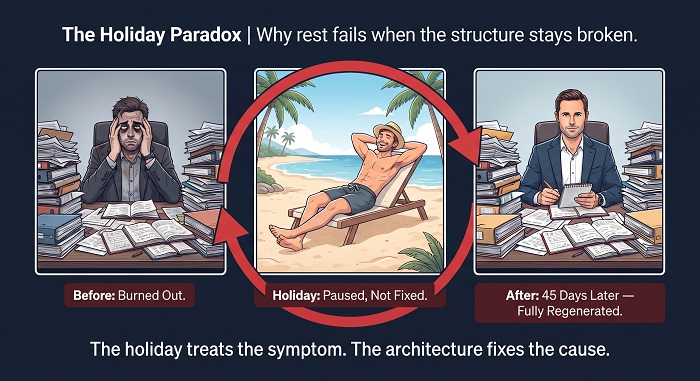
The Holiday Fails Every Time: A holiday taken from a structurally broken business is not a recovery. It is a pause. The founder returns to identical conditions, and the burnout regenerates within weeks. Recovery requires structural change, not temporary absence.
The Fastest Path Back to Mondays You Want Is Subtraction: The most immediately effective single action for burnout recovery is eliminating the activities, clients, and offers that generate the most burnout per unit of revenue, not adding more wellness practices on top of an unchanged workload.
Burnout Recovery and Business Building Are the Same Project: The architectural work required to recover from burnout, simplifying the model, building systems, installing team authority, rewiring the identity, is identical to the architectural work required to build a genuinely autonomous business. The recovery is the build. They are not separate programmes running in parallel.
What Burnout Is Really Telling You
The Sunday evening sensation, the low-level dread that settles somewhere between the chest and the stomach as the weekend gives way to the thought of Monday, is one of the most widely shared and least honestly discussed experiences in entrepreneurship.
It is also one of the most misdiagnosed.
Conventional advice treats Monday dread as evidence of an attitude problem: not enough gratitude for the business you have built, not enough morning routine, not enough resilience. The implication is that the founder needs to change their relationship to the workload. In reality, the founder's nervous system is giving them perfectly accurate information: tomorrow will begin another cycle of unlimited reactive demand with no visible end, no meaningful progress toward the freedom the business was supposed to provide, and no structural mechanism that would allow the day to finish before the founder is exhausted.
That is not a gratitude problem. It is a structural problem. And it produces a very specific type of suffering, one that conventional wellness advice cannot reach, because it treats the symptom while the structural cause remains completely unchanged.
The Three Types of Founder Burnout
Burnout presents similarly in almost all founders, exhaustion, cynicism, reduced effectiveness, and the Sunday dread but it is produced by three distinct root causes. Identifying the dominant type determines the most effective starting point for recovery.
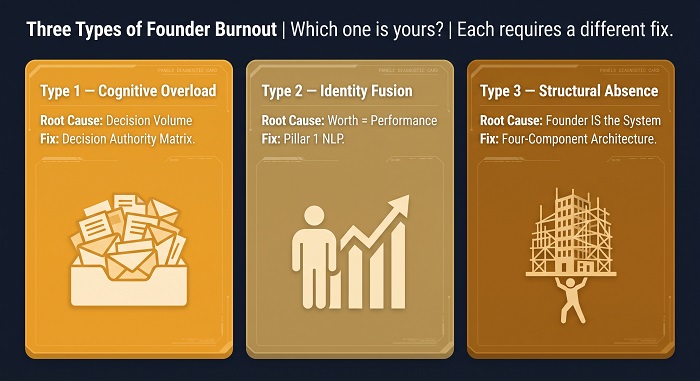
Type 1 — Cognitive Overload Burnout
Cognitive Overload Burnout is produced by the volume and variety of decisions the founder is required to make every working day. Research by psychologist Roy Baumeister on decision fatigue demonstrates that the quality of human decision-making degrades measurably after a sustained period of decision-making, regardless of the difficulty of individual decisions. A founder who is making 50–100 decisions per day, from strategic to trivial, from client to operational — is experiencing neurological depletion by early afternoon, every afternoon.
The experience: mental fog by 3 PM, inability to think clearly about important strategic questions, physical tiredness disproportionate to physical activity, irritability with team members and family, the sense that the working day is simultaneously endless and unproductive.
The structural cause: the absence of a Decision Authority Matrix means the founder is the default decision-maker for every situation, including hundreds of decisions that should never reach them.
The primary fix: install decision frameworks that eliminate 70–80% of the daily decision volume by assigning authority to team members for all routine and semi-routine decisions. The founder's decision-making bandwidth is then reserved exclusively for the genuinely strategic choices that justify it.
Type 2 — Identity Fusion Burnout
Identity Fusion Burnout is produced by the subconscious fusion of professional identity with business performance. When the founder's sense of worth, their self-concept, their feeling of being valuable and adequate, is entirely dependent on the business performing well, every client complaint, revenue dip, or operational setback is experienced as a personal threat to self-worth rather than a normal business event requiring a rational response.
The experience: disproportionate emotional reactivity to business setbacks. Inability to rest during downtime because it feels "unproductive" and therefore dangerous to self-worth. Constant sense of not doing enough. The business is never good enough because the founder is the business — and the founder's perfectionism extends to every aspect of the operation.
The structural cause: this is a Pillar 1 issue, the identity fusion was built gradually, over years, as the founder's professional achievements became the primary source of self-validation. No structural business intervention alone will solve it, because the issue is not in the business, it is in the psychological architecture that sits beneath it.
The primary fix: NLP and Timeline Therapy (Pillar 1) to dissolve the identity fusion and separate professional worth from business performance. The founder's self-concept is anchored in values, capabilities, and relationships that exist independent of the business's daily performance.
Type 3 — Structural Absence Burnout
Structural Absence Burnout is produced by the complete absence of business systems, the founder is not just involved in the business, they are the business. Every delivery requires them personally. Every decision requires them. Every client relationship is maintained by them. The business has no structural independent existence. The founder cannot stop without the business stopping.
The experience: the physical impossibility of rest, not just the psychological reluctance, but the genuine operational impossibility. There is always something that only the founder can do. Evenings are consumed by operational necessity. Holidays are impossible without significant client impact. The workload has no ceiling because there is no structure to absorb it.
The structural cause: the absence of documented systems, decision frameworks, quality benchmarks, and accountable owners, the Four-Component Architecture that allows the business to run without the founder as the system.
The primary fix: Pillar 3 (Freedom-First Business Structure), building the operational architecture that absorbs the founder's workload and allows the working week to have genuine, defended boundaries.
"Burnout is not the price of ambition. It is the cost of an architecturally broken business. Fix the architecture. The burnout resolves itself, permanently, not temporarily." — James R. Elliot
The Burnout Diagnosis Matrix
Use this matrix to identify your dominant burnout type. Match your primary symptoms to their root cause, and the correct primary intervention becomes clear.
Burnout Type | Primary Symptoms You Experience | Root Cause | What Does NOT Work | Primary Intervention |
Type 1 | Mental fog by mid-afternoon. Disproportionate tiredness. Inability to think strategically by end of day. Irritability with small decisions. Feeling busy but unproductive. | Decision overload. Founder is default decision-maker for 80%+ of daily situations, including hundreds that should never reach them. | Meditation, journalling, sleep hygiene. These help symptoms but leave decision volume unchanged. Burnout returns within days of any break. | Decision Authority Matrix. Assign decision categories to named team members. Eliminate 70–80% of daily decision volume reaching the founder immediately. |
Type 2 | Cannot rest without guilt. Disproportionate emotional response to setbacks. Business performance is never "enough." Perfectionism extending to all operational details. Sunday dread rooted in self-worth anxiety, not workload anxiety. | Founder's self-concept is fused with business performance. Setbacks are personal threats. Rest is experienced as failure. Busyness is experienced as worth. | Business systems and delegation. Structural improvements don't touch the psychological root. The founder rebuilds their operational centrality from a different psychological driver even after delegation. | Pillar 1: NLP and Timeline Therapy. Dissolve identity fusion. Anchor self-worth in values and capabilities independent of business performance. |
Type 3 | Cannot physically stop working, not just psychologically reluctant but operationally impossible. Always something only the founder can do. Evenings consumed by operational necessity. Holidays impossible without significant client impact. | The business has no structural independent existence. No systems, no decision frameworks, no accountable owners. Founder IS the system. | Holidays, "boundaries," time management techniques. These address personal behaviour without changing the structural conditions that make the founder operationally indispensable. | Pillar 3: Four-Component System Architecture. Build documented processes, decision frameworks, quality benchmarks, and accountable owners for every critical business function. |
Monday Dread to Monday Energy: What Changes
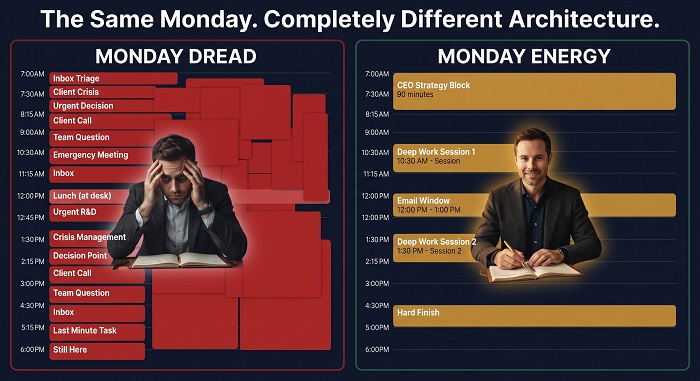
Business Dimension | 😔 Monday Dread (The Broken Architecture) | ✓ Monday Energy (The Rebuilt Architecture) |
How Monday Morning Begins | Inbox opened within 10 minutes of waking. Immediate reactive mode. Tone of the day set by whoever emailed at 6 AM. No agenda, just response management. | Protected 90-minute CEO block before any inbox is opened. Monday agenda pre-written on Friday. Three specific strategic priorities chosen. Inbox opened at 9:30 AM as a scheduled task. |
The First Decision of the Day | Usually made in response to a client or team message before breakfast. Reactive, low-context, often poor quality under the pressure of immediacy. | A strategic choice, made in the protected morning block, with full context and cognitive clarity. Not a response to someone else's agenda, a choice generated by the founder's own strategic plan. |
Decision Volume By Noon | 20–40 decisions, ranging from trivial to significant. Cognitive bandwidth significantly depleted before the afternoon's strategic work begins. | 3–5 genuinely strategic decisions. All routine and semi-routine decisions handled by the team under the Decision Authority Matrix. Cognitive bandwidth intact for the afternoon. |
The End of the Working Day | Not a defined time, the working day ends when the founder is too exhausted to continue. Often 8–10 PM. Inbox still open. Mental thread still active. | A defined time, consistently honoured. Inbox closed. Phone face-down. The business is running without the founder's active supervision, structurally, not as an act of willpower. |
The Source of Monday's Energy | None, or caffeine. The day begins in deficit, the Sunday dread has already consumed the emotional reserves that Monday requires. | Genuine clarity and purpose. Monday is the beginning of a week of chosen, high-leverage work on a business that is designed to serve the founder's life, not consume it. |
The Sunday Evening Experience | Low-level anxiety from approximately 5 PM. Mental rehearsal of tomorrow's problems. Inbox checked "just in case." Difficulty being present with family or for personal activities. | Genuine rest. Sunday belongs entirely to the founder. The Monday agenda is already written. The business is handled. The nervous system's alarm is no longer triggered, because the structural conditions that triggered it no longer exist. |
Why Standard Burnout Advice Fails Entrepreneurs
The conventional burnout recovery toolkit was developed primarily for employees in large organisations, people whose burnout is produced by excessive workload within a system they do not own or control. The recommended interventions (rest, boundaries, reduced hours, therapeutic support) are appropriate for that context. They are structurally insufficient for the context of a founder whose burnout is produced not by excessive hours within a working system but by being the system.
The Holiday Paradox
A founder who takes a two-week holiday from a business with no operational systems returns to a business with no operational systems. The two-week break restores their physical energy and provides temporary emotional relief. It changes nothing about the structural conditions that produced the burnout. Within 45–60 days of returning, the burnout is fully regenerated, often worse, because the accumulation of deferred decisions and undone work means the return workload is heavier than the pre-holiday workload was.
The Boundary Failure
A founder who attempts to set personal boundaries, "I will not check email after 6 PM", inside a business with no operational systems is attempting to create behavioural change that runs directly against the structural reality. The business requires the founder's presence after 6 PM because there is no structural mechanism that handles what arrives after 6 PM. Setting the boundary requires either ignoring the operational reality (generating anxiety) or breaking the boundary (generating guilt). Neither is recovery. Both are forms of suffering in a slightly different configuration.
The Framework: The 5 Shifts to Freedom and Burnout Recovery
The 5 Shifts to Freedom are the recovery map for founder burnout, because the conditions that produce burnout are identical to the conditions that prevent business freedom. Recovering from burnout and building a free business are the same project.
Shift 1 — Vision Alignment: Ending the Fog
The most immediate cognitive relief for Type 1 and Type 2 burnout is clarity. A founder who knows precisely what they are building, exactly why each decision is being made, and what the end state of the business looks like experiences a measurable reduction in cognitive load. The fog lifts not because the workload reduces immediately but because the decisions that remain all point in the same direction. Ambiguity is one of the most cognitively expensive states a founder can inhabit. Vision Alignment eliminates it.
Shift 2 — Ruthless Elimination: The Fastest Burnout Relief Available
The single fastest path to burnout relief is removing the offers, clients, and activities that generate the most burnout per unit of revenue. Not reducing them. Removing them. Most burned-out founders have at least two or three engagement types or client categories that consume disproportionate emotional, cognitive, and operational energy relative to the revenue they generate. Eliminating them, even if the short-term revenue impact is uncomfortable, produces immediate, measurable relief that no amount of wellness practice achieves at the same speed.
Shift 3 — Systems That Scale: Ending Structural Absence Burnout
The Four-Component System Architecture (documented process + decision framework + quality benchmark + accountable owner) directly addresses Type 3 Structural Absence Burnout by removing the founder as the system and replacing them with an operational infrastructure that runs independently. When this shift is complete, the working day has a genuine, structurally enforced end, not because the founder has more willpower, but because the systems handle what comes after.
Shift 4 — Mindset Unlock: Ending Identity Fusion Burnout
The deep Pillar 1 work of Shift 4 directly targets Type 2 Identity Fusion Burnout at its neurological root. The unconscious equation of worth with busyness, performance with adequacy, and rest with failure is dissolved. The founder's nervous system updates its baseline. Sunday evenings become what they were always supposed to be, the end of the week, not the beginning of tomorrow's anxiety.
Shift 5 — Magnetic Authority: Replacing Dread with Purpose
The final shift replaces the reactive, dread-driven Monday that burnout produces with a proactive, purpose-driven Monday that is the defining experience of the Limitless CEO. The founder's working hours are now exclusively occupied by the highest-leverage, most energising activities in the business, thought leadership, strategic relationships, premium positioning — activities that generate energy rather than consuming it.

Case Evidence
Tom — Type 3 Structural Absence Burnout, Recovered in 12 Weeks
Tom was a textbook Type 3. He had been running at 62 hours per week for three consecutive years. He had not taken a genuine holiday, uncontacted, offline, in four years. He had tried taking long weekends, but the accumulation of messages on his return made the break feel costlier than not taking it. He described his Sundays as "the worst part of the week."
His burnout was structural in its purest form: there were no systems. The business had twelve team members, but every significant decision and every quality review went through Tom personally. The business required his presence to function every day.
We began with Shift 2 (Ruthless Elimination), removing two service lines that consumed 35% of Tom's decision-making bandwidth while generating only 18% of revenue. Then Shift 3 (Systems That Scale), building decision frameworks, quality benchmarks, and accountable ownership for all remaining delivery processes. By Week 12, Tom took a four-day uncontacted break for the first time in four years. Nothing broke. He returned on a Monday morning for the first time in recent memory looking forward to his agenda. The Sunday dread was gone, not because Tom had changed his attitude, but because the structural conditions that generated it had been dismantled.
Jennifer — Type 2 Identity Fusion Burnout, Resolved Through Pillar 1
Jennifer's burnout presented very differently. Her working hours were high, 55 per week, but not as extreme as Tom's. Her suffering was primarily internal rather than operational: a persistent sense of inadequacy regardless of performance, an inability to celebrate wins before moving to the next target, and a quality of rest during evenings and weekends that was essentially non-existent because the mental thread never switched off.
The structural interventions that worked for Tom would not have reached Jennifer's core issue, because the problem was not structural. Jennifer could have delegated everything and still experienced the same anxious monitoring thread, because the thread was generated by her identity, not by her operational responsibilities.
Through Pillar 1, specifically four weeks of NLP and Timeline Therapy, Jennifer dissolved the identity fusion that had accumulated over eleven years of equating business performance with personal worth. By the end of Week 4, she described experiencing her first genuinely restful Sunday in "as long as I can remember." Revenue had not changed. Hours had not changed. The architectural root of her burnout had changed, and the symptoms (the monitoring thread, the Sunday dread, the inability to rest) resolved immediately.
Decision Framework: Which Recovery Path Is Yours?
Start with Pillar 1 if: Your burnout is predominantly Type 2 (Identity Fusion). You feel the anxiety even on days when nothing has gone wrong. You cannot rest without guilt regardless of how well the business is running. You would feel the same internal pressure even if every operational task were delegated. The suffering is internal, not a response to external operational demand.
Start with Shift 2 (Ruthless Elimination) if: Your burnout is predominantly Type 1 or Type 3 and is most acute in relation to specific clients, offers, or activities. The fastest immediate relief is removing the highest-burnout, lowest-leverage work from your week, starting this week, not after a strategic planning session.
Start with Pillar 3 if: Your burnout is predominantly Type 3 (Structural Absence) and you are psychologically ready to step back but there are genuinely no systems to step back into. You want to trust your team, the architecture does not yet exist to make that trust safe. Build the systems. The rest becomes possible.
Try This: The Sunday Evening Test (5 Minutes)
Step 1 Rate your last Sunday evening on a scale of 1 (severe dread) to 10 (genuine peace and presence). Be honest. The number below 7 is data, not judgment.
Step 2 Identify what you were dreading specifically. Was it the volume of decisions waiting on Monday? (Type 1 signal.) Was it a diffuse anxiety about whether you are doing enough, being enough? (Type 2 signal.) Was it the specific knowledge that certain tasks can only be done by you and they are waiting? (Type 3 signal.)
Step 3 Name one item you are carrying this week that should not require your personal involvement, a task, a decision, a client communication, that you are doing because there is no system or team authority to handle it instead. That single item is your first build target. Document it. Delegate it. Build the system for it this week.
Run this test again in 30 days. The score should move. If it does not, a structural change has not yet been made, and the architecture, not the founder, needs attention.
Further Reading
Entrepreneurial Mindset Through NLP — the Pillar 1 tools that resolve Type 2 Identity Fusion Burnout at its neurological root.
Overcoming Procrastination — understanding how burnout and avoidance interact: the paralysis that arrives when the workload feels permanently overwhelming.
Harnessing Structure & Systems — the Pillar 3 architecture that resolves Type 3 Structural Absence Burnout permanently.
Mastering Mindsets for Business — the broader mindset framework for separating business performance from personal identity — the prerequisite for Type 2 recovery.
American Psychological Association: Work Burnout — external research distinguishing burnout from stress and the evidence base for structural versus symptomatic intervention approaches.
Frequently Asked Questions
What causes entrepreneur burnout and how is it different from employee burnout?
Entrepreneur burnout shares the surface symptoms of employee burnout, exhaustion, cynicism, reduced effectiveness, but has distinct root causes. Employee burnout is typically produced by excessive workload within a system the individual does not control. Entrepreneur burnout is most commonly produced by one of three structural and psychological conditions: decision overload (the founder makes every decision in the business, including hundreds that should be delegated), identity fusion (the founder's self-worth is fused with business performance, making every setback a personal threat), or structural absence (the business has no operational systems, making the founder's personal presence operationally indispensable). Employee burnout can sometimes be resolved by workload reduction. Entrepreneur burnout requires architectural intervention.
Why do holidays not fix entrepreneur burnout?
Because a holiday removes the founder from the business temporarily without changing the structural conditions that produced the burnout. A founder who returns from two weeks away returns to a business with the same decision overload, the same absent systems, and the same identity fusion. The holiday restores physical energy. It does not change any of the architectural variables. The burnout regenerates, typically within 45–60 days, as the restored energy is consumed by identical structural conditions. Genuine burnout recovery requires changing the architecture, not temporarily exiting it.
Is it possible to build a successful business without burning out?
Yes, when the business is architecturally designed to prevent burnout from the beginning. A business built with documented systems, clear team authority, a simplified offer model, and a founder whose identity is independent of daily operational performance does not produce the conditions for burnout. Most burnout occurs in businesses that were built for speed and revenue without attention to the structural conditions of the founder's working life. Retrofitting those structures, through the 3-Pillar Blueprint, resolves existing burnout and prevents its recurrence.
How long does it take to recover from entrepreneur burnout?
The first measurable relief typically arrives within 2–4 weeks of the correct primary intervention, which varies by burnout type. Type 1 (Cognitive Overload) responds fastest to structural changes: installing a Decision Authority Matrix and decision frameworks can reduce daily decision volume within days. Type 3 (Structural Absence) requires more build time, typically 6–12 weeks for the core system architecture to be operational. Type 2 (Identity Fusion) responds to 3–6 weeks of intensive NLP and Timeline Therapy work. The full architectural recovery — where the burnout conditions are permanently dismantled rather than temporarily managed — is typically complete within the 16-week Limitless Entrepreneur programme.
Can I recover from burnout while still running my business at full capacity?
Yes, in fact, you must. The recovery work happens inside the business, not outside it. Shift 2 (Ruthless Elimination) reduces the burnout-generating workload immediately. Shift 3 (Systems That Scale) builds the architecture during the working week, not in addition to it. Pillar 1 (Performance Psychology) is delivered through sessions that replace rather than add to the founder's schedule. The 3-Pillar Blueprint is designed specifically for founders who cannot step away from their businesses to recover, who must rebuild the aircraft while flying it. The sequence is designed to generate relief as it progresses, not only after it is complete.
Conclusion: The Monday That Changed the Frame
James R. Elliot spent years experiencing the Sunday evening signal and misreading it as a personal failing. He tried the morning routine. He tried the gym. He tried the gratitude journal. He tried the holiday twice, both times returning to identical conditions, re-burning within 45 days of return. The advice he had was excellent advice for managing burnout symptoms. None of it addressed the structural and psychological architecture that was continuously producing them.
The recovery arrived when he stopped treating burnout as a wellbeing problem and started treating it as an engineering problem. His business was architecturally broken in three specific, diagnosable, fixable ways. He was carrying a decision volume that a Decision Authority Matrix could have absorbed. He was experiencing identity fusion that four weeks of NLP and Timeline Therapy dissolved. He was inside a system with no structural existence independent of his personal presence, and building the Four-Component Architecture gave it that existence.
The first Monday after the architecture was fully installed, he woke up and realised, genuinely, for the first time in 24 years, that he was looking forward to his agenda. Not because the work had become easier. Because the work he was doing was entirely chosen, entirely strategic, and entirely his. The reactive, compulsory, unlimited demand was gone. It had been replaced by a defined, protected, purposeful morning with a hard finish at a time of his choosing.
He visits his niece now. He takes a 36-minute nap every afternoon. He works 25 hours per week. And Sunday evenings belong to him entirely. That is not a wellness outcome. It is an engineering outcome. Build the architecture. The Mondays follow.
Ready to diagnose your burnout type and map the architectural recovery? Book the Freedom Blueprint Call (30 mins). We will run the Burnout Diagnosis Matrix together and identify your specific recovery sequence.