
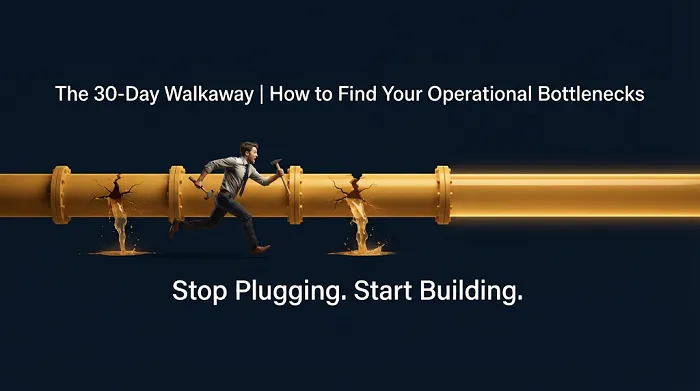
The 30-Day Walkaway: How to Find Your Operational Bottlenecks
An operational bottleneck is any point in your business process where work stalls, quality drops, or decisions cannot be made without your personal involvement. Most founders cannot identify their bottlenecks clearly because they are always inside the system, patching problems in real time before they become visible. The 30-Day Walkaway is a structured diagnostic protocol: by systematically reducing your operational presence over 30 days, first to four days a week, then three, then two, you create controlled pressure on your business systems. Every crack that appears under that pressure is a documented bottleneck. Instead of guessing where your business depends on you, you let reality tell you with precision. The bottlenecks you discover during the Walkaway become the exact build list for your Freedom-First operational architecture. This is not a sabbatical. It is a diagnostic. And it is the most efficient tool available for converting a founder-dependent operation into a genuine autonomous business.
Key Takeaways
Bottlenecks Are Invisible While You Are Present: As long as you are in the business full-time, you unconsciously resolve problems before they surface as visible failures. You must step back to see what breaks.
The 30-Day Walkaway Is a Diagnostic, Not a Holiday: Every problem that appears during your reduced presence is not a crisis, it is data. It is your business telling you exactly what system needs to be built next.
The Three Bottleneck Categories: Every operational bottleneck falls into one of three types: Decision Bottlenecks (only you can approve), Knowledge Bottlenecks (only you know how), or Relationship Bottlenecks (clients only trust you). Each requires a different fix.
The Build List Is the Output: The goal of the 30-Day Walkaway is not to prove the business can survive without you. It is to generate a precise, prioritised list of systems, SOPs, and delegation structures that need to be built.
Psychology Must Come First: Many founders unconsciously sabotage the Walkaway by staying "slightly available", answering one message, checking in once. The psychological rewiring to tolerate the discomfort of stepping back is the prerequisite to getting accurate diagnostic data.
The Founder Who Cannot See the Ceiling
There is a peculiar blindness that affects almost every successful service-based entrepreneur. They have been inside their business, actively managing, adjusting, and personally resolving problems, for so long that they genuinely cannot identify where the operational bottlenecks are.
Ask a founder trapped at 60-hour weeks where their business depends on them and they will typically say: "Everywhere." Or, more dangerously: "Nowhere, I have a team."
Neither answer is actionable. "Everywhere" cannot be fixed systematically. "Nowhere" is almost certainly false, and the false confidence it creates is the most dangerous state a scaling business can be in.
The only reliable way to find operational bottlenecks with precision is to introduce controlled absence. Remove the founder from specific functions. Watch what breaks. Document exactly what broke, how it broke, and what decision or knowledge was missing that caused the break. That documented list is your operational build plan.
This is the logic behind the 30-Day Walkaway.
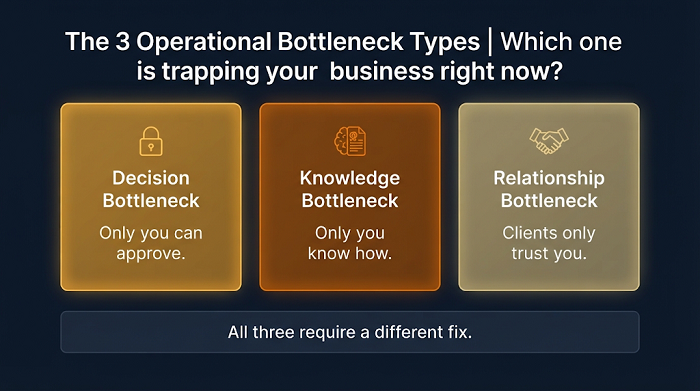
The Three Types of Operational Bottleneck
Before running the Walkaway, it helps to understand the three categories every bottleneck falls into — because each has a different solution architecture.
Type 1 — The Decision Bottleneck
A decision bottleneck exists when your team consistently escalates choices to you that they should be able to make independently. This is the most common bottleneck in founder-led businesses, and it is almost always a symptom of unclear authority structures rather than team incompetence.
Symptoms: Your inbox is full of questions that begin with "Should I..." or "Is it okay to..." Your team freezes on routine client requests without your approval. Nothing ships without a final check from you.
The fix: A Decision Authority Matrix, a documented guide that maps which decisions your team owns at full authority, which require a brief check, and which are yours alone.
Type 2 — The Knowledge Bottleneck
A knowledge bottleneck exists when critical operational knowledge lives only in your head. Your team cannot execute a process because the steps, standards, or judgment criteria were never written down, they exist as institutional memory only you carry.
Symptoms: The same questions are asked repeatedly by team members. Quality varies dramatically when you are not reviewing the work personally. Onboarding new team members is almost impossibly slow because everything must be taught verbally, by you.
The fix: Standard Operating Procedures (SOPs) that extract your knowledge into documented, replicable frameworks. The methodology extraction process used in Shift 3 (Systems That Scale) is the primary tool here.
Type 3 — The Relationship Bottleneck
A relationship bottleneck exists when clients expect and require direct access to you specifically, not your team, not your methodology, but you personally. This bottleneck is the most psychologically entangled, because it often feels like a compliment ("they love working with me") rather than a structural problem.
Symptoms: Clients book sessions with you personally and refuse substitutes. Complaints arrive when team members handle communications. Client retention drops sharply when your personal availability is reduced.
The fix: Strategic transition of high-value client touchpoints to a documented process that your team delivers, while you retain only the highest-leverage relationship moments (initial assessment, strategic reviews, final delivery).
"You cannot fix a bottleneck you cannot see. And you cannot see a bottleneck you are continuously patching. Step back. Let it break. Then build it properly." — James R. Elliot
The 30-Day Walkaway Protocol
The Walkaway is run in four weekly phases, each increasing your absence and therefore increasing the pressure on your operational systems. Each phase generates specific diagnostic data.
Week 1 — The Observation Week (4 Days Present, 1 Day Away)
Before reducing your presence, spend Week 1 documenting. For every task you perform personally, note three things: (1) what the task is, (2) why it requires your personal involvement, and (3) how long it takes.
On Day 5, take a complete day away from the business, phone off, email closed, zero check-ins. Document every message, escalation, or problem that accumulated during your absence. These are your first documented bottlenecks.
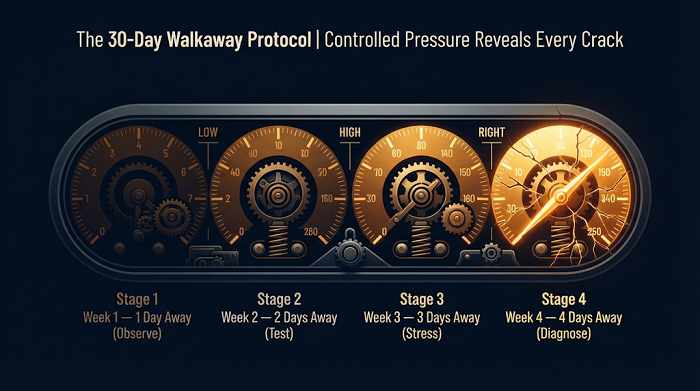
Week 2 — The Pressure Test (3 Days Present, 2 Days Away)
Extend your absence to two consecutive days. Before leaving, do not brief your team on how to handle things. Do not leave a list of instructions. The absence must be unmediated to generate accurate diagnostic data.
Document everything that broke, stalled, or required your intervention on return. Categorise each item: Decision Bottleneck, Knowledge Bottleneck, or Relationship Bottleneck.
Week 3 — The Stress Test (2 Days Present, 3 Days Away)
By now, your team is beginning to adapt. But three consecutive days of absence will expose the deeper, less obvious bottlenecks, the ones that your team managed to paper over during the Week 2 two-day test. Document everything that surfaced.
Week 4 — The Full Diagnostic (1–2 Days Present, 3–4 Days Away)
The final phase reveals your systemic bottlenecks, the ones that appear not in acute crises but as gradual quality degradation, missed details, and declining client experience. These are often the most important ones to fix, and the hardest to see without sustained absence.
At the end of Week 4, you have your complete Operational Build List: every specific bottleneck, categorised by type, documented with the exact symptom it produced.
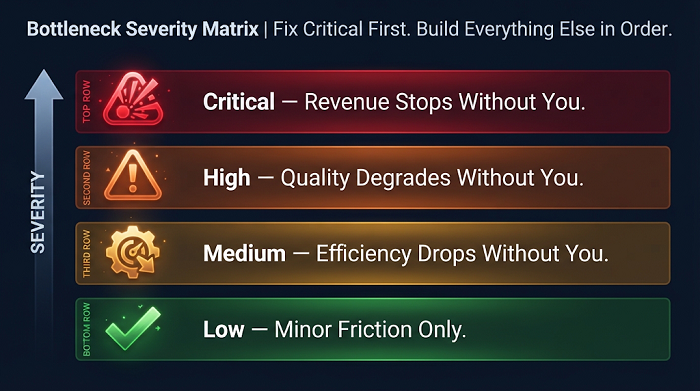
The Bottleneck Severity Matrix
Not all bottlenecks are equally urgent to fix. Use this matrix to prioritise your Operational Build List after the 30-Day Walkaway.
Severity Level | Definition | Symptoms Observed During Walkaway | Fix Priority |
Critical | The business cannot generate or retain revenue for more than 48 hours without your direct intervention. | Contracts unsigned. Sales calls not closed. Client payments not chased. Deliverables not shipped. Emergency client calls made directly to you. | Fix first. Week 5–6. Document and delegate immediately. This is a survival-level structural failure. |
High | Revenue continues but client experience drops measurably within 5 days of your absence. | Client feedback declines. Deliverable quality inconsistent. Team makes decisions that you would not make. Clients escalate to you directly. | Fix next. Weeks 6–8. Requires SOP creation and team authority restructuring. |
Medium | Operations continue and quality holds, but speed and efficiency decline significantly. | Tasks take twice as long. Decisions queue up waiting for your return. Team morale dips. Minor client irritations reported. | Fix in Phase 3. Weeks 8–12. Requires documented decision trees and team confidence building. |
Low | The business runs at near-normal capacity. Isolated minor issues appear but resolve themselves or are handled by the team. | One or two non-urgent questions queued. Minor administrative delay. Team shows initiative and resolves most things independently. | Monitor and optimise. Ongoing. These are evidence the system is working. Refine further over time. |
Before and After the 30-Day Walkaway
Business Area | Before the Walkaway (The Guessing State) | After the Walkaway (The Build State) |
Bottleneck Visibility | Founder suspects "everything depends on me" but cannot articulate specific points of failure. | A precise, categorised list of 8–15 specific bottlenecks, each with the exact symptom it produced during absence. |
Build Priority | Founder doesn't know what to delegate, systematise, or automate first. Every problem feels equally urgent. | A severity-ranked build list. Critical bottlenecks addressed first. Founder knows exactly which SOP to write this week. |
Team Capability | Founder believes team "isn't ready" to operate independently — but has never tested this belief with structured absence. | Real capability data. Founder knows exactly which team members stepped up, which decisions they struggled with, and what training/authority they need. |
Founder's Work Week | 60+ hours. Founder is the first to arrive, last to leave, and is mentally on call 24 hours a day. | Structured 4-day week in progress. Founder works on the build list — creating the systems that will eventually make the 3-day and 2-day week possible. |
The Framework: The 5 Shifts to Freedom & The 3 Pillars
The 30-Day Walkaway feeds directly into the Limitless Entrepreneur methodology by generating the precise input data that Shift 3 and Pillar 3 require.
The 3 Pillars: Where the Walkaway Fits
Pillar 1 — Performance Psychology: The prerequisite to running an honest Walkaway. Many founders cannot tolerate the anxiety of stepping back, they compulsively check in, answer one message, review one deliverable, and contaminate the diagnostic data. Through NLP and Timeline Therapy, we dissolve the anxiety of operational absence so the Walkaway produces clean, accurate data.
Pillar 2 — Freedom-First Business Strategy: The Walkaway data is used here to inform strategic decisions. Which offers require the most founder involvement? Which client segments generate the most relationship bottlenecks? The diagnostic determines which parts of the business model need to be restructured before the systems can be built.
Pillar 3 — Freedom-First Business Structure: The Operational Build List generated by the Walkaway becomes the exact construction plan for Pillar 3. Every Critical and High severity bottleneck gets an SOP, a decision authority assignment, or a delegation structure built in Weeks 5–12.
The 5 Shifts: The Walkaway in Sequence
Phase 1: Clarity (Weeks 1–4)
Shift 1 — Vision Alignment: We establish the exact future state of the business before running the Walkaway. What does "Day 30 with you absent four days a week" look like? This vision becomes the measurement standard against which the Walkaway data is assessed.
Phase 2: Liberation (Weeks 5–11)
Shift 2 — Ruthless Elimination: Before building systems for everything on the Walkaway build list, we eliminate any offer or process that should not exist at all. No point building an SOP for a service you should be discontinuing.
Shift 3 — Systems That Scale: The primary build phase. Every Critical and High severity bottleneck on the Walkaway list is converted into a documented, delegable system. The founder's knowledge is extracted into SOPs. Decision authority is formally assigned.
Phase 3: Amplification (Weeks 12–16)
Shift 4 — Mindset Unlock: The emotional residue of the Walkaway, guilt about stepping back, anxiety about client relationships, fear of becoming irrelevant, is resolved neurologically. The founder genuinely releases the operational role.
Shift 5 — Magnetic Authority: With the systems built and the founder released from operational management, their attention is now entirely available for the highest-leverage CEO activities: thought leadership, strategic relationships, and premium market positioning.
Case Evidence: What the Walkaway Reveals
David — Three Days Away That Changed Everything
David had twelve team members and was still working sixty hours a week. He was convinced the problem was hiring, he just needed better people. We ran the 30-Day Walkaway protocol instead. On his first three-day absence, four things broke: a new client contract sat unsigned because no one had authority to approve the standard terms; two deliverables were delivered late because only David knew the exact quality threshold; a key client sent an escalation email directly to David because they did not trust his team to handle a sensitive request.
These were not people problems. They were system problems. We used the Walkaway data to build a Decision Authority Matrix, two critical SOPs, and a structured client relationship handover protocol. David ran the Walkaway again six weeks later. Nothing broke. He was physically absent for four days and the business ran at full capacity. He finally had a business, not a job with twelve employees.
Nik — The Knowledge Bottleneck Uncovered
Nik believed his team was incapable. He had a team of three delivering his core methodology and felt compelled to review every piece of work before it went to clients. Through the Walkaway, we discovered the truth: his team was not incapable, they were uninformed. Nik had never written down his quality standards. His team was making reasonable decisions based on incomplete information and being overridden by Nik based on criteria he had never shared with them.
The Walkaway produced a five-page Knowledge Bottleneck list. We converted that list into a 23-page Delivery Standards document, the knowledge extraction that Shift 3 prescribes. Within 30 days of the document being published, Nik's team was operating at 94% of his personal quality standard without his involvement. His review sessions dropped from daily to weekly.
Decision Framework: Are You Ready to Run the Walkaway?
✓ You are ready if: You have at least one team member (full-time, part-time, or contractor) who could theoretically handle operations in your absence. The business is actively generating revenue. You are willing to experience discomfort and resist the urge to intervene, because the data only works if your absence is genuine.
✗ You are not ready if: You are a solo operator with zero team. You cannot afford to lose a single client during the diagnostic period. Or if the idea of being absent for even one day triggers a threat response you cannot manage, in that case, Pillar 1 (Performance Psychology) must come first to build the psychological tolerance for absence.
Try This: The 24-Hour Mini-Walkaway
Step 1 Prepare nothing. Tomorrow, take one full working day completely away from the business. No briefing your team. No leaving a task list. No setting up "just in case" protocols. The absence must be cold and unmediated to generate accurate data.
Step 2 Log every interruption. Every call, message, or escalation that reaches you during your absence, write it down. Include: what the issue was, who sent it, and what decision or information was missing that caused the escalation.
Step 3 Categorise your log. On returning, look at your list. Sort each item: Decision Bottleneck, Knowledge Bottleneck, or Relationship Bottleneck. Count how many items fall into each category.
Step 4 Pick the top one. The single highest-severity item on your list is your first build priority. Document it. Assign it. Build the system this week. Then repeat the 24-Hour Mini-Walkaway next week to test whether the fix held.
Further Reading
Harnessing Structure & Systems — how to build the operational architecture revealed by your Walkaway bottleneck list.
Entrepreneurial Mindset Through NLP — building the psychological tolerance for operational absence before running the Walkaway.
Effective Decision Making — building the Decision Authority Matrix that solves Type 1 Decision Bottlenecks.
Mastering Mindsets for Business — resolving the identity fusion that compels founders to stay operationally central.
Harvard Business Review: How to Decide Which Tasks to Delegate — external research on identifying and resolving founder-level delegation failures.

Frequently Asked Questions
What is an operational bottleneck in a business?
An operational bottleneck is any point in your business process where work stops, quality drops, or decisions cannot be made without a specific person's direct involvement, typically the founder. Bottlenecks fall into three types: Decision Bottlenecks (only you can approve), Knowledge Bottlenecks (only you know how), and Relationship Bottlenecks (clients only trust you personally). The 30-Day Walkaway is a structured diagnostic tool for identifying exactly which type you have and where they sit.
Won't stepping back during the 30-Day Walkaway damage client relationships?
In the short term, there may be minor friction as clients adapt to your team. However, a business where clients can only be served by the founder is not a scalable or sellable business, it is a dependency that ultimately harms clients by making the quality of their experience contingent on your personal availability. The Walkaway, executed well, actually improves long-term client experience by revealing and fixing the structural gaps that prevent your team from serving clients at the highest standard.
What if everything breaks during the Walkaway?
That is actually the ideal outcome. Everything breaking means the diagnostic worked, you now have a complete and accurate bottleneck list. The Walkaway is not a test you pass or fail. It is a data collection exercise. The more things break, the more precisely you know what systems to build. The business that breaks completely during a 48-hour absence is a business with a very clear, actionable build list ahead of it.
How is the 30-Day Walkaway different from taking a normal holiday?
A normal holiday typically involves extensive briefing of the team, "emergency contact" protocols, daily check-ins disguised as casual messages, and early returns. All of these contaminate the diagnostic data by allowing the founder to patch problems in real time. The Walkaway requires genuine, unmediated absence, specifically because the cracks that appear when the founder cannot intervene are the real bottlenecks. Managed holidays hide them.
How do I build the systems identified in my Walkaway bottleneck list?
Each bottleneck type requires a specific solution. Decision Bottlenecks require a Decision Authority Matrix, a documented framework that assigns specific decision categories to team members by name. Knowledge Bottlenecks require Standard Operating Procedures that extract the founder's institutional knowledge into written, replicable steps. Relationship Bottlenecks require a structured Client Relationship Transition protocol that systematically moves client trust from the founder's personality to the business's methodology. Shift 3 (Systems That Scale) within the 5 Shifts to Freedom addresses all three in sequence.
Conclusion: The Business That Taught Itself to Walk
James R. Elliot ran five businesses before he understood that the operational bottlenecks holding him back were invisible to him precisely because he was always present to smooth them over. He was working 80 hours a week on anxiety medication, believing his team was the problem, his clients were the problem, the market was the problem.
He was the problem. Specifically, he was the system, and systems cannot see themselves from the inside.
The moment he stepped back, genuinely stepped back, phone off, for four consecutive days, the business told him everything he needed to know. Seven specific bottlenecks appeared with perfect clarity. He built seven systems in response. Within 90 days, his working week had dropped from 80 hours to 25. Revenue increased because the systems, not the founder, were now delivering the value.
He visits his niece now. He takes a 36-minute nap every afternoon. He runs a business that walks on its own.
The only way to find out what needs building is to find out what breaks when you leave. Leave. Then build.
Ready to identify your operational bottlenecks? Book the Freedom Blueprint Call (45 mins). We will map your specific bottleneck categories and design your Walkaway protocol together.