
The 3-Pillar Blueprint: Integrating Mindset, Strategy, and Structure
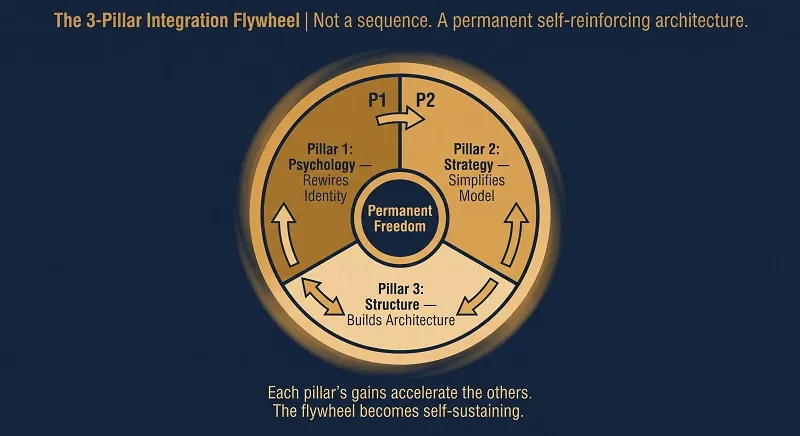
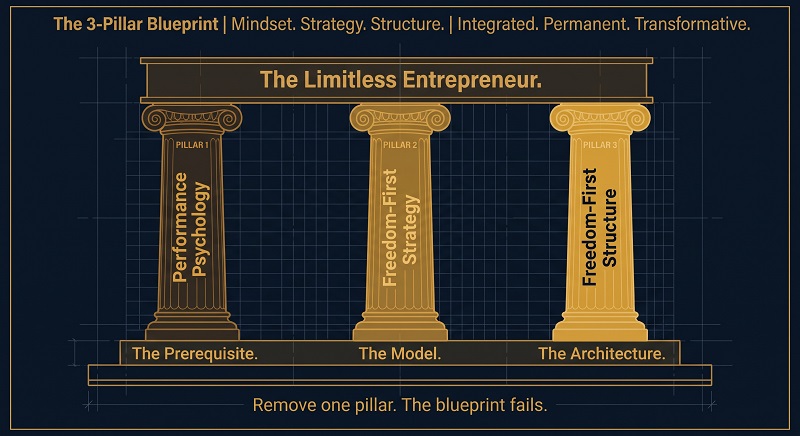
The 3-Pillar Blueprint is the foundational architecture of the Limitless Entrepreneur methodology. It is built on a single insight that most business transformation frameworks ignore: sustainable business freedom requires three distinct interventions applied in deliberate sequence and maintained in permanent integration, Performance Psychology (mindset), Freedom-First Business Strategy, and Freedom-First Business Structure. Remove any one pillar and the other two become temporarily effective at best, self-defeating at worst. A founder who rewires their mindset without redesigning their strategy will think differently inside the same limiting model. A founder who builds operational systems without doing the psychological work will unconsciously undermine every system they create. A founder who redesigns their strategy without building the structural infrastructure will have a compelling vision they cannot operationally execute. The 3-Pillar Blueprint is not a linear programme where you complete one section and move to the next. It is an integrated architecture where all three pillars are active simultaneously, each reinforcing and accelerating the other two. The result is not incremental improvement — it is a categorical transformation in how the business operates, how the founder shows up, and what becomes permanently possible.
Key Takeaways
Single-Pillar Approaches Always Fail Eventually: A mindset-only approach (coaching, therapy, NLP without business redesign) produces a psychologically healthier founder trapped in the same limiting model. A strategy-only approach (business consulting, offer redesign) produces a better-designed business that the founder's psychology quietly undermines. A structure-only approach (systems, SOPs, delegation tools) produces operational architecture that collapses when the founder re-enters it compulsively. Integration is not optional — it is the mechanism.
Pillar 1 Is the Prerequisite, Not the Programme: Performance Psychology is not the full methodology — it is the prerequisite for everything else. Without the psychological rewiring that Pillar 1 provides, every Pillar 2 strategy decision and every Pillar 3 system will be subtly undermined by the founder's unchanged subconscious programming.
The Pillars Reinforce Each Other Non-Linearly: Progress in Pillar 1 accelerates Pillar 2 clarity. Pillar 2 simplification makes Pillar 3 systems more buildable. Pillar 3 structural wins create new psychological evidence that reinforces Pillar 1 rewiring. The three pillars are not sequential — they are mutually amplifying.
The Blueprint Is Designed Around Permanent Installation: The 3-Pillar Blueprint is not a 16-week sprint that ends at completion. It is an architectural installation — a permanent operating system for the business and the founder. Once installed, it does not require maintenance from external support. It is self-reinforcing.
The Integration Point Is the Founder: The three pillars converge in a single place: the founder's daily decisions. A founder who has done the psychological work, redesigned the strategy, and built the structural systems makes every decision from a completely different operating context. The cumulative effect of those transformed decisions is the business transformation.
Why Single-Pillar Approaches Fail
The business coaching and personal development industries have produced two decades of powerful single-pillar solutions — and a consistent track record of incomplete, unsustained results. Not because the individual tools are ineffective. They often are highly effective in isolation. The failure occurs at the integration gap: the point where a powerful intervention in one domain runs directly into an unchanged constraint in another.
The Mindset-Only Trap
The founder invests deeply in coaching, therapy, NLP, or mindset work. They think differently. They feel differently. They genuinely shift in their internal relationship to the business. And then they return to a business model that is structurally designed to consume their time and require their personal involvement — and the psychological gains are slowly eroded by the daily structural reality. Six months later, they are booking another mindset programme, not because the first one failed, but because there was no structural redesign to hold the psychological gains in place.
The Strategy-Only Trap
The founder works with a business consultant or strategist. They redesign their offer, their pricing, their market positioning, their client acquisition model. The strategy is sound. But the founder implementing it is psychologically unchanged, still driven by the same identity that equates control with safety, still uncomfortable delegating, still compulsively inserting themselves into every delivery touchpoint. The new strategy is implemented in exactly the same founder-dependent way as the old one. The model changes. The outcome does not.
The Structure-Only Trap
The founder builds systems. They hire a team. They document processes. They implement project management tools. And then, because the psychological work was never done, they unconsciously undermine every structural improvement: they re-enter every system at the final review stage, they answer every question their team has the framework to handle, they maintain the Identity Layer intact beneath a surface of operational sophistication. The systems exist. The founder is still inside them.
"Mindset without structure is inspiration without implementation. Strategy without psychology is a map in the hands of someone who does not believe they can leave. Structure without mindset is a cage you have redecorated. All three, integrated and sequenced — that is the only architecture that holds." — James R. Elliot
The 3 Pillars: Full Architecture
PILLAR 1 Performance Psychology — The Prerequisite Foundation
What it is: The systematic reprogramming of the subconscious beliefs, identity structures, and nervous system responses that drive the founder's daily decisions. Delivered through NLP (Neuro-Linguistic Programming) and Timeline Therapy, tools that operate at the subconscious level where habitual decision-making is formed and where lasting change must be anchored.
What it addresses: The Identity Layer of the successful prison. The belief that operational indispensability equals worth. The threat response that activates when the founder considers stepping back. The imposter patterns that prevent premium pricing. The perfectionism that prevents genuine delegation. The compulsive busyness that fills reclaimed time with new low-leverage activity.
What changes when it works: The founder's baseline changes. Stepping back feels correct rather than dangerous. Trusting the team feels appropriate rather than risky. Working 25 hours feels like mastery rather than slacking. Premium pricing feels aligned rather than arrogant. These are not cognitive shifts, they are subconscious reprints. The founder does not talk themselves into a new behaviour. They find the old behaviour no longer arises.
Why it must come first: Without Pillar 1, every Pillar 2 strategy decision is filtered through the founder's unchanged psychology, brilliant strategic decisions made and then quietly undermined in implementation. Every Pillar 3 system is built by a founder who cannot genuinely trust it, resulting in systems that are installed and then re-entered compulsively. Pillar 1 makes Pillars 2 and 3 possible to sustain.
PILLAR 2 Freedom-First Business Strategy — The Model Redesign
What it is: A deliberate redesign of the business's fundamental operating model, what it sells, to whom, at what premium, delivered how, and with what structural constraints on the founder's personal involvement. It is not tactical marketing advice. It is the strategic architecture of a business that is designed from inception to operate with minimal founder involvement in delivery.
What it addresses: The Offer Layer of the successful prison. Service models designed around personal delivery that cannot be systematised. Pricing models that cap revenue at the founder's available hours. Client acquisition processes that attract founder-dependent clients. Revenue diversification strategies that increase complexity without increasing freedom.
What changes when it works: The business sells a documented methodology, not a founder's personal time. Pricing reflects the value of outcomes rather than the cost of hours. The client base is simplified to premium clients who buy results rather than access. Revenue is generated by the business's model, not the founder's diary.
The key strategic moves: Ruthless Elimination (removing every offer that cannot be systematised or delegated), Methodology Extraction (converting personal delivery into a named, documented, replicable framework), Premium Repositioning (restructuring pricing to reflect outcome value rather than input hours), and Client Architecture (deliberately designing the client profile, onboarding, and relationship model to produce the highest revenue with the lowest founder-involvement requirement).
PILLAR 3 Freedom-First Business Structure — The Operational Architecture
What it is: The full operational infrastructure that allows the business to function autonomously, documented systems with decision frameworks and quality benchmarks, a team with genuine authority, communication protocols that eliminate founder-as-default-escalation, and performance measurement systems that give the founder visibility without requiring daily involvement.
What it addresses: The Structural Layer and the Relationship Layer of the successful prison. The absence of systems means the founder is the system. The absence of decision authority means the team cannot operate independently. The absence of quality benchmarks means the founder must personally verify every output.
What changes when it works: The business runs in the founder's absence without degradation in quality or client experience. The team makes decisions, handles exceptions, and improves processes without founder involvement. The founder receives a weekly performance summary and no escalation requests. A 30-day, uncontacted absence produces no operational crisis.
The structural components: Four-Component System Architecture (documented process + decision framework + quality benchmark + accountable owner), Strategic Client Transition (repositioning client relationships from founder-personal to methodology-based), Decision Authority Matrix (explicit assignment of decision categories to team members by name), and Performance Dashboard (founder-visible metrics that make operational check-in unnecessary).
What Breaks When a Pillar Is Missing
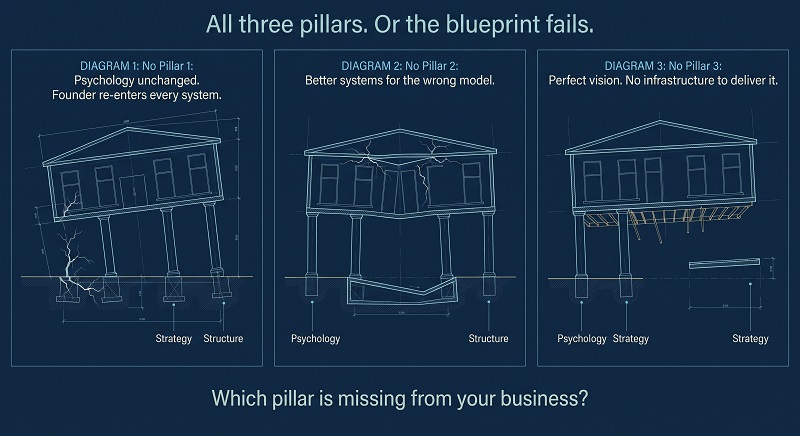
The following matrix documents the specific, predictable failure modes that occur when each pillar is absent. These are not theoretical — they are the patterns observed consistently in founders who attempted single or dual-pillar solutions before the full integration.
Configuration | What Initially Improves | The Specific Failure Mode | Timeline to Failure |
Strategy + Structure only (No Pillar 1) | Systems are built. Offer is redesigned. Team has authority on paper. Initial weeks show reduced founder hours. | Founder re-enters every system at the review stage. Feels anxious about client relationships handled by team. Gradually rebuilds operational centrality under new labels ("Quality oversight", "Client relationship management"). Working hours creep back to original level within 60–90 days. | 60–90 days. The re-entry is gradual and rationalised, making it difficult for the founder to recognise it as a regression. |
Psychology + Structure only (No Pillar 2) | Founder is psychologically healthier and more comfortable delegating. Systems are built. Founder genuinely releases operational control. Working hours reduce temporarily. | Systems are built for a business model that is structurally incapable of operating without the founder — because the offer requires personal delivery. The structural work is real but applied to the wrong model. Revenue hits a ceiling that no amount of operational improvement can break. | 3–6 months. The founder feels better but the business cannot grow beyond the founder's capacity, because the offer architecture was never redesigned. |
Psychology + Strategy only (No Pillar 3) | Founder has excellent strategic clarity. Offer is redesigned around a documented methodology. Psychologically ready to step back. New clients are onboarded under the new premium model. | No operational infrastructure exists to deliver the new model without the founder. Team has no documented processes, no decision frameworks, no quality benchmarks. Founder ends up delivering the new premium model just as personally as the old one — just at a higher price point. | Immediate. The strategic design and the psychological readiness both exist, but the structural execution fails from Day 1 without the systems to support it. |
All Three Pillars Integrated | Psychological rewiring makes strategy decisions intuitive and systems genuinely trusted. Strategic simplification makes systems buildable and maintainable. Structural wins provide psychological evidence that reinforces the rewiring. | No characteristic failure mode. The three pillars reinforce each other in a self-sustaining loop. New challenges are addressed within the integrated architecture rather than outside it. | Sustained permanently. The integration is self-reinforcing — each pillar's gains compound the others rather than competing with them. |
The 5 Shifts to Freedom: How They Map to the Blueprint
The 5 Shifts to Freedom are the sequential milestones of progress through the 3-Pillar Blueprint. Each Shift corresponds to a primary Pillar — though all three Pillars are active throughout.
Shift 1 — Vision Alignment (Primary: Pillar 1 + Pillar 2)
The founder articulates, with precision, the exact future state of the business and their life within it. This requires Pillar 1 (the psychological safety to imagine a genuinely different operating reality) and Pillar 2 (the strategic literacy to describe what that reality looks like as a business model). Without Pillar 1, the vision is constrained by the founder's current identity. Without Pillar 2, the vision is an aspiration without strategic specificity.
Shift 2 — Ruthless Elimination (Primary: Pillar 2)
Every offer, client segment, and revenue channel that is structurally incompatible with the vision is eliminated. This Shift requires Pillar 1 (the psychological tolerance to release revenue sources that feel safe but are structurally limiting) and Pillar 2 (the strategic framework to identify which eliminations create the most leverage). It is called "Ruthless" because the psychological resistance to eliminating revenue is intense — and only Pillar 1 makes it possible to act on the Pillar 2 strategy without unconscious sabotage.
Shift 3 — Systems That Scale (Primary: Pillar 3)
The Four-Component System Architecture is built for every remaining business process. This Shift is the primary Pillar 3 build phase. It requires Pillar 1 (the psychological trust that allows systems to be genuinely released to the team) and Pillar 2 (the simplified model that makes systems buildable, complex, bespoke models cannot be effectively systematised).
Shift 4 — Mindset Unlock (Primary: Pillar 1)
The residual psychological constraints that survived the early Pillar 1 work are resolved. The founder's identity fully recalibrates to the role of strategic owner rather than operational executor. Shift 4 is the deepest Pillar 1 work, addressing the subtle, persistent patterns that emerge as the structural architecture (Pillar 3) begins to actually work and the founder's operational necessity genuinely diminishes.
Shift 5 — Magnetic Authority (Primary: Pillar 2 + Pillar 1)
With the structural prison dismantled and the psychological identity fully rewired, the founder's full cognitive bandwidth is redirected toward the highest-leverage CEO activities. Thought leadership, premium positioning, strategic relationship building, and market authority, activities that compound exponentially because they are no longer competing with operational management for the founder's attention.
Case Evidence: The Three Pillars in Action
Tom — Pillar 1 Changed Everything He Had Already Built
Tom arrived with 15 documented processes, two team members, and a project management system — all built in 8 months of solo effort. His working hours were higher than when he started. The structural work was real but the Identity Layer was unchanged. Pillar 1 was the only intervention we applied in the first four weeks. No new systems. No strategy redesign. Just the psychological work. By Week 4, Tom found he could actually trust the systems he had already built eight months earlier. He stopped re-entering the review chain. He stopped answering team questions that his decision frameworks covered. His working hours dropped from 62 to 38 using infrastructure he had already installed — simply because Pillar 1 made him able to trust it.
Marcus — All Three Pillars, Correct Sequence
Marcus followed the full Blueprint in sequence. Pillar 1 first: the identity work dissolved his need to be the client-facing face of every engagement. Pillar 2 second: his offer suite was simplified from six service lines to two, and a named methodology, The Clarity Framework, was documented and positioned as the delivery mechanism (rather than Marcus's personal attention). Pillar 3 third: systems were built for every remaining delivery process with full team authority. At Week 16, Marcus reduced his client-base from 20 to 9 premium clients, doubled per-client revenue, and reduced his working week from 60 to 28 hours. The integration of all three pillars produced an outcome that none of the three could have delivered individually.
Jennifer — Pillar 2 Unlocked the Exit That Pillar 3 Had Made Possible
Jennifer's story illustrates the power of the 3-Pillar integration specifically around the concept of business saleability. Her Pillar 2 work produced a documented, proprietary methodology, a named framework her team could deliver. Her Pillar 3 work produced the operational infrastructure around it. When a third acquisition approach arrived 18 months after beginning the Blueprint, the due diligence was clean: documented methodology, systems-run delivery, team-owned operations, recurring revenue independent of founder presence. The combined Pillar 2 and Pillar 3 work had created something genuinely sellable. Jennifer chose not to sell, but for the first time had the optionality to do so. That optionality was itself the evidence that the Blueprint had been fully installed.
Decision Framework: Which Pillar Should You Begin With?
Begin with Pillar 1 if: You have already invested in systems, delegation, or strategy work that produced temporary results before reverting. You find yourself re-entering delegated tasks or systems regularly. The idea of being absent from the business for two weeks triggers genuine anxiety. Your psychology is the most visible constraint on your current progress.
Begin with Pillar 2 if: Your business model is structurally incompatible with delegation, highly bespoke, heavily personalised, or impossible to document because the delivery is different every time. Before building systems, the model itself must be simplified. You have strong psychological readiness to step back but the offer architecture prevents it.
Begin with Pillar 3 if: You are psychologically ready and strategically clear, you know exactly what the business should look like, but the operational infrastructure does not yet exist to support it. You are ready to trust the team; there is simply no system to trust yet.
Note: In practice, all three beginning points converge at the same place: the full Blueprint. The starting pillar is the first door you walk through. All three rooms must eventually be inhabited simultaneously.
Try This: The 3-Pillar Audit (15 Minutes)
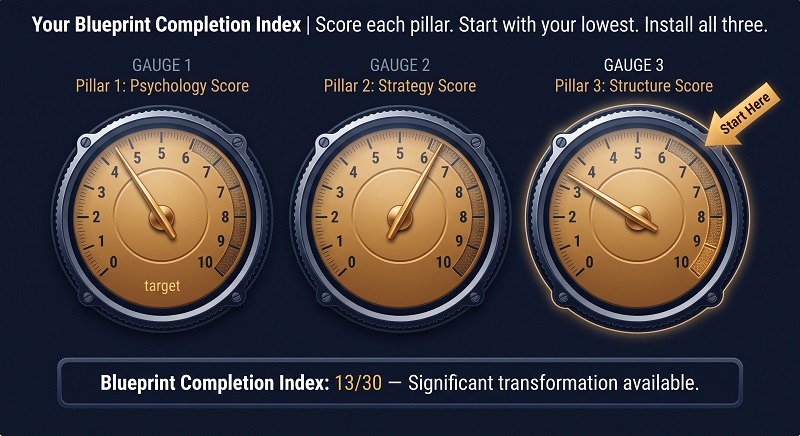
Pillar 1 Audit Score your psychology (1–10): On a scale of 1 (not at all) to 10 (completely), how comfortable are you with the business running without your operational involvement for 30 consecutive days? A score below 6 indicates Pillar 1 as your primary constraint.
Pillar 2 Audit Score your model (1–10): On a scale of 1 (not at all) to 10 (completely), how confident are you that your current offer could be delivered at the same quality by a well-trained team member following a documented process? A score below 6 indicates Pillar 2 as your primary constraint.
Pillar 3 Audit Score your structure (1–10): On a scale of 1 (not at all) to 10 (completely), how confident are you that your team can make all routine and semi-routine operational decisions without escalating to you? A score below 6 indicates Pillar 3 as your primary constraint.
Your lowest score is your starting pillar. Your total score out of 30 is your Blueprint Completion Index. Below 18: significant transformation available across all three pillars. 18–24: solid foundation with specific gaps to address. 25–30: the Blueprint is substantially installed — focus on Shift 5 amplification.
Further Reading (Internal & External Links)
Entrepreneurial Mindset Through NLP — a deep exploration of the Pillar 1 tools: NLP and Timeline Therapy applied to founder psychology.
Harnessing Structure & Systems — the complete guide to the Pillar 3 Four-Component System Architecture.
Strategies to Scale Your Business — the Pillar 2 strategic moves in full detail: elimination, positioning, and premium model design.
Mastering Mindsets for Business — how the Pillar 1 psychological rewiring interacts with daily strategic and operational decisions.
Harvard Business Review: Building Organisational Resilience — external research on why integrated, multi-domain business transformation produces exponentially more resilient outcomes than single-domain interventions.
Frequently Asked Questions
1. What is the 3-Pillar Blueprint and how does it differ from standard business coaching?
The 3-Pillar Blueprint is an integrated framework combining Performance Psychology (Pillar 1), Freedom-First Business Strategy (Pillar 2), and Freedom-First Business Structure (Pillar 3), applied simultaneously rather than sequentially. Standard business coaching typically addresses one domain: either mindset, or strategy, or operational systems. The Blueprint's differentiator is integration: each pillar is designed to reinforce the others, producing results that are self-sustaining rather than dependent on continuous external coaching input. The measure of success is not improvement during the programme — it is permanent transformation after it.
2. Why must Pillar 1 (Performance Psychology) come before Pillars 2 and 3?
Because the founder is the implementation mechanism for every Pillar 2 strategy and every Pillar 3 system. If the founder's subconscious programming is unchanged, if they still equate operational indispensability with worth, still trigger anxiety when stepping back, still compulsively re-enter delegated systems, then every strategic and structural intervention will be subtly undermined in execution. The psychological rewiring does not need to be complete before Pillars 2 and 3 begin. It needs to be active and progressing. Tom's case illustrates the alternative: eight months of structural investment wasted because Pillar 1 was skipped entirely.
3. How long does it take to install all three pillars?
The initial installation is complete within the 16-week Limitless Entrepreneur programme. The deepening of the installation, particularly Pillar 1's neurological rewiring, which continues to settle as structural wins accumulate, continues for 3–6 months post-programme. By month 6, the integrated architecture is typically self-sustaining: the founder's new psychological baseline, strategic model, and operational structure are all reinforcing each other without external support.
4. Can I work on all three pillars simultaneously, or must they be done in strict sequence?
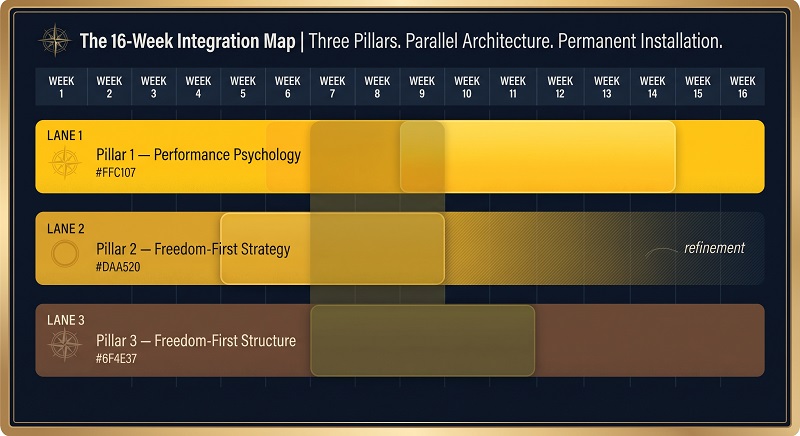
They must begin in sequence (Pillar 1 active before Pillar 2 is designed, Pillar 2 simplified before Pillar 3 is built) but they overlap and run in parallel. The 16-Week Integration Map above shows this precisely: Pillar 1 is active across all 16 weeks; Pillar 2 peaks in weeks 3–6 while Pillar 1 is still active; Pillar 3 peaks in weeks 7–12 while both Pillar 1 and Pillar 2 continue. The sequence determines the starting order and the primary focus in each phase. It does not mean completing one pillar before beginning the next.
5. What results should I expect at the end of the 16 weeks?
The specific results vary by starting point, business complexity, and the depth of the founder's psychological engagement with the work. The consistent pattern across completed programmes: a reduction in working hours of 30–60% (founders typically move from 55–80 hours to 25–35 hours); a significant increase in revenue per client due to Pillar 2 premium repositioning; a business that can operate for 30+ consecutive days without founder involvement; and, most importantly, a psychological baseline shift that makes the new operating reality feel natural rather than effortful. The external results are the evidence of the internal transformation. The internal transformation is what makes the external results permanent.
Conclusion: The Architecture That Changes Everything
James R. Elliot spent 24 years and five businesses discovering the hard way that single-pillar solutions produce single-pillar results. He tried the mindset work. He hired the business consultant. He built the systems. Each intervention produced real results, and then, within months, the results softened, eroded, or reversed as the unchanged constraints in the other two domains reasserted themselves.
It was not until he ran all three interventions simultaneously, in deliberate sequence, with each pillar informing and accelerating the others, that the result he had been pursuing for two decades finally arrived. The psychological rewiring held because the strategic model supported it. The strategic model worked because the structural systems delivered it. The structural systems held because the psychological rewiring meant he could genuinely trust them.
The transformation was not additive. It was not that three good things were better than one. It was that the integration itself produced something none of the three could produce alone, a self-reinforcing architecture that did not require external maintenance to sustain.
His working week settled at 25 hours. His revenue grew. His niece sees him. He takes a 36-minute nap every afternoon, not as a luxury but as a performance protocol, and with zero guilt. That is what the full Blueprint produces: not a better version of what was there before, but a categorically different operating reality. Built deliberately. Held permanently. Available to any founder willing to install all three pillars and trust the integration.
Ready to discover your Blueprint Completion Index and map your specific 3-Pillar installation? Book theFreedom Blueprint Call (45 mins). We will run the full audit together and design your personalised pillar sequence.